

National Identity
- Official name
- Federal Republic of Germany
- Official name (in German)
- Bundesrepublik Deutschland
- Name etymology
the origin of the name is unclear; it may come from Celtic words meaning "neighboring people," or it may derive from Germanic words meaning either "spear man" or "head man;" the native designation "Deutsch" comes from the Old High German "diutisc" meaning "national"
Sources:- Basic Law for the Federal Republic of Germany ↗ - Laws on internet - Federal Ministry of Justice and the Federal Office of Justice
- The World Factbook: Germany - CIA
- Coat of arms
- National flag
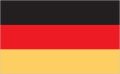
Translated from the Federal Ministry of Justice and Consumer Protection and the Federal Office of Justice of Germany The Federal flag consists of three horizontal stripes of equal width, black at the top, red in the middle, gold-coloured at the bottom; ratio of the height to the length of the flag cloth as 3 to 5.
Unofficial translation by WorldometerTranslated from the Federal Ministry of the Interior of Germany This colour scheme continues a long tradition. It is a symbol of unity, freedom and democracy.
Unofficial translation by WorldometerTranslated from the German Bundestag The origin of Black-Red-Gold cannot be clearly established. After the Wars of Liberation in 1815, the colours were traced back to the black uniforms with red piping and gold-coloured buttons of the "Lützow Free Corps", which had taken part in the fighting against Napoleon. The colours gained great popularity through the black-red flag with gold decoration of the so-called "Jena Urburschenschaft" (original student fraternity of Jena), to which former members of the "Lützow" corps belonged.
Unofficial translation by WorldometerTranslated from the German Bundestag The colours acquired national symbolic power, however, above all because they were mistakenly regarded by the German public as the colours of the old German Empire. Thus, at the Hambach Festival in 1832, many of the participants carried black-red-gold flags. The colours became the symbol of national unity and civic freedom and were almost omnipresent during the Revolution of 1848/49. In 1848 the Frankfurt Federal Diet, as did the German National Assembly, declared Black-Red-Gold to be the colours of the German Confederation and of the German Empire that was to be founded, respectively.
Unofficial translation by WorldometerTranslated from the German Bundestag In the course of the unification of the Empire under Prussian leadership that had been emerging since 1866, Black-Red-Gold was replaced as the national colours by Black-White-Red at Bismarck's instigation. Black and white were the traditional colours of Prussia, to which red was added, symbolising the Hanseatic cities.
Unofficial translation by WorldometerTranslated from the German Bundestag After 1919, the determination of the flag colours divided not only the Weimar National Assembly but also the German public: large sections of the population were opposed to the replacement of the colours of the Empire by Black-Red-Gold. The National Assembly finally adopted a compromise: "The colours of the Reich are Black-Red-Gold; the merchant flag is Black-White-Red with the colours of the Reich in the upper inner corner." Without inner acceptance by large parts of the people, Black-Red-Gold could only with difficulty become popular in the Weimar Republic.
Unofficial translation by WorldometerTranslated from the Federal Ministry of the Interior of Germany In 1935 the NSDAP imposed its party flag on the nation. The swastika flag was declared the national flag by the Reich Flag Law.
Unofficial translation by WorldometerTranslated from the German Bundestag In 1949 the Parliamentary Council decided, with one vote against, on Black-Red-Gold as the colours of the state flag of the Federal Republic of Germany. In the Basic Law, the colours of the unity and freedom movement and of the first republic were laid down in Article 22. The GDR likewise chose Black-Red-Gold, but from 1959 added the hammer-and-compass emblem surrounded by a wreath of ears of grain.
Unofficial translation by WorldometerTranslated from the German Bundestag On 3 October 1990 the Basic Law also came into force in the eastern federal states, and the black-red-gold flag became the flag of reunified Germany.
Unofficial translation by WorldometerSources:- gesetze-im-internet.de ↗ - the Federal Ministry of Justice and Consumer Protection and the Federal Office of Justice of Germany
- bmi.bund.de ↗ - the Federal Ministry of the Interior of Germany
- bundestag.de ↗ - the German Bundestag
- protokoll-inland.de ↗ - the Federal Ministry of the Interior of Germany
- National anthem
- Deutschlandlied1:20
- Title (in German)
- Deutschlandlied
- Title (in English, translated)
- Song of Germany
- Alternate title (in German)
- Lied der Deutschen
- Alternate title (in English, translated)
- Song of the Germans
- Lyrics
Einigkeit und Recht und Freiheit Für das deutsche Vaterland – Danach lasst uns alle streben Brüderlich mit Herz und Hand! Einigkeit und Recht und Freiheit Sind des Glückes Unterpfand. Blüh’ im Glanze dieses Glückes, Blühe, deutsches Vaterland! Blüh’ im Glanze dieses Glückes, Blühe, deutsches Vaterland!
Source: - Citizens
- Germans
- Official name:Basic Law for the Federal Republic of Germany ↗ - Laws on internet - Federal Ministry of Justice and the Federal Office of Justice
- Official name, Citizens:The World Factbook: Germany - CIA
- National flag:gesetze-im-internet.de ↗ - the Federal Ministry of Justice and Consumer Protection and the Federal Office of Justice of Germany
- National flag:bmi.bund.de ↗ - the Federal Ministry of the Interior of Germany
- National flag:bundestag.de ↗ - the German Bundestag
- National flag:protokoll-inland.de ↗ - the Federal Ministry of the Interior of Germany
- National anthem:nationalanthems.info ↗
Geography
- Location
- Central Europe, bordering the Baltic Sea and the North Sea, between the Netherlands and Poland, south of Denmark
- Total area
- 357,022 km²
- Land area
- 348,672 km²
- Water area
- 8,350 km²
- Land borders
- 3,694 km(9 countries)
- Austria
- 801 km
- Czech Republic (Czechia)
- 704 km
- Netherlands
- 575 km
- Poland
- 447 km
- France
- 418 km
- Switzerland
- 348 km
- Denmark
- 140 km
- Belgium
- 133 km
- Luxembourg
- 128 km
Source:- The World Factbook: Germany - CIA
- Coastline
- 2,389 km
- Terrain
Lowlands in north, uplands in center, Bavarian Alps in south - Mean elevation
- 263 m
- Highest point
- 2,963 mZugspitze
- Lowest point
- −3.5 mNeuendorf bei Wilster
- Climate
Temperate and marine cool, cloudy, wet winters and summers; occasional warm mountain (foehn) wind - Avg. temperature
- 9.4 °C
- Avg. daily range
- 5.8 to 13 °C
- Annual precipitation
- 874 mm
Temperature °CMeanDaily rangePrecipitation mmMonthly climate normals Month Avg. high, °C Mean, °C Avg. low, °C Precipitation, mm January 3.1 0.9 −1.3 71 February 4.4 1.6 −1.1 59 March 8.4 4.8 1.3 67 April 13.5 9.1 4.5 57 May 17.6 13.2 8.3 80 June 20.8 16.4 11.6 82 July 23 18.4 13.7 92 August 22.8 18.1 13.5 84 September 18.3 14 10 71 October 13 9.5 6.4 68 November 7.2 4.9 2.6 67 December 3.8 1.9 −0.2 76 Country-wide averages over 1991–2020.
Sources:- The World Factbook: Germany - CIA
- Climate Change Knowledge Portal (ERA5 reanalysis) ↗ - World Bank
- Weather
- Loading
- Land use2023
- Arable33.4%Perm. crops0.6%Pasture13.5%Forest32.8%Other15.0%
- Arable land
- 11,681,000 hectares (33.4%)
- Permanent crops
- 200,000 hectares (0.6%)
- Permanent meadows & pastures
- 4,704,000 hectares (13.5%)
- Forest
- 11,471,800 hectares (32.8%)
- Other land
- 5,237,200 hectares (15.0%)
Reported categories cover 95.3% of the land area.
Source: - Major lakes
- Stettiner Haff/Zalew Szczecinski900 km²Lake Constance540 km²
- Natural hazards2026
- Coastal floods8.0Very high#14/191River floods7.8Very high#23/191Earthquakes3.7Medium#92/191Epidemics2.2Very low#177/191Drought1.3Very low#141/191Tsunamis0.0Very lowTropical cyclones0.0Very low
Scores out of 10, ranks out of 191 countries.
Source:- INFORM Risk Index ↗ - European Commission Joint Research Centre
- Location, Land borders, Coastline, Terrain, Mean elevation, Highest point, Lowest point, Climate, Major rivers, Major lakes:The World Factbook: Germany - CIA
- Climate:Climate Change Knowledge Portal (ERA5 reanalysis) ↗ - World Bank
- Land use:FAOSTAT Land Use domain ↗ - FAO
- Natural hazards:INFORM Risk Index ↗ - European Commission Joint Research Centre
Demographics
- Population change2026
- −0.51% per year−430,817 people/yearWorld Rank205thof 237
- Birth rate
- 8.2 per 1,000 population
- Death rate
- 12.5 per 1,000 population
- Net migration rate
- +1.9 per 1,000 population
- 2026
- 45.7 yearsWorld Rank19thof 237
- Age structure2026
- 0-14 years13.9%15-64 years61.9%65 years +24.2%
- Share aged 65 and over
- 24.2%
- Share aged under 18
- 16.6%
- Total dependency ratio
- 62
- Youth dependency ratio
- 22
- Elderly dependency ratio
- 39
- Sex ratio
- 0.98 male / female
MaleAgeFemalePopulation by age group, % of total population Age Male Female 80+ 2.9% 4.5% 70-79 4.6% 5.4% 60-69 7.3% 7.6% 50-59 6.8% 6.8% 40-49 6.4% 6.2% 30-39 6.5% 6.1% 20-29 5.4% 5.0% 10-19 4.8% 4.5% 0-9 4.7% 4.5% - 2026
- 0.64 below the replacement level for Germany ()1.46 births per womanreplacement 2.10123World Rank180thof 237
- 0.70 daughters per woman0.30 below replacement, long-run each generation smaller than the lastreplacement 1.000.511.5
- 2026
- −4.2 per 1,000 populationfor every 1,000 people, 4.2 more deaths than births a year
- 2026
- +1.9 per 1,000 population
- Urbanization2026
- 82.3% live in 68,801,281 urban residents
- Largest cities2025
- Berlin, Hamburg, Munich, CologneRankCityPopulation (2025 estimate)1Berlin3,700,5772Hamburg1,869,4733Munich1,505,0364Cologne1,025,5235Frankfurt am Main760,6566Düsseldorf619,4447Leipzig615,9328Stuttgart609,3659Dortmund600,88010Bremen588,413Source:
- Federal Statistical Office of Germany and State statistical offices, Germany (2025 estimate), via City Population by Thomas Brinkhoff ↗
- Population distribution
- Second most populous country in Europe; a fairly even distribution throughout most of the country, with urban areas attracting larger and denser populations, particularly in the far-western part of the industrial state of North Rhine-Westphalia.
- Ethnic groups2022
- Figures count nationality, not ethnicity.German85.4%Turkish1.8%Ukrainian1.4%Syrian1.1%Romanian1.0%Poland1.0%Other/stateless/unspecified8.3%
- Religions2022
- Roman Catholic24.8%Protestant22.6%Muslim3.7%Other5.1%None43.8%
- Languages
- German (Deutsch)
- Population, Population change, Median age, Age structure, Total fertility rate, Net reproduction rate, Natural change, Net migration rate:UN World Population Prospects ↗
- Urbanization:UN World Urbanization Prospects ↗
- Largest cities:Federal Statistical Office of Germany and State statistical offices, Germany (2025 estimate), via City Population by Thomas Brinkhoff ↗
- Population distribution, Ethnic groups, Religions:The World Factbook: Germany - CIA
Government & Administration
- Form of state
- RepublicThe Federal President is elected without debate by the Federal Convention, made up of the Bundestag (federal parliament) members and an equal number chosen by the Länder (states') parliaments, for five years, with one consecutive re-election allowed (Art. 54).
- System of government
- ParliamentaryThe Bundestag elects the Federal Chancellor on the President's proposal and can remove him only by electing a successor; it may be dissolved only after a failed confidence motion or a failed chancellor election (Arts. 63, 67, 68).Source:
- Territorial organisation
- Federal
- Official websites
- Capital
- Berlin3.7 million people(2024)
- National holidays
- 9 days in 2026
- ThuJan 1New Year's Day
- FriApr 3Good Friday
- MonApr 6Easter Monday
- FriMay 1Labor Day
- ThuMay 14Ascension Day
- MonMay 25Pentecost Monday
- SatOct 3German Unity Day
- FriDec 25Christmas Day
- SatDec 26Second Day of Christmas
Nationwide public holidays only, excluding regional, bank and government-only days.
- Time
- Currency
- Euro (EUR)
- Entry requirements
- Official visa and entry information
- Calling code
- +49
- Internet TLD
- .de
- ISO 3166-1 codes
- DE, DEU
- Infrastructure
- Passengers carried
- 80,199,572 by the country's airlines(2023)
- Heliports
- 449
- Aircraft departures
- 655,842 by the country's airlines(2023)
- Air freight
- 12,766.5 million tonne-km(2023)
- Aircraft registration prefix
- D
Sources:- The World Factbook: Germany - CIA
- World Development Indicators ↗ - World Bank
- Flag carrier
- LufthansaPrivately owned (Lufthansa Group)
- Passenger rail
- Deutsche Bahn
- 2025
- 77 / 100World Rank10thof 182Confidence interval
Corruption index score by year Year Score Lower bound Upper bound 2012 79 75 83 2013 78 74 82 2014 79 75 83 2015 81 77 85 2016 81 77 86 2017 81 78 84 2018 80 76 84 2019 80 74.6 85.4 2020 80 76.7 83.3 2021 80 77.1 82.9 2022 79 75.4 82.6 2023 78 74.5 81.5 2024 75 72.8 77.2 2025 77 74 80 Source:- Corruption Perceptions Index 2025 ↗ - Transparency International, CC BY 4.0
- Form of state, System of government, Territorial organisation:Grundgesetz für die Bundesrepublik Deutschland vom 23. Mai 1949, consolidated text ↗ - Federal Ministry of Justice and Federal Office of Justice
- National holidays:Open World Holidays Framework (vacanza/holidays) ↗
- Infrastructure:The World Factbook: Germany - CIA
- Infrastructure:World Development Indicators ↗ - World Bank
- Corruption Perceptions Index:Corruption Perceptions Index 2025 ↗ - Transparency International, CC BY 4.0
Economy
- High income
- GDP growth (real)2026
- +1.3% per yearWorld Rank156thof 195
- GDP per capita (PPP)2026
- GDP per capita (nominal)
- $65,699 (17th in the world)
Source:- 2025
- Services64.5% of GDPIndustry25.2% of GDPAgriculture0.9% of GDPManufacturing17.6%part of industry
- Households
- +53.2%
- Government
- +22.5%
- Investment
- +21.9%
- Exports
- +40.4%
- Imports
- −38.1%
The shape of the economyGDP by end useSource:- World Development Indicators ↗ - World Bank
- Inflation2026
- 2.7%up 0.5 percentage points0.5pp from 2025
- Labor force2024
- 44.3 million (52% of population)World Rank15thof 187
- Labor force participation2024
- 60.9% of people aged 15+
- Unemployment2024
- 3.4%
- Youth unemployment2024
- 6.6% ages 15 to 24
- Labor productivity2024
- $79.2 per hour worked at PPP
- Labor cost2025
- €45.00 per hour$50.85 (USD), $62.60 (PPP)
- Budget balance2026
- 4.3% of GDP deficit
- Current account
- 4.5% of GDP, $244.8 billion surplus
Source: - Debt2024
- Government debt63.9% of GDPHousehold debt49.9% of GDPCompany debt89.5% of GDPInterest on debt1.1% of GDPCentral government debt44% of GDP
- Trade2025
- Goods$1.5 trillion74.7%
- Services$518 billion25.3%
- Total exports
- $2 trillion
- Change from 2024
- up 4.5 percent on the previous year4.5%
Sources:- World Development Indicators ↗ - World Bank
- The World Factbook: Germany - CIA
- 2024
- +1.36World Rank6thof 145
- Projected GDP growth
- +1.2% a year over the next 10 years
Source:- Atlas of Economic Complexity ↗ - Harvard Growth Lab
- Agricultural products2024
- Rye, Sugar beet, Triticale, and 7 more
- 1Rye18×
- 2Sugar beet10.1×
- 3Triticale9.9×
- 4Barley6×
- 5Raw milk of cattle3.4×
- 6Rape or colza seed3.3×
- 7Meat of pig with the bone (fresh or chilled)2.8×
- 8Potatoes2.6×
- 9Wheat1.9×
- 10Maize (corn)0.3×
ProductSource:- FAOSTAT ↗ - Food and Agriculture Organization
- Gold reserves2025
- 3,350 tonnesWorth $470.5 billion, 82% of total official reserves by value
- Industries
- iron, steel, coal, cement, chemicals, machinery, vehicles, machine tools, electronics, automobiles, food and beverages, shipbuilding, textiles
- Income level, GDP by sector, Trade, Gold reserves:World Development Indicators ↗ - World Bank
- GDP (nominal), GDP growth (real), GDP per capita (PPP), Inflation, Budget balance:IMF World Economic Outlook ↗
- Labor force, Labor force participation, Unemployment, Youth unemployment, Labor productivity, Labor cost:ILOSTAT ↗ - International Labour Organization
- Debt:IMF Global Debt Database ↗
- Debt:IMF Public Finances in Modern History ↗
- Trade, Industries:The World Factbook: Germany - CIA
- Economic Complexity Index:Atlas of Economic Complexity ↗ - Harvard Growth Lab
- Agricultural products:FAOSTAT ↗ - Food and Agriculture Organization
Cost of Living
- Cost of living index
- Loading
- Monthly costs (excluding rent)
- Loading
- Rent
- Loading
- Buying an apartment
- Loading
- Average gross salary2022
- €4,413 per month$4,647 (USD), $6,135 (PPP)
- Median
- €3,774 per month($3,974)
- Men
- €5,166 per month($5,440)
- Women
- €3,553 per month($3,741)
Source:- ILOSTAT ↗ - International Labour Organization
- 2025
- €2,161 per month, gross$2,442 (USD), $3,006 (PPP)
- Average gross salary, Minimum wage:ILOSTAT ↗ - International Labour Organization
Society
- 2023
- 0.959Very highWorld Rank5thof 193GermanyWorld
Human Development Index by year Year Germany World 1990 0.834 0.608 1991 0.841 0.611 1992 0.849 0.614 1993 0.859 0.617 1994 0.865 0.620 1995 0.870 0.625 1996 0.875 0.631 1997 0.881 0.636 1998 0.887 0.641 1999 0.892 0.646 2000 0.897 0.651 2001 0.904 0.657 2002 0.909 0.662 2003 0.914 0.669 2004 0.923 0.675 2005 0.923 0.681 2006 0.927 0.688 2007 0.931 0.694 2008 0.933 0.698 2009 0.933 0.701 2010 0.936 0.707 2011 0.942 0.713 2012 0.944 0.717 2013 0.945 0.721 2014 0.949 0.726 2015 0.948 0.731 2016 0.949 0.735 2017 0.951 0.739 2018 0.952 0.741 2019 0.957 0.745 2020 0.955 0.742 2021 0.958 0.742 2022 0.955 0.752 2023 0.959 0.756 Source:- Human Development Report ↗ - United Nations Development Programme
- 2022
- 33.7
- Mean years of schooling2023
- 14.3 years
- Expected for a child today
- 17.3 years
Source:- Human Development Report ↗ - United Nations Development Programme
- Education expenditure2022
- 5.2% of GDP
- Share of government spending
- 10.7%
Source:- World Development Indicators ↗ - World Bank
- Internet users2024
- 93.5% of the population
- Households with Internet access
- 92.6%
Source:- ITU DataHub ↗ - International Telecommunication Union
- Mobile subscriptions2024
- 109.2 million
- Fixed telephone lines
- 38,400,000
- Fixed broadband
- 45.6 subscriptions per 100 people
Counts subscriptions, not people.
Source:- ITU DataHub ↗ - International Telecommunication Union
- Credit-card ownership2021
- 57% of adults
- Debit-card ownership
- 94%
- Account at a bank or mobile-money provider
- 100%
- Made or received a digital payment
- 99%
Source:- Global Findex Database ↗ - World Bank
- Refugees hosted2025
- 2.7 million people
- Asylum seekers
- 320,133
- Stateless persons
- 28,132
- Internally displaced persons
- 100(2023)All due to disasters
- Refugees from Germany abroad
- 325
Sources:- Refugee Data Finder ↗ - UN Refugee Agency
- Global Internal Displacement Database ↗ - Internal Displacement Monitoring Centre
- 2024
- Official tourism site37.4 million arrivalsdown 5% against 20195% below 2019World Rank7thof 139
- Per resident
- 4.4 arrivals per 10 residents
- $40.1 billion
- Spending per arrival
- $1,072
- 2.2% tourism direct GDP(2021, latest available)
- Domestic trips
- 162.8 million overnight trips by residents
- Residents' trips abroad
- 114.4 million overnight trips
- $120.4 billion
- Hotel beds
- 2 million
- Average hotel stay
- 2.1 nights
Overnight arrivals by year2010 to 2024A tourist stays at least one night. Arrivals count trips, not people.
Source:- UN Tourism Data Dashboard ↗ - UN Tourism
- UNESCO World Heritage Sites
- 56 sites54 cultural2 natural
Site Type Museumsinsel (Museum Island), Berlin Cultural Palaces and Parks of Potsdam and Berlin Cultural Speyer Cathedral Cultural Aachen Cathedral Cultural Bauhaus and its Sites in Weimar, Dessau, and Bernau Cultural Caves and Ice Age Art in the Swabian Jura Cultural Roman Monuments, Cathedral of St. Peter, and Church of Our Lady in Trier Cultural Hanseatic City of Lübeck Cultural Old Town of Regensburg with Stadtamhof Cultural Würzburg Residence with the Court Gardens and Residence Square Cultural Pilgrimage Church of Wies Cultural Castles of Augustusburg and Falkenlust at Brühl Cultural St Mary's Cathedral and St Michael's Church at Hildesheim Cultural Abbey and Altenmünster of Lorsch Cultural Maulbronn Monastery Complex Cultural Collegiate Church, Castle and Old Town of Quedlinburg Cultural Cologne Cathedral Cultural Castle Church in Wittenberg Cultural Classical Weimar Cultural Wartburg Castle Cultural Garden Kingdom of Dessau-Wörlitz Cultural Monastic Island of Reichenau Cultural Berlin Modernism Housing Estates Cultural Prehistoric Pile Dwellings around the Alps Cultural Moravian Church Settlements Cultural Speicherstadt and Kontorhaus District with Chilehaus Cultural The Architectural Work of Le Corbusier, an Outstanding Contribution to the Modern Movement Cultural Archaeological Border complex of Hedeby and the Danevirke Cultural Naumburg Cathedral Cultural Mathildenhöhe Darmstadt Cultural ShUM Sites of Speyer, Worms and Mainz Cultural The Great Spa Towns of Europe Cultural Jewish-Medieval Heritage of Erfurt Cultural Schwerin Residence Ensemble Cultural The Palaces of King Ludwig II of Bavaria: Neuschwanstein, Linderhof, Schachen and Herrenchiemsee Cultural The Factbook names 35 of the 56 sites.
Source:- The World Factbook: Germany - CIA
- Human Development Index, Mean years of schooling:Human Development Report ↗ - United Nations Development Programme
- Income inequality (Gini), Education expenditure:World Development Indicators ↗ - World Bank
- Internet users, Mobile subscriptions:ITU DataHub ↗ - International Telecommunication Union
- Credit-card ownership:Global Findex Database ↗ - World Bank
- Refugees hosted:Refugee Data Finder ↗ - UN Refugee Agency
- Refugees hosted:Global Internal Displacement Database ↗ - Internal Displacement Monitoring Centre
- Inbound tourists:UN Tourism Data Dashboard ↗ - UN Tourism
- UNESCO World Heritage Sites:The World Factbook: Germany - CIA
Crime & Safety
- Travel advisory (US)
- Loading
- Active humanitarian crisisAug 2026
- None - no active crisis
- Homicide rate2024
- Very low by global standards0.9 per 100,000 peopleWorld Rank84thof 115
- Crime rates
- 7 offence categories
Offence Per 100,000 Count Year Homicide (victims) 0.9 779 2024 Serious assault 182.8 154,541 2023 Sexual violence 62.3 52,656 2023 Kidnapping 6.0 5,041 2023 Burglary 309.9 260,605 2022 Theft 1,241.4 1,043,887 2022 Vehicle theft 58.5 49,210 2022 A low figure can also mean weak recording.
Source:- UNODC Data Portal ↗ - UN Office on Drugs and Crime
- Prison population2023
- 70 per 100,000 people
- Persons held
- 59,165
Source:- UNODC Data Portal ↗ - UN Office on Drugs and Crime
- Active humanitarian crisis:INFORM Severity Index ↗ - European Commission Joint Research Centre
- Homicide rate, Crime rates, Prison population:UNODC Data Portal ↗ - UN Office on Drugs and Crime
Health
- Life expectancy2026
- 81.9 years
- Health expenditure2024
- 12.3% of GDP$6,849 per person
- Physicians2022
- 4.53 per 1,000 population
- Hospital beds2023
- 7.6 per 1,000 population
- Infant mortality2026
- 2.6 per 1,000 live births
- Maternal mortality2023
- 4 per 100,000 live births
- Alcohol consumption2022
- 11.2 litres of pure alcohol per adult per year
- Tobacco use2023
- 22.4% of adults
- Men
- 24.8%
- Women
- 19.9%
Source:- Global Health Observatory ↗ - World Health Organization
- Alcohol and Tobacco Spending2023
- 3.1% of household spendingWorld Rank51stof 105
- World median
- 3.1%
Source:- The World Factbook: Germany - CIA
- Road traffic deaths2019
- 3.8 per 100,000 population
- Life expectancy, Infant mortality:UN World Population Prospects ↗
- Health expenditure, Physicians, Hospital beds, Road traffic deaths:World Development Indicators ↗ - World Bank
- Maternal mortality:Maternal mortality estimates ↗ - UN Maternal Mortality Estimation Inter-agency Group
- Alcohol consumption, Tobacco use:Global Health Observatory ↗ - World Health Organization
- Alcohol and Tobacco Spending:The World Factbook: Germany - CIA
Environment
- CO₂ emissions2024
- 579.9 Mt per yeardown 1.6 percent on the previous year1.6% from 2023
- CO₂ per capita
- 7 t per personWorld Rank38thof 207
- Share of global CO₂
- 1.5%
- Methane (CH₄)
- 55.5 Mt CO₂-eq
- Nitrous oxide (N₂O)
- 30 Mt CO₂-eq
- Fluorinated gases
- 8.87 Mt CO₂-eq
- All greenhouse gases
- 674.4 Mt CO₂-eq
Source:- Emissions Database for Global Atmospheric Research (EDGAR) ↗ - European Commission, Joint Research Centre
- 2024
- 8.5 µg/m³ of PM2.50.4 years of life expectancy lost against the WHO guidelineMost polluted146thof 236
- WHO guideline
- 5 µg/m³
- National standard
- 10 µg/m³
Source:- Air Quality Life Index ↗ - Energy Policy Institute at the University of Chicago
- Environmental issues
- air pollution and acid rain from coal-burning utilities and industries
- water pollution from raw sewage and industrial effluents
- hazardous waste disposal
- International agreements
- 19 of 20 landmark treaties in forceParty to 202 multilateral environmental agreements
Treaty Standing Joined Climate Paris Agreement in force 2016 UN Framework Convention on Climate Change in force 1994 Kyoto Protocol in force 2005 Ozone layer Montreal Protocol in force 1989 Vienna Convention (Ozone Layer) in force 1988 Biodiversity Convention on Biological Diversity in force 1994 CITES in force 1976 Convention on Migratory Species (Bonn) in force 1984 Cartagena Protocol on Biosafety in force 2004 Nagoya Protocol in force 2016 Land and heritage Ramsar Convention on Wetlands in force 1976 World Heritage Convention in force 1976 UN Convention to Combat Desertification in force 1996 Chemicals and waste Basel Convention in force 1995 Rotterdam Convention (PIC) in force 2004 Stockholm Convention (POPs) in force 2004 Minamata Convention on Mercury in force 2017 Oceans UN Convention on the Law of the Sea in force 1994 High Seas Treaty (BBNJ) signed 2023, not ratified MARPOL 73/78 in force 1983 Source:- International Environmental Agreements Database ↗ - Université Laval
- CO₂ emissions:Emissions Database for Global Atmospheric Research (EDGAR) ↗ - European Commission, Joint Research Centre
- Air pollution:Air Quality Life Index ↗ - Energy Policy Institute at the University of Chicago
- Environmental issues:The World Factbook: Germany - CIA
- International agreements:International Environmental Agreements Database ↗ - Université Laval
Food & Water
- No access to safe drinking water2022
- 0% of the population
- Renewable water2022
- 154 billion m³ per year
- Per person
- 1,831 m³ per year
- Dependency ratio
- 31% originates outside the country
- Annual water withdrawal
- 26 billion m³ per year
- Withdrawn for agriculture
- 4%
- Water stress
- 35% of available freshwater withdrawn
Source:- AQUASTAT ↗ - Food and Agriculture Organization
- Obesity2024
- 20.6% of adults
- Men
- 22.1%
- Women
- 19.1%
Source:- Global Health Observatory ↗ - World Health Organization
- Underweight children2016
- 0.6% of children under five
- No access to safe drinking water, Renewable water:AQUASTAT ↗ - Food and Agriculture Organization
- Obesity:Global Health Observatory ↗ - World Health Organization
- Underweight children:World Development Indicators ↗ - World Bank
Energy
- Energy consumption2024
- Per capita
- 123.8 GJ per person
- Share of world total
- 1.6%
- Supply
- Deficitproduces 29% of what it consumes, 2024
Source:- International Energy Statistics ↗ - U.S. Energy Information Administration
- Electricity2024
- Balanced trade, imports 82 TWh and exports 55 TWh in 2024490 TWh generated per year
- Generation
- 490 TWh per year
- Consumption
- 490 TWh per year
- Imports
- 82 TWh per year
- Exports
- 55 TWh per year
- Net
- −26 TWh per year
Source:- International Energy Statistics ↗ - U.S. Energy Information Administration
- Oil, gas & coal
- Deficitproduces 9.1% of what it consumes, 2025Oil reserves2025105.8 million barrelsWorld Rank69thof 99Imports20201.7 million b/d
Oil imports and exports count crude oil only.
- Energy consumption, Electricity, Oil, gas & coal:International Energy Statistics ↗ - U.S. Energy Information Administration
- Oil, gas & coal:Worldwide Oil and Gas Survey ↗ - Oil & Gas Journal
Defense
- Military expenditure2024
- 1.9% of GDP$88.5 billion, 3.9% of government spending
- Military personnel2025
- approximately 185,000active-duty military personnel
- Military service2025
- Voluntaryno conscription since 2011; men and women 17–23; 7–23 months or 12 years service obligation
Must have completed compulsory full-time education and have German citizenship.In 2020, the German Government launched a new voluntary conscript initiative focused on homeland security tasks, with the volunteers serving for 7 months plus 5 months as reservists over a 6-year period.In December 2025, Germany passed a law reforming military service; from 2026, the new regulations require German males residing in Germany who have reached the age of 18 to complete a questionnaire, including questions about their willingness to serve; participation will remain voluntary for women.Women have been eligible for voluntary service in all military branches and positions since 2001; in 2025, they accounted for more than 13% of the active-duty German military.
Source:- The World Factbook: Germany - CIA
- Space program2025
- German Aerospace Center (Deutsches Zentrum für Luft- und Raumfahrt, DLR; established 1997)
Has one of Europe’s largest space programs and is a top contributor to the ESA; builds and operates satellites, satellite/space launch vehicles (SLVs), probes, and unmanned orbiters; researches and develops a range of capabilities and technologies, including reusable space planes, satellite payloads, rockets, propulsion-assisted landing technologies, and aeronautics; participates in EU and ESA programs, including the Cassini-Huygens research mission to Saturn, Mars and Venus exploration missions, and the Galileo global navigation satellite system; participates in ESA’s astronaut training program and human space flight operations; hosts the European Astronaut Center; participates in international programs such as the International Space Station (ISS) and the James Webb Space Telescope; hosts mission control centers for the ISS, the ESA, and the European Organization for the Exploitation of Meteorological Satellites (EUMETSAT); has ties to foreign space programs, including those of China, Japan, Russia, and the US; has a robust commercial space sector
- Launch sites
- A commercial offshore launch platform that will operate from the North Sea is under development with both government and private funding
- 1969
- First German scientific satellite (Azur) launched by US
- 1973
- Participated with other European states, particularly France and the UK, in development of Ariane satellite launch vehicle
- 1978
- First German in space on Soviet Salyut space station
- 1980s-1990s
- Participated in US Space Shuttle program, including providing astronauts
- 1999
- Launched a space-based X-ray telescope (ABRAXIS) on Russian rocket
- 2005
- Began development of reusable space plane/shuttle/transporter
- 2019
- Launched first space-based X-ray telescope (eROSITA) capable of imaging the entire sky (joint project with Russia)
- 2023
- Signed US-led Artemis Accords for the exploration of space and the Moon; adopted a new national space strategy
Key milestones
DLR's predecessor organization, the German Test and Research Institute for Aviation and Space Flight, was established in 1969; the Federal Republic of Germany was allowed to research space flight after gaining sovereignty in 1955
Source:- The World Factbook: Germany - CIA
- Nuclear weapons2026
- None - no nuclear arsenal
- Military expenditure:SIPRI Military Expenditure Database ↗ - Stockholm International Peace Research Institute
- Military expenditure:World Development Indicators ↗ - World Bank
- Military personnel, Military service, Space program:The World Factbook: Germany - CIA
- Nuclear weapons:Status of World Nuclear Forces ↗ - Federation of American Scientists


