

National Identity
- Official name
- Republic of South Sudan
- Name etymology
self-descriptive name from the country's geographic position within Sudan prior to independence; the name Sudan derives from the Arabic balad-as-sudan, meaning "Land of the Black [peoples]"
Sources:- The Transitional Constitution of the Republic of South Sudan, 2011 ↗ - The Embassy of the Republic of South Sudan, Washington D.C.
- The World Factbook: South Sudan - CIA
- Coat of arms
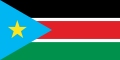
- National flag
- National anthem
- South Sudan Oyee!1:17
- Title
- South Sudan Oyee!
- Title (in English, translated)
- South Sudan Hurray!
- Lyrics
- English
Oh God! We praise and glorify you For your grace on South Sudan The land of great abundance Uphold us united in peace and harmony
Oh motherland! Arise! Raise your flag with the guiding star And sing songs of freedom with joy For peace, justice and liberty Shall forever more reign
Oh great warriors! Let us stand up in silence and respect Saluting our martyrs whose blood Cemented our national foundation We vow to protect our nation
So Lord, bless South Sudan!
Source: - Citizens
- South Sudanese
- Official name:The Transitional Constitution of the Republic of South Sudan, 2011 ↗ - The Embassy of the Republic of South Sudan, Washington D.C.
- Official name, Citizens:The World Factbook: South Sudan - CIA
- National anthem:nationalanthems.info ↗
Geography
- Location
- Total area
- 644,329 km²
- Land area
- 644,329 km²
- Water area
- 0.00 km²
- Land borders
- 6,018 km(6 countries)
- Sudan
- 2,158 km
- Ethiopia
- 1,299 km
- Central African Republic
- 1,055 km
- Uganda
- 475 km
- Kenya
- 317 km
South Sudan-Sudan boundary represents 1 January 1956 alignment; final alignment pending negotiations and demarcation; final sovereignty status of Abyei Area pending negotiations between South Sudan and Sudan
Source:- The World Factbook: South Sudan - CIA
- Coastline
- 0 km(Landlocked)
- Terrain
Plains in the north and center rise to southern highlands along the border with Uganda and Kenya; the White Nile, flowing north out of the uplands of Central Africa, is the major geographic feature of the country; The Sudd (a name derived from floating vegetation that hinders navigation) is a large swampy area of more than 100,000 sq km fed by the waters of the White Nile that dominates the center of the country - Highest point
- 3,187 mKinyeti
- Lowest point
- 381 mWhite Nile
- Climate
Hot with seasonal rainfall influenced by the annual shift of the Inter-Tropical Convergence Zone; rainfall heaviest in upland areas of the south and diminishes to the north - Avg. temperature
- 27.7 °C
- Avg. daily range
- 23.1 to 33.3 °C
- Annual precipitation
- 1,022 mm
Temperature °CMeanDaily rangePrecipitation mmMonthly climate normals Month Avg. high, °C Mean, °C Avg. low, °C Precipitation, mm January 35.2 28.4 22.6 4 February 36.9 30.1 24 5 March 37.4 30.9 25.3 27 April 35.9 30.1 25.4 75 May 33.6 28.4 24.3 118 June 31.5 26.7 23 130 July 30 25.5 22.1 163 August 29.8 25.3 21.8 177 September 30.7 25.9 22.1 141 October 31.5 26.3 22.3 135 November 33.2 27.3 22.4 41 December 34.4 27.9 22.4 7 Country-wide averages over 1991–2020.
Sources:- The World Factbook: South Sudan - CIA
- Climate Change Knowledge Portal (ERA5 reanalysis) ↗ - World Bank
- Weather
- Loading
- Land use2023
- Arable3.9%Perm. crops0.1%Pasture40.8%Forest11.3%Other43.8%
- Arable land
- 2,489,233 hectares (3.9%)
- Permanent crops
- 85,000 hectares (0.1%)
- Permanent meadows & pastures
- 25,773,000 hectares (40.8%)
- Forest
- 7,157,000 hectares (11.3%)
- Other land
- 27,688,767 hectares (43.8%)
Source: - Natural hazards2026
- River floods7.7Very high#26/191Epidemics7.4Very high#13/191Drought3.7Medium#73/191Earthquakes2.7Low#107/191Tsunamis0.0Very lowTropical cyclones0.0Very lowCoastal floods0.0Very low
Scores out of 10, ranks out of 191 countries.
Source:- INFORM Risk Index ↗ - European Commission Joint Research Centre
- Location, Land borders, Coastline, Terrain, Highest point, Lowest point, Climate, Major rivers:The World Factbook: South Sudan - CIA
- Climate:Climate Change Knowledge Portal (ERA5 reanalysis) ↗ - World Bank
- Land use:FAOSTAT Land Use domain ↗ - FAO
- Natural hazards:INFORM Risk Index ↗ - European Commission Joint Research Centre
Demographics
- Population change2026
- +2.03% per year+247,249 people/yearWorld Rank43rdof 237
- Birth rate
- 29.4 per 1,000 population
- Death rate
- 9.9 per 1,000 population
- Net migration rate
- +0.6 per 1,000 population
- 2026
- 19.0 yearsWorld Rank209thof 237
- Age structure2026
- 0-14 years37.1%15-64 years59.8%65 years +3.2%
- Share aged 65 and over
- 3.2%
- Share aged under 18
- 45.0%
- Total dependency ratio
- 67
- Youth dependency ratio
- 62
- Elderly dependency ratio
- 5
- Sex ratio
- 0.97 male / female
MaleAgeFemalePopulation by age group, % of total population Age Male Female 80+ 0.1% 0.2% 70-79 0.6% 0.8% 60-69 1.6% 2.0% 50-59 3.3% 3.8% 40-49 4.6% 5.2% 30-39 4.7% 5.0% 20-29 9.2% 9.2% 10-19 12.9% 12.7% 0-9 12.3% 12.0% - 2026
- 1.23 above the replacement level for South Sudan ()3.63 births per womanreplacement 2.401234World Rank34thof 237
- 1.50 daughters per woman0.50 above replacement, long-run each generation larger than the lastreplacement 1.000.511.52
- 2026
- +19.5 per 1,000 populationfor every 1,000 people, 19.5 more births than deaths a year
- 2026
- +0.6 per 1,000 population
- Urbanization2026
- 22.0% live in 2,735,482 urban residents
- Largest cities2008latest available
- Juba, Wau, Malakal, YambioRankCity or TownPopulation (2008 census)1Juba230,1952Wau118,3313Malakal114,5284Yambio105,8815Yei69,7206Renk69,0797Aweil59,2178Maridi55,6029Bentiu41,32810Bor25,188Source:
- National Bureau of Statistics, South Sudan (2008 census), via City Population by Thomas Brinkhoff ↗
- Population distribution
- Clusters found in urban areas, particularly in the western interior and around the White Nile.
- Ethnic groups2011
- Dinka (Jieng)35-40%, Nuer (Naath)about 15%, Shilluk (Chollo), Azande, Bari, Kakwa, Kuku, Murle, Mandari, Didinga, Ndogo, Bviri, Lndi, Anuak, Bongo, Lango, Dungotona, Acholi, Baka, FertitFigures are estimates, with no updated demographic studies.
Population changed during South Sudan's civil war.
Source:- The World Factbook: South Sudan - CIA
- Religions2020
- Christian60.5%Folk religion32.9%Muslim6.2%Other<1%Unaffiliated<1%
- Languages
- English
- Population, Population change, Median age, Age structure, Total fertility rate, Net reproduction rate, Natural change, Net migration rate:UN World Population Prospects ↗
- Urbanization:UN World Urbanization Prospects ↗
- Largest cities:National Bureau of Statistics, South Sudan (2008 census), via City Population by Thomas Brinkhoff ↗
- Population distribution, Ethnic groups, Religions:The World Factbook: South Sudan - CIA
Government & Administration
- Form of state
- RepublicThe Transitional Constitution names the state "The Republic of South Sudan" and makes the President head of State and Government and Commander-in-Chief (Arts. 1, 97).Source:
- System of government
- PresidentialMinisters appointed by the President need the National Legislative Assembly's approval, and the Council of Ministers answers to both; the President may dissolve the legislature only in an emergency (Arts. 113, 116, 188). Governed under the 2011 Transitional Constitution and the 2018 Revitalised Agreement.
- Territorial organisation
- Unitary
- Transitional arrangement
- Yes
- Capital
- Juba230,195 people(2017)
- National holidays
- 15 days in 2026
- ThuJan 1New Year's Day
- FriJan 9Peace Agreement Day
- FriMar 20Eid al-Fitr (estimated)
- FriApr 3Good Friday
- SatApr 4Holy Saturday
- SunApr 5Easter Sunday
- MonApr 6Easter Monday
- FriMay 1International Labour Day
- SatMay 16SPLA Day
- WedMay 27Eid al-Adha (estimated)
- ThuJul 9Independence Day
- ThuJul 30Martyrs' Day
- ThuDec 24Christmas Eve
- FriDec 25Christmas Day
- SatDec 26Second Day of Christmas
Nationwide public holidays only, excluding regional, bank and government-only days.
- Time
- CATCentral Africa TimeUTC+2
- Currency
- South Sudanese Pound (SSP)
- Entry requirements
- Official visa and entry information
- Calling code
- +211
- Internet TLD
- .ss
- ISO 3166-1 codes
- SS, SSD
- Infrastructure
- Heliports
- 2
- Aircraft registration prefix
- Z8
Source:- The World Factbook: South Sudan - CIA
- 2025
- 9 / 100World Rank181stof 182
Significant declinerDown 6 points since 2015, when it scored 15.
Confidence intervalCorruption index score by year Year Score Lower bound Upper bound 2013 14 11 17 2014 15 11 19 2015 15 13 17 2016 11 5 16 2017 12 9 15 2018 13 10 16 2019 12 9.9 14.1 2020 12 10.2 13.8 2021 11 10.3 11.7 2022 13 9.9 16.1 2023 13 10.8 15.2 2024 8 4.6 11.4 2025 9 4.8 13.2 Source:- Corruption Perceptions Index 2025 ↗ - Transparency International, CC BY 4.0
- Form of state, System of government, Territorial organisation, Transitional arrangement:The Transitional Constitution of the Republic of South Sudan, 2011 ↗ - Ministry of Justice and Constitutional Affairs of South Sudan
- National holidays:Open World Holidays Framework (vacanza/holidays) ↗
- Infrastructure:The World Factbook: South Sudan - CIA
- Corruption Perceptions Index:Corruption Perceptions Index 2025 ↗ - Transparency International, CC BY 4.0
Economy
- Low income
- GDP growth (real)2026
- +10.5% per yearWorld Rank3rdof 195
- GDP per capita (PPP)2026
- GDP per capita (nominal)
- $642 (191st in the world)
Source:- 2015latest available
- Services56.6% of GDPIndustry33.1% of GDPAgriculture10.4% of GDPManufacturing3.5%part of industryThe shape of the economySource:
- World Development Indicators ↗ - World Bank
- Inflation2026
- 27.6%down 70 percentage points70pp from 2025
- Labor force2023
- 5.1 million (44% of population)World Rank86thof 187
- Labor force participation2023
- 73.4% of people aged 15+
- Unemployment2023
- 12.4%
- Youth unemployment2023
- 18.5% ages 15 to 24
- Labor productivity2023
- $3.6 per hour worked at PPP
- Budget balance2026
- 0.3% of GDP deficit
- Current account
- 8.3% of GDP, $659 million surplus
Source: - Debt2024
- Central government debt54.3% of GDP
- Trade2023
- Goods$4 billion89.2%
- Services$484.5 million10.8%
- Total exports
- $4.5 billion
- Change from 2022
- down 22.6 percent on the previous year22.6%
Sources:- World Development Indicators ↗ - World Bank
- The World Factbook: South Sudan - CIA
- Agricultural products2024
- Sesame seed, Raw milk of goats, Sorghum, and 6 more
- 1Sesame seed35.7×
- 2Raw milk of goats33.3×
- 3Sorghum20.3×
- 4Raw milk of sheep18.7×
- 5Cassava (fresh)6.8×
- 6Raw milk of cattle4.9×
- 7Groundnuts (in shell)4.7×
- 8Meat of cattle with the bone (fresh or chilled)2.6×
- 9Maize (corn)0.2×
ProductSource:- FAOSTAT ↗ - Food and Agriculture Organization
- Income level, GDP by sector, Trade:World Development Indicators ↗ - World Bank
- GDP (nominal), GDP growth (real), GDP per capita (PPP), Inflation, Budget balance:IMF World Economic Outlook ↗
- Labor force, Labor force participation, Unemployment, Youth unemployment, Labor productivity:ILOSTAT ↗ - International Labour Organization
- Debt:IMF Global Debt Database ↗
- Trade:The World Factbook: South Sudan - CIA
- Agricultural products:FAOSTAT ↗ - Food and Agriculture Organization
Cost of Living
Society
- 2023
- 0.388LowWorld Rank193rdof 193South SudanWorld
Human Development Index by year Year South Sudan World 2010 0.420 0.707 2011 0.422 0.713 2012 0.389 0.717 2013 0.391 0.721 2014 0.343 0.726 2015 0.317 0.731 2016 0.297 0.735 2017 0.292 0.739 2018 0.371 0.741 2019 0.403 0.745 2020 0.398 0.742 2021 0.393 0.742 2022 0.388 0.752 2023 0.388 0.756 Source:- Human Development Report ↗ - United Nations Development Programme
- 2016latest available
- 44
- Mean years of schooling2023
- 5.7 years
- Expected for a child today
- 5.6 years
Source:- Human Development Report ↗ - United Nations Development Programme
- Literacy2008latest available
- 26.8% of adults
- Education expenditure2015latest available
- 1.5% of GDP
- Share of government spending
- 3.3%
Source:- World Development Indicators ↗ - World Bank
- Internet users2018latest available
- 4.8% of the population
- Households with Internet access
- 4.8%
Source:- ITU DataHub ↗ - International Telecommunication Union
- Mobile subscriptions2018latest available
- 1.9 million
- Fixed telephone lines
- 0
- Fixed broadband
- 0 subscriptions per 100 people
Counts subscriptions, not people.
Source:- ITU DataHub ↗ - International Telecommunication Union
- Credit-card ownership2021
- 0% of adults
- Debit-card ownership
- 1%
- Account at a bank or mobile-money provider
- 6%
- Mobile-money account
- 1%
- Made or received a digital payment
- 5%
Source:- Global Findex Database ↗ - World Bank
- Refugees hosted2025
- 580,926 people
- Asylum seekers
- 4,546
- Stateless persons
- 18,000
- Internally displaced persons
- 1,575,000945,000 due to conflicts, 630,000 due to disasters
- Refugees from South Sudan abroad
- 2,382,692
Sources:- Refugee Data Finder ↗ - UN Refugee Agency
- Global Internal Displacement Database ↗ - Internal Displacement Monitoring Centre
- Human Development Index, Mean years of schooling:Human Development Report ↗ - United Nations Development Programme
- Income inequality (Gini), Education expenditure:World Development Indicators ↗ - World Bank
- Literacy:UIS Data Browser ↗ - UNESCO Institute for Statistics
- Internet users, Mobile subscriptions:ITU DataHub ↗ - International Telecommunication Union
- Credit-card ownership:Global Findex Database ↗ - World Bank
- Refugees hosted:Refugee Data Finder ↗ - UN Refugee Agency
- Refugees hosted:Global Internal Displacement Database ↗ - Internal Displacement Monitoring Centre
Crime & Safety
- Travel advisory (US)
- Loading
- Active humanitarian crisisAug 2026
- Very high9.5 out of 10Conflict and violence, Floods, International displacement, Political and economic crisis
Crisis Since Sep 2024 Severity Country overallConflict and violence, Floods, International displacement, Political and economic crisis 9.5Very high Displacement from Sudan to South SudanInternational displacement 7.6High Data reliability as rated by INFORM: High. Last updated Jul 31, 2026.
Source:- INFORM Severity Index ↗ - European Commission Joint Research Centre
- Homicide rate2012
- 14 per 100,000 peopleHigh by global standards
- Crime rates
- 1 offence category
Offence Per 100,000 Count Year Homicide (victims) 14.0 1,504 2012 A low figure can also mean weak recording.
Source:- UNODC Data Portal ↗ - UN Office on Drugs and Crime
- Prison population2021
- 77.3 per 100,000 people
- Persons held
- 8,400
Source:- UNODC Data Portal ↗ - UN Office on Drugs and Crime
- Active humanitarian crisis:INFORM Severity Index ↗ - European Commission Joint Research Centre
- Homicide rate, Crime rates, Prison population:UNODC Data Portal ↗ - UN Office on Drugs and Crime
Health
- Life expectancy2026
- 58.0 years
- Health expenditure2023
- 11.6% of GDP$73 per person
- Physicians2022
- 0.04 per 1,000 population
- Infant mortality2026
- 62.2 per 1,000 live births
- Maternal mortality2023
- 692 per 100,000 live births
- Alcohol consumption2022
- 0.8 litres of pure alcohol per adult per year
- Road traffic deaths2019
- 36.7 per 100,000 population
- Life expectancy, Infant mortality:UN World Population Prospects ↗
- Health expenditure, Physicians, Road traffic deaths:World Development Indicators ↗ - World Bank
- Maternal mortality:Maternal mortality estimates ↗ - UN Maternal Mortality Estimation Inter-agency Group
- Alcohol consumption:Global Health Observatory ↗ - World Health Organization
Environment
- 2024
- 20.9 µg/m³ of PM2.51.6 years of life expectancy lost against the WHO guidelineMost polluted53rdof 236
- WHO guideline
- 5 µg/m³
Source:- Air Quality Life Index ↗ - Energy Policy Institute at the University of Chicago
- Environmental issues
- water pollution
- inadequate supplies of potable water
- wildlife conservation and loss of biodiversity
- deforestation
- soil erosion
- desertification
- drought
Source:- The World Factbook: South Sudan - CIA
- International agreements
- 8 of 20 landmark treaties in forceParty to 14 multilateral environmental agreements
Treaty Standing Joined Climate Paris Agreement in force 2021 UN Framework Convention on Climate Change in force 2014 Kyoto Protocol not a party Ozone layer Montreal Protocol in force 2012 Vienna Convention (Ozone Layer) in force 2012 Biodiversity Convention on Biological Diversity in force 2014 CITES not a party Convention on Migratory Species (Bonn) not a party Cartagena Protocol on Biosafety not a party Nagoya Protocol not a party Land and heritage Ramsar Convention on Wetlands in force 2013 World Heritage Convention in force 2016 UN Convention to Combat Desertification in force 2014 Chemicals and waste Basel Convention not a party Rotterdam Convention (PIC) not a party Stockholm Convention (POPs) not a party Minamata Convention on Mercury not a party Oceans UN Convention on the Law of the Sea not a party High Seas Treaty (BBNJ) not a party MARPOL 73/78 not a party Source:- International Environmental Agreements Database ↗ - Université Laval
- Air pollution:Air Quality Life Index ↗ - Energy Policy Institute at the University of Chicago
- Environmental issues:The World Factbook: South Sudan - CIA
- International agreements:International Environmental Agreements Database ↗ - Université Laval
Food & Water
- No access to safe drinking water2022
- 41.3% of the population
- Renewable water2022
- 50 billion m³ per year
- Per person
- 4,491 m³ per year
- Dependency ratio
- 66% originates outside the country
- Annual water withdrawal
- 0.7 billion m³ per year
- Withdrawn for agriculture
- 36%
- Water stress
- 4% of available freshwater withdrawn
Source:- AQUASTAT ↗ - Food and Agriculture Organization
- Undernourishment2022
- 19.3% of the population2.1 million people
- Obesity2024
- 8.9% of adults
- Men
- 5.3%
- Women
- 12.1%
Source:- Global Health Observatory ↗ - World Health Organization
- Underweight children2010latest available
- 27.7% of children under five
- No access to safe drinking water, Renewable water:AQUASTAT ↗ - Food and Agriculture Organization
- Undernourishment:Food security indicators (FAOSTAT) ↗ - Food and Agriculture Organization
- Obesity:Global Health Observatory ↗ - World Health Organization
- Underweight children:World Development Indicators ↗ - World Bank
Energy
- Energy consumption2024
- Per capita
- 2.2 GJ per person
- Share of world total
- < 0.01%
- Supply
- Surplusproduces 5.9× what it consumes, 2024
Source:- International Energy Statistics ↗ - U.S. Energy Information Administration
- Electricity2024
- 0.6 TWh generated per year
- Generation
- 0.6 TWh per year
- Consumption
- 0.5 TWh per year
Source:- International Energy Statistics ↗ - U.S. Energy Information Administration
- Energy consumption, Electricity, Oil, gas & coal:International Energy Statistics ↗ - U.S. Energy Information Administration
Defense
- Military expenditure2024
- 2% of GDP$2 billion, 8.2% of government spending
- Military personnel2025
- estimated 150,000–200,000active Defense ForcesEstimates vary.
Some active SSPDF personnel may be militia; the National/Necessary Unified Forces (NUF) were expected to have up to 80,000 personnel when training and integration is completed; the first batch of approximately 20,000 NUF personnel completed training in late 2022.
Source:- The World Factbook: South Sudan - CIA
- Military service2025
- Voluntarymen and women 18–35, 18 is the legal minimum age; 12–24 months service
The UN reports that there are thousands of child soldiers in South Sudan serving in the SSPDF and militia forces although the South Sudanese Government has pledged to end the practice.
Source:- The World Factbook: South Sudan - CIA
- Nuclear weapons2026
- None - no nuclear arsenal
- Military expenditure:SIPRI Military Expenditure Database ↗ - Stockholm International Peace Research Institute
- Military expenditure:World Development Indicators ↗ - World Bank
- Military personnel, Military service:The World Factbook: South Sudan - CIA
- Nuclear weapons:Status of World Nuclear Forces ↗ - Federation of American Scientists

