

National Identity
- Official name
- Republic of the Sudan
- Official name (in Arabic)
- جمهورية السودان
- Official name (in Arabic, Romanized)
- Jumhūriyyat as-Sūdān
- Name etymology
the name derives from the Arabic balad-as-sudan, meaning "Land of the Black [peoples]"
Sources:- About Sudan - The Country ↗ - Embassy of the Republic of The Sudan | The Hague, The Netherlands
- The World Factbook: Sudan - CIA
- National emblem
- National flag
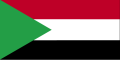
Translated from the Embassy of the Republic of the Sudan in Cairo It consists of 4 colours (red, white and black in parallel horizontal stripes, and green in the form of a triangle at which the colours meet on the left of the flag).
Unofficial translation by WorldometerTranslated from the Embassy of the Republic of the Sudan in Cairo Symbolism of the colours of the flag:
Red symbolises the blood of the martyrs
White symbolises peace and purity
Black symbolises the strong ancestors of the past
Green symbolises fertility and growthUnofficial translation by WorldometerTranslated from the Embassy of the Republic of the Sudan in Cairo The first flag of Sudan was approved in the House of Representatives at its sitting No. 53 in its third session, on Saturday, 31 December 1955, on the proposal of Mr. Mubarak Zarrouk, Leader of the House.
Unofficial translation by WorldometerSource:- sudanembassyeg.gov.sd ↗ - the Embassy of the Republic of the Sudan in Cairo
- National anthem
- Nahnu Djundulla Djundulwatan (نحن جند لله جند الوطن)0:46
- Title (in Arabic)
- نحن جند لله جند الوطن
- Title (in Arabic, Romanized)
- Nahnu Djundulla Djundulwatan
- Title (in English, translated)
- We Are the Army of God and of Our Land
- Lyrics
نحن جنــــد الله جنــــد الوطــــن إن دعـــــا داعي الفـــداء لم نخــن نتحــدى المـــوت عنـــد المحـــن نشترى المجــد بأغلى ثمــــــــــــن هــذه الأرض لــنا فليعش ســــــوداننا عـــلماً بين الأمـــم يابني الســــودان هـــــــذا رمزكم يحمل العبء ويحمى أرضـــــكم
Source: - Citizens
- Sudanese
- Official name:About Sudan - The Country ↗ - Embassy of the Republic of The Sudan | The Hague, The Netherlands
- Official name, Citizens:The World Factbook: Sudan - CIA
- National flag:sudanembassyeg.gov.sd ↗ - the Embassy of the Republic of the Sudan in Cairo
- National anthem:nationalanthems.info ↗
Geography
- Location
- Total area
- 1,861,484 km²
- Land area
- 1,731,671 km²
- Water area
- 129,813 km²
- Land borders
- 6,819 km(7 countries)
- South Sudan
- 2,158 km
- Chad
- 1,403 km
- Egypt
- 1,276 km
- Ethiopia
- 744 km
- Eritrea
- 682 km
- Libya
- 382 km
- Central African Republic
- 174 km
Sudan-South Sudan boundary represents 1 January 1956 alignment; final alignment pending negotiations and demarcation; final sovereignty status of Abyei region pending negotiations between Sudan and South Sudan
Source:- The World Factbook: Sudan - CIA
- Coastline
- 853 km
- Terrain
Generally flat, featureless plain; desert dominates the north - Mean elevation
- 568 m
- Highest point
- 3,042 mJabal Marrah
- Lowest point
- 0 mRed Sea
- Climate
Hot and dry arid desert; rainy season varies by region (April to November) - Avg. temperature
- 27.2 °C
- Avg. daily range
- 20.9 to 33.8 °C
- Annual precipitation
- 208 mm
Temperature °CMeanDaily rangePrecipitation mmMonthly climate normals Month Avg. high, °C Mean, °C Avg. low, °C Precipitation, mm January 27.3 20.1 13.6 1 February 29.9 22.5 15.6 0 March 33.4 26 18.7 1 April 36.9 29.6 22.2 3 May 38.3 31.6 24.8 14 June 38 31.7 25.3 23 July 36.2 30.4 24.9 52 August 35.3 29.9 24.8 64 September 35.9 30 24.3 34 October 35 28.6 22.7 15 November 31.5 24.7 18.4 1 December 28.2 21.1 14.8 1 Country-wide averages over 1991–2020.
Sources:- The World Factbook: Sudan - CIA
- Climate Change Knowledge Portal (ERA5 reanalysis) ↗ - World Bank
- Weather
- Loading
- Land use2023
- Arable11.2%Perm. crops0.1%Pasture49.0%Forest12.0%Other27.7%
- Arable land
- 20,995,000 hectares (11.2%)
- Permanent crops
- 216,000 hectares (0.1%)
- Permanent meadows & pastures
- 91,454,000 hectares (49.0%)
- Forest
- 22,328,680 hectares (12.0%)
- Other land
- 51,806,320 hectares (27.7%)
Source: - Natural hazards2026
- River floods8.6Very high#10/191Epidemics6.0High#58/191Drought5.7High#34/191Coastal floods0.8Very low#136/191Earthquakes0.1Very low#127/191Tsunamis0.0Very lowTropical cyclones0.0Very low
Scores out of 10, ranks out of 191 countries.
Source:- INFORM Risk Index ↗ - European Commission Joint Research Centre
- Location, Land borders, Coastline, Terrain, Mean elevation, Highest point, Lowest point, Climate, Major rivers:The World Factbook: Sudan - CIA
- Climate:Climate Change Knowledge Portal (ERA5 reanalysis) ↗ - World Bank
- Land use:FAOSTAT Land Use domain ↗ - FAO
- Natural hazards:INFORM Risk Index ↗ - European Commission Joint Research Centre
Demographics
- Population change2026
- +3.14% per year+1,620,571 people/yearWorld Rank8thof 237
- Birth rate
- 31.8 per 1,000 population
- Death rate
- 6.2 per 1,000 population
- Net migration rate
- +4.7 per 1,000 population
- 2026
- 18.8 yearsWorld Rank212thof 237
- Age structure2026
- 0-14 years39.8%15-64 years56.7%65 years +3.5%
- Share aged 65 and over
- 3.5%
- Share aged under 18
- 46.4%
- Total dependency ratio
- 76
- Youth dependency ratio
- 70
- Elderly dependency ratio
- 6
- Sex ratio
- 0.98 male / female
MaleAgeFemalePopulation by age group, % of total population Age Male Female 80+ 0.2% 0.2% 70-79 0.8% 0.8% 60-69 1.7% 1.9% 50-59 2.5% 3.0% 40-49 3.8% 4.4% 30-39 6.2% 6.5% 20-29 8.8% 8.8% 10-19 11.3% 11.0% 0-9 14.3% 13.9% - 2026
- 1.93 above the replacement level for Sudan ()4.13 births per womanreplacement 2.2012345World Rank17thof 237
- 1.87 daughters per woman0.87 above replacement, long-run each generation larger than the lastreplacement 1.000.511.52
- 2026
- +25.6 per 1,000 populationfor every 1,000 people, 25.6 more births than deaths a year
- 2026
- +4.7 per 1,000 population
- Urbanization2026
- 35.0% live in 18,648,426 urban residents
- Largest cities2008latest available
- Omdurman, Khartoum, Khartoum North, NyalaRankCity or TownPopulation (2008 census)1Omdurman1,849,6592Khartoum1,410,8583Khartoum North1,012,2114Nyala492,9845Port Sudan394,5616El Obeid345,1267Kassala298,5298Wad Madani289,4829Gedaref269,39510El Fasher217,827Source:
- Central Bureau of Statistics, Sudan (2008 census), via City Population by Thomas Brinkhoff ↗
- Population distribution
- With the exception of a ribbon of settlement that corresponds to the banks of the Nile, northern Sudan is sparsely populated; sizeable areas of population are found around Khartoum, southeast between the Blue and White Nile Rivers, and throughout South Darfur.
- Ethnic groups
- Sudanese Arababout 70%, Fur, Beja, Nuba, Ingessana, Uduk, Fallata, Masalit, Dajo, Gimir, Tunjur, BertiThe largest of more than 500 ethnic groups.
- Religions
- Sunni Muslim, Christian (small minority)
- Languages
- Arabic (العربية), English
- Population, Population change, Median age, Age structure, Total fertility rate, Net reproduction rate, Natural change, Net migration rate:UN World Population Prospects ↗
- Urbanization:UN World Urbanization Prospects ↗
- Largest cities:Central Bureau of Statistics, Sudan (2008 census), via City Population by Thomas Brinkhoff ↗
- Population distribution, Ethnic groups, Religions:The World Factbook: Sudan - CIA
Government & Administration
- Form of state
- RepublicThe Constitutional Document for the Transitional Period calls Sudan "an independent, sovereign, democratic, parliamentary, pluralistic, decentralised State"; the head of State is a nine-member Sovereignty Council chaired by the Commander-in-Chief of the Armed Forces (Arts. 4(1), 11).Sources:
- الوثيقة الدستورية للفترة الانتقالية لسنة 2019م (Constitutional Document for the Transitional Period, 2019), Constitutional Decree No. 38 of 2019, Republic of Sudan Gazette No. 1895 of 3/10/2019 ↗, Arts. 4(1), 11
- الوثيقة الدستورية للفترة الانتقالية (تعديل) لسنة 2025 (Constitutional Document for the Transitional Period (Amendment) 2025), Official Gazette No. 1960 (special issue), 15 March 2025 ↗, Arts. 4(1), 11
- Constitutional Document for the Transitional Period (Amendment) 2025, second amendment, Official Gazette No. 1963, 15 June 2025 ↗, Arts. 4(1), 11
- System of government
- Military ruleUnder the Constitutional Document as amended in 2025, the armed forces nominate six of nine Sovereignty Council members; the Council appoints the Prime Minister, and ministers answer to the two councils (Arts. 10, 12, 15).Sources:
- الوثيقة الدستورية للفترة الانتقالية لسنة 2019م (Constitutional Document for the Transitional Period, 2019), Constitutional Decree No. 38 of 2019, Republic of Sudan Gazette No. 1895 of 3/10/2019 ↗, Arts. 10, 12, 15
- الوثيقة الدستورية للفترة الانتقالية (تعديل) لسنة 2025 (Constitutional Document for the Transitional Period (Amendment) 2025), Official Gazette No. 1960 (special issue), 15 March 2025 ↗, Arts. 10, 12, 15
- Constitutional Document for the Transitional Period (Amendment) 2025, second amendment, Official Gazette No. 1963, 15 June 2025 ↗, Arts. 10, 12, 15
- Territorial organisation
- Unitary
- Transitional arrangement
- Yes
- Territorial control
- ContestedThe "Government of Peace and Unity" (Tasis), led by the Rapid Support Forces, controls areas principally in Darfur and parts of Kordofan.
- Official websites
- Capital
- Khartoum1.4 million people(2008)
- National holidays
- 15 days in 2026
- ThuJan 1Independence Day
- WedJan 7Coptic Christmas Day
- FriMar 20Eid al-Fitr (estimated)
- SatMar 21Eid al-Fitr (estimated)
- SunMar 22Eid al-Fitr (estimated)
- MonMar 23Eid al-Fitr (estimated)
- SunApr 12Coptic Easter
- TueMay 26Eid al-Adha (estimated)
- WedMay 27Eid al-Adha (estimated)
- ThuMay 28Eid al-Adha (estimated)
- FriMay 29Eid al-Adha (estimated)
- SatMay 30Eid al-Adha (estimated)
- TueJun 16Islamic New Year (estimated)
- TueAug 25Prophet's Birthday (estimated)
- FriDec 25Christmas Day
Nationwide public holidays only, excluding regional, bank and government-only days.
- Time
- CATCentral Africa TimeUTC+2
- Currency
- Sudanese Pound (SDG)
- Calling code
- +249
- Internet TLD
- .sd
- ISO 3166-1 codes
- SD, SDN
- Infrastructure
- Passengers carried
- 911,090 by the country's airlines(2023)
- Heliports
- 8
- Aircraft departures
- 9,330 by the country's airlines(2023)
- Air freight
- 20 million tonne-km(2023)
- Aircraft registration prefix
- ST
Sources:- The World Factbook: Sudan - CIA
- World Development Indicators ↗ - World Bank
- Flag carrier
- Sudan Airways (in Arabic)State-owned
- 2025
- 14 / 100World Rank175thof 182Confidence interval
Corruption index score by year Year Score Lower bound Upper bound 2012 13 8 17 2013 11 5 17 2014 11 5 17 2015 12 6 18 2016 14 9 19 2017 16 12 20 2018 16 12 20 2019 16 11.5 20.5 2020 16 12.5 19.5 2021 20 16 24 2022 22 16.3 27.7 2023 20 14.9 25.1 2024 15 11.9 18.1 2025 14 10.8 17.2 Source:- Corruption Perceptions Index 2025 ↗ - Transparency International, CC BY 4.0
- Form of state, System of government, Territorial organisation, Transitional arrangement, Territorial control:الوثيقة الدستورية للفترة الانتقالية لسنة 2019م (Constitutional Document for the Transitional Period, 2019), Constitutional Decree No. 38 of 2019, Republic of Sudan Gazette No. 1895 of 3/10/2019 ↗ - Ministry of Justice of Sudan
- Form of state, System of government, Territorial organisation, Transitional arrangement, Territorial control:الوثيقة الدستورية للفترة الانتقالية (تعديل) لسنة 2025 (Constitutional Document for the Transitional Period (Amendment) 2025), Official Gazette No. 1960 (special issue), 15 March 2025 ↗ - Ministry of Justice of Sudan
- Form of state, System of government, Territorial organisation, Transitional arrangement, Territorial control:Constitutional Document for the Transitional Period (Amendment) 2025, second amendment, Official Gazette No. 1963, 15 June 2025 ↗ - Ministry of Justice of Sudan
- National holidays:Open World Holidays Framework (vacanza/holidays) ↗
- Infrastructure:The World Factbook: Sudan - CIA
- Infrastructure:World Development Indicators ↗ - World Bank
- Corruption Perceptions Index:Corruption Perceptions Index 2025 ↗ - Transparency International, CC BY 4.0
Economy
- Low income
- GDP growth (real)2026
- +7% per yearWorld Rank13thof 195
- GDP per capita (PPP)2026
- GDP per capita (nominal)
- $597 (192nd in the world)
Source:- Inflation2026
- 41.3%down 58.6 percentage points58.6pp from 2025
- Labor force2022
- 10.9 million (22% of population)World Rank53rdof 187
- Labor force participation2022
- 37.5% of people aged 15+
- Unemployment2022
- 7.5%
- Youth unemployment2022
- 12.0% ages 15 to 24
- Labor productivity2022
- $5.8 per hour worked at PPP
- Budget balance2026
- 3.9% of GDP deficit
- Current account
- 14.6% of GDP, $4.5 billion deficit
Source: - Debt2024
- Central government debt272% of GDPInterest on debt0.1% of GDP
- Trade2022
- Goods$4.4 billion73.8%
- Services$1.6 billion26.2%
- Total exports
- $5.9 billion
- Change from 2021
- down 11.4 percent on the previous year11.4%
Sources:- World Development Indicators ↗ - World Bank
- The World Factbook: Sudan - CIA
- 2024
- −2.13World Rank138thof 145
- Projected GDP growth
- +3.2% a year over the next 10 years
Source:- Atlas of Economic Complexity ↗ - Harvard Growth Lab
- Agricultural products2024
- Sesame seed, Sorghum, Raw milk of goats, and 7 more
- 1Sesame seed37.8×
- 2Sorghum33.8×
- 3Raw milk of goats22.6×
- 4Dates18×
- 5Raw milk of sheep16.9×
- 6Pomelos and grapefruits12.7×
- 7Groundnuts (in shell)11.8×
- 8Millet10.4×
- 9Okra9.2×
- 10Lemons and limes7.2×
ProductSource:- FAOSTAT ↗ - Food and Agriculture Organization
- Industries
- oil, cotton ginning, textiles, cement, edible oils, sugar, soap distilling, shoes, petroleum refining, pharmaceuticals, armaments, automobile/light truck assembly, milling
- Income level, Trade:World Development Indicators ↗ - World Bank
- GDP (nominal), GDP growth (real), GDP per capita (PPP), Inflation, Budget balance:IMF World Economic Outlook ↗
- Labor force, Labor force participation, Unemployment, Youth unemployment, Labor productivity:ILOSTAT ↗ - International Labour Organization
- Debt:IMF Global Debt Database ↗
- Debt:IMF Public Finances in Modern History ↗
- Trade, Industries:The World Factbook: Sudan - CIA
- Economic Complexity Index:Atlas of Economic Complexity ↗ - Harvard Growth Lab
- Agricultural products:FAOSTAT ↗ - Food and Agriculture Organization
Cost of Living
- Average gross salary2022
- SDG 155,379 per month$284 (USD), $693 (PPP)
- Median
- SDG 80,278 per month($147)
- Men
- SDG 170,748 per month($312)
- Women
- SDG 68,496 per month($125)
Source:- ILOSTAT ↗ - International Labour Organization
- 2022
- SDG 425 per month, gross$1 (USD), $2 (PPP)
- Share of the average gross salary
- 0%
Source:- ILOSTAT ↗ - International Labour Organization
- Average gross salary, Minimum wage:ILOSTAT ↗ - International Labour Organization
Society
- 2023
- 0.511LowWorld Rank176thof 193SudanWorld
Human Development Index by year Year Sudan World 2008 0.456 0.698 2009 0.469 0.701 2010 0.479 0.707 2011 0.476 0.713 2012 0.482 0.717 2013 0.488 0.721 2014 0.496 0.726 2015 0.498 0.731 2016 0.502 0.735 2017 0.506 0.739 2018 0.515 0.741 2019 0.517 0.745 2020 0.513 0.742 2021 0.512 0.742 2022 0.516 0.752 2023 0.511 0.756 Source:- Human Development Report ↗ - United Nations Development Programme
- 2014latest available
- 34.2
- Mean years of schooling2023
- 4 years
- Expected for a child today
- 8.6 years
Source:- Human Development Report ↗ - United Nations Development Programme
- Literacy2008latest available
- 53.5% of adults
- Mobile subscriptions2020
- 35.2 million
- Fixed telephone lines
- 129,408
- Fixed broadband
- 0.1 subscriptions per 100 people
Counts subscriptions, not people.
Source:- ITU DataHub ↗ - International Telecommunication Union
- Credit-card ownership2014latest available
- 0% of adults
- Debit-card ownership
- 10%
- Account at a bank or mobile-money provider
- 15%
- Made or received a digital payment
- 12%
Source:- Global Findex Database ↗ - World Bank
- Refugees hosted2025
- 832,566 people
- Asylum seekers
- 48,998
- Internally displaced persons
- 9,117,000All due to conflicts
- Refugees from Sudan abroad
- 2,466,231
Sources:- Refugee Data Finder ↗ - UN Refugee Agency
- Global Internal Displacement Database ↗ - Internal Displacement Monitoring Centre
- Inbound tourists2018latest available
- 836,000 arrivals
- Per resident
- 1.9 arrivals per 100 residents
- $1.1 billion(2022)
- $21.6 million(2022)
- Hotel beds
- 18,478(2016, latest available)
Overnight arrivals by year2010 to 2018A tourist stays at least one night. Arrivals count trips, not people.
Source:- UN Tourism Data Dashboard ↗ - UN Tourism
- UNESCO World Heritage Sites
- 3 sites2 cultural1 natural
Site Type Gebel Barkal and the Sites of the Napatan Region Cultural Archaeological Sites of the Island of Meroe Cultural Sanganeb Marine National Park and Dungonab Bay – Mukkawar Island Marine National Park Natural Source:- The World Factbook: Sudan - CIA
- Human Development Index, Mean years of schooling:Human Development Report ↗ - United Nations Development Programme
- Income inequality (Gini):World Development Indicators ↗ - World Bank
- Literacy:UIS Data Browser ↗ - UNESCO Institute for Statistics
- Mobile subscriptions:ITU DataHub ↗ - International Telecommunication Union
- Credit-card ownership:Global Findex Database ↗ - World Bank
- Refugees hosted:Refugee Data Finder ↗ - UN Refugee Agency
- Refugees hosted:Global Internal Displacement Database ↗ - Internal Displacement Monitoring Centre
- Inbound tourists:UN Tourism Data Dashboard ↗ - UN Tourism
- UNESCO World Heritage Sites:The World Factbook: Sudan - CIA
Crime & Safety
- Travel advisory (US)
- Loading
- Active humanitarian crisisAug 2026
- Very high9.5 out of 10Conflict and violence, International displacement, Political and economic crisisSeverity by monthSep 2024 to Aug 2026What the score is made ofImpact of the crisis9.9Conditions of people affected9.7Complexity of the crisis9.0
Data reliability as rated by INFORM: High. Last updated Aug 31, 2026.
Source:- INFORM Severity Index ↗ - European Commission Joint Research Centre
- Prison population2017
- 49.2 per 100,000 people
- Persons held
- 21,000
Source:- UNODC Data Portal ↗ - UN Office on Drugs and Crime
- Active humanitarian crisis:INFORM Severity Index ↗ - European Commission Joint Research Centre
- Prison population:UNODC Data Portal ↗ - UN Office on Drugs and Crime
Health
- Life expectancy2026
- 66.9 years
- Health expenditure2023
- 2.9% of GDP$21 per person
- Physicians2017
- 0.25 per 1,000 population
- Hospital beds2021
- 0.7 per 1,000 population
- Infant mortality2026
- 36.0 per 1,000 live births
- Maternal mortality2023
- 256 per 100,000 live births
- Alcohol consumption2022
- 0 litres of pure alcohol per adult per year
- Road traffic deaths2019
- 26.8 per 100,000 population
- Life expectancy, Infant mortality:UN World Population Prospects ↗
- Health expenditure, Physicians, Hospital beds, Road traffic deaths:World Development Indicators ↗ - World Bank
- Maternal mortality:Maternal mortality estimates ↗ - UN Maternal Mortality Estimation Inter-agency Group
- Alcohol consumption:Global Health Observatory ↗ - World Health Organization
Environment
- CO₂ emissions2024
- 21.9 Mt per yearup 0.8 percent on the previous year0.8% from 2023
- CO₂ per capita
- 0.3 t per personWorld Rank181stof 207
- Share of global CO₂
- 0.06%
- Methane (CH₄)
- 84.9 Mt CO₂-eq
- Nitrous oxide (N₂O)
- 29.9 Mt CO₂-eq
- Fluorinated gases
- 2.1 Mt CO₂-eq
- All greenhouse gases
- 138.7 Mt CO₂-eq
Source:- Emissions Database for Global Atmospheric Research (EDGAR) ↗ - European Commission, Joint Research Centre
- 2024
- 16.9 µg/m³ of PM2.51.2 years of life expectancy lost against the WHO guidelineMost polluted79thof 236
- WHO guideline
- 5 µg/m³
- National standard
- 10 µg/m³
- Life expectancy gain if the national standard were met
- 0.7 years
Source:- Air Quality Life Index ↗ - Energy Policy Institute at the University of Chicago
- Environmental issues
- water pollution
- inadequate supplies of potable water
- water scarcity and drought
- overhunting
- soil erosion
- desertification
- deforestation
- loss of biodiversity
Source:- The World Factbook: Sudan - CIA
- International agreements
- 16 of 20 landmark treaties in forceParty to 56 multilateral environmental agreements
Treaty Standing Joined Climate Paris Agreement in force 2017 UN Framework Convention on Climate Change in force 1994 Kyoto Protocol in force 2005 Ozone layer Montreal Protocol in force 1993 Vienna Convention (Ozone Layer) in force 1993 Biodiversity Convention on Biological Diversity in force 1996 CITES in force 1983 Convention on Migratory Species (Bonn) not a party Cartagena Protocol on Biosafety in force 2005 Nagoya Protocol in force 2014 Land and heritage Ramsar Convention on Wetlands in force 2005 World Heritage Convention in force 1975 UN Convention to Combat Desertification in force 1996 Chemicals and waste Basel Convention in force 2006 Rotterdam Convention (PIC) in force 2005 Stockholm Convention (POPs) in force 2006 Minamata Convention on Mercury signed 2014, not ratified Oceans UN Convention on the Law of the Sea in force 1994 High Seas Treaty (BBNJ) not a party MARPOL 73/78 not a party Source:- International Environmental Agreements Database ↗ - Université Laval
- CO₂ emissions:Emissions Database for Global Atmospheric Research (EDGAR) ↗ - European Commission, Joint Research Centre
- Air pollution:Air Quality Life Index ↗ - Energy Policy Institute at the University of Chicago
- Environmental issues:The World Factbook: Sudan - CIA
- International agreements:International Environmental Agreements Database ↗ - Université Laval
Food & Water
- No access to safe drinking water2022
- 44.5% of the population
- Renewable water2022
- 38 billion m³ per year
- Per person
- 765 m³ per year
- Dependency ratio
- 96% originates outside the country
- Annual water withdrawal
- 27 billion m³ per year
- Withdrawn for agriculture
- 96%
- Water stress
- 119% of available freshwater withdrawn
Source:- AQUASTAT ↗ - Food and Agriculture Organization
- Undernourishment2022
- 11% of the population5 million people
- Obesity2024
- 17.8% of adults
- Men
- 12.1%
- Women
- 23%
Source:- Global Health Observatory ↗ - World Health Organization
- Underweight children2014
- 33% of children under five
- No access to safe drinking water, Renewable water:AQUASTAT ↗ - Food and Agriculture Organization
- Undernourishment:Food security indicators (FAOSTAT) ↗ - Food and Agriculture Organization
- Obesity:Global Health Observatory ↗ - World Health Organization
- Underweight children:World Development Indicators ↗ - World Bank
Energy
- Energy consumption2024
- Per capita
- 4.61 GJ per person
- Share of world total
- 0.04%
- Supply
- Deficitproduces 50% of what it consumes, 2024
Source:- International Energy Statistics ↗ - U.S. Energy Information Administration
- Electricity2024
- Imports only, 0.8 TWh imported, nothing exported in 202415 TWh generated per year
- Generation
- 15 TWh per year
- Consumption
- 12 TWh per year
- Imports
- 0.8 TWh per year
Source:- International Energy Statistics ↗ - U.S. Energy Information Administration
- Energy consumption, Electricity, Oil, gas & coal:International Energy Statistics ↗ - U.S. Energy Information Administration
- Oil, gas & coal:Worldwide Oil and Gas Survey ↗ - Oil & Gas Journal
Defense
- Military expenditure2021
- 0.9% of GDP$375.2 million, 9.5% of government spending
- Military service2025
- Conscriptionmen and women 18–33, 12–24 months, compulsory or voluntary
Official implementation of compulsory service is reportedly uneven; both the SAF and the RSF have been accused of engaging in forced recruitment of men and boys during the ongoing conflict.
Source:- The World Factbook: Sudan - CIA
- Nuclear weapons2026
- None - no nuclear arsenal
- Military expenditure:SIPRI Military Expenditure Database ↗ - Stockholm International Peace Research Institute
- Military expenditure:World Development Indicators ↗ - World Bank
- Military service:The World Factbook: Sudan - CIA
- Nuclear weapons:Status of World Nuclear Forces ↗ - Federation of American Scientists


