

National Identity
- Official name
- Republic of Kenya
- Official name (in Swahili)
- Jamhuri ya Kenya
- Name etymology
named for Mount Kenya; the mountain's name may derive from the Kikuyu word kere nyaga, or "white mountain"
Sources:- The Constitution of Kenya, 2010 ↗ - Parliament of Kenya
- The World Factbook: Kenya - CIA
- Coat of arms
- National flag
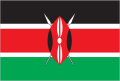
As published by The Kenya Law Reform Commission (KLRC) Three major strips of equal width coloured from top to bottom black, red and green and separated by narrow white strips, with a symmetrical shield and white spears superimposed centrally.
As published in EnglishAs published by the Kenya High Commission in London The color black represents the people of the Republic of Kenya, red for the blood shed during the fight for independence, green for the country’s landscape and the white fimbriation was added later to symbolize peace and honesty. The black, red, and white traditional Maasai shield and two spears symbolize the defense of all the things mentioned above.
As published in EnglishAs published by the Kenya High Commission in Ottawa, Canada In the years following World War II, the Kenya African Union was created and introduced a flag on September 3, 1951, which was a black and red bicolour with a shield and arrow at its center. The next year it was altered into a black, red and the additional green tricolor with a shield crossed with a spear and arrow coupled with the initials “KAU” at its center. The black stood for the native people, red for the common blood of all humanity and green for the nation’s fertile land. The weapons were a reminder for the organized struggle that was the basis for independence.
As published in EnglishAs published by the Kenya High Commission in Ottawa, Canada The flag was later adopted by the Kenya African National Union (KANU), successor to the KAU, in May 1960 with the weapons being replaced with a rooster wielding a battle axe. The Kenya Africa Democratic Union (KADU) was formed a month after adopted a flag following its formation in June 1960. Its flag was a tricolor of a similar design to that of KANU but with white instead of red in the middle.
As published in EnglishAs published by the Kenya High Commission in Ottawa, Canada Some officials wanted to use the KANU flag as the national flag. This was influenced by Tanganyika and Uganda’s choices to use the ruling party’s flag as the national flag. Tom Mboya, one of Kenya’s founding fathers, warned against using the KANU flag to avoid further politically polarizing the country. A committee set up by Jomo Kenyatta came up with a compromise that everyone could agree on. This was achieved by combining flags of the two rivaling parties, the KANU flag and that of KADU with the addition the white fimbriations (which were originally to symbolize Kenya’s multiracial society as they did in KADU’s flag but were changed to symbolize peace and unity), a modified Maasai shield crossed with spears, reminiscent to the original KAU flag, were also added.
As published in EnglishAs published by the Kenya High Commission in Ottawa, Canada The flag is mainly based on that of Kenya African National Union and was officially adopted on 12 December 1963 after Kenya’s independence.
As published in EnglishSources:- klrc.go.ke ↗ - The Kenya Law Reform Commission (KLRC)
- kenyahighcom.org.uk ↗ - the Kenya High Commission in London
- kenyahighcommission.ca ↗ - the Kenya High Commission in Ottawa, Canada
- National anthem
- Ee Mungu Nguvu Yetu0:41
- Title (in Swahili)
- Ee Mungu Nguvu Yetu
- Title (in English)
- Oh God of All Creation
- Lyrics
1Ee Mungu nguvu yetu Ilete baraka kwetu Haki iwe ngao na mlinzi Natukae na undugu Amani na uhuru Raha tupate na ustawi.
2Amkeni ndugu zetu Tufanye sote bidii Nasi tujitoe kwa nguvu Nchi yetu ya Kenya Tunayoipenda Tuwe tayari kuilinda
3Natujenge taifa letu Ee, ndio wajibu wetu Kenya istahili heshima Tuungane mikono Pamoja kazini Kila siku tuwe na shukrani
Source: - Citizens
- Kenyans
- Official name:The Constitution of Kenya, 2010 ↗ - Parliament of Kenya
- Official name, Citizens:The World Factbook: Kenya - CIA
- Coat of arms:Image credit
- National flag:klrc.go.ke ↗ - The Kenya Law Reform Commission (KLRC)
- National flag:kenyahighcom.org.uk ↗ - the Kenya High Commission in London
- National flag:kenyahighcommission.ca ↗ - the Kenya High Commission in Ottawa, Canada
- National anthem:nationalanthems.info ↗
Geography
- Location
- Total area
- 580,367 km²
- Land area
- 569,140 km²
- Water area
- 11,227 km²
- Land borders
- 3,457 km(5 countries)
- Ethiopia
- 867 km
- Uganda
- 814 km
- Tanzania
- 775 km
- Somalia
- 684 km
- South Sudan
- 317 km
Source:- The World Factbook: Kenya - CIA
- Coastline
- 536 km
- Terrain
Low plains rise to central highlands bisected by Great Rift Valley; fertile plateau in west - Mean elevation
- 762 m
- Highest point
- 5,199 mMount Kenya
- Lowest point
- 0 mIndian Ocean
- Climate
Varies from tropical along coast to arid in interior - Avg. temperature
- 25.3 °C
- Avg. daily range
- 20.8 to 30.5 °C
- Annual precipitation
- 701 mm
Temperature °CMeanDaily rangePrecipitation mmMonthly climate normals Month Avg. high, °C Mean, °C Avg. low, °C Precipitation, mm January 31.6 25.9 20.8 36 February 32.8 26.8 21.4 24 March 32.6 26.9 22.1 59 April 31 26 21.9 109 May 30.2 25.3 21.4 75 June 29.4 24.5 20.5 42 July 28.6 23.8 19.7 42 August 29.1 24 19.8 45 September 30.4 24.9 20.2 33 October 30.8 25.4 21 66 November 29.7 24.8 20.9 106 December 30.4 25.2 20.6 63 Country-wide averages over 1991–2020.
Sources:- The World Factbook: Kenya - CIA
- Climate Change Knowledge Portal (ERA5 reanalysis) ↗ - World Bank
- Weather
- Loading
- Land use2023
- Arable11.4%Perm. crops1.4%Pasture36.7%Forest6.5%Other44.0%
- Arable land
- 6,632,159 hectares (11.4%)
- Permanent crops
- 836,508 hectares (1.4%)
- Permanent meadows & pastures
- 21,300,000 hectares (36.7%)
- Forest
- 3,784,870 hectares (6.5%)
- Other land
- 25,534,093 hectares (44.0%)
Source: - Major lakes
- Lake Victoria62,940 km²Lake Turkana6,400 km²
- Natural hazards2026
- Drought6.7Very high#13/191Epidemics6.2High#47/191River floods5.2High#95/191Tsunamis3.2Low#77/191Earthquakes2.8Low#104/191Coastal floods2.7Low#113/191Tropical cyclones0.0Very low
Scores out of 10, ranks out of 191 countries.
Source:- INFORM Risk Index ↗ - European Commission Joint Research Centre
- Location, Land borders, Coastline, Terrain, Mean elevation, Highest point, Lowest point, Climate, Major lakes:The World Factbook: Kenya - CIA
- Climate:Climate Change Knowledge Portal (ERA5 reanalysis) ↗ - World Bank
- Land use:FAOSTAT Land Use domain ↗ - FAO
- Natural hazards:INFORM Risk Index ↗ - European Commission Joint Research Centre
Demographics
- Population change2026
- +1.92% per year+1,103,920 people/yearWorld Rank49thof 237
- Birth rate
- 26.6 per 1,000 population
- Death rate
- 7.1 per 1,000 population
- Net migration rate
- −0.6 per 1,000 population
- 2026
- 20.3 yearsWorld Rank196thof 237
- Age structure2026
- 0-14 years35.7%15-64 years61.2%65 years +3.1%
- Share aged 65 and over
- 3.1%
- Share aged under 18
- 42.8%
- Total dependency ratio
- 63
- Youth dependency ratio
- 58
- Elderly dependency ratio
- 5
- Sex ratio
- 0.99 male / female
MaleAgeFemalePopulation by age group, % of total population Age Male Female 80+ 0.2% 0.3% 70-79 0.6% 0.7% 60-69 1.5% 1.7% 50-59 3.0% 3.0% 40-49 4.9% 4.7% 30-39 6.7% 6.9% 20-29 9.1% 9.4% 10-19 11.6% 11.5% 0-9 12.2% 12.0% - 2026
- 0.87 above the replacement level for Kenya ()3.07 births per womanreplacement 2.201234World Rank54thof 237
- 1.41 daughters per woman0.41 above replacement, long-run each generation larger than the lastreplacement 1.000.511.5
- 2026
- +19.5 per 1,000 populationfor every 1,000 people, 19.5 more births than deaths a year
- 2026
- −0.6 per 1,000 population
- Urbanization2026
- 32.6% live in 19,107,929 urban residents
- Largest cities2019
- Nairobi, Mombasa, Nakuru, RuiruRankCity, Town or Urban CenterPopulation (2019 census)1Nairobi4,397,0732Mombasa1,208,3333Nakuru570,6744Ruiru490,1205Eldoret475,7166Kisumu397,9577Kikuyu323,8818Thika251,4079Naivasha198,44410Karuri194,342Source:
- Kenya National Bureau of Statistics (2019 census), via City Population by Thomas Brinkhoff ↗
- Population distribution
- Population heavily concentrated in the west along the shore of Lake Victoria; other areas of high density include the capital of Nairobi, and in the southeast along the Indian Ocean coast.
- Ethnic groups2019
- Kikuyu17.1%Luhya14.3%Kalenjin13.4%Luo10.7%Kamba9.8%Somali5.8%Kisii5.7%Mijikenda5.2%Meru4.2%Maasai2.5%Turkana2.1%Non-Kenyan1.0%Other8.2%
- Religions2019
- Christian85.5%Muslim10.9%Other1.8%None1.6%Don't know/no answer0.2%
- Christian
- 85.5%
- Protestant
- 33.4%
- Catholic
- 20.6%
- Evangelical
- 20.4%
- African Instituted Churches
- 7.0%
- Other Christian
- 4.1%
Source:- The World Factbook: Kenya - CIA
- Languages
- Swahili (Kiswahili), English
- Population, Population change, Median age, Age structure, Total fertility rate, Net reproduction rate, Natural change, Net migration rate:UN World Population Prospects ↗
- Urbanization:UN World Urbanization Prospects ↗
- Largest cities:Kenya National Bureau of Statistics (2019 census), via City Population by Thomas Brinkhoff ↗
- Population distribution, Ethnic groups, Religions:The World Factbook: Kenya - CIA
Government & Administration
- Form of state
- RepublicThe President is elected by registered voters in a national election; the Constitution declares Kenya "a sovereign Republic" and "a multi-party democratic State" (Arts. 4, 136).Source:
- The Constitution of Kenya, 2010 (Laws of Kenya) ↗, Arts. 4, 136
- System of government
- PresidentialThe President is Head of State and Government; Cabinet Secretaries, who may not be MPs, are appointed with National Assembly approval and must be dismissed if an Assembly resolution requires it, and Parliament's term ends at the next general election (Arts. 102, 131, 152).Source:
- The Constitution of Kenya, 2010 (Laws of Kenya) ↗, Arts. 102, 131, 152
- Territorial organisation
- Unitary
- Official websites
- Capital
- Nairobi4.8 million people(2024)
- National holidays
- 11 days in 2026
- ThuJan 1New Year's Day
- FriMar 20Eid al-Fitr (estimated)
- FriApr 3Good Friday
- MonApr 6Easter Monday
- FriMay 1Labor Day
- MonJun 1Madaraka Day
- SatOct 10Mazingira Day
- TueOct 20Mashujaa Day
- SatDec 12Jamhuri Day
- FriDec 25Christmas Day
- SatDec 26Boxing Day
Nationwide public holidays only, excluding regional, bank and government-only days.
- Time
- EATEast Africa TimeUTC+3
- Currency
- Kenyan Shilling (KES)
- Entry requirements
- Official visa and entry information
- Calling code
- +254
- Internet TLD
- .ke
- ISO 3166-1 codes
- KE, KEN
- Infrastructure
- Passengers carried
- 5,138,290 by the country's airlines(2023)
- Aircraft departures
- 69,323 by the country's airlines(2023)
- Air freight
- 288.6 million tonne-km(2023)
- Aircraft registration prefix
- 5Y
Sources:- The World Factbook: Kenya - CIA
- World Development Indicators ↗ - World Bank
- Flag carrier
- Kenya AirwaysPartly state-owned
- Passenger rail
- Kenya Railways
- 2025
- 30 / 100World Rank130thof 182Confidence interval
Corruption index score by year Year Score Lower bound Upper bound 2012 27 24 31 2013 27 23 31 2014 25 20 30 2015 25 20 30 2016 26 24 29 2017 28 25 31 2018 27 24 30 2019 28 24.4 31.6 2020 31 28.6 33.4 2021 30 27.8 32.2 2022 32 29.5 34.5 2023 31 28.5 33.5 2024 32 28.6 35.4 2025 30 27.2 32.8 Source:- Corruption Perceptions Index 2025 ↗ - Transparency International, CC BY 4.0
- Form of state, System of government, Territorial organisation:The Constitution of Kenya, 2010 (Laws of Kenya) ↗ - National Council for Law Reporting, with the Authority of the Attorney-General
- National holidays:Open World Holidays Framework (vacanza/holidays) ↗
- Infrastructure:The World Factbook: Kenya - CIA
- Infrastructure:World Development Indicators ↗ - World Bank
- Corruption Perceptions Index:Corruption Perceptions Index 2025 ↗ - Transparency International, CC BY 4.0
Economy
- Lower middle income
- GDP growth (real)2026
- +4.5% per yearWorld Rank41stof 195
- GDP per capita (PPP)2026
- GDP per capita (nominal)
- $2,785 (156th in the world)
Source:- 2025
- Services55.1% of GDPIndustry16.3% of GDPAgriculture23.2% of GDPManufacturing7.1%part of industry
- Households
- +76.9%
- Government
- +11.2%
- Investment
- +17%
- Exports
- +15.8%
- Imports
- −21.8%
The shape of the economyGDP by end useSource:- World Development Indicators ↗ - World Bank
- Inflation2026
- 6%up 1.9 percentage points1.9pp from 2025
- Labor force2024
- 24 million (43% of population)World Rank29thof 187
- Labor force participation2024
- 67.4% of people aged 15+
- Unemployment2024
- 5.5%
- Youth unemployment2024
- 15.5% ages 15 to 24
- Labor productivity2024
- $7.2 per hour worked at PPP
- Budget balance2026
- 6.6% of GDP deficit
- Current account
- 4.5% of GDP, $6.8 billion deficit
Source: - Debt2024
- Central government debt65.6% of GDPInterest on debt5.7% of GDP
- Trade2024
- Goods$12.5 billion60.8%
- Services$8 billion39.2%
- Total exports
- $20.5 billion
- Change from 2023
- up 13.1 percent on the previous year13.1%
Sources:- World Development Indicators ↗ - World Bank
- The World Factbook: Kenya - CIA
- 2024
- −0.27World Rank91stof 145
- Projected GDP growth
- +3.4% a year over the next 10 years
Source:- Atlas of Economic Complexity ↗ - Harvard Growth Lab
- Agricultural products2024
- Raw milk of camel, Tea leaves, Avocados, and 7 more
- 1Raw milk of camel78.2×
- 2Tea leaves24.5×
- 3Avocados15.5×
- 4Beans (dry)8.9×
- 5Bananas4.4×
- 6Mangoes and guavas and mangosteens3.8×
- 7Cabbages3.6×
- 8Sweet potatoes2.8×
- 9Raw milk of cattle2.1×
- 10Potatoes1.7×
ProductSource:- FAOSTAT ↗ - Food and Agriculture Organization
- Gold reserves2025
- 0.02 tonnesWorth $2.4 million, <0.1% of total official reserves by value
- Industries
- agriculture, transportation, services, manufacturing, construction, telecommunications, tourism, retail
- Income level, GDP by sector, Trade, Gold reserves:World Development Indicators ↗ - World Bank
- GDP (nominal), GDP growth (real), GDP per capita (PPP), Inflation, Budget balance:IMF World Economic Outlook ↗
- Labor force, Labor force participation, Unemployment, Youth unemployment, Labor productivity:ILOSTAT ↗ - International Labour Organization
- Debt:IMF Global Debt Database ↗
- Debt:IMF Public Finances in Modern History ↗
- Trade, Industries:The World Factbook: Kenya - CIA
- Economic Complexity Index:Atlas of Economic Complexity ↗ - Harvard Growth Lab
- Agricultural products:FAOSTAT ↗ - Food and Agriculture Organization
Cost of Living
- Cost of living index
- Loading
- Monthly costs (excluding rent)
- Loading
- Rent
- Loading
- Buying an apartment
- Loading
- Average gross salary2019
- KES 13,933 per month$137 (USD), $322 (PPP)
- Median
- KES 6,000 per month($59)
- Men
- KES 14,663 per month($144)
- Women
- KES 12,668 per month($124)
Source:- ILOSTAT ↗ - International Labour Organization
- 2024
- KES 16,033 per month, gross$119 (USD), $361 (PPP)
- Average gross salary, Minimum wage:ILOSTAT ↗ - International Labour Organization
Society
- 2023
- 0.628MediumWorld Rank143rdof 193KenyaWorld
Human Development Index by year Year Kenya World 1990 0.485 0.608 1991 0.485 0.611 1992 0.484 0.614 1993 0.483 0.617 1994 0.484 0.620 1995 0.488 0.625 1996 0.491 0.631 1997 0.493 0.636 1998 0.496 0.641 1999 0.499 0.646 2000 0.500 0.651 2001 0.505 0.657 2002 0.504 0.662 2003 0.515 0.669 2004 0.526 0.675 2005 0.532 0.681 2006 0.541 0.688 2007 0.548 0.694 2008 0.553 0.698 2009 0.553 0.701 2010 0.552 0.707 2011 0.560 0.713 2012 0.565 0.717 2013 0.570 0.721 2014 0.576 0.726 2015 0.583 0.731 2016 0.594 0.735 2017 0.599 0.739 2018 0.605 0.741 2019 0.611 0.745 2020 0.600 0.742 2021 0.608 0.742 2022 0.626 0.752 2023 0.628 0.756 Source:- Human Development Report ↗ - United Nations Development Programme
- 2022
- 38.5
- Mean years of schooling2023
- 8.6 years
- Expected for a child today
- 11.5 years
Source:- Human Development Report ↗ - United Nations Development Programme
- Education expenditure2024
- 4% of GDP
- Share of government spending
- 27.9%
Source:- World Development Indicators ↗ - World Bank
- Internet users2024
- 35% of the population
- Households with Internet access
- 47.5%
Source:- ITU DataHub ↗ - International Telecommunication Union
- Mobile subscriptions2024
- 71.4 million
- Fixed telephone lines
- 57,017
- Fixed broadband
- 3 subscriptions per 100 people
Counts subscriptions, not people.
Source:- ITU DataHub ↗ - International Telecommunication Union
- Credit-card ownership2024
- 4% of adults
- Debit-card ownership
- 20%
- Account at a bank or mobile-money provider
- 90%
- Mobile-money account
- 87%
- Made or received a digital payment
- 89%
Source:- Global Findex Database ↗ - World Bank
- Refugees hosted2025
- 626,546 people
- Asylum seekers
- 228,305
- Stateless persons
- 9,800
- Internally displaced persons
- 13,80010,000 due to conflicts, 3,800 due to disasters
- Refugees from Kenya abroad
- 12,138
Sources:- Refugee Data Finder ↗ - UN Refugee Agency
- Global Internal Displacement Database ↗ - Internal Displacement Monitoring Centre
- Inbound tourists2017latest available
- 1.4 million arrivalsOfficial tourism site
- Per resident
- 2.8 arrivals per 100 residents
- Same-day visitors
- 85,000 arrivals
- $1.7 billion(2023)
- 4.4% tourism direct GDP(2019, latest available)
- $138.2 million(2023)
Overnight arrivals by year2010 to 2017A tourist stays at least one night. Arrivals count trips, not people.
Source:- UN Tourism Data Dashboard ↗ - UN Tourism
- UNESCO World Heritage Sites
- 8 sites5 cultural3 natural
Site Type Lake Turkana National Parks Natural Mount Kenya National Park/Natural Forest Natural Lamu Old Town Cultural Sacred Mijikenda Kaya Forests Cultural Fort Jesus, Mombasa Cultural Kenya Lake System in the Great Rift Valley Natural Thimlich Ohinga Archaeological Site Cultural The Historic Town and Archaeological Site of Gedi Cultural Source:- The World Factbook: Kenya - CIA
- Human Development Index, Mean years of schooling:Human Development Report ↗ - United Nations Development Programme
- Income inequality (Gini), Education expenditure:World Development Indicators ↗ - World Bank
- Internet users, Mobile subscriptions:ITU DataHub ↗ - International Telecommunication Union
- Credit-card ownership:Global Findex Database ↗ - World Bank
- Refugees hosted:Refugee Data Finder ↗ - UN Refugee Agency
- Refugees hosted:Global Internal Displacement Database ↗ - Internal Displacement Monitoring Centre
- Inbound tourists:UN Tourism Data Dashboard ↗ - UN Tourism
- UNESCO World Heritage Sites:The World Factbook: Kenya - CIA
Crime & Safety
- Travel advisory (US)
- Loading
- Active humanitarian crisisAug 2026
- High7.1 out of 10Drought and drier conditions, International displacement
Crisis Since Sep 2024 Severity Country overallAll crises below combined 7.1High Drought in ASAL areas of KenyaDrought and drier conditions 6.9High International displacement to KenyaInternational displacement 5.9Medium Data reliability as rated by INFORM: Medium. Last updated Aug 31, 2026.
Source:- INFORM Severity Index ↗ - European Commission Joint Research Centre
- Homicide rate2024
- Medium by global standards4.6 per 100,000 peopleWorld Rank33rdof 115
- Crime rates
- 7 offence categories
Offence Per 100,000 Count Year Homicide (victims) 4.6 2,624 2024 Serious assault 41.6 22,573 2022 Sexual violence 13.2 7,166 2022 Kidnapping 0.1 57 2022 Burglary 2.9 1,589 2022 Theft 27.1 14,718 2022 Vehicle theft 0.4 240 2022 A low figure can also mean weak recording.
Source:- UNODC Data Portal ↗ - UN Office on Drugs and Crime
- Prison population2022
- 108.5 per 100,000 people
- Persons held
- 58,887
Source:- UNODC Data Portal ↗ - UN Office on Drugs and Crime
- Active humanitarian crisis:INFORM Severity Index ↗ - European Commission Joint Research Centre
- Homicide rate, Crime rates, Prison population:UNODC Data Portal ↗ - UN Office on Drugs and Crime
Health
- Life expectancy2026
- 64.2 years
- Health expenditure2023
- 4.4% of GDP$85 per person
- Physicians2023
- 0.29 per 1,000 population
- Hospital beds2019
- 1.3 per 1,000 population
- Infant mortality2026
- 28.2 per 1,000 live births
- Maternal mortality2023
- 379 per 100,000 live births
- Alcohol consumption2022
- 2.5 litres of pure alcohol per adult per year
- Tobacco use2022
- 10.2% of adults
- Men
- 17.8%
- Women
- 2.6%
Source:- Global Health Observatory ↗ - World Health Organization
- Alcohol and Tobacco Spending2023
- 3.5% of household spendingWorld Rank39thof 105
- World median
- 3.1%
Source:- The World Factbook: Kenya - CIA
- Road traffic deaths2019
- 28.3 per 100,000 population
- Life expectancy, Infant mortality:UN World Population Prospects ↗
- Health expenditure, Physicians, Hospital beds, Road traffic deaths:World Development Indicators ↗ - World Bank
- Maternal mortality:Maternal mortality estimates ↗ - UN Maternal Mortality Estimation Inter-agency Group
- Alcohol consumption, Tobacco use:Global Health Observatory ↗ - World Health Organization
- Alcohol and Tobacco Spending:The World Factbook: Kenya - CIA
Environment
- CO₂ emissions2024
- 21.6 Mt per yearup 1.7 percent on the previous year1.7% from 2023
- CO₂ per capita
- 0.4 t per personWorld Rank179thof 207
- Share of global CO₂
- 0.05%
- Methane (CH₄)
- 64.9 Mt CO₂-eq
- Nitrous oxide (N₂O)
- 16.1 Mt CO₂-eq
- Fluorinated gases
- 0.16 Mt CO₂-eq
- All greenhouse gases
- 102.8 Mt CO₂-eq
Source:- Emissions Database for Global Atmospheric Research (EDGAR) ↗ - European Commission, Joint Research Centre
- 2024
- 20.2 µg/m³ of PM2.51.5 years of life expectancy lost against the WHO guidelineMost polluted58thof 236
- WHO guideline
- 5 µg/m³
- National standard
- 35 µg/m³
Source:- Air Quality Life Index ↗ - Energy Policy Institute at the University of Chicago
- Environmental issues
- water pollution from urban and industrial wastes and from use of pesticides and fertilizers
- flooding
- water-hyacinth infestation in Lake Victoria
- deforestation
- soil erosion
- desertification
- poaching
Source:- The World Factbook: Kenya - CIA
- International agreements
- 20 of 20 landmark treaties in forceParty to 84 multilateral environmental agreements
Treaty Standing Joined Climate Paris Agreement in force 2017 UN Framework Convention on Climate Change in force 1994 Kyoto Protocol in force 2005 Ozone layer Montreal Protocol in force 1989 Vienna Convention (Ozone Layer) in force 1989 Biodiversity Convention on Biological Diversity in force 1994 CITES in force 1979 Convention on Migratory Species (Bonn) in force 1999 Cartagena Protocol on Biosafety in force 2003 Nagoya Protocol in force 2014 Land and heritage Ramsar Convention on Wetlands in force 1990 World Heritage Convention in force 1991 UN Convention to Combat Desertification in force 1997 Chemicals and waste Basel Convention in force 2000 Rotterdam Convention (PIC) in force 2005 Stockholm Convention (POPs) in force 2004 Minamata Convention on Mercury in force 2023 Oceans UN Convention on the Law of the Sea in force 1994 High Seas Treaty (BBNJ) in force 2026 MARPOL 73/78 in force 1993 Source:- International Environmental Agreements Database ↗ - Université Laval
- CO₂ emissions:Emissions Database for Global Atmospheric Research (EDGAR) ↗ - European Commission, Joint Research Centre
- Air pollution:Air Quality Life Index ↗ - Energy Policy Institute at the University of Chicago
- Environmental issues:The World Factbook: Kenya - CIA
- International agreements:International Environmental Agreements Database ↗ - Université Laval
Food & Water
- No access to safe drinking water2022
- 36.8% of the population
- Renewable water2022
- 31 billion m³ per year
- Per person
- 566 m³ per year
- Dependency ratio
- 33% originates outside the country
- Annual water withdrawal
- 4 billion m³ per year
- Withdrawn for agriculture
- 80%
- Water stress
- 33% of available freshwater withdrawn
Source:- AQUASTAT ↗ - Food and Agriculture Organization
- Undernourishment2022
- 31.1% of the population16.5 million people
- Obesity2024
- 11.3% of adults
- Men
- 5.6%
- Women
- 16.8%
Source:- Global Health Observatory ↗ - World Health Organization
- Underweight children2022
- 9.8% of children under five
- No access to safe drinking water, Renewable water:AQUASTAT ↗ - Food and Agriculture Organization
- Undernourishment:Food security indicators (FAOSTAT) ↗ - Food and Agriculture Organization
- Obesity:Global Health Observatory ↗ - World Health Organization
- Underweight children:World Development Indicators ↗ - World Bank
Energy
- Energy consumption2024
- Per capita
- 6.04 GJ per person
- Share of world total
- 0.05%
- Supply
- Deficitproduces 13% of what it consumes, 2024
Source:- International Energy Statistics ↗ - U.S. Energy Information Administration
- Electricity2024
- Net importer, net 1.5 TWh in 2024, 13% of consumption13 TWh generated per year
- Generation
- 13 TWh per year
- Consumption
- 11 TWh per year
- Imports
- 1.5 TWh per year
- Exports
- 0 TWh per year
- Net
- −1.5 TWh per year
Source:- International Energy Statistics ↗ - U.S. Energy Information Administration
- Oil, gas & coal
- Production endedlast produced in 2016Consumption2024116,161 b/d
Oil imports and exports count crude oil only.
- Energy consumption, Electricity, Oil, gas & coal:International Energy Statistics ↗ - U.S. Energy Information Administration
Defense
- Military expenditure2024
- 1% of GDP$1.2 billion, 4.4% of government spending
- Military personnel2025
- approximately 25,000active Kenya Defense Forces
- Military service2026
- Voluntarymen and women 18–26, under 18 with parental consent; upper limit 30 for specialists, tradesmen, or women with a diploma, 39 for chaplains/imams; 7–9 year service obligations
- Space program2025
- Kenya Space Agency (KSA; established 2017)
Has a national space strategy focused on acquiring and applying space technologies for agriculture, communications, disaster and resource management, security, urban planning, and weather monitoring; jointly develops and builds nanosatellites with foreign partners; operates satellites; researching and developing satellite payloads and imagery data analysis capabilities; has cooperated on space issues with China, Japan, India, Italy, and the US, as well as a variety of African partners; member of the African Space Agency
- Launch sites
- Luigi Broglio Space Center (aka Malindi Space Center, Malindi Station, San Marco Satellite Launching and Tracking Station; Kilifi County; over 20 sounding rockets and nine satellites launched from the site, 1967-1989); in 2020, Kenya concluded a new deal with Italy to conduct rocket launches from the site again in the future
- 1970
- First satellite (US-made Uhura) launched from Kenya
- 2008
- Established country's first satellite ground station
- 2018
- First remote-sensing (RS)/technology-demonstrator cube nanosatellite (1KUNS-PF) produced jointly with Japan and Italy and deployed from the International Space Station
- 2023
- First domestically designed RS satellite (TAIFA-1) built by Bulgaria and launched by US
Key milestones
KSA's predecessor, the National Space Secretariat, was established in 2009
Source:- The World Factbook: Kenya - CIA
- Nuclear weapons2026
- None - no nuclear arsenal
- Military expenditure:SIPRI Military Expenditure Database ↗ - Stockholm International Peace Research Institute
- Military expenditure:World Development Indicators ↗ - World Bank
- Military personnel, Military service, Space program:The World Factbook: Kenya - CIA
- Nuclear weapons:Status of World Nuclear Forces ↗ - Federation of American Scientists

