

National Identity
- Official name
- Democratic Republic of the Congo
- Official name (in French)
- République Démocratique du Congo
- Name etymology
named for the Congo River, most of which lies within the DRC; the river name derives from Kongo, a Bantu kingdom in the area
Sources:- Constitution of the Democratic Republic of Congo ↗ - Presidency RDC (Democratic Republic of Congo)
- The World Factbook: Democratic Republic of the Congo - CIA
- National emblem
- National flag
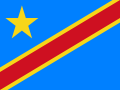
Translated from the Presidency of the Democratic Republic of the Congo Its emblem is the sky-blue flag, adorned with a yellow star in the upper left corner and crossed diagonally by a red band finely bordered with yellow.
Unofficial translation by WorldometerTranslated from the Presidency of the Democratic Republic of the Congo The blue colour symbolises peace and hope, the red represents the blood of the martyrs, and the yellow colour is the sign of the country's wealth. Finally, the yellow star refers to a united country promised a radiant future.
Unofficial translation by WorldometerTranslated from the Presidency of the Democratic Republic of the Congo The first flag of the Congo was created for the International African Association of King Leopold II of Belgium, and depicted a five-pointed star at its centre on a dark blue background, supposedly designed by Henry Morton Stanley, representing the light of civilisation illuminating black Africa. This flag was used for the Congo Free State, then the Belgian Congo.
Unofficial translation by WorldometerTranslated from the Presidency of the Democratic Republic of the Congo Flag of the Democratic Republic of the Congo (2006–present)
Unofficial translation by WorldometerSources:- presidence.cd ↗ - the Presidency of the Democratic Republic of the Congo
- presidence.cd ↗ - the Presidency of the Democratic Republic of the Congo
- presidence.cd ↗ - the Presidency of the Democratic Republic of the Congo
- National anthem
- Debout Congolaise1:29
- Title (in French)
- Debout Congolaise
- Title (in English, translated)
- Arise Congolese
- Lyrics
ChoirDebout Congolais, Unis par le sort, Unis dans l’effort pour l’indépendance, Dressons nos fronts longtemps courbés Et pour de bon prenons le plus bel élan, dans la paix, O peuple ardent, par le labeur, nous bâtirons un pays plus beau qu’avant, dans la paix.
VerseCitoyens, entonnez l’hymne sacré de votre solidarité, Fièrement, saluez l’emblème d’or de votre souveraineté, Congo.
RefrainDon béni, Congo des aïeux Congo, O pays Congo bien aimé Congo, Nous peuplerons ton sol et nous assurerons ta grandeur. Trente juin O doux soleil trente juin du trente juin, Jour sacré Sois le témoin jour sacré de l’immortel serment de liberté Que nous léguons à notre postérité pour toujours.
Source: - Citizens
- Congolese
- Official name:Constitution of the Democratic Republic of Congo ↗ - Presidency RDC (Democratic Republic of Congo)
- Official name, Citizens:The World Factbook: Democratic Republic of the Congo - CIA
- National flag:presidence.cd ↗ - the Presidency of the Democratic Republic of the Congo
- National flag:presidence.cd ↗ - the Presidency of the Democratic Republic of the Congo
- National flag:presidence.cd ↗ - the Presidency of the Democratic Republic of the Congo
- National anthem:nationalanthems.info ↗
Geography
- Location
- Central Africa, northeast of Angola
- Total area
- 2,344,858 km²
- Land area
- 2,267,048 km²
- Water area
- 77,810 km²
- Land borders
- 11,027 km(9 countries)
- Angola
- 2,646 km(of which 225 km is the boundary of Angola's discontiguous Cabinda Province)
- Zambia
- 2,332 km
- Republic of the Congo
- 1,775 km
- Central African Republic
- 1,747 km
- Uganda
- 877 km
- South Sudan
- 714 km
- Tanzania
- 479 km
- Burundi
- 236 km
- Rwanda
- 221 km
Source:- The World Factbook: Democratic Republic of the Congo - CIA
- Coastline
- 37 km
- Terrain
Vast central basin is a low-lying plateau; mountains in east - Mean elevation
- 726 m
- Highest point
- 5,110 mPic Marguerite on Mont Ngaliema (Mount Stanley)
- Lowest point
- 0 mAtlantic Ocean
- Climate
Tropical hot and humid in equatorial river basin; cooler and drier in southern highlands; cooler and wetter in eastern highlands; north of Equator - wet season (April to October), dry season (December to February); south of Equator - wet season (November to March), dry season (April to October) - Avg. temperature
- 24.1 °C
- Avg. daily range
- 20.4 to 29.3 °C
- Annual precipitation
- 1,648 mm
Temperature °CMeanDaily rangePrecipitation mmMonthly climate normals Month Avg. high, °C Mean, °C Avg. low, °C Precipitation, mm January 29.3 24.2 20.5 140 February 30 24.6 20.9 135 March 29.7 24.5 21 176 April 29.2 24.3 21 163 May 29.5 24.4 20.8 103 June 29.4 24 19.9 63 July 29.4 23.8 19.5 64 August 29.5 24.1 20.1 101 September 29.4 24.2 20.4 139 October 28.8 23.8 20.5 194 November 28.3 23.6 20.4 203 December 28.6 23.7 20.3 167 Country-wide averages over 1991–2020.
Sources:- The World Factbook: Democratic Republic of the Congo - CIA
- Climate Change Knowledge Portal (ERA5 reanalysis) ↗ - World Bank
- Weather
- Loading
- Land use2023
- Arable6.6%Perm. crops0.9%Pasture8.0%Forest61.6%Other22.9%
- Arable land
- 14,897,864 hectares (6.6%)
- Permanent crops
- 1,997,800 hectares (0.9%)
- Permanent meadows & pastures
- 18,200,000 hectares (8.0%)
- Forest
- 139,754,834 hectares (61.6%)
- Other land
- 51,854,502 hectares (22.9%)
Source: - Major lakes
- Lake Tanganyika32,000 km²Lake Albert5,590 km²Lake Mweru4,350 km²Lac Mai-Ndombe2,300 km²Lake Kivu2,220 km²Lake Edward2,150 km²Lac Upemba530 km²Lac Tumba500 km²Source:
- The World Factbook: Democratic Republic of the Congo - CIA
- Natural hazards2026
- Epidemics8.3Very high#1/191River floods7.0Very high#41/191Earthquakes4.2Medium#86/191Drought2.3Very low#122/191Coastal floods1.0Very low#135/191Tsunamis0.0Very lowTropical cyclones0.0Very low
Scores out of 10, ranks out of 191 countries.
Source:- INFORM Risk Index ↗ - European Commission Joint Research Centre
- Location, Land borders, Coastline, Terrain, Mean elevation, Highest point, Lowest point, Climate, Major rivers, Major lakes:The World Factbook: Democratic Republic of the Congo - CIA
- Climate:Climate Change Knowledge Portal (ERA5 reanalysis) ↗ - World Bank
- Land use:FAOSTAT Land Use domain ↗ - FAO
- Natural hazards:INFORM Risk Index ↗ - European Commission Joint Research Centre
Demographics
- Population change2026
- +3.21% per year+3,619,689 people/yearWorld Rank6thof 237
- Birth rate
- 39.8 per 1,000 population
- Death rate
- 8.2 per 1,000 population
- Net migration rate
- −0.2 per 1,000 population
- 2026
- 15.9 yearsWorld Rank233rdof 237
- Age structure2026
- 0-14 years45.8%15-64 years51.1%65 years +3.1%
- Share aged 65 and over
- 3.1%
- Share aged under 18
- 52.4%
- Total dependency ratio
- 96
- Youth dependency ratio
- 90
- Elderly dependency ratio
- 6
- Sex ratio
- 0.98 male / female
MaleAgeFemalePopulation by age group, % of total population Age Male Female 80+ 0.2% 0.2% 70-79 0.6% 0.8% 60-69 1.4% 1.6% 50-59 2.3% 2.5% 40-49 3.5% 3.6% 30-39 5.5% 5.6% 20-29 7.9% 8.0% 10-19 11.6% 11.7% 0-9 16.6% 16.5% - 2026
- 3.50 above the replacement level for the Democratic Republic of the Congo ()5.80 births per womanreplacement 2.30123456World Rank3rdof 237
- 2.51 daughters per woman1.51 above replacement, long-run each generation larger than the lastreplacement 1.000.511.522.53
- 2026
- +31.6 per 1,000 populationfor every 1,000 people, 31.6 more births than deaths a year
- 2026
- −0.2 per 1,000 population
- Urbanization2026
- 45.5% live in cities52,961,718 urban residents
- Largest urban areas2026
- Kinshasa, Kasaï-Oriental, Lubumbashi, BeniRankUrban AreaPopulation (2026 estimate)1Kinshasa11,078,5272Kasaï-Oriental3,675,7603Lubumbashi2,930,3064Beni1,962,4985Kananga1,557,0736Tshikapa1,081,6547Bukavu975,8388Kisangani919,9619Goma827,96810Kalemie776,232
Unlike official city figures, UN urban areas cover the entire built-up area, which can include multiple cities and towns.
- Population distribution
- Urban clusters are spread throughout the country, particularly in the northeast along the border with Uganda, Rwanda, and Burundi; the largest city is the capital, Kinshasha, located in the west along the Congo River; the south is least densely populated.
- Ethnic groups
- Mongo (Bantu), Luba (Bantu), Kongo (Bantu), Mangbetu-AzandeThe four largest of more than 200 ethnic groups, most of them Bantu. Together they make up about 45% of the population.
- Religions2014
- Christian93.1%Kimbanguist2.8%Muslim1.3%Other1.2%None1.3%Unspecified0.2%
- Christian
- 93.1%
- Roman Catholic
- 29.9%
- Protestant
- 26.7%
- Other Christian
- 36.5%
Other includes syncretic sects and indigenous beliefs.
Source:- The World Factbook: Democratic Republic of the Congo - CIA
- Languages
- French (Français)
- Population, Population change, Median age, Age structure, Total fertility rate, Net reproduction rate, Natural change, Net migration rate:UN World Population Prospects ↗
- Urbanization, Largest cities:UN World Urbanization Prospects ↗
- Population distribution, Ethnic groups, Religions:The World Factbook: Democratic Republic of the Congo - CIA
Government & Administration
- Form of state
- RepublicThe President of the Republic is head of state, elected by direct universal suffrage for five years, renewable once only (Arts. 69, 70).
- System of government
- Semi-presidentialThe President appoints the Prime Minister from the parliamentary majority; the National Assembly invests and can censure the Government, and dissolution requires a persistent crisis (Arts. 78, 90, 146, 147, 148).
- Territorial organisation
- Unitary
- Territorial control
- ContestedThe Congo River Alliance / March 23 Movement (AFC/M23) controls parts of North Kivu, including Goma, and of South Kivu.
- Official websites
- Government (in French)
- President
- Parliament (in French)
- Capital
- Kinshasa14.6 million people(2020)
- National holidays
- 13 days in 2026
- ThuJan 1New Year's Day
- SatJan 3Martyrs' Day (observed)
- SunJan 4Martyrs' Day
- FriJan 16National Hero Laurent Désiré Kabila Day
- SatJan 17National Hero Patrice Emery Lumumba Day
- MonApr 6Day of the Struggle of Simon Kimbangu and African Consciousness
- FriMay 1Labor Day
- SatMay 16Revolution and Armed Forces Day (observed)
- SunMay 17Revolution and Armed Forces Day
- TueJun 30Independence Day
- SatAug 1Congolese Genocide Memorial Day (observed)Parents' Day
- SunAug 2Congolese Genocide Memorial Day
- FriDec 25Christmas Day
Nationwide public holidays only, excluding regional, bank and government-only days.
- Time
- WATWest Africa TimeUTC+1
Democratic Republic of the Congo spans multiple time zones, the capital's is shown here. All 2 time zones
- Currency
- Congolese Franc (CDF)
- Calling code
- +243
- Internet TLD
- .cd
- ISO 3166-1 codes
- CD, COD
- Infrastructure
- Passengers carried
- 1,150,170 by the country's airlines(2023)
- Heliports
- 1
- Aircraft departures
- 9,822 by the country's airlines(2023)
- Air freight
- 0.5 million tonne-km(2023)
- Aircraft registration prefix
- 9Q
Sources:- The World Factbook: Democratic Republic of the Congo - CIA
- World Development Indicators ↗ - World Bank
- Flag carrier
- Congo Airways (in French)State-owned
- 2025
- 20 / 100World Rank163rdof 182Confidence interval
Corruption index score by year Year Score Lower bound Upper bound 2012 21 16 27 2013 22 15 29 2014 22 15 29 2015 22 17 27 2016 21 18 25 2017 21 18 24 2018 20 17 23 2019 18 15.7 20.3 2020 18 16.8 19.2 2021 19 17.4 20.6 2022 20 18.4 21.6 2023 20 18.2 21.8 2024 20 17.3 22.7 2025 20 18 22 Source:- Corruption Perceptions Index 2025 ↗ - Transparency International, CC BY 4.0
- Form of state, System of government, Territorial organisation, Territorial control:Constitution de la République Démocratique du Congo du 18 février 2006, modifiée par la Loi n° 11/002 du 20 janvier 2011 (textes coordonnés), Journal Officiel de la République Démocratique du Congo, 52e année, Numéro Spécial, 5 février 2011 ↗ - Senate of the Democratic Republic of the Congo
- National holidays:Open World Holidays Framework (vacanza/holidays) ↗
- Infrastructure:The World Factbook: Democratic Republic of the Congo - CIA
- Infrastructure:World Development Indicators ↗ - World Bank
- Corruption Perceptions Index:Corruption Perceptions Index 2025 ↗ - Transparency International, CC BY 4.0
Economy
- Low income
- GDP growth (real)2026
- +5.2% per yearWorld Rank29thof 195
- GDP per capita (PPP)2026
- GDP per capita (nominal)
- $1,111 (181st in the world)
Source:- 2025
- Services48% of GDPIndustry39.7% of GDPAgriculture8.9% of GDPManufacturing7.9%part of industry
- Households
- +52.7%
- Government
- +15.9%
- Investment
- +31.7%
- Exports
- +43.4%
- Imports
- −43.9%
The shape of the economyGDP by end useSource:- World Development Indicators ↗ - World Bank
- Inflation2026
- 4.3%down 3.2 percentage points3.2pp from 2025
- Labor force2024
- 38 million (35% of population)World Rank17thof 187
- Labor force participation2024
- 64.4% of people aged 15+
- Unemployment2024
- 4.4%
- Youth unemployment2024
- 8.0% ages 15 to 24
- Labor productivity2024
- $2.3 per hour worked at PPP
- Budget balance2026
- 2.7% of GDP deficit
- Current account
- 1.9% of GDP, $2.3 billion deficit
Source: - Debt2024
- Government debt19.3% of GDPInterest on debt0.5% of GDP
- Trade2025
- Goods$35.9 billion98.5%
- Services$548.1 million1.5%
- Total exports
- $36.4 billion
- Change from 2024
- up 3.3 percent on the previous year3.3%
Sources:- World Development Indicators ↗ - World Bank
- The World Factbook: Democratic Republic of the Congo - CIA
- 2024
- −3.13World Rank144thof 145
- Projected GDP growth
- +1.2% a year over the next 10 years
Source:- Atlas of Economic Complexity ↗ - Harvard Growth Lab
- Agricultural products2024
- Cassava (fresh), Plantains and cooking bananas, Bananas, and 4 more
- 1Cassava (fresh)23.4×
- 2Plantains and cooking bananas18.9×
- 3Bananas1×
- 4Oil palm fruit0.8×
- 5Rice0.4×
- 6Maize (corn)0.3×
- 7Sugar cane0.2×
ProductSource:- FAOSTAT ↗ - Food and Agriculture Organization
- Industries
- mining (copper, cobalt, gold, diamonds, coltan, zinc, tin, tungsten), mineral processing, consumer products (textiles, plastics, footwear, cigarettes), metal products, processed foods and beverages, timber, cement, commercial ship repair
- Income level, GDP by sector, Trade:World Development Indicators ↗ - World Bank
- GDP (nominal), GDP growth (real), GDP per capita (PPP), Inflation, Budget balance:IMF World Economic Outlook ↗
- Labor force, Labor force participation, Unemployment, Youth unemployment, Labor productivity:ILOSTAT ↗ - International Labour Organization
- Debt:IMF Global Debt Database ↗
- Debt:IMF Public Finances in Modern History ↗
- Trade, Industries:The World Factbook: Democratic Republic of the Congo - CIA
- Economic Complexity Index:Atlas of Economic Complexity ↗ - Harvard Growth Lab
- Agricultural products:FAOSTAT ↗ - Food and Agriculture Organization
Cost of Living
- Cost of living index
- Loading
- Monthly costs (excluding rent)
- Loading
- Rent
- Loading
- Buying an apartment
- Loading
- Average gross salary2016latest available
- CDF 146,110 per month$145 (USD), $298 (PPP)
- Median
- CDF 90,000 per month($89)
- Men
- CDF 158,817 per month($157)
- Women
- CDF 102,900 per month($102)
Source:- ILOSTAT ↗ - International Labour Organization
- 2023
- CDF 183,950 per month, gross$79 (USD)
- Average gross salary, Minimum wage:ILOSTAT ↗ - International Labour Organization
Society
- 2023
- 0.522LowWorld Rank171stof 193Democratic Republic of the CongoWorld
Human Development Index by year Year Democratic Republic of the Congo World 1990 0.388 0.608 1991 0.389 0.611 1992 0.387 0.614 1993 0.385 0.617 1994 0.382 0.620 1995 0.385 0.625 1996 0.386 0.631 1997 0.388 0.636 1998 0.385 0.641 1999 0.383 0.646 2000 0.391 0.651 2001 0.389 0.657 2002 0.392 0.662 2003 0.398 0.669 2004 0.403 0.675 2005 0.408 0.681 2006 0.413 0.688 2007 0.417 0.694 2008 0.426 0.698 2009 0.431 0.701 2010 0.440 0.707 2011 0.447 0.713 2012 0.451 0.717 2013 0.456 0.721 2014 0.467 0.726 2015 0.477 0.731 2016 0.487 0.735 2017 0.491 0.739 2018 0.497 0.741 2019 0.501 0.745 2020 0.506 0.742 2021 0.508 0.742 2022 0.514 0.752 2023 0.522 0.756 Source:- Human Development Report ↗ - United Nations Development Programme
- 2020
- 44.7
- Mean years of schooling2023
- 7.4 years
- Expected for a child today
- 10.9 years
Source:- Human Development Report ↗ - United Nations Development Programme
- Literacy2023
- 68.5% of adults
- Education expenditure2017
- 1.5% of GDP
- Share of government spending
- 13.1%
Source:- World Development Indicators ↗ - World Bank
- Internet users2024
- 19.7% of the population
- Households with Internet access
- 24.2%
Source:- ITU DataHub ↗ - International Telecommunication Union
- Mobile subscriptions2024
- 64 million
- Fixed telephone lines
- 0
- Fixed broadband
- 0 subscriptions per 100 people
Counts subscriptions, not people.
Source:- ITU DataHub ↗ - International Telecommunication Union
- Credit-card ownership2024
- 2% of adults
- Debit-card ownership
- 5%
- Account at a bank or mobile-money provider
- 39%
- Mobile-money account
- 35%
- Made or received a digital payment
- 37%
Source:- Global Findex Database ↗ - World Bank
- Refugees hosted2025
- 515,083 people
- Asylum seekers
- 1,546
- Internally displaced persons
- 4,906,0004,276,000 due to conflicts, 630,000 due to disasters
- Refugees from the Democratic Republic of the Congo abroad
- 1,146,706
Sources:- Refugee Data Finder ↗ - UN Refugee Agency
- Global Internal Displacement Database ↗ - Internal Displacement Monitoring Centre
- Inbound tourists2021latest available
- 382,000 arrivalsdown 20% against 201920% below 2019
- Per resident
- 0.4 arrivals per 100 residents
- Same-day visitors
- 11,000 arrivals(2011, latest available)
- $244.7 million(2024)
- Domestic trips
- 530,000 overnight trips by residents(2015, latest available)
- Residents' trips abroad
- 424,000 overnight trips(2016, latest available)
- $184 million(2024)
Overnight arrivals by year2010 to 2021A tourist stays at least one night. Arrivals count trips, not people.
Source:- UN Tourism Data Dashboard ↗ - UN Tourism
- UNESCO World Heritage Sites
- 5 sites5 natural
Site Garamba National Park Kahuzi-Biega National Park Okapi Wildlife Reserve Salonga National Park Virunga National Park Source:- The World Factbook: Democratic Republic of the Congo - CIA
- Human Development Index, Mean years of schooling:Human Development Report ↗ - United Nations Development Programme
- Income inequality (Gini), Education expenditure:World Development Indicators ↗ - World Bank
- Literacy:UIS Data Browser ↗ - UNESCO Institute for Statistics
- Internet users, Mobile subscriptions:ITU DataHub ↗ - International Telecommunication Union
- Credit-card ownership:Global Findex Database ↗ - World Bank
- Refugees hosted:Refugee Data Finder ↗ - UN Refugee Agency
- Refugees hosted:Global Internal Displacement Database ↗ - Internal Displacement Monitoring Centre
- Inbound tourists:UN Tourism Data Dashboard ↗ - UN Tourism
- UNESCO World Heritage Sites:The World Factbook: Democratic Republic of the Congo - CIA
Crime & Safety
- Travel advisory (US)
- Loading
- Active humanitarian crisisAug 2026
- Very high9.2 out of 10Conflict and violence, FloodsSeverity by monthSep 2024 to Aug 2026What the score is made ofImpact of the crisis9.4Conditions of people affected9.0Complexity of the crisis9.2
Data reliability as rated by INFORM: Very high. Last updated Aug 26, 2026.
Source:- INFORM Severity Index ↗ - European Commission Joint Research Centre
- Prison population2022
- 43.5 per 100,000 people
- Persons held
- 44,536
Source:- UNODC Data Portal ↗ - UN Office on Drugs and Crime
- Active humanitarian crisis:INFORM Severity Index ↗ - European Commission Joint Research Centre
- Prison population:UNODC Data Portal ↗ - UN Office on Drugs and Crime
Health
- Life expectancy2026
- 62.4 years
- Health expenditure2023
- 3.7% of GDP$23 per person
- Physicians2022
- 0.21 per 1,000 population
- Hospital beds2006latest available
- 0.8 per 1,000 population
- Infant mortality2026
- 47.4 per 1,000 live births
- Maternal mortality2023
- 427 per 100,000 live births
- Alcohol consumption2022
- 2 litres of pure alcohol per adult per year
- Tobacco use2015latest available
- 14.3% of adults
- Men
- 24.8%
- Women
- 3.8%
Source:- Global Health Observatory ↗ - World Health Organization
- Road traffic deaths2019
- 34.9 per 100,000 population
- Life expectancy, Infant mortality:UN World Population Prospects ↗
- Health expenditure, Physicians, Hospital beds, Road traffic deaths:World Development Indicators ↗ - World Bank
- Maternal mortality:Maternal mortality estimates ↗ - UN Maternal Mortality Estimation Inter-agency Group
- Alcohol consumption, Tobacco use:Global Health Observatory ↗ - World Health Organization
Environment
- CO₂ emissions2024
- 6.21 Mt per yearup 1.1 percent on the previous year1.1% from 2023
- CO₂ per capita
- 0.1 t per personWorld Rank205thof 207
- Share of global CO₂
- 0.02%
- Methane (CH₄)
- 42.2 Mt CO₂-eq
- Nitrous oxide (N₂O)
- 7.48 Mt CO₂-eq
- Fluorinated gases
- 2.65 Mt CO₂-eq
- All greenhouse gases
- 58.5 Mt CO₂-eq
Source:- Emissions Database for Global Atmospheric Research (EDGAR) ↗ - European Commission, Joint Research Centre
- 2024
- 41.3 µg/m³ of PM2.53.6 years of life expectancy lost against the WHO guidelineMost polluted4thof 236
- WHO guideline
- 5 µg/m³
Source:- Air Quality Life Index ↗ - Energy Policy Institute at the University of Chicago
- Environmental issues
- poaching
- water pollution
- deforestation from agriculture and wood used for fuel
- soil erosion
- damage from mining
Source:- The World Factbook: Democratic Republic of the Congo - CIA
- International agreements
- 17 of 20 landmark treaties in forceParty to 58 multilateral environmental agreements
Treaty Standing Joined Climate Paris Agreement in force 2018 UN Framework Convention on Climate Change in force 1995 Kyoto Protocol in force 2005 Ozone layer Montreal Protocol in force 1995 Vienna Convention (Ozone Layer) in force 1995 Biodiversity Convention on Biological Diversity in force 1995 CITES in force 1976 Convention on Migratory Species (Bonn) in force 1990 Cartagena Protocol on Biosafety in force 2005 Nagoya Protocol in force 2015 Land and heritage Ramsar Convention on Wetlands in force 1996 World Heritage Convention in force 1975 UN Convention to Combat Desertification in force 1997 Chemicals and waste Basel Convention in force 1995 Rotterdam Convention (PIC) in force 2005 Stockholm Convention (POPs) in force 2005 Minamata Convention on Mercury not a party Oceans UN Convention on the Law of the Sea in force 1994 High Seas Treaty (BBNJ) not a party MARPOL 73/78 not a party Source:- International Environmental Agreements Database ↗ - Université Laval
- CO₂ emissions:Emissions Database for Global Atmospheric Research (EDGAR) ↗ - European Commission, Joint Research Centre
- Air pollution:Air Quality Life Index ↗ - Energy Policy Institute at the University of Chicago
- Environmental issues:The World Factbook: Democratic Republic of the Congo - CIA
- International agreements:International Environmental Agreements Database ↗ - Université Laval
Food & Water
- No access to safe drinking water2022
- 47.6% of the population
- Renewable water2022
- 1,283 billion m³ per year
- Per person
- 12,530 m³ per year
- Dependency ratio
- 30% originates outside the country
- Annual water withdrawal
- 0.7 billion m³ per year
- Withdrawn for agriculture
- 11%
- Water stress
- 0% of available freshwater withdrawn
Source:- AQUASTAT ↗ - Food and Agriculture Organization
- Undernourishment2022
- 35.7% of the population34.2 million people
- Obesity2024
- 6.7% of adults
- Men
- 4.1%
- Women
- 9.1%
Source:- Global Health Observatory ↗ - World Health Organization
- Underweight children2023
- 25% of children under five
- No access to safe drinking water, Renewable water:AQUASTAT ↗ - Food and Agriculture Organization
- Undernourishment:Food security indicators (FAOSTAT) ↗ - Food and Agriculture Organization
- Obesity:Global Health Observatory ↗ - World Health Organization
- Underweight children:World Development Indicators ↗ - World Bank
Energy
- Energy consumption2024
- Per capita
- 1.12 GJ per person
- Share of world total
- 0.02%
- Supply
- Deficitproduces 78% of what it consumes, 2024
Source:- International Energy Statistics ↗ - U.S. Energy Information Administration
- Electricity2024
- Net importer, net 1.4 TWh in 2024, 8.9% of consumption16 TWh generated per year
- Generation
- 16 TWh per year
- Consumption
- 16 TWh per year
- Imports
- 1.5 TWh per year
- Exports
- 0.1 TWh per year
- Net
- −1.4 TWh per year
Source:- International Energy Statistics ↗ - U.S. Energy Information Administration
- Oil, gas & coal
- Deficitproduces 68% of what it consumes, 2024Oil reserves2025180 million barrelsWorld Rank58thof 99Exports201821,278 b/d
Oil imports and exports count crude oil only.
- Mineral resources2025
- Copper
Mineral Mine production Reserves Copper 3.2 million t13.9% of world 80 million t USGS estimates. Shows only minerals where the country is a major producer.
Source:- Mineral Commodity Summaries ↗ - U.S. Geological Survey
- Energy consumption, Electricity, Oil, gas & coal:International Energy Statistics ↗ - U.S. Energy Information Administration
- Oil, gas & coal:Worldwide Oil and Gas Survey ↗ - Oil & Gas Journal
- Mineral resources:Mineral Commodity Summaries ↗ - U.S. Geological Survey
Defense
- Military expenditure2024
- 1.2% of GDP$899.2 million, 7.1% of government spending
- Military personnel2025
- estimated 100,000–150,000active FARDC
- Military service2025
- Conscriptionmen 18–45, it is unclear how much conscription is used; voluntary men and women 18–35
In eastern Congo, fighters from armed groups, including some associated with government security forces, have been accused of forced recruitment of child soldiers.
Source:- The World Factbook: Democratic Republic of the Congo - CIA
- Nuclear weapons2026
- None - no nuclear arsenal
- Military expenditure:SIPRI Military Expenditure Database ↗ - Stockholm International Peace Research Institute
- Military expenditure:World Development Indicators ↗ - World Bank
- Military personnel, Military service:The World Factbook: Democratic Republic of the Congo - CIA
- Nuclear weapons:Status of World Nuclear Forces ↗ - Federation of American Scientists

