

National Identity
- Official name
- State of Libya
- Official name (in Arabic)
- دولة ليبيا
- Official name (in Arabic, Romanized)
- Dawlat Lībiyā
- Name etymology
the name probably derives from the Libu, a North African tribe first mentioned in texts from the 13th century B.C.; the ancient Greeks and Romans used the name for the entire North African coast west of Egypt
Sources:- The Constitutional Declaration and its amendments ↗ - State of Libya - Supreme Judicial Council - Libyan Cases Department
- The World Factbook: Libya - CIA
- National flag
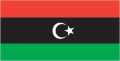
Translated from the Libyan Litigation Department The national flag shall be in accordance with the following shape and dimensions:
Its length is twice its width, and it is divided into three parallel colours: the uppermost red, then black, then green, provided that the area of the black colour is equal to the area of the other two colours, and that its centre contains a white crescent, between whose two tips is a white five-pointed star.
Unofficial translation by WorldometerTranslated from February Newspaper (Sahifat Febrayer), Libya The red colour: the red colour signifies the shedding of the blood of the Libyan people, and the sacrifices they made in order to obtain freedom and independence. The green colour: it is the national colour of Libya, and it reflects the Islamic character; it also signifies the effort to make Libya a green country—as it was previously—in light of the increase in desert areas in the country, by expanding agricultural areas and so on. The black colour: like the other colours, its presence has a certain meaning; the black colour in the flag signifies the people with black skin who live in Africa, and it was also said to signify the dark days that Libya went through during the Italian occupation.
Unofficial translation by WorldometerTranslated from February Newspaper (Sahifat Febrayer), Libya The shape of the crescent and the star has an Islamic meaning; the crescent recalls the beginning of the lunar month and the story of the Prophet's Hijra, and the star is a sign of hope, light and optimism for a better tomorrow.
Unofficial translation by WorldometerTranslated from February Newspaper (Sahifat Febrayer), Libya The flag of Libya was the flag of the Emirate of Cyrenaica, which was a black flag bearing a white star and a crescent; the Emirate of Cyrenaica is a region in eastern Libya that unilaterally declared in 1949 its independence from the Allies under King Idris, who then moved on to unify it with the two other historical regions of the country: Tripolitania and Fezzan.
Unofficial translation by WorldometerTranslated from February Newspaper (Sahifat Febrayer), Libya History of the flag of Libya in 1951At this stage Libya obtained its independence from the Allies, so Omar Faiek Shennib – Chief of the Royal Diwan, Vice-President of the National Assembly and Minister of Defence under King Idris – designed a new flag by adding a red stripe at the top of the flag and a green stripe at the bottom of the flag; the flag thus came to consist of the colours (red, black and green), the white star and the crescent.
Unofficial translation by WorldometerTranslated from February Newspaper (Sahifat Febrayer), Libya History of the flag of Libya between 1969 and 2011 At this stage Gaddafi took power; in 1969 he named Libya the Libyan Arab Republic, and made the flag consist of three horizontal stripes: red, white and black, and in 1977 he changed the name of Libya once again and called it: the Great Socialist People's Libyan Arab Jamahiriya, and he changed the colour of the flag and made it green.
Unofficial translation by WorldometerTranslated from February Newspaper (Sahifat Febrayer), Libya The flag of Libya after the year 2011 In this year, and after the overthrow of the regime of Muammar Gaddafi, the flag of Libya that had been in use in the period between 1951 and 1969 was restored, and it is the flag that the United Nations currently uses to represent Libya.
Unofficial translation by WorldometerSources:- sld.gov.ly ↗ - the Libyan Litigation Department
- febp.ly ↗ - February Newspaper (Sahifat Febrayer), Libya
- National anthem
- Libya, Libya, Libya (ليبيا ليبيا ليبيا)1:08
- Title (in Arabic)
- ليبيا ليبيا ليبيا
- Title (in Arabic, Romanized)
- Libya, Libya, Libya
- Title (in English, translated)
- Libya, Libya, Libya
- Unofficial title (in Arabic)
- يا بلادي
- Unofficial title (in Arabic, Romanized)
- Ya Biladi
- Unofficial title (in English, translated)
- Oh, My Country!
- Lyrics
Chorusيا بلادي بجهادي وجلادي ادفعي كيد الأعادي واسلمي اسلمي طول المدي إننا نحن الفدا ليبيا ليبيا ليبيا
1يا بلادي أنت ميراث الجدود لارعى الله يداً تمتد لك فاسلمي، إنا -على الدهر- جنود لا نبالي إن سلمت من هلك وخذي منا وثيقات العهود إننا يا ليبيا لن نخذلك لن نعود للقيود قد تحررنا وحررنا الوطن ليبيا ليبيا ليبيا
يا بلادي بجهادي وجلادي2جرّد الأجداد عزماً مرهفاً يوم ناداهم منادٍ للكفاح ثم ساروا يحملون المصحفا باليد الأولى، وبالأخرى سلاح فإذا في الكون دين وصفا وإذا العالم خير وصلاح فالخلود للجدود إنهم قد شرفوا هذا الوطن ليبيا ليبيا ليبيا
يا بلادي بجهادي وجلادي3يا ابن ليبيا، يا ابن آساد الشرى إننا للمجد والمجد والمجدُ لنا مذ سرونا حمد القوم السرى بارك الله لنا استقلالنا فابتغوا العلياء شأواً في الورى واستعدوا للوغى أشبالنا للغلاب يا شباب إنما الدنيا كفاح للوطن ليبيا ليبيا ليبيا
يا بلادي بجهادي وجلاديSource: - Citizens
- Libyans
- Official name:The Constitutional Declaration and its amendments ↗ - State of Libya - Supreme Judicial Council - Libyan Cases Department
- Official name, Citizens:The World Factbook: Libya - CIA
- National flag:sld.gov.ly ↗ - the Libyan Litigation Department
- National flag:febp.ly ↗ - February Newspaper (Sahifat Febrayer), Libya
- National anthem:nationalanthems.info ↗
Geography
- Location
- Total area
- 1,759,540 km²
- Land area
- 1,759,540 km²
- Water area
- 0.00 km²
- Land borders
- 4,339 km(6 countries)
- Coastline
- 1,770 km
- Terrain
Mostly barren, flat to undulating plains, plateaus, depressions - Mean elevation
- 423 m
- Highest point
- 2,267 mBikku Bitti
- Lowest point
- −47 mSabkhat Ghuzayyil
- Climate
Mediterranean along coast; dry, extreme desert interior - Avg. temperature
- 22.4 °C
- Avg. daily range
- 15.7 to 28.8 °C
- Annual precipitation
- 23 mm
Temperature °CMeanDaily rangePrecipitation mmMonthly climate normals Month Avg. high, °C Mean, °C Avg. low, °C Precipitation, mm January 18 11.8 5.8 4 February 20.3 13.9 7.3 4 March 24.9 18.2 11.2 3 April 30 23.2 15.9 2 May 33.8 27.2 20 2 June 36.4 29.9 22.7 1 July 36.6 30.3 23.3 0 August 36.5 30.4 23.6 0 September 34.9 28.7 22 1 October 30.1 23.9 17.6 2 November 24 17.7 11.5 2 December 19.1 13 7.1 3 Country-wide averages over 1991–2020.
Sources:- The World Factbook: Libya - CIA
- Climate Change Knowledge Portal (ERA5 reanalysis) ↗ - World Bank
- Weather
- Loading
- Land use2023
- Arable1.0%Perm. crops0.2%Pasture7.6%Forest0.1%Other91.2%
- Arable land
- 1,720,000 hectares (1.0%)
- Permanent crops
- 330,000 hectares (0.2%)
- Permanent meadows & pastures
- 13,300,000 hectares (7.6%)
- Forest
- 205,998 hectares (0.1%)
- Other land
- 160,398,002 hectares (91.2%)
Source: - Natural hazards2026
- Tsunamis5.4High#53/191Coastal floods5.4High#52/191Drought5.0High#46/191Epidemics3.3Low#148/191Earthquakes1.4Very low#120/191River floods0.6Very low#148/191Tropical cyclones0.0Very low
Scores out of 10, ranks out of 191 countries.
Source:- INFORM Risk Index ↗ - European Commission Joint Research Centre
- Location, Land borders, Coastline, Terrain, Mean elevation, Highest point, Lowest point, Climate:The World Factbook: Libya - CIA
- Climate:Climate Change Knowledge Portal (ERA5 reanalysis) ↗ - World Bank
- Land use:FAOSTAT Land Use domain ↗ - FAO
- Natural hazards:INFORM Risk Index ↗ - European Commission Joint Research Centre
Demographics
- Population change2026
- +1.09% per year+81,298 people/yearWorld Rank95thof 237
- Birth rate
- 15.8 per 1,000 population
- Death rate
- 4.9 per 1,000 population
- Net migration rate
- +0.3 per 1,000 population
- 2026
- 28.0 yearsWorld Rank152ndof 237
- Age structure2026
- 0-14 years26.2%15-64 years68.4%65 years +5.4%
- Share aged 65 and over
- 5.4%
- Share aged under 18
- 31.8%
- Total dependency ratio
- 46
- Youth dependency ratio
- 38
- Elderly dependency ratio
- 8
- Sex ratio
- 1.03 male / female
MaleAgeFemalePopulation by age group, % of total population Age Male Female 80+ 0.4% 0.5% 70-79 1.0% 1.3% 60-69 2.8% 2.9% 50-59 5.7% 5.6% 40-49 7.4% 7.1% 30-39 7.1% 6.8% 20-29 8.2% 7.8% 10-19 9.5% 9.0% 0-9 8.7% 8.2% - 2026
- 0.11 above the replacement level for Libya ()2.21 births per womanreplacement 2.10123World Rank92ndof 237
- 1.05 daughters per woman0.05 above replacement, long-run each generation larger than the lastreplacement 1.000.511.5
- 2026
- +10.9 per 1,000 populationfor every 1,000 people, 10.9 more births than deaths a year
- 2026
- +0.3 per 1,000 population
- Urbanization2026
- 87.9% live in cities6,630,757 urban residents
- Largest cities2006latest available
- Tripoli, Benghazi, Misrata, ZlitenRankCity or Urban SettlementPopulation (2006 census)1Tripoli1,063,5712Benghazi618,3253Misrata290,3164Zliten166,3505Zawiya141,6536Al-Khums126,3487Janzur126,0258Sabha121,8959Tobruk115,50310Ajdabiya107,564Source:
- Bureau of Statistics and Census, Libya (2006 census), via City Population by Thomas Brinkhoff ↗
- Population distribution
- Over 90% of the population lives along the Mediterranean coast in and between Tripoli to the west and Al Bayda to the east; the interior remains vastly underpopulated due to the Sahara and its lack of surface water.
- Ethnic groups
- Amazigh and Arab97.0%Other3.0%
Other includes Egyptian, Greek, Indian, Italian, Maltese, Pakistani, Tunisian, and Turkish.
Source:- The World Factbook: Libya - CIA
- Religions2020
- Muslim96.6%Christian2.7%Buddhist<1%Hindu<1%Jewish<1%Folk religion<1%Other<1%Unaffiliated<1%
Non-Sunni Muslims include native Ibadhi Muslims (<1% of the population) and foreign Muslims.Islam is the official religion. Virtually all Muslims are Sunni.
Source:- The World Factbook: Libya - CIA
- Languages
- Arabic (العربية)
- Population, Population change, Median age, Age structure, Total fertility rate, Net reproduction rate, Natural change, Net migration rate:UN World Population Prospects ↗
- Urbanization:UN World Urbanization Prospects ↗
- Largest cities:Bureau of Statistics and Census, Libya (2006 census), via City Population by Thomas Brinkhoff ↗
- Population distribution, Ethnic groups, Religions:The World Factbook: Libya - CIA
Government & Administration
- Form of state
- RepublicThe interim constitutional text describes Libya as "an independent democratic State where the people are the source of authority."
- System of government
- Not statedLibya is governed under the interim Constitutional Declaration of 3 August 2011 as amended, and the transitional period has not ended.
- Territorial organisation
- Unitary
- Transitional arrangement
- Yes
- Territorial control
- ContestedA rival Libyan Government, appointed by the House of Representatives, controls eastern and southern Libya.
- Official websites
- Government (in Arabic)
- Presidential Council
- Parliament (in Arabic)
- Capital
- Tripoli1.3 million people(2020)
- National holidays
- 15 days in 2026
- TueFeb 17Anniversary of the February 17 Revolution
- FriMar 20Eid al-Fitr (estimated)
- SatMar 21Eid al-Fitr (estimated)
- SunMar 22Eid al-Fitr (estimated)
- FriMay 1Labor Day
- TueMay 26Day of Arafah (estimated)
- WedMay 27Eid al-Adha (estimated)
- ThuMay 28Eid al-Adha (estimated)
- FriMay 29Eid al-Adha (estimated)
- TueJun 16Islamic New Year Day (estimated)
- FriAug 14National Environmental Sanitation Day
- TueAug 25Prophet's Birthday (estimated)
- WedSep 16Martyrs' Day
- FriOct 23Liberation Day
- ThuDec 24Independence Day
Nationwide public holidays only, excluding regional, bank and government-only days.
- Time
- EETEastern European Standard TimeUTC+2
- Currency
- Libyan Dinar (LYD)
- Entry requirements
- Official visa and entry information
- Calling code
- +218
- Internet TLD
- .ly
- ISO 3166-1 codes
- LY, LBY
- Infrastructure
- Passengers carried
- 1,094,579 by the country's airlines(2023)
- Aircraft departures
- 11,246 by the country's airlines(2023)
- Air freight
- 60.1 million tonne-km(2023)
- Aircraft registration prefix
- 5A
Sources:- The World Factbook: Libya - CIA
- World Development Indicators ↗ - World Bank
- 2025
- 13 / 100World Rank177thof 182Confidence interval
Corruption index score by year Year Score Lower bound Upper bound 2012 21 14 27 2013 15 10 20 2014 18 13 23 2015 16 11 21 2016 14 11 17 2017 17 12 22 2018 17 13 21 2019 18 14.3 21.7 2020 17 14.2 19.8 2021 17 14.2 19.8 2022 17 14.4 19.6 2023 18 15 21 2024 13 8.7 17.3 2025 13 8.7 17.3 Source:- Corruption Perceptions Index 2025 ↗ - Transparency International, CC BY 4.0
- Form of state, System of government, Territorial organisation, Transitional arrangement, Territorial control:Constitutional Declaration of 3 August 2011, consolidated to Amendment No. 8 of 2014 ↗
- National holidays:Open World Holidays Framework (vacanza/holidays) ↗
- Infrastructure:The World Factbook: Libya - CIA
- Infrastructure:World Development Indicators ↗ - World Bank
- Corruption Perceptions Index:Corruption Perceptions Index 2025 ↗ - Transparency International, CC BY 4.0
Economy
- Upper middle income
- GDP growth (real)2026
- +3.3% per yearWorld Rank88thof 195
- GDP per capita (PPP)2026
- GDP per capita (nominal)
- $7,557 (110th in the world)
Source:- 2017
- Services64.1% of GDPIndustry39% of GDPAgriculture3.9% of GDPManufacturing2.8%part of industry
- Households
- +30.9%
- Government
- +32.3%
- Investment
- +14.3%
- Exports
- +71.7%
- Imports
- −65.9%
The shape of the economyGDP by end useThe five add up to 83.3% of GDP, not 100. The gap is in the source data.
Source:- World Development Indicators ↗ - World Bank
- Inflation2026
- 14.1%up 12.2 percentage points12.2pp from 2025
- Labor force2024
- 2.6 million (35% of population)World Rank120thof 187
- Labor force participation2024
- 48.3% of people aged 15+
- Unemployment2024
- 19.1%
- Youth unemployment2024
- 50.6% ages 15 to 24
- Labor productivity2024
- $20.2 per hour worked at PPP
- Budget balance2026
- 22.5% of GDP deficit
- Current account
- 0.9% of GDP, $529 million surplus
Source: - Debt2017latest available
- Central government debt142.7% of GDP
- Trade2023
- Goods$37.1 billion98.3%
- Services$642.2 million1.7%
- Total exports
- $37.8 billion
- Change from 2022
- down 5.2 percent on the previous year5.2%
Sources:- World Development Indicators ↗ - World Bank
- The World Factbook: Libya - CIA
- 2024
- −1.71World Rank134thof 145
- Projected GDP growth
- +0.4% a year over the next 10 years
Source:- Atlas of Economic Complexity ↗ - Harvard Growth Lab
- Agricultural products2024
- Dates, Onions and shallots (green), Almonds (in shell), and 7 more
- 1Dates81.8×
- 2Onions and shallots (green)43.5×
- 3Almonds (in shell)40.4×
- 4Raw milk of sheep27.2×
- 5Apricots25.4×
- 6Olives21.9×
- 7Plums and sloes19.5×
- 8Meat of sheep (fresh or chilled)10.9×
- 9Watermelons9.7×
- 10Onions and shallots (dry)7.5×
ProductSource:- FAOSTAT ↗ - Food and Agriculture Organization
- Gold reserves2025
- 147 tonnesWorth $20.6 billion, 20% of total official reserves by value
- Industries
- petroleum, petrochemicals, aluminum, iron and steel, food processing, textiles, handicrafts, cement
- Income level, GDP by sector, Trade, Gold reserves:World Development Indicators ↗ - World Bank
- GDP (nominal), GDP growth (real), GDP per capita (PPP), Inflation, Budget balance:IMF World Economic Outlook ↗
- Labor force, Labor force participation, Unemployment, Youth unemployment, Labor productivity:ILOSTAT ↗ - International Labour Organization
- Debt:IMF Global Debt Database ↗
- Trade, Industries:The World Factbook: Libya - CIA
- Economic Complexity Index:Atlas of Economic Complexity ↗ - Harvard Growth Lab
- Agricultural products:FAOSTAT ↗ - Food and Agriculture Organization
Cost of Living
- Cost of living index
- Loading
- Monthly costs (excluding rent)
- Loading
- Rent
- Loading
- Buying an apartment
- Loading
- 2024
- LYD 1,000 per month, gross$207 (USD), $553 (PPP)
- Minimum wage:ILOSTAT ↗ - International Labour Organization
Society
- 2023
- 0.721HighWorld Rank115thof 193LibyaWorld
Human Development Index by year Year Libya World 1990 0.690 0.608 1991 0.700 0.611 1992 0.703 0.614 1993 0.705 0.617 1994 0.710 0.620 1995 0.712 0.625 1996 0.716 0.631 1997 0.721 0.636 1998 0.721 0.641 1999 0.724 0.646 2000 0.727 0.651 2001 0.730 0.657 2002 0.733 0.662 2003 0.739 0.669 2004 0.741 0.675 2005 0.747 0.681 2006 0.751 0.688 2007 0.754 0.694 2008 0.754 0.698 2009 0.753 0.701 2010 0.755 0.707 2011 0.715 0.713 2012 0.758 0.717 2013 0.748 0.721 2014 0.728 0.726 2015 0.728 0.731 2016 0.725 0.735 2017 0.740 0.739 2018 0.743 0.741 2019 0.737 0.745 2020 0.688 0.742 2021 0.729 0.742 2022 0.741 0.752 2023 0.721 0.756 Source:- Human Development Report ↗ - United Nations Development Programme
- Mean years of schooling2023
- 7.8 years
- Expected for a child today
- 12.9 years
Source:- Human Development Report ↗ - United Nations Development Programme
- Internet users2022
- 80.6% of the population
- Households with Internet access
- 75.9%
Source:- ITU DataHub ↗ - International Telecommunication Union
- Mobile subscriptions2022
- 13.9 million
- Fixed telephone lines
- 1,218,180
- Fixed broadband
- 4.5 subscriptions per 100 people
Counts subscriptions, not people.
Source:- ITU DataHub ↗ - International Telecommunication Union
- Credit-card ownership2024
- 10% of adults
- Debit-card ownership
- 26%
- Account at a bank or mobile-money provider
- 33%
- Made or received a digital payment
- 23%
Source:- Global Findex Database ↗ - World Bank
- Refugees hosted2025
- 315,661 people
- Asylum seekers
- 91,025
- Internally displaced persons
- 106,00085,000 due to conflicts, 21,000 due to disasters
- Refugees from Libya abroad
- 17,524
Sources:- Refugee Data Finder ↗ - UN Refugee Agency
- Global Internal Displacement Database ↗ - Internal Displacement Monitoring Centre
- Official tourism site
- Official tourism site (in Arabic)
- UNESCO World Heritage Sites
- 5 sites5 cultural
Site Archaeological Site of Cyrene Archaeological Site of Leptis Magna, Archaeological Site of Sabratha Rock-Art Sites of Tadrart Acacus Old Town of Ghadamès The Factbook names 4 of the 5 sites.
Source:- The World Factbook: Libya - CIA
- Human Development Index, Mean years of schooling:Human Development Report ↗ - United Nations Development Programme
- Internet users, Mobile subscriptions:ITU DataHub ↗ - International Telecommunication Union
- Credit-card ownership:Global Findex Database ↗ - World Bank
- Refugees hosted:Refugee Data Finder ↗ - UN Refugee Agency
- Refugees hosted:Global Internal Displacement Database ↗ - Internal Displacement Monitoring Centre
- UNESCO World Heritage Sites:The World Factbook: Libya - CIA
Crime & Safety
- Travel advisory (US)
- Loading
- Active humanitarian crisisAug 2026
- High7.2 out of 10International displacement
Crisis Since Sep 2024 Severity Country overallAll crises below combined 7.2High International displacement to LibyaInternational displacement 6.4High Displacement from Sudan to LibyaInternational displacement 6.3High Data reliability as rated by INFORM: Very high. Last updated Aug 31, 2026.
Source:- INFORM Severity Index ↗ - European Commission Joint Research Centre
- Prison population2023
- 261.5 per 100,000 people
- Persons held
- 19,103
Source:- UNODC Data Portal ↗ - UN Office on Drugs and Crime
- Active humanitarian crisis:INFORM Severity Index ↗ - European Commission Joint Research Centre
- Prison population:UNODC Data Portal ↗ - UN Office on Drugs and Crime
Health
- Life expectancy2026
- 75.2 years
- Health expenditure2023
- 7.8% of GDP$470 per person
- Physicians2017
- 2.04 per 1,000 population
- Hospital beds2022
- 3.5 per 1,000 population
- Infant mortality2026
- 6.8 per 1,000 live births
- Maternal mortality2023
- 59 per 100,000 live births
- Alcohol consumption2022
- 0 litres of pure alcohol per adult per year
- Tobacco use2023
- 24.5% of adults
- Men
- 48.7%
- Women
- 0.2%
Source:- Global Health Observatory ↗ - World Health Organization
- Road traffic deaths2019
- 21.3 per 100,000 population
- Life expectancy, Infant mortality:UN World Population Prospects ↗
- Health expenditure, Physicians, Hospital beds, Road traffic deaths:World Development Indicators ↗ - World Bank
- Maternal mortality:Maternal mortality estimates ↗ - UN Maternal Mortality Estimation Inter-agency Group
- Alcohol consumption, Tobacco use:Global Health Observatory ↗ - World Health Organization
Environment
- CO₂ emissions2024
- 64 Mt per yearup 1.2 percent on the previous year1.2% from 2023
- CO₂ per capita
- 9.2 t per personWorld Rank26thof 207
- Share of global CO₂
- 0.16%
- Methane (CH₄)
- 27.4 Mt CO₂-eq
- Nitrous oxide (N₂O)
- 1.47 Mt CO₂-eq
- Fluorinated gases
- 5.32 Mt CO₂-eq
- All greenhouse gases
- 98.2 Mt CO₂-eq
Source:- Emissions Database for Global Atmospheric Research (EDGAR) ↗ - European Commission, Joint Research Centre
- 2024
- 9.1 µg/m³ of PM2.50.4 years of life expectancy lost against the WHO guidelineMost polluted141stof 236
- WHO guideline
- 5 µg/m³
Source:- Air Quality Life Index ↗ - Energy Policy Institute at the University of Chicago
- Environmental issues
- desertification
- limited natural freshwater resources
- water pollution
- threats to coastal ecosystem from sewage, oil byproducts, and industrial waste
Source:- The World Factbook: Libya - CIA
- International agreements
- 15 of 20 landmark treaties in forceParty to 61 multilateral environmental agreements
Treaty Standing Joined Climate Paris Agreement signed 2016, not ratified UN Framework Convention on Climate Change in force 1999 Kyoto Protocol in force 2006 Ozone layer Montreal Protocol in force 1990 Vienna Convention (Ozone Layer) in force 1990 Biodiversity Convention on Biological Diversity in force 2001 CITES in force 2003 Convention on Migratory Species (Bonn) in force 2002 Cartagena Protocol on Biosafety in force 2005 Nagoya Protocol not a party Land and heritage Ramsar Convention on Wetlands in force 2000 World Heritage Convention in force 1979 UN Convention to Combat Desertification in force 1996 Chemicals and waste Basel Convention in force 2001 Rotterdam Convention (PIC) in force 2004 Stockholm Convention (POPs) in force 2005 Minamata Convention on Mercury signed 2013, not ratified Oceans UN Convention on the Law of the Sea signed 1984, not ratified High Seas Treaty (BBNJ) not a party MARPOL 73/78 in force 2005 Source:- International Environmental Agreements Database ↗ - Université Laval
- CO₂ emissions:Emissions Database for Global Atmospheric Research (EDGAR) ↗ - European Commission, Joint Research Centre
- Air pollution:Air Quality Life Index ↗ - Energy Policy Institute at the University of Chicago
- Environmental issues:The World Factbook: Libya - CIA
- International agreements:International Environmental Agreements Database ↗ - Université Laval
Food & Water
- No access to safe drinking water2022
- 28.8% of the population
- Renewable water2022
- 0.7 billion m³ per year
- Per person
- 97 m³ per year
- Dependency ratio
- 0% originates outside the country
- Annual water withdrawal
- 5.8 billion m³ per year
- Withdrawn for agriculture
- 83%
- Water stress
- 817% of available freshwater withdrawn
Source:- AQUASTAT ↗ - Food and Agriculture Organization
- Undernourishment2022
- 11.9% of the population800,000 people
- Obesity2024
- 33.7% of adults
- Men
- 25.3%
- Women
- 41.9%
Source:- Global Health Observatory ↗ - World Health Organization
- Underweight children2022
- 4.3% of children under five
- No access to safe drinking water, Renewable water:AQUASTAT ↗ - Food and Agriculture Organization
- Undernourishment:Food security indicators (FAOSTAT) ↗ - Food and Agriculture Organization
- Obesity:Global Health Observatory ↗ - World Health Organization
- Underweight children:World Development Indicators ↗ - World Bank
Energy
- Energy consumption2024
- Per capita
- 120.1 GJ per person
- Share of world total
- 0.14%
- Supply
- Surplusproduces 3.5× what it consumes, 2024
Source:- International Energy Statistics ↗ - U.S. Energy Information Administration
- Electricity2024
- Trade ended, last exchange reported in 202235 TWh generated per year
- Generation
- 35 TWh per year
- Consumption
- 28 TWh per year
Source:- International Energy Statistics ↗ - U.S. Energy Information Administration
- Oil, gas & coal
- Surplusproduces 5.3× what it consumes, 2024Oil reserves202548.4 billion barrelsWorld Rank10thof 99Exports20181.1 million b/d
Oil imports and exports count crude oil only.
- Energy consumption, Electricity, Oil, gas & coal:International Energy Statistics ↗ - U.S. Energy Information Administration
- Oil, gas & coal:Worldwide Oil and Gas Survey ↗ - Oil & Gas Journal
Defense
- Military expenditure2023
- 5.3% of GDP$1.6 billion, 5.5% of government spending
- Nuclear weapons2026
- None - no nuclear arsenal
- Military expenditure:SIPRI Military Expenditure Database ↗ - Stockholm International Peace Research Institute
- Military expenditure:World Development Indicators ↗ - World Bank
- Nuclear weapons:Status of World Nuclear Forces ↗ - Federation of American Scientists


