

National Identity
- Official name
- Republic of Namibia
- Name etymology
named for the coastal Namib Desert; the word namib comes from the local Nama language and means "an area where there is nothing"
Sources:- Constitution of the Republic of Namibia ↗ - Embassy of Namibia in France
- The World Factbook: Namibia - CIA
- Coat of arms
- National flag
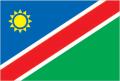
- The sun symbolises life and energy. The colour gold represents warmth and the colour of our plains and the Namib Desert.
- Blue symbolises the Namibian sky, the Atlantic Ocean, our marine resources and the importance of rain and water.
- Red represents the Namibian people, their heroism and determination to build a future of equal opportunities for all.
- White refers to peace and unity.
- Green symbolises Namibia’s vegetation and agricultural resources.
As published by the Embassy of the Republic of Namibia in France The Flag is a rectangular, with the colours arranged diagonally across it. The top left-hand triangle is blue, the centre band red and the bottom right-hand triangle is green. The colours are separated by narrow white bands. On the blue triangle is a golden sun with twelve triangular rays. The rays are separated from the golden centre by a blue ring.
As published in EnglishAs published by the Embassy of the Republic of Namibia in France The National Flag is a symbol of our struggle for national unity. It symbolises peace, unity and common loyalty to Namibia. The National Flag represents the nation in every aspect. [...]
As published in EnglishAs published by New Era Namibia The National Symbols Sub-Committee of the Constituent Assembly which was tasked with the responsibility of coming up with the national flag made a national call to patriotic Namibians to design a national flag, of course with no promise of payment in return but to do it as patriotic citizens and to contribute to the building of the new nation.
As published in EnglishAs published by New Era Namibia A total of 870 entries were received by the National Symbols Sub-Committee for the national flag. Initially six designs were selected and subsequently trimmed to only three designs. Afterwards, three designs, those of Theo Jankowski of Rehoboth, Don Stevenson of Windhoek and Ortrud Clay of Lüderitz were integrated to form the Namibia national flag, which was unanimously adopted by the Constituent Assembly on February 2, 1990. The abovementioned designers were publicly announced as the designers of the Namibia national flag at the ceremony chaired by the late Judge Hans Berker on March 9, 1990.
As published in EnglishSources:- embassyofnamibia.fr ↗ - the Embassy of the Republic of Namibia in France
- neweralive.na ↗ - New Era Namibia
- National anthem
- Namibia, Land of the Brave1:28
- Title
- Namibia, Land of the Brave
- Lyrics
- English
Namibia land of the brave Freedom’s fight we have won Glory to their bravery Whose blood waters our freedom We give our love and loyalty Together in unity Contrasting beautiful Namibia Namibia our country Beloved land of savannahs Hold high the banner of liberty
Chorus: Namibia our country Namibia motherland We love thee.
Source: - Citizens
- Namibians
- Official name:Constitution of the Republic of Namibia ↗ - Embassy of Namibia in France
- Official name, Citizens:The World Factbook: Namibia - CIA
- National flag:embassyofnamibia.fr ↗ - the Embassy of the Republic of Namibia in France
- National flag:neweralive.na ↗ - New Era Namibia
- National anthem:nationalanthems.info ↗
Geography
- Location
- Southern Africa, bordering the South Atlantic Ocean, between Angola and South Africa
- Total area
- 824,292 km²
- Land area
- 823,290 km²
- Water area
- 1,002 km²
- Land borders
- 4,220 km(4 countries)
- Botswana
- 1,544 km
- Angola
- 1,427 km
- South Africa
- 1,005 km
- Zambia
- 244 km
Source:- The World Factbook: Namibia - CIA
- Coastline
- 1,572 km
- Terrain
Mostly high plateau; Namib Desert along coast; Kalahari Desert in east - Mean elevation
- 1,141 m
- Highest point
- 2,573 mKonigstein on Brandberg
- Lowest point
- 0 mAtlantic Ocean
- Climate
Desert hot, dry; rainfall sparse and erratic - Avg. temperature
- 21.5 °C
- Avg. daily range
- 14.8 to 28.9 °C
- Annual precipitation
- 340 mm
Temperature °CMeanDaily rangePrecipitation mmMonthly climate normals Month Avg. high, °C Mean, °C Avg. low, °C Precipitation, mm January 31.3 24.8 19.2 79 February 30.8 24.5 19.2 78 March 30.2 23.9 18.4 61 April 28.8 22 15.8 21 May 26.8 19.1 12.1 3 June 24 15.9 8.5 1 July 23.7 15.6 8.2 1 August 26.1 17.8 9.9 1 September 29.6 21.4 13.5 3 October 31.5 23.8 16.6 11 November 31.7 24.4 17.6 29 December 31.8 24.9 18.7 52 Country-wide averages over 1991–2020.
Sources:- The World Factbook: Namibia - CIA
- Climate Change Knowledge Portal (ERA5 reanalysis) ↗ - World Bank
- Weather
- Loading
- Land use2023
- Arable1.0%Pasture46.2%Forest9.8%Other43.1%
- Arable land
- 800,000 hectares (1.0%)
- Permanent crops
- 12,000 hectares (0.0%)
- Permanent meadows & pastures
- 38,000,000 hectares (46.2%)
- Forest
- 8,044,248 hectares (9.8%)
- Other land
- 35,472,752 hectares (43.1%)
Source: - Natural hazards2026
- Drought9.4Very high#2/191River floods5.1High#97/191Epidemics4.8Medium#99/191Coastal floods1.2Very low#134/191Earthquakes0.1Very low#127/191Tsunamis0.0Very lowTropical cyclones0.0Very low
Scores out of 10, ranks out of 191 countries.
Source:- INFORM Risk Index ↗ - European Commission Joint Research Centre
- Location, Land borders, Coastline, Terrain, Mean elevation, Highest point, Lowest point, Climate, Major rivers:The World Factbook: Namibia - CIA
- Climate:Climate Change Knowledge Portal (ERA5 reanalysis) ↗ - World Bank
- Land use:FAOSTAT Land Use domain ↗ - FAO
- Natural hazards:INFORM Risk Index ↗ - European Commission Joint Research Centre
Demographics
- Population change2026
- +1.95% per year+60,430 people/yearWorld Rank48thof 237
- Birth rate
- 25.0 per 1,000 population
- Death rate
- 6.2 per 1,000 population
- Net migration rate
- 0.0 per 1,000 population
- 2026
- 21.5 yearsWorld Rank187thof 237
- Age structure2026
- 0-14 years36.3%15-64 years59.8%65 years +3.9%
- Share aged 65 and over
- 3.9%
- Share aged under 18
- 42.2%
- Total dependency ratio
- 67
- Youth dependency ratio
- 61
- Elderly dependency ratio
- 7
- Sex ratio
- 0.95 male / female
MaleAgeFemalePopulation by age group, % of total population Age Male Female 80+ 0.2% 0.4% 70-79 0.6% 1.0% 60-69 1.6% 2.2% 50-59 3.1% 3.4% 40-49 4.9% 5.2% 30-39 7.3% 7.6% 20-29 8.3% 8.2% 10-19 10.3% 10.4% 0-9 12.5% 12.6% - 2026
- 1.03 above the replacement level for Namibia ()3.13 births per womanreplacement 2.101234World Rank51stof 237
- 1.47 daughters per woman0.47 above replacement, long-run each generation larger than the lastreplacement 1.000.511.5
- 2026
- +18.8 per 1,000 populationfor every 1,000 people, 18.8 more births than deaths a year
- 2026
- 0.0 per 1,000 population
- Urbanization2026
- 51.3% live in cities1,618,242 urban residents
- Largest towns2023
- Windhoek, Rundu, Walvis Bay, SwakopmundRankTown, Village or SettlementPopulation (2023 census)1Windhoek486,1862Rundu118,6323Walvis Bay102,7044Swakopmund75,9215Oshakati58,6566Otjiwarongo49,0227Katima Mulilo46,4018Okahandja45,1829Rehoboth40,78810Tsumeb34,960Source:
- Namibia Statistics Agency (2023 census), via City Population by Thomas Brinkhoff ↗
- Population distribution
- Population density is very low, with the largest clusters found in the extreme north-central area along the border with Angola.
- Ethnic groups
- Ovambo50.0%Kavangos9.0%Herero7.0%Damara7.0%Mixed European and African ancestry6.5%European6.0%Nama5.0%Caprivian4.0%San3.0%Baster2.0%Tswana0.5%
- Religions2020
- Christian97.5%Other0.6%Unaffiliated1.9%
Other includes Muslim, Baha'i, Jewish, Buddhist.
Source:- The World Factbook: Namibia - CIA
- Languages
- English
- Population, Population change, Median age, Age structure, Total fertility rate, Net reproduction rate, Natural change, Net migration rate:UN World Population Prospects ↗
- Urbanization:UN World Urbanization Prospects ↗
- Largest cities:Namibia Statistics Agency (2023 census), via City Population by Thomas Brinkhoff ↗
- Population distribution, Ethnic groups, Religions:The World Factbook: Namibia - CIA
Government & Administration
- Form of state
- RepublicThe President is Head of State, elected by direct, universal and equal suffrage; the Constitution establishes Namibia as "a sovereign, secular, democratic and unitary State" (Arts. 1, 27).
- System of government
- PresidentialThe President is also head of the Government and appoints the Prime Minister and ministers; the National Assembly can force out individual Cabinet members by no-confidence, and a dissolution also triggers a new presidential election (Arts. 27, 32, 39, 57).Source:
- The Constitution of the Republic of Namibia, consolidated edition, February 2016 ↗, Arts. 27, 32, 39, 57
- Territorial organisation
- Unitary
- Official websites
- Capital
- Windhoek486,186 people(2023)
- National holidays
- 13 days in 2026
- ThuJan 1New Year's Day
- SatMar 21Independence Day
- FriApr 3Good Friday
- MonApr 6Easter Monday
- FriMay 1Workers' Day
- MonMay 4Cassinga Day
- ThuMay 14Ascension Day
- MonMay 25Africa Day
- ThuMay 28Genocide Remembrance Day
- WedAug 26Heroes' Day
- ThuSep 10Day of the Namibian Women and International Human Rights Day
- FriDec 25Christmas Day
- SatDec 26Family Day
Nationwide public holidays only, excluding regional, bank and government-only days.
- Time
- CATCentral Africa TimeUTC+2
- Currencies
- Namibian Dollar (NAD)South African Rand (ZAR)
- Calling code
- +264
- Internet TLD
- .na
- ISO 3166-1 codes
- NA, NAM
- Infrastructure
- Railways2,628 km
- Passengers carried
- 2,246 by the country's airlines(2021)
- Heliports
- 1
- Aircraft departures
- 32 by the country's airlines(2021)
- Air freight
- 0 million tonne-km(2021)
- Aircraft registration prefix
- V5
Sources:- The World Factbook: Namibia - CIA
- World Development Indicators ↗ - World Bank
- 2025
- 46 / 100World Rank65thof 182Confidence interval
Corruption index score by year Year Score Lower bound Upper bound 2012 48 42 54 2013 48 42 54 2014 49 42 56 2015 53 48 58 2016 52 49 55 2017 51 46 56 2018 53 47 59 2019 52 46.9 57.1 2020 51 47.9 54.1 2021 49 44.7 53.3 2022 49 44.9 53.1 2023 49 44.3 53.7 2024 49 46.4 51.6 2025 46 42.7 49.3 Source:- Corruption Perceptions Index 2025 ↗ - Transparency International, CC BY 4.0
- Form of state, System of government, Territorial organisation:The Constitution of the Republic of Namibia, consolidated edition, February 2016 ↗ - Office of the Ombudsman of Namibia
- National holidays:Open World Holidays Framework (vacanza/holidays) ↗
- Infrastructure:The World Factbook: Namibia - CIA
- Infrastructure:World Development Indicators ↗ - World Bank
- Corruption Perceptions Index:Corruption Perceptions Index 2025 ↗ - Transparency International, CC BY 4.0
Economy
- Lower middle income
- GDP growth (real)2026
- +2% per yearWorld Rank132ndof 195
- GDP per capita (PPP)2026
- GDP per capita (nominal)
- $5,742 (121st in the world)
Source:- 2025
- Services55% of GDPIndustry28.9% of GDPAgriculture7% of GDPManufacturing10%part of industry
- Households
- +78.3%
- Government
- +22.3%
- Investment
- +18.7%
- Exports
- +44.7%
- Imports
- −63.9%
The shape of the economyGDP by end useSource:- World Development Indicators ↗ - World Bank
- Inflation2026
- 4.1%up 0.6 percentage points0.6pp from 2025
- Labor force2024
- 1.1 million (37% of population)World Rank143rdof 187
- Labor force participation2024
- 58.9% of people aged 15+
- Unemployment2024
- 19.2%
- Youth unemployment2024
- 37.2% ages 15 to 24
- Labor productivity2024
- $15.7 per hour worked at PPP
- Budget balance2026
- 5.8% of GDP deficit
- Current account
- 16.9% of GDP, $3 billion deficit
Source: - Debt2024
- Central government debt67.7% of GDPInterest on debt5.2% of GDP
- Trade2024
- Goods$4.7 billion78.4%
- Services$1.3 billion21.6%
- Total exports
- $6 billion
- Change from 2023
- up 2.7 percent on the previous year2.7%
Sources:- World Development Indicators ↗ - World Bank
- The World Factbook: Namibia - CIA
- 2024
- −0.52World Rank99thof 145
- Projected GDP growth
- +2.6% a year over the next 10 years
Source:- Atlas of Economic Complexity ↗ - Harvard Growth Lab
- Agricultural products2024
- Meat of sheep (fresh or chilled), Grapes, Meat of cattle with the bone (fresh or chilled), and 7 more
- 1Meat of sheep (fresh or chilled)12.2×
- 2Grapes7.3×
- 3Meat of cattle with the bone (fresh or chilled)7×
- 4Millet5.4×
- 5Onions and shallots (dry)3.4×
- 6Raw milk of cattle1.9×
- 7Meat of chickens (fresh or chilled)1.3×
- 8Tomatoes0.6×
- 9Potatoes0.5×
- 10Maize (corn)0.3×
ProductSource:- FAOSTAT ↗ - Food and Agriculture Organization
- Industries
- mining, tourism, fishing, agriculture
- Income level, GDP by sector, Trade:World Development Indicators ↗ - World Bank
- GDP (nominal), GDP growth (real), GDP per capita (PPP), Inflation, Budget balance:IMF World Economic Outlook ↗
- Labor force, Labor force participation, Unemployment, Youth unemployment, Labor productivity:ILOSTAT ↗ - International Labour Organization
- Debt:IMF Global Debt Database ↗
- Debt:IMF Public Finances in Modern History ↗
- Trade, Industries:The World Factbook: Namibia - CIA
- Economic Complexity Index:Atlas of Economic Complexity ↗ - Harvard Growth Lab
- Agricultural products:FAOSTAT ↗ - Food and Agriculture Organization
Cost of Living
- Cost of living index
- Loading
- Monthly costs (excluding rent)
- Loading
- Rent
- Loading
- Buying an apartment
- Loading
- Average gross salary2018
- NAD 7,233 per month$547 (USD), $1,008 (PPP)
- Median
- NAD 2,800 per month($212)
- Men
- NAD 7,593 per month($574)
- Women
- NAD 6,820 per month($515)
Source:- ILOSTAT ↗ - International Labour Organization
- Average gross salary:ILOSTAT ↗ - International Labour Organization
Society
- 2023
- 0.665MediumWorld Rank136thof 193NamibiaWorld
Human Development Index by year Year Namibia World 1990 0.597 0.608 1991 0.602 0.611 1992 0.603 0.614 1993 0.601 0.617 1994 0.600 0.620 1995 0.595 0.625 1996 0.587 0.631 1997 0.580 0.636 1998 0.574 0.641 1999 0.565 0.646 2000 0.561 0.651 2001 0.555 0.657 2002 0.555 0.662 2003 0.558 0.669 2004 0.563 0.675 2005 0.564 0.681 2006 0.569 0.688 2007 0.576 0.694 2008 0.581 0.698 2009 0.585 0.701 2010 0.591 0.707 2011 0.598 0.713 2012 0.607 0.717 2013 0.616 0.721 2014 0.624 0.726 2015 0.630 0.731 2016 0.634 0.735 2017 0.638 0.739 2018 0.642 0.741 2019 0.647 0.745 2020 0.647 0.742 2021 0.631 0.742 2022 0.649 0.752 2023 0.665 0.756 Source:- Human Development Report ↗ - United Nations Development Programme
- 2015latest available
- 59.1
- Mean years of schooling2023
- 7.3 years
- Expected for a child today
- 11.8 years
Source:- Human Development Report ↗ - United Nations Development Programme
- Literacy2023
- 87.6% of adults
- Education expenditure2024
- 9.1% of GDP
- Share of government spending
- 25.1%
Source:- World Development Indicators ↗ - World Bank
- Internet users2024
- 64.9% of the population
- Households with Internet access
- 70.3%
Source:- ITU DataHub ↗ - International Telecommunication Union
- Mobile subscriptions2024
- 2.6 million
- Fixed telephone lines
- 77,390
- Fixed broadband
- 2.8 subscriptions per 100 people
Counts subscriptions, not people.
Source:- ITU DataHub ↗ - International Telecommunication Union
- Credit-card ownership2024
- 9% of adults
- Debit-card ownership
- 47%
- Account at a bank or mobile-money provider
- 73%
- Mobile-money account
- 48%
- Made or received a digital payment
- 68%
Source:- Global Findex Database ↗ - World Bank
- Refugees hosted2025
- 5,334 people
- Asylum seekers
- 1,277
- Stateless persons
- 14,796
- Internally displaced persons
- 1,300All due to disasters
- Refugees from Namibia abroad
- 603
Sources:- Refugee Data Finder ↗ - UN Refugee Agency
- Global Internal Displacement Database ↗ - Internal Displacement Monitoring Centre
- Inbound tourists2023
- Official tourism site864,000 arrivalsdown 46% against 201946% below 2019World Rank86thof 139
- Per resident
- 2.9 arrivals per 10 residents
- Same-day visitors
- 148,000 arrivals
- $443.3 million(2024)
- Share of GDP
- 6.9% tourism direct GDP(2022)
- Domestic trips
- 4.7 million overnight trips by residents(2022)
- $154.2 million(2024)
- Hotel beds
- 9,399(2011, latest available)
Overnight arrivals by year2010 to 2023A tourist stays at least one night. Arrivals count trips, not people.
Source:- UN Tourism Data Dashboard ↗ - UN Tourism
- UNESCO World Heritage Sites
- 2 sites1 cultural1 natural
Site Type Twyfelfontein or /Ui-//aes Cultural Namib Sand Sea Natural Source:- The World Factbook: Namibia - CIA
- Human Development Index, Mean years of schooling:Human Development Report ↗ - United Nations Development Programme
- Income inequality (Gini), Education expenditure:World Development Indicators ↗ - World Bank
- Literacy:UIS Data Browser ↗ - UNESCO Institute for Statistics
- Internet users, Mobile subscriptions:ITU DataHub ↗ - International Telecommunication Union
- Credit-card ownership:Global Findex Database ↗ - World Bank
- Refugees hosted:Refugee Data Finder ↗ - UN Refugee Agency
- Refugees hosted:Global Internal Displacement Database ↗ - Internal Displacement Monitoring Centre
- Inbound tourists:UN Tourism Data Dashboard ↗ - UN Tourism
- UNESCO World Heritage Sites:The World Factbook: Namibia - CIA
Crime & Safety
- Travel advisory (US)
- Loading
- Active humanitarian crisisAug 2026
- Medium5.3 out of 10Drought and drier conditionsSeverity by monthSep 2024 to Aug 2026What the score is made ofImpact of the crisis5.9Conditions of people affected5.7Complexity of the crisis4.2
Data reliability as rated by INFORM: Medium. Last updated Aug 27, 2026.
Source:- INFORM Severity Index ↗ - European Commission Joint Research Centre
- Homicide rate2021
- High by global standards11.2 per 100,000 peopleWorld Rank20thof 115
- Crime rates
- 4 offence categories
Offence Per 100,000 Count Year Homicide (victims) 11.2 315 2021 Serious assault 336.8 9,465 2021 Sexual violence 43.9 1,235 2021 Kidnapping 2.5 69 2021 A low figure can also mean weak recording.
Source:- UNODC Data Portal ↗ - UN Office on Drugs and Crime
- Prison population2016
- 303.4 per 100,000 people
- Persons held
- 7,400
Source:- UNODC Data Portal ↗ - UN Office on Drugs and Crime
- Active humanitarian crisis:INFORM Severity Index ↗ - European Commission Joint Research Centre
- Homicide rate, Crime rates, Prison population:UNODC Data Portal ↗ - UN Office on Drugs and Crime
Health
- Life expectancy2026
- 67.8 years
- Health expenditure2023
- 9.5% of GDP$397 per person
- Physicians2022
- 0.55 per 1,000 population
- Hospital beds2009latest available
- 2.7 per 1,000 population
- Infant mortality2026
- 25.9 per 1,000 live births
- Maternal mortality2023
- 139 per 100,000 live births
- Alcohol consumption2022
- 12 litres of pure alcohol per adult per year
- Road traffic deaths2019
- 34.8 per 100,000 population
- Life expectancy, Infant mortality:UN World Population Prospects ↗
- Health expenditure, Physicians, Hospital beds, Road traffic deaths:World Development Indicators ↗ - World Bank
- Maternal mortality:Maternal mortality estimates ↗ - UN Maternal Mortality Estimation Inter-agency Group
- Alcohol consumption:Global Health Observatory ↗ - World Health Organization
Environment
- CO₂ emissions2024
- 3.65 Mt per yearup 1 percent on the previous year1% from 2023
- CO₂ per capita
- 1.3 t per personWorld Rank142ndof 207
- Share of global CO₂
- 0.01%
- Methane (CH₄)
- 7.82 Mt CO₂-eq
- Nitrous oxide (N₂O)
- 2.41 Mt CO₂-eq
- Fluorinated gases
- 0.33 Mt CO₂-eq
- All greenhouse gases
- 14.2 Mt CO₂-eq
Source:- Emissions Database for Global Atmospheric Research (EDGAR) ↗ - European Commission, Joint Research Centre
- 2024
- 14.5 µg/m³ of PM2.50.9 years of life expectancy lost against the WHO guidelineMost polluted97thof 236
- WHO guideline
- 5 µg/m³
Source:- Air Quality Life Index ↗ - Energy Policy Institute at the University of Chicago
- Environmental issues
- depletion and degradation of water and aquatic resources
- desertification
- land degradation
- loss of biodiversity
- wildlife poaching
Source:- The World Factbook: Namibia - CIA
- International agreements
- 18 of 20 landmark treaties in forceParty to 70 multilateral environmental agreements
Treaty Standing Joined Climate Paris Agreement in force 2016 UN Framework Convention on Climate Change in force 1995 Kyoto Protocol in force 2005 Ozone layer Montreal Protocol in force 1993 Vienna Convention (Ozone Layer) in force 1993 Biodiversity Convention on Biological Diversity in force 1997 CITES in force 1991 Convention on Migratory Species (Bonn) not a party Cartagena Protocol on Biosafety in force 2005 Nagoya Protocol in force 2014 Land and heritage Ramsar Convention on Wetlands in force 1995 World Heritage Convention in force 2000 UN Convention to Combat Desertification in force 1997 Chemicals and waste Basel Convention in force 1995 Rotterdam Convention (PIC) in force 2005 Stockholm Convention (POPs) in force 2005 Minamata Convention on Mercury in force 2017 Oceans UN Convention on the Law of the Sea in force 1994 High Seas Treaty (BBNJ) not a party MARPOL 73/78 in force 2003 Source:- International Environmental Agreements Database ↗ - Université Laval
- CO₂ emissions:Emissions Database for Global Atmospheric Research (EDGAR) ↗ - European Commission, Joint Research Centre
- Air pollution:Air Quality Life Index ↗ - Energy Policy Institute at the University of Chicago
- Environmental issues:The World Factbook: Namibia - CIA
- International agreements:International Environmental Agreements Database ↗ - Université Laval
Food & Water
- No access to safe drinking water2022
- 9% of the population
- Renewable water2022
- 40 billion m³ per year
- Per person
- 13,811 m³ per year
- Dependency ratio
- 85% originates outside the country
- Annual water withdrawal
- 0.3 billion m³ per year
- Withdrawn for agriculture
- 71%
- Water stress
- 0% of available freshwater withdrawn
Source:- AQUASTAT ↗ - Food and Agriculture Organization
- Undernourishment2022
- 20.5% of the population500,000 people
- Obesity2024
- 18.3% of adults
- Men
- 10.8%
- Women
- 25%
Source:- Global Health Observatory ↗ - World Health Organization
- Underweight children2013
- 13.2% of children under five
- No access to safe drinking water, Renewable water:AQUASTAT ↗ - Food and Agriculture Organization
- Undernourishment:Food security indicators (FAOSTAT) ↗ - Food and Agriculture Organization
- Obesity:Global Health Observatory ↗ - World Health Organization
- Underweight children:World Development Indicators ↗ - World Bank
Energy
- Energy consumption2024
- Per capita
- 22.5 GJ per person
- Share of world total
- 0.01%
- Supply
- Deficitproduces 8.5% of what it consumes, 2024
Source:- International Energy Statistics ↗ - U.S. Energy Information Administration
- Electricity2024
- Net importer, net 2.4 TWh in 2024, 67% of consumption1.7 TWh generated per year
- Generation
- 1.7 TWh per year
- Consumption
- 3.6 TWh per year
- Imports
- 2.6 TWh per year
- Exports
- 0.2 TWh per year
- Net
- −2.4 TWh per year
Source:- International Energy Statistics ↗ - U.S. Energy Information Administration
- Oil, gas & coal
- No domestic productionconsumes 24,413 b/d in 2024Consumption202424,413 b/d
Oil imports and exports count crude oil only.
- Energy consumption, Electricity, Oil, gas & coal:International Energy Statistics ↗ - U.S. Energy Information Administration
Defense
- Military expenditure2024
- 2.7% of GDP$362.4 million, 7.1% of government spending
- Military personnel2025
- estimated 12,000active Namibian Defense Forces
- Military service2026
- Voluntaryno conscription; men and women 18–25
- Nuclear weapons2026
- None - no nuclear arsenal
- Military expenditure:SIPRI Military Expenditure Database ↗ - Stockholm International Peace Research Institute
- Military expenditure:World Development Indicators ↗ - World Bank
- Military personnel, Military service:The World Factbook: Namibia - CIA
- Nuclear weapons:Status of World Nuclear Forces ↗ - Federation of American Scientists

