

National Identity
- Official name
- Republic of South Africa
- Official name (in Zulu)
- IRiphabliki yaseNingizimu Afrika
- Official name (in Afrikaans)
- Republiek van Suid-Afrika
- Official name (in Xhosa)
- IRiphabliki yoMzantsi Afrika
- Name etymology
self-descriptive name from the country's location on the continent; "Africa" is derived from the Roman designation of the area corresponding to present-day Tunisia "Africa terra," which meant "Land of the Afri" (the tribe resident in that area), but which eventually came to mean the entire continent
Sources:- The South Africa Constitution - Founding Provisions, Chapter 1 ↗ - Department of Justice and Constitutional Development
- The World Factbook: South Africa - CIA
- Coat of arms
- National flag
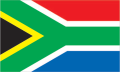
As published by the Government of South Africa 1. The national flag is rectangular; it is one and a half times longer than it is wide.
2. It is black, gold, green, white, chilli red and blue.
3. It has a green Y-shaped band that is one fifth as wide as the flag. The centre lines of the band start in the top and bottom corners next to the flag post, converge in the centre of the flag, and continue horizontally to the middle of the free edge.
4. The green band is edged, above and below in white, and towards the flag post end, in gold. Each edging is one fifteenth as wide as the flag.
5. The triangle next to the flag post is black.
6. The upper horizontal band is chilli red and the lower horizontal band is blue. These bands are each one third as wide as the flag.
As published in EnglishAs published by the Government of South Africa Individual colours, or colour combinations represent different meanings for different people and therefore no universal symbolism should be attached to any of the colours.
As published in EnglishAs published by the Government of South Africa The central design of the flag, beginning at the flagpost in a 'V' form and flowing into a single horizontal band to the outer edge of the fly, can be interpreted as the convergence of diverse elements within South African society, taking the road ahead in unity. The theme of convergence and unity ties in with the motto Unity is Strength of the previous South African Coat of Arms.
As published in EnglishAs published by South African Tourism It started in 1993 already, when a national competition invited the public to submit flag designs, the pressure was on to create what would become the most visible symbol of the fledgeling democracy.
As published in EnglishAs published by South African Tourism Just a few months before the elections in 1994, a committee was tasked to come up with the perfect design with little time to spare. Led by former State Herald, Fred Brownell, the team was given one week to come up with an appropriate design.
As published in EnglishAs published by South African Tourism Brownell had reportedly made a few sketches the year before, while at a vexillological (flag expert) conference in Switzerland. One of these was selected by both sides of the transitional government as the preferred design. It was even sent to Nelson Mandela who was in Rustenburg at the time, to approve it by fax.
As published in EnglishAs published by the Government of South Africa The national flag was designed by a former South African State Herald, Mr Fred Brownell, and was first used on 27 April 1994. The design and colours are a synopsis of principal elements of the country's flag history.
As published in EnglishAs published by South African Tourism The current South African flag was only destined to be the country’s interim flag to coincide with the interim government, but was eventually assimilated as one of the official symbols of the new democracy.
As published in EnglishSources:- gov.za ↗ - the Government of South Africa
- gov.za ↗ - the Government of South Africa
- southafrica.net ↗ - South African Tourism
- southafrica.net ↗ - South African Tourism
- National anthem
- National Anthem of South Africa2:03
- Title
- National Anthem of South Africa
- Lyrics
Nkosi sikelel’ iAfrika Maluphakanyisw’ uphondo lwayo, Yizwa imithandazo yethu, Nkosi sikelela, thina lusapho lwayo.
Morena boloka setjhaba sa heso, O fedise dintwa le matshwenyeho, O se boloke, O se boloke setjhaba sa heso, Setjhaba sa South Afrika – South Afrika.
Uit die blou van onse hemel, Uit die diepte van ons see, Oor ons ewige gebergtes, Waar die kranse antwoord gee,
Sounds the call to come together, And united we shall stand, Let us live and strive for freedom, In South Africa our land.
Source: - Citizens
- South Africans
- Official name:The South Africa Constitution - Founding Provisions, Chapter 1 ↗ - Department of Justice and Constitutional Development
- Official name, Citizens:The World Factbook: South Africa - CIA
- Coat of arms:Image credit
- National flag:gov.za ↗ - the Government of South Africa
- National flag:gov.za ↗ - the Government of South Africa
- National flag:southafrica.net ↗ - South African Tourism
- National flag:southafrica.net ↗ - South African Tourism
- National anthem:nationalanthems.info ↗
Geography
- Location
- Southern Africa, at the southern tip of the continent of Africa
- Total area
- 1,219,090 km²
- Land area
- 1,214,470 km²
- Water area
- 4,620 km²
- Land borders
- 5,244 km(6 countries)
- Coastline
- 2,798 km
- Terrain
Vast interior plateau rimmed by rugged hills and narrow coastal plain - Mean elevation
- 1,034 m
- Highest point
- 3,450 mNtheledi (Mafadi)
- Lowest point
- 0 mAtlantic/Indian Oceans
- Climate
Mostly semiarid subtropical along east coast; sunny days, cool nights - Avg. temperature
- 17.9 °C
- Avg. daily range
- 11.7 to 25 °C
- Annual precipitation
- 523 mm
Temperature °CMeanDaily rangePrecipitation mmMonthly climate normals Month Avg. high, °C Mean, °C Avg. low, °C Precipitation, mm January 29.7 23.3 17.5 81 February 29.4 23 17.5 69 March 27.9 21.3 15.8 62 April 24.8 17.9 12.3 39 May 22.1 14.5 8.4 20 June 19.2 11.4 5.1 16 July 19 11.1 4.7 14 August 21.1 13.3 6.6 17 September 24.4 16.7 9.9 21 October 26.4 19.2 12.6 44 November 27.6 20.8 14.3 62 December 29.1 22.5 16.4 77 Country-wide averages over 1991–2020.
Sources:- The World Factbook: South Africa - CIA
- Climate Change Knowledge Portal (ERA5 reanalysis) ↗ - World Bank
- Weather
- Loading
- Land use2023
- Arable9.9%Perm. crops0.3%Pasture69.2%Forest18.7%Other1.9%
- Arable land
- 12,000,000 hectares (9.9%)
- Permanent crops
- 413,000 hectares (0.3%)
- Permanent meadows & pastures
- 83,928,000 hectares (69.2%)
- Forest
- 22,706,288 hectares (18.7%)
- Other land
- 2,261,712 hectares (1.9%)
Source: - Natural hazards2026
- Drought8.6Very high#5/191Epidemics4.5Medium#109/191River floods3.2Low#131/191Coastal floods2.9Low#108/191Earthquakes1.5Very low#119/191Tropical cyclones1.3Very low#58/191Tsunamis1.1Very low#94/191
Scores out of 10, ranks out of 191 countries.
Source:- INFORM Risk Index ↗ - European Commission Joint Research Centre
- Location, Land borders, Coastline, Terrain, Mean elevation, Highest point, Lowest point, Climate, Major rivers:The World Factbook: South Africa - CIA
- Climate:Climate Change Knowledge Portal (ERA5 reanalysis) ↗ - World Bank
- Land use:FAOSTAT Land Use domain ↗ - FAO
- Natural hazards:INFORM Risk Index ↗ - European Commission Joint Research Centre
Demographics
- Population change2026
- +1.09% per year+705,765 people/yearWorld Rank94thof 237
- Birth rate
- 17.8 per 1,000 population
- Death rate
- 9.3 per 1,000 population
- Net migration rate
- +2.0 per 1,000 population
- 2026
- 28.9 yearsWorld Rank146thof 237
- Age structure2026
- 0-14 years25.6%15-64 years67.3%65 years +7.1%
- Share aged 65 and over
- 7.1%
- Share aged under 18
- 30.6%
- Total dependency ratio
- 48
- Youth dependency ratio
- 38
- Elderly dependency ratio
- 11
- Sex ratio
- 0.95 male / female
MaleAgeFemalePopulation by age group, % of total population Age Male Female 80+ 0.4% 0.8% 70-79 1.2% 1.9% 60-69 2.7% 3.6% 50-59 4.0% 4.6% 40-49 6.7% 6.9% 30-39 8.4% 8.6% 20-29 8.2% 8.1% 10-19 8.2% 8.1% 0-9 8.9% 8.7% - 2026
- 0.03 below the replacement level for South Africa ()2.17 births per womanreplacement 2.20123World Rank97thof 237
- 1.00 daughters per womanat replacement, each generation about the same size as the lastreplacement 1.000.511.5
- 2026
- +8.5 per 1,000 populationfor every 1,000 people, 8.5 more births than deaths a year
- 2026
- +2.0 per 1,000 population
- Urbanization2026
- 64.0% live in cities41,859,196 urban residents
- Largest urban areas2011latest available
- Johannesburg, Cape Town, Durban, PretoriaRankUrban AreaPopulation (2011 census)1Johannesburg7,860,7812Cape Town3,430,9923Durban2,786,0464Pretoria1,763,3365Port Elizabeth876,4366Soshanguve728,0637Evaton605,5048Pietermaritzburg475,2389Bloemfontein464,59110Vereeniging377,922Source:
- Statistics South Africa (2011 census), via City Population by Thomas Brinkhoff ↗
- Population distribution
- The population is concentrated along the southern and southeastern coast, and inland around Pretoria; the eastern half of the country is more densely populated than the west.
- Ethnic groups2021
- Black African80.9%Colored8.8%White7.8%Indian/Asian2.6%
Colored is a term used in South Africa, including on the national census, for persons of mixed race ancestry who developed a distinct cultural identity over several hundred years.
Source:- The World Factbook: South Africa - CIA
- Religions2015
- Christian86.0%Ancestral, tribal, animist, or other traditional African religions5.4%Muslim1.9%Other1.5%Nothing in particular5.2%
- Languages
- English, Zulu (IsiZulu), Afrikaans, Xhosa (IsiXhosa)
- Population, Population change, Median age, Age structure, Total fertility rate, Net reproduction rate, Natural change, Net migration rate:UN World Population Prospects ↗
- Urbanization:UN World Urbanization Prospects ↗
- Largest cities:Statistics South Africa (2011 census), via City Population by Thomas Brinkhoff ↗
- Population distribution, Ethnic groups, Religions:The World Factbook: South Africa - CIA
Government & Administration
- Form of state
- RepublicThe President is Head of State and head of the national executive, elected by the National Assembly from among its members; the Constitution calls the state "one, sovereign, democratic state" (ss. 1, 83, 86).Sources:
- Constitution of the Republic of South Africa, 1996 ↗, ss. 1, 83, 86
- Constitution of the Republic of South Africa, 1996 ↗, ss. 1, 83, 86
- System of government
- ParliamentaryThere is no separate prime minister: the President heads the Cabinet, whose members are accountable to Parliament, and a majority no-confidence vote of the National Assembly removes the President and Cabinet together (ss. 91, 92, 102).Sources:
- Constitution of the Republic of South Africa, 1996 ↗, ss. 91, 92, 102
- Constitution of the Republic of South Africa, 1996 ↗, ss. 91, 92, 102
- Territorial organisation
- Unitary
- Official websites
- Capital
- PretoriaExecutive741,651 people(2011)Cape TownLegislative433,688 people(2011)BloemfonteinJudicial111,697 people(2011)
- National holidays
- 13 days in 2026
- ThuJan 1New Year's Day
- SatMar 21Human Rights Day
- FriApr 3Good Friday
- MonApr 6Family Day
- MonApr 27Freedom Day
- FriMay 1Workers' Day
- TueJun 16Youth Day
- SunAug 9National Women's Day
- MonAug 10National Women's Day (observed)
- ThuSep 24Heritage Day
- WedDec 16Day of Reconciliation
- FriDec 25Christmas Day
- SatDec 26Day of Goodwill
Nationwide public holidays only, excluding regional, bank and government-only days.
- Time
- SASTSouth Africa Standard TimeUTC+2
- Currency
- South African Rand (ZAR)
- Entry requirements
- Official visa and entry information
- Calling code
- +27
- Internet TLD
- .za
- ISO 3166-1 codes
- ZA, ZAF
- Infrastructure
- Passengers carried
- 15,454,596 by the country's airlines(2023)
- Heliports
- 49
- Aircraft departures
- 169,154 by the country's airlines(2023)
- Air freight
- 59.7 million tonne-km(2023)
- Aircraft registration prefix
- ZS
Sources:- The World Factbook: South Africa - CIA
- World Development Indicators ↗ - World Bank
- Flag carrier
- South African AirwaysState-owned
- 2025
- 41 / 100World Rank81stof 182Confidence interval
Corruption index score by year Year Score Lower bound Upper bound 2012 43 39 48 2013 42 37 47 2014 44 40 48 2015 44 40 48 2016 45 41 49 2017 43 36 50 2018 43 37 49 2019 44 38.4 49.6 2020 44 40.4 47.6 2021 44 40.1 47.9 2022 43 39.7 46.3 2023 41 37.6 44.4 2024 41 37 45 2025 41 37.1 44.9 Source:- Corruption Perceptions Index 2025 ↗ - Transparency International, CC BY 4.0
- Form of state, System of government, Territorial organisation:Constitution of the Republic of South Africa, 1996 ↗ - South African Government
- Form of state, System of government, Territorial organisation:Constitution of the Republic of South Africa, 1996 ↗ - Department of Justice and Constitutional Development
- National holidays:Open World Holidays Framework (vacanza/holidays) ↗
- Infrastructure:The World Factbook: South Africa - CIA
- Infrastructure:World Development Indicators ↗ - World Bank
- Corruption Perceptions Index:Corruption Perceptions Index 2025 ↗ - Transparency International, CC BY 4.0
Economy
- Upper middle income
- GDP growth (real)2026
- +1% per yearWorld Rank164thof 195
- GDP per capita (PPP)2026
- GDP per capita (nominal)
- $7,659 (108th in the world)
Source:- 2025
- Services63.1% of GDPIndustry24.1% of GDPAgriculture2.8% of GDPManufacturing12.3%part of industry
- Households
- +65.8%
- Government
- +18.9%
- Investment
- +13.9%
- Exports
- +31.4%
- Imports
- −29.5%
The shape of the economyGDP by end useSource:- World Development Indicators ↗ - World Bank
- Inflation2026
- 4.4%up 1.2 percentage points1.2pp from 2025
- Labor force2024
- 26.4 million (41% of population)World Rank26thof 187
- Labor force participation2024
- 55.6% of people aged 15+
- Unemployment2024
- 32.3%
- Youth unemployment2024
- 60.2% ages 15 to 24
- Labor productivity2024
- $22.5 per hour worked at PPP
- Budget balance2026
- 4.4% of GDP deficit
- Current account
- 0.7% of GDP, $3.2 billion deficit
Source: - Debt2024
- Central government debt76.4% of GDPHousehold debt33.7% of GDPCompany debt33.1% of GDPInterest on debt5.3% of GDP
- Trade2025
- Goods$116.4 billion86.6%
- Services$18.1 billion13.4%
- Total exports
- $134.5 billion
- Change from 2024
- up 5.3 percent on the previous year5.3%
Sources:- World Development Indicators ↗ - World Bank
- The World Factbook: South Africa - CIA
- 2024
- +0.37World Rank58thof 145
- Projected GDP growth
- +1.8% a year over the next 10 years
Source:- Atlas of Economic Complexity ↗ - Harvard Growth Lab
- Agricultural products2024
- Lemons and limes, Oranges, Grapes, and 7 more
- 1Lemons and limes6.4×
- 2Oranges4.9×
- 3Grapes4.9×
- 4Meat of cattle with the bone (fresh or chilled)3.1×
- 5Meat of chickens (fresh or chilled)3×
- 6Tangerines and mandarins (including clementines)2.9×
- 7Apples2.7×
- 8Sunflower seed2.4×
- 9Maize (corn)2.1×
- 10Sugar cane1.7×
ProductSource:- FAOSTAT ↗ - Food and Agriculture Organization
- Gold reserves2025
- 126 tonnesWorth $17.6 billion, 23% of total official reserves by value
- Industries
- mining (world's largest producer of platinum, gold, chromium), automobile assembly, metalworking, machinery, textiles, iron and steel, chemicals, fertilizer, foodstuffs, commercial ship repair
- Income level, GDP by sector, Trade, Gold reserves:World Development Indicators ↗ - World Bank
- GDP (nominal), GDP growth (real), GDP per capita (PPP), Inflation, Budget balance:IMF World Economic Outlook ↗
- Labor force, Labor force participation, Unemployment, Youth unemployment, Labor productivity:ILOSTAT ↗ - International Labour Organization
- Debt:IMF Global Debt Database ↗
- Debt:IMF Public Finances in Modern History ↗
- Trade, Industries:The World Factbook: South Africa - CIA
- Economic Complexity Index:Atlas of Economic Complexity ↗ - Harvard Growth Lab
- Agricultural products:FAOSTAT ↗ - Food and Agriculture Organization
Cost of Living
- Cost of living index
- Loading
- Monthly costs (excluding rent)
- Loading
- Rent
- Loading
- Buying an apartment
- Loading
- Average gross salary2020
- ZAR 7,980 per month$485 (USD), $1,076 (PPP)
- Median
- ZAR 4,200 per month($255)
- Men
- ZAR 9,551 per month($580)
- Women
- ZAR 6,146 per month($373)
Source:- ILOSTAT ↗ - International Labour Organization
- 2024
- ZAR 4,777 per month, gross$261 (USD), $620 (PPP)
- Average gross salary, Minimum wage:ILOSTAT ↗ - International Labour Organization
Society
- 2023
- 0.741HighWorld Rank106thof 193South AfricaWorld
Human Development Index by year Year South Africa World 1990 0.633 0.608 1991 0.641 0.611 1992 0.645 0.614 1993 0.650 0.617 1994 0.654 0.620 1995 0.654 0.625 1996 0.649 0.631 1997 0.642 0.636 1998 0.634 0.641 1999 0.626 0.646 2000 0.618 0.651 2001 0.613 0.657 2002 0.614 0.662 2003 0.610 0.669 2004 0.613 0.675 2005 0.616 0.681 2006 0.622 0.688 2007 0.632 0.694 2008 0.643 0.698 2009 0.657 0.701 2010 0.669 0.707 2011 0.683 0.713 2012 0.696 0.717 2013 0.705 0.721 2014 0.713 0.726 2015 0.722 0.731 2016 0.722 0.735 2017 0.726 0.739 2018 0.732 0.741 2019 0.742 0.745 2020 0.724 0.742 2021 0.721 0.742 2022 0.737 0.752 2023 0.741 0.756 Source:- Human Development Report ↗ - United Nations Development Programme
- 2022
- 54.1
- Mean years of schooling2023
- 11.6 years
- Expected for a child today
- 13.8 years
Source:- Human Development Report ↗ - United Nations Development Programme
- Literacy2024
- 91.2% of adults
- Education expenditure2024
- 6% of GDP
- Share of government spending
- 18.5%
Source:- World Development Indicators ↗ - World Bank
- Internet users2024
- 78.4% of the population
- Households with Internet access
- 82.1%
Source:- ITU DataHub ↗ - International Telecommunication Union
- Mobile subscriptions2024
- 114.8 million
- Fixed telephone lines
- 1,013,039
- Fixed broadband
- 5.3 subscriptions per 100 people
Counts subscriptions, not people.
Source:- ITU DataHub ↗ - International Telecommunication Union
- Credit-card ownership2024
- 10% of adults
- Debit-card ownership
- 60%
- Account at a bank or mobile-money provider
- 81%
- Mobile-money account
- 32%
- Made or received a digital payment
- 67%
Source:- Global Findex Database ↗ - World Bank
- Refugees hosted2025
- 68,918 people
- Asylum seekers
- 98,629
- Internally displaced persons
- 28,000All due to disasters
- Refugees from South Africa abroad
- 1,166
Sources:- Refugee Data Finder ↗ - UN Refugee Agency
- Global Internal Displacement Database ↗ - Internal Displacement Monitoring Centre
- Inbound tourists2024
- Official tourism site8.9 million arrivalsdown 13% against 201913% below 2019World Rank33rdof 139
- Per resident
- 1.4 arrivals per 10 residents
- Same-day visitors
- 2.5 million arrivals
- $6.7 billion
- Spending per arrival
- $754
- 3.5% tourism direct GDP(2022)
- Domestic trips
- 34 million overnight trips by residents(2022)
- $4.6 billion
Overnight arrivals by year2010 to 2024A tourist stays at least one night. Arrivals count trips, not people.
Source:- UN Tourism Data Dashboard ↗ - UN Tourism
- UNESCO World Heritage Sites
- 12 sites7 cultural4 natural1 mixed
Site Type Fossil Hominid Sites of South Africa Cultural iSimangaliso Wetland Park Natural Robben Island Cultural Maloti-Drakensberg Park Mixed Mapungubwe Cultural Landscape Cultural Cape Floral Region Protected Areas Natural Vredefort Dome Natural Richtersveld Cultural and Botanical Landscape Cultural Khomani Cultural Landscape Cultural Barberton Makhonjwa Mountains Natural Human Rights, Liberation and Reconciliation: Nelson Mandela Legacy Sites Cultural The Emergence of Modern Human Behaviour: The Pleistocene Occupation Sites of South Africa Cultural Source:- The World Factbook: South Africa - CIA
- Human Development Index, Mean years of schooling:Human Development Report ↗ - United Nations Development Programme
- Income inequality (Gini), Education expenditure:World Development Indicators ↗ - World Bank
- Literacy:UIS Data Browser ↗ - UNESCO Institute for Statistics
- Internet users, Mobile subscriptions:ITU DataHub ↗ - International Telecommunication Union
- Credit-card ownership:Global Findex Database ↗ - World Bank
- Refugees hosted:Refugee Data Finder ↗ - UN Refugee Agency
- Refugees hosted:Global Internal Displacement Database ↗ - Internal Displacement Monitoring Centre
- Inbound tourists:UN Tourism Data Dashboard ↗ - UN Tourism
- UNESCO World Heritage Sites:The World Factbook: South Africa - CIA
Crime & Safety
- Travel advisory (US)
- Loading
- Active humanitarian crisisAug 2026
- None - no active crisis
- Homicide rate2024
- Very high by global standards39.7 per 100,000 peopleWorld Rank4thof 115
- Crime rates
- 4 offence categories
Offence Per 100,000 Count Year Homicide (victims) 39.7 25,423 2024 Serious assault 290.4 167,352 2017 Sexual violence 86.9 50,108 2017 Kidnapping 9.5 5,455 2017 A low figure can also mean weak recording.
Source:- UNODC Data Portal ↗ - UN Office on Drugs and Crime
- Prison population2022
- 232.4 per 100,000 people
- Persons held
- 144,938
Source:- UNODC Data Portal ↗ - UN Office on Drugs and Crime
- Active humanitarian crisis:INFORM Severity Index ↗ - European Commission Joint Research Centre
- Homicide rate, Crime rates, Prison population:UNODC Data Portal ↗ - UN Office on Drugs and Crime
Health
- Life expectancy2026
- 66.7 years
- Health expenditure2023
- 8.9% of GDP$537 per person
- Physicians2022
- 0.79 per 1,000 population
- Hospital beds2010latest available
- 2.3 per 1,000 population
- Infant mortality2026
- 21.9 per 1,000 live births
- Maternal mortality2023
- 118 per 100,000 live births
- Alcohol consumption2022
- 7.8 litres of pure alcohol per adult per year
- Tobacco use2020
- 23.4% of adults
- Men
- 38%
- Women
- 8.8%
Source:- Global Health Observatory ↗ - World Health Organization
- Alcohol and Tobacco Spending2023
- 4.1% of household spendingWorld Rank29thof 105
- World median
- 3.1%
Source:- The World Factbook: South Africa - CIA
- Road traffic deaths2019
- 22.2 per 100,000 population
- Life expectancy, Infant mortality:UN World Population Prospects ↗
- Health expenditure, Physicians, Hospital beds, Road traffic deaths:World Development Indicators ↗ - World Bank
- Maternal mortality:Maternal mortality estimates ↗ - UN Maternal Mortality Estimation Inter-agency Group
- Alcohol consumption, Tobacco use:Global Health Observatory ↗ - World Health Organization
- Alcohol and Tobacco Spending:The World Factbook: South Africa - CIA
Environment
- CO₂ emissions2024
- 440.2 Mt per yearup 3 percent on the previous year3% from 2023
- CO₂ per capita
- 7.2 t per personWorld Rank36thof 207
- Share of global CO₂
- 1.1%
- Methane (CH₄)
- 93.2 Mt CO₂-eq
- Nitrous oxide (N₂O)
- 19.1 Mt CO₂-eq
- Fluorinated gases
- 17.4 Mt CO₂-eq
- All greenhouse gases
- 569.8 Mt CO₂-eq
Source:- Emissions Database for Global Atmospheric Research (EDGAR) ↗ - European Commission, Joint Research Centre
- 2024
- 21.6 µg/m³ of PM2.51.6 years of life expectancy lost against the WHO guidelineMost polluted52ndof 236
- WHO guideline
- 5 µg/m³
- National standard
- 20 µg/m³
- Life expectancy gain if the national standard were met
- 0.2 years
Source:- Air Quality Life Index ↗ - Energy Policy Institute at the University of Chicago
- Environmental issues
- limited freshwater resources due to lack of major rivers or lakes
- pollution of rivers from agricultural runoff and urban waste
- air pollution resulting in acid rain
- deforestation
- soil erosion
- land degradation
- desertification
- solid waste pollution
- significant floral extinctions
Source:- The World Factbook: South Africa - CIA
- International agreements
- 19 of 20 landmark treaties in forceParty to 118 multilateral environmental agreements
Treaty Standing Joined Climate Paris Agreement in force 2016 UN Framework Convention on Climate Change in force 1997 Kyoto Protocol in force 2005 Ozone layer Montreal Protocol in force 1990 Vienna Convention (Ozone Layer) in force 1990 Biodiversity Convention on Biological Diversity in force 1996 CITES in force 1975 Convention on Migratory Species (Bonn) in force 1991 Cartagena Protocol on Biosafety in force 2003 Nagoya Protocol in force 2014 Land and heritage Ramsar Convention on Wetlands in force 1975 World Heritage Convention in force 1997 UN Convention to Combat Desertification in force 1997 Chemicals and waste Basel Convention in force 1994 Rotterdam Convention (PIC) in force 2004 Stockholm Convention (POPs) in force 2004 Minamata Convention on Mercury in force 2019 Oceans UN Convention on the Law of the Sea in force 1998 High Seas Treaty (BBNJ) signed 2025, not ratified MARPOL 73/78 in force 1985 Source:- International Environmental Agreements Database ↗ - Université Laval
- CO₂ emissions:Emissions Database for Global Atmospheric Research (EDGAR) ↗ - European Commission, Joint Research Centre
- Air pollution:Air Quality Life Index ↗ - Energy Policy Institute at the University of Chicago
- Environmental issues:The World Factbook: South Africa - CIA
- International agreements:International Environmental Agreements Database ↗ - Université Laval
Food & Water
- No access to safe drinking water2022
- 6.8% of the population
- Renewable water2022
- 51 billion m³ per year
- Per person
- 823 m³ per year
- Dependency ratio
- 13% originates outside the country
- Annual water withdrawal
- 20 billion m³ per year
- Withdrawn for agriculture
- 59%
- Water stress
- 68% of available freshwater withdrawn
Source:- AQUASTAT ↗ - Food and Agriculture Organization
- Undernourishment2022
- 7.7% of the population4.6 million people
- Obesity2024
- 31.8% of adults
- Men
- 14.5%
- Women
- 47.5%
Source:- Global Health Observatory ↗ - World Health Organization
- Underweight children2017
- 4.9% of children under five
- No access to safe drinking water, Renewable water:AQUASTAT ↗ - Food and Agriculture Organization
- Undernourishment:Food security indicators (FAOSTAT) ↗ - Food and Agriculture Organization
- Obesity:Global Health Observatory ↗ - World Health Organization
- Underweight children:World Development Indicators ↗ - World Bank
Energy
- Energy consumption2024
- Per capita
- 88.9 GJ per person
- Share of world total
- 0.89%
- Supply
- Self-sufficientproduction matches consumption, 2024
Source:- International Energy Statistics ↗ - U.S. Energy Information Administration
- Electricity2024
- Balanced trade, imports 11 TWh and exports 12 TWh in 2024243 TWh generated per year
- Generation
- 243 TWh per year
- Consumption
- 217 TWh per year
- Imports
- 11 TWh per year
- Exports
- 12 TWh per year
- Net
- +1.3 TWh per year
Source:- International Energy Statistics ↗ - U.S. Energy Information Administration
- Oil, gas & coal
- Deficitproduces 15% of what it consumes, 2024Oil reserves202515 million barrelsWorld Rank84thof 99
Oil imports and exports count crude oil only.
- Mineral resources2025
- Rare earths
Mineral Mine production Reserves Rare earthsas rare-earth oxide No mine production 860,000 t USGS estimates. Shows only minerals where the country is a major producer.
Source:- Mineral Commodity Summaries ↗ - U.S. Geological Survey
- Energy consumption, Electricity, Oil, gas & coal:International Energy Statistics ↗ - U.S. Energy Information Administration
- Oil, gas & coal:Worldwide Oil and Gas Survey ↗ - Oil & Gas Journal
- Mineral resources:Mineral Commodity Summaries ↗ - U.S. Geological Survey
Defense
- Military expenditure2024
- 0.7% of GDP$2.8 billion, 2.1% of government spending
- Military personnel2025
- approximately 65,000–70,000active-duty National Defense Forces
- Military service2025
- Voluntarymen and women 18–22, 18–26 for college graduates; initial 24-month service obligation
In 2023, women comprised nearly 30% of the military.
Source:- The World Factbook: South Africa - CIA
- Space program2025
- South African National Space Agency (SANSA; established 2010)
Key areas of emphasis for its national space program include Earth observation/remote sensing (RS) capabilities, weather monitoring, research, engineering, and operations (tracking, telemetry, etc.); produces and operates satellites; has a sounding rocket program for carrying experimental payloads for research; cooperates with a range of foreign space agencies and industries, including those of China, France, India, Russia, and the US; member of the African Space Agency; participates in international programs such as the Square Kilometer Array Project; has a number of state- and privately-owned aerospace companies, as well as academic and research institutions involved in space-related activities
- Launch sites
- Arniston launch facility (Western Cape) used to support space launch vehicle and ballistic missile program (1980s-1990s); it is now a weapons testing facility called the Denel Overberg Test Range
- 1976
- Established a satellite remote sensing (RS)/radio astronomy center (originally built by the US in 1961 to receive data from US space missions)
- 1980s
- Conducted program to launch reconnaissance satellites on a domestically produced satellite launch vehicle (abandoned in 1994 along with nuclear program)
- 1999
- First domestically built RS/technology demonstrator microsatellite (Sunsat-1) launched by US
- 2009
- First government-owned and -operated RS/scientific/technology demonstrator satellite (SumbandilaSat) launched by Russia
- 2018
- Inaugurated a radio space telescope array (Karoo Array Telescope or MeerKAT)
- 2021
- Began construction of the international Square Kilometer Array radio telescope observatory; launched a sounding rocket for research purposes to an altitude of nearly 18,000 km (11,185 mi)
- 2022
- Opened Africa's first regional space weather center
- 2023
- Agreed to participate in China's international lunar research station project
Key milestones
Source:- The World Factbook: South Africa - CIA
- Nuclear weapons2026
- None - no nuclear arsenal
- Military expenditure:SIPRI Military Expenditure Database ↗ - Stockholm International Peace Research Institute
- Military expenditure:World Development Indicators ↗ - World Bank
- Military personnel, Military service, Space program:The World Factbook: South Africa - CIA
- Nuclear weapons:Status of World Nuclear Forces ↗ - Federation of American Scientists

