

National Identity
- Official name
- Republic of Burundi
- Official name (in Kirundi)
- Repuburika y’Uburundi
- Official name (in French)
- République du Burundi
- Name etymology
name dates from 1966 and is derived from the name of the local Bantu people, the Rundi or Barundi; ba- is the prefix for the people, and bu- is the prefix for the country; the former name, Urundi, is the Swahili version
Sources:- Constitution of the Republic of Burundi ↗ - Official site of the Presidency of the Republic
- The World Factbook: Burundi - CIA
- Coat of arms
- National flag
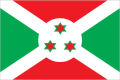
Translated from the Presidency of the Republic of Burundi The flag consists of a white diagonal cross which divides the flag into four triangular parts: two red ones at the top and bottom, and two green ones at the sides. At its centre is a white disc containing three red six-pointed stars edged in green.
Unofficial translation by WorldometerTranslated from the Presidency of the Republic of Burundi Meaning of the colours
Each colour of the flag has a particular meaning:
Red Red recalls the sacrifices made by past generations for the defence of the Nation and the attainment of independence. It also symbolises the courage, determination and commitment of the Burundian people in building their future.
Green Green represents hope, prosperity and the immense natural wealth of Burundi. It also evokes the importance of agriculture, which for centuries has been one of the pillars of the economic and social life of the country.
White White symbolises peace, unity and concord among citizens. It recalls the importance of dialogue, reconciliation and harmonious coexistence, which are the foundation of national stability.
Unofficial translation by WorldometerTranslated from the Presidency of the Republic of Burundi Traditionally, they represent the national motto:
Unity – Work – Progress
Unofficial translation by WorldometerTranslated from the Presidency of the Republic of Burundi Adopted after the independence of Burundi on 1 July 1962, the national flag underwent several changes before reaching its current form.
Unofficial translation by WorldometerSource:- presidence.gov.bi ↗ - the Presidency of the Republic of Burundi
- National anthem
- Burundi Bwâcu1:50
- Title (in Kirundi)
- Burundi Bwâcu
- Title (in English, translated)
- Our Beloved Burundi
- Lyrics
Burundi Bwâcu, Burundi buhire, Shinga icùmu mu mashinga, Gaba intahe y’ùbugabo ku bugingo. Warápfunywe ntíwapfùye, Waráhabishijwe ntíwahababuka, Uhagurukana, uhagurukana, uhagurukana, ubugabo urîkukira. Komerwamashyí n’ámakùngu, Habwa impundu nâbâwe, Isamírane mu mashinga, isamírane mu mashinga,
Burundi bwâcu, rági ry’ábasôkùru, Ramutswa intahe n’íbihùgu, Ufatanije ishyaka n’ubù hizi; Vuza impundu wiganzuye uwakùganza uwakùganza.
Burundi bwâcu, nkóramùtima kurí twese, Tugutuye amabóko, umítima n’ùbuzima, Imâna yakùduhaye ikudùtungire. Horana ubumwe n’ábagabo n’ítekane. Sagwa n’ùrweze, sagwa n’ámahóro mezá.
- Citizens
- Burundians
- Official name:Constitution of the Republic of Burundi ↗ - Official site of the Presidency of the Republic
- Official name, Citizens:The World Factbook: Burundi - CIA
- National flag:presidence.gov.bi ↗ - the Presidency of the Republic of Burundi
- National anthem:nationalanthems.info ↗
- National anthem:Recording credit
Geography
- Location
- Central Africa, east of the Democratic Republic of the Congo, west of Tanzania
- Total area
- 27,830 km²
- Land area
- 25,680 km²
- Water area
- 2,150 km²
- Land borders
- 1,140 km(3 countries)Source:
- The World Factbook: Burundi - CIA
- Coastline
- 0 km(Landlocked)
- Terrain
Hilly and mountainous, dropping to a plateau in east, some plains - Mean elevation
- 1,504 m
- Highest point
- 2,685 m
- Lowest point
- 772 mLake Tanganyika
- Climate
Equatorial high plateau with considerable altitude variation (772 m to 2,670 m above sea level); average annual temperature varies with altitude from 23 to 17 degrees Celsius but is generally moderate; average annual rainfall is about 150 cm with two wet seasons (February to May and September to November) and two dry seasons (June to August and December to January) - Avg. temperature
- 20.5 °C
- Avg. daily range
- 16.5 to 25.2 °C
- Annual precipitation
- 1,910 mm
Temperature °CMeanDaily rangePrecipitation mmMonthly climate normals Month Avg. high, °C Mean, °C Avg. low, °C Precipitation, mm January 25 20.3 16.5 227 February 25.4 20.6 16.7 196 March 25 20.4 16.7 237 April 24.2 19.9 16.5 250 May 24.4 20.1 16.4 132 June 24.8 20.1 15.8 37 July 25.3 20.2 15.6 17 August 26.3 21.3 16.7 36 September 26.9 21.8 17.4 80 October 25.8 21.1 17.1 192 November 24.5 20 16.5 252 December 24.5 20 16.3 254 Country-wide averages over 1991–2020.
Sources:- The World Factbook: Burundi - CIA
- Climate Change Knowledge Portal (ERA5 reanalysis) ↗ - World Bank
- Weather
- Loading
- Land use2023
- Arable51.4%Perm. crops13.6%Pasture18.8%Forest10.9%Other5.2%
- Arable land
- 1,321,207 hectares (51.4%)
- Permanent crops
- 350,000 hectares (13.6%)
- Permanent meadows & pastures
- 483,000 hectares (18.8%)
- Forest
- 279,640 hectares (10.9%)
- Other land
- 134,153 hectares (5.2%)
Source: - Major lakes
- Lake Tanganyika32,000 km²
- Natural hazards2026
- Epidemics6.8Very high#29/191Earthquakes4.6Medium#77/191Drought3.8Medium#70/191River floods2.6Very low#136/191Tsunamis0.0Very lowTropical cyclones0.0Very lowCoastal floods0.0Very low
Scores out of 10, ranks out of 191 countries.
Source:- INFORM Risk Index ↗ - European Commission Joint Research Centre
- Location, Land borders, Coastline, Terrain, Mean elevation, Highest point, Lowest point, Climate, Major lakes:The World Factbook: Burundi - CIA
- Climate:Climate Change Knowledge Portal (ERA5 reanalysis) ↗ - World Bank
- Land use:FAOSTAT Land Use domain ↗ - FAO
- Natural hazards:INFORM Risk Index ↗ - European Commission Joint Research Centre
Demographics
- Population change2026
- +2.36% per year+339,155 people/yearWorld Rank28thof 237
- Birth rate
- 32.0 per 1,000 population
- Death rate
- 6.6 per 1,000 population
- Net migration rate
- −2.4 per 1,000 population
- 2026
- 16.6 yearsWorld Rank230thof 237
- Age structure2026
- 0-14 years43.2%15-64 years54.2%65 years +2.6%
- Share aged 65 and over
- 2.6%
- Share aged under 18
- 50.9%
- Total dependency ratio
- 84
- Youth dependency ratio
- 80
- Elderly dependency ratio
- 5
- Sex ratio
- 0.99 male / female
MaleAgeFemalePopulation by age group, % of total population Age Male Female 80+ 0.1% 0.2% 70-79 0.5% 0.7% 60-69 1.1% 1.3% 50-59 2.2% 2.3% 40-49 4.4% 4.6% 30-39 5.8% 5.9% 20-29 7.8% 7.9% 10-19 13.1% 13.0% 0-9 14.7% 14.5% - 2026
- 2.27 above the replacement level for Burundi ()4.57 births per womanreplacement 2.3012345World Rank8thof 237
- 2.02 daughters per woman1.02 above replacement, long-run each generation larger than the lastreplacement 1.000.511.522.5
- 2026
- +25.4 per 1,000 populationfor every 1,000 people, 25.4 more births than deaths a year
- 2026
- −2.4 per 1,000 population
- Urbanization2026
- 26.5% live in cities3,904,568 urban residents
- Largest cities2008latest available
- Bujumbura, Gitega, Ngozi, RumongeRankCity or Urban LocalityPopulation (2008 census)1Bujumbura497,1662Gitega41,9443Ngozi39,8844Rumonge35,9315Cibitoke23,8856Kayanza21,7677Bubanza20,0318Gatumba11,7009Karuzi10,31710Kirundo10,024Source:
- Government of Burundi (2008 census), via City Population by Thomas Brinkhoff ↗
- Population distribution
- One of Africa's most densely populated countries; concentrations tend to be in the north and along the northern shore of Lake Tanganyika in the west; most people live on farms near areas of fertile volcanic soil.
- Ethnic groups
- Hutu, Tutsi, Twa, South Asian
- Religions2016
- Christian93.9%Muslim3.4%Other1.3%None1.3%
- Christian
- 93.9%
- Roman Catholic
- 58.6%
- Protestant
- 35.3%
The Protestant share splits into Adventist 2.7% and other Protestant religions 32.6%.
Source:- The World Factbook: Burundi - CIA
- Languages
- Kirundi (Ikirundi), French (Français), English
- Population, Population change, Median age, Age structure, Total fertility rate, Net reproduction rate, Natural change, Net migration rate:UN World Population Prospects ↗
- Urbanization:UN World Urbanization Prospects ↗
- Largest cities:Government of Burundi (2008 census), via City Population by Thomas Brinkhoff ↗
- Population distribution, Ethnic groups, Religions:The World Factbook: Burundi - CIA
Government & Administration
- Form of state
- RepublicThe President of the Republic, head of the executive power and assisted by a Vice-President, is elected by direct universal suffrage for a seven-year term, with no more than two consecutive terms (Arts. 93, 97).
- System of government
- Semi-presidentialAlthough often described as presidential, Burundi is classified as semi-presidential because it combines a directly elected President with a Government that the National Assembly may censure, including by removing the Prime Minister by a two-thirds vote (Arts. 130, 132, 208).Source:
- Territorial organisation
- Unitary
- Official websites
- Government (in French)
- President (in French)
- Parliament (in French)
- Capital
- Gitega252,082 people(2023)
- National holidays
- 15 days in 2026
- ThuJan 1New Year's Day
- ThuFeb 5Unity Day
- FriMar 20Eid al-Fitr (estimated)
- MonApr 6Commemoration of the Assassination of President Cyprien Ntaryamira
- FriMay 1International Labor Day
- ThuMay 14Ascension Day
- WedMay 27Eid al-Adha (estimated)
- MonJun 8National Day of Patriotism and Commemoration of the Death of President Pierre Nkurunziza
- WedJul 1Independence Day
- SatAug 15Assumption Day
- TueOct 13Commemoration of the Assassination of National Hero, Prince Louis Rwagasore
- WedOct 21Commemoration of the Assassination of President Melchior Ndadaye
- SunNov 1All Saints' Day
- MonNov 2All Saints' Day (observed)
- FriDec 25Christmas Day
Nationwide public holidays only, excluding regional, bank and government-only days.
- Time
- CATCentral Africa TimeUTC+2
- Currency
- Burundian Franc (BIF)
- Entry requirements
- Official visa and entry information
- Calling code
- +257
- Internet TLD
- .bi
- ISO 3166-1 codes
- BI, BDI
- Infrastructure
- Aircraft registration prefix
- 9U
Source:- The World Factbook: Burundi - CIA
- 2025
- 17 / 100World Rank167thof 182Confidence interval
Corruption index score by year Year Score Lower bound Upper bound 2012 19 14 23 2013 21 17 25 2014 20 14 26 2015 21 16 26 2016 20 18 23 2017 22 17 27 2018 17 13 21 2019 19 11 27 2020 19 12.9 25.1 2021 19 13.6 24.4 2022 17 13.2 20.8 2023 20 17.1 22.9 2024 17 11.5 22.5 2025 17 11.4 22.6 Source:- Corruption Perceptions Index 2025 ↗ - Transparency International, CC BY 4.0
- Form of state, System of government, Territorial organisation:Constitution de la République du Burundi promulguée le 7 juin 2018, official bilingual French/Kirundi edition ↗ - Presidency of the Republic of Burundi
- National holidays:Open World Holidays Framework (vacanza/holidays) ↗
- Infrastructure:The World Factbook: Burundi - CIA
- Corruption Perceptions Index:Corruption Perceptions Index 2025 ↗ - Transparency International, CC BY 4.0
Economy
- Low income
- GDP growth (real)2026
- +3.6% per yearWorld Rank73rdof 195
- GDP per capita (PPP)2026
- GDP per capita (nominal)
- $510 (194th in the world)
Source:- 2025
- Services42.1% of GDPIndustry18.2% of GDPAgriculture34.3% of GDPManufacturing13.1%part of industryThe shape of the economySource:
- World Development Indicators ↗ - World Bank
- Inflation2026
- 10.5%down 23.5 percentage points23.5pp from 2025
- Labor force2024
- 6.1 million (43% of population)World Rank75thof 187
- Labor force participation2024
- 78.5% of people aged 15+
- Unemployment2024
- 0.9%
- Youth unemployment2024
- 1.7% ages 15 to 24
- Labor productivity2024
- $0.9 per hour worked at PPP
- Budget balance2026
- 3.5% of GDP deficit
- Current account
- 6.8% of GDP, $515 million deficit
Source: - Debt2024
- Central government debt43.2% of GDPInterest on debt1.6% of GDP
- Trade2025
- Goods$406.9 million73.3%
- Services$148.1 million26.7%
- Total exports
- $555 million
- Change from 2024
- up 57.9 percent on the previous year57.9%
Sources:- World Development Indicators ↗ - World Bank
- The World Factbook: Burundi - CIA
- Agricultural products2024
- Beans (dry), Sweet potatoes, Bananas, and 6 more
- 1Beans (dry)24.5×
- 2Sweet potatoes15.3×
- 3Bananas12.7×
- 4Cassava (fresh)11.5×
- 5Potatoes1.6×
- 6Maize (corn)0.7×
- 7Oil palm fruit0.3×
- 8Rice0.2×
- 9Sugar cane0.1×
ProductSource:- FAOSTAT ↗ - Food and Agriculture Organization
- Gold reserves2023
- 0.03 tonnesWorth $2 million, 2% of total official reserves by value
- Industries
- light consumer goods (sugar, shoes, soap, beer)
- cement, assembly of imported components
- public works construction
- food processing (fruits)
Source:- The World Factbook: Burundi - CIA
- Income level, GDP by sector, Trade, Gold reserves:World Development Indicators ↗ - World Bank
- GDP (nominal), GDP growth (real), GDP per capita (PPP), Inflation, Budget balance:IMF World Economic Outlook ↗
- Labor force, Labor force participation, Unemployment, Youth unemployment, Labor productivity:ILOSTAT ↗ - International Labour Organization
- Debt:IMF Global Debt Database ↗
- Debt:IMF Public Finances in Modern History ↗
- Trade, Industries:The World Factbook: Burundi - CIA
- Agricultural products:FAOSTAT ↗ - Food and Agriculture Organization
Cost of Living
- Average gross salary2020
- BIF 96,844 per month$51 (USD), $153 (PPP)
- Median
- BIF 43,300 per month($23)
- Men
- BIF 103,060 per month($54)
- Women
- BIF 85,497 per month($45)
Source:- ILOSTAT ↗ - International Labour Organization
- 2024
- BIF 4,157 per month, gross$1 (USD), $4 (PPP)
- Average gross salary, Minimum wage:ILOSTAT ↗ - International Labour Organization
Society
- 2023
- 0.439LowWorld Rank187thof 193BurundiWorld
Human Development Index by year Year Burundi World 1990 0.294 0.608 1991 0.296 0.611 1992 0.294 0.614 1993 0.265 0.617 1994 0.298 0.620 1995 0.294 0.625 1996 0.292 0.631 1997 0.297 0.636 1998 0.303 0.641 1999 0.306 0.646 2000 0.308 0.651 2001 0.311 0.657 2002 0.324 0.662 2003 0.332 0.669 2004 0.344 0.675 2005 0.352 0.681 2006 0.376 0.688 2007 0.389 0.694 2008 0.401 0.698 2009 0.409 0.701 2010 0.416 0.707 2011 0.420 0.713 2012 0.425 0.717 2013 0.428 0.721 2014 0.431 0.726 2015 0.432 0.731 2016 0.436 0.735 2017 0.434 0.739 2018 0.434 0.741 2019 0.435 0.745 2020 0.435 0.742 2021 0.435 0.742 2022 0.437 0.752 2023 0.439 0.756 Source:- Human Development Report ↗ - United Nations Development Programme
- 2020
- 37.5
- Mean years of schooling2023
- 3.5 years
- Expected for a child today
- 9.8 years
Source:- Human Development Report ↗ - United Nations Development Programme
- Literacy2020
- 71.3% of adults
- Education expenditure2025
- 4.5% of GDP
- Share of government spending
- 10.3%
Source:- World Development Indicators ↗ - World Bank
- Internet users2023
- 7.2% of the population
- Households with Internet access
- 24.9%
Source:- ITU DataHub ↗ - International Telecommunication Union
- Mobile subscriptions2023
- 8.6 million
- Fixed telephone lines
- 14,363
- Fixed broadband
- 0 subscriptions per 100 people
Counts subscriptions, not people.
Source:- ITU DataHub ↗ - International Telecommunication Union
- Credit-card ownership2014latest available
- 0% of adults
- Debit-card ownership
- 1%
- Account at a bank or mobile-money provider
- 7%
- Mobile-money account
- 1%
- Made or received a digital payment
- 4%
Source:- Global Findex Database ↗ - World Bank
- Refugees hosted2025
- 104,253 people
- Asylum seekers
- 1,709
- Stateless persons
- 736
- Internally displaced persons
- 88,8006,800 due to conflicts, 82,000 due to disasters
- Refugees from Burundi abroad
- 324,632
Sources:- Refugee Data Finder ↗ - UN Refugee Agency
- Global Internal Displacement Database ↗ - Internal Displacement Monitoring Centre
- Inbound tourists2017latest available
- 299,000 arrivals
- Per resident
- 2.6 arrivals per 100 residents
- $2.8 million(2023)
- $58 million(2023)
Overnight arrivals by year2010 to 2017A tourist stays at least one night. Arrivals count trips, not people.
Source:- UN Tourism Data Dashboard ↗ - UN Tourism
- Human Development Index, Mean years of schooling:Human Development Report ↗ - United Nations Development Programme
- Income inequality (Gini), Education expenditure:World Development Indicators ↗ - World Bank
- Literacy:UIS Data Browser ↗ - UNESCO Institute for Statistics
- Internet users, Mobile subscriptions:ITU DataHub ↗ - International Telecommunication Union
- Credit-card ownership:Global Findex Database ↗ - World Bank
- Refugees hosted:Refugee Data Finder ↗ - UN Refugee Agency
- Refugees hosted:Global Internal Displacement Database ↗ - Internal Displacement Monitoring Centre
- Inbound tourists:UN Tourism Data Dashboard ↗ - UN Tourism
Crime & Safety
- Travel advisory (US)
- Loading
- Active humanitarian crisisAug 2026
- Medium5.2 out of 10International displacementSeverity by monthSep 2024 to Aug 2026What the score is made ofImpact of the crisis5.0Conditions of people affected5.0Complexity of the crisis5.8
Data reliability as rated by INFORM: Very high. Last updated Aug 25, 2026.
Source:- INFORM Severity Index ↗ - European Commission Joint Research Centre
- Homicide rate2016
- 5.6 per 100,000 peopleMedium by global standards
- Crime rates
- 5 offence categories
Offence Per 100,000 Count Year Homicide (victims) 5.6 635 2016 Serious assault 5.1 549 2014 Sexual violence 11.7 1,265 2014 Kidnapping 0.7 79 2014 Theft 7.5 807 2014 A low figure can also mean weak recording.
Source:- UNODC Data Portal ↗ - UN Office on Drugs and Crime
- Prison population2022
- 93.4 per 100,000 people
- Persons held
- 12,448
Source:- UNODC Data Portal ↗ - UN Office on Drugs and Crime
- Active humanitarian crisis:INFORM Severity Index ↗ - European Commission Joint Research Centre
- Homicide rate, Crime rates, Prison population:UNODC Data Portal ↗ - UN Office on Drugs and Crime
Health
- Life expectancy2026
- 64.1 years
- Health expenditure2023
- 9.1% of GDP$28 per person
- Physicians2022
- 0.08 per 1,000 population
- Hospital beds2014
- 0.7 per 1,000 population
- Infant mortality2026
- 33.9 per 1,000 live births
- Maternal mortality2023
- 392 per 100,000 live births
- Alcohol consumption2022
- 4.5 litres of pure alcohol per adult per year
- Tobacco use2015latest available
- 14.1% of adults
- Men
- 20.4%
- Women
- 7.9%
Source:- Global Health Observatory ↗ - World Health Organization
- Road traffic deaths2019
- 35.5 per 100,000 population
- Life expectancy, Infant mortality:UN World Population Prospects ↗
- Health expenditure, Physicians, Hospital beds, Road traffic deaths:World Development Indicators ↗ - World Bank
- Maternal mortality:Maternal mortality estimates ↗ - UN Maternal Mortality Estimation Inter-agency Group
- Alcohol consumption, Tobacco use:Global Health Observatory ↗ - World Health Organization
Environment
- CO₂ emissions2024
- 0.97 Mt per yearup 2 percent on the previous year2% from 2023
- CO₂ per capita
- 0.1 t per personWorld Rank203rdof 207
- Share of global CO₂
- < 0.01%
- Methane (CH₄)
- 5.7 Mt CO₂-eq
- Nitrous oxide (N₂O)
- 1.46 Mt CO₂-eq
- Fluorinated gases
- 0.29 Mt CO₂-eq
- All greenhouse gases
- 8.42 Mt CO₂-eq
Source:- Emissions Database for Global Atmospheric Research (EDGAR) ↗ - European Commission, Joint Research Centre
- 2024
- 39 µg/m³ of PM2.53.3 years of life expectancy lost against the WHO guidelineMost polluted9thof 236
- WHO guideline
- 5 µg/m³
Source:- Air Quality Life Index ↗ - Energy Policy Institute at the University of Chicago
- Environmental issues
- soil erosion from overgrazing and agricultural expansion
- deforestation
- wildlife habitat loss
- International agreements
- 17 of 20 landmark treaties in forceParty to 44 multilateral environmental agreements
Treaty Standing Joined Climate Paris Agreement in force 2018 UN Framework Convention on Climate Change in force 1997 Kyoto Protocol in force 2005 Ozone layer Montreal Protocol in force 1997 Vienna Convention (Ozone Layer) in force 1997 Biodiversity Convention on Biological Diversity in force 1997 CITES in force 1988 Convention on Migratory Species (Bonn) in force 2011 Cartagena Protocol on Biosafety in force 2008 Nagoya Protocol in force 2014 Land and heritage Ramsar Convention on Wetlands in force 2002 World Heritage Convention in force 1982 UN Convention to Combat Desertification in force 1997 Chemicals and waste Basel Convention in force 1997 Rotterdam Convention (PIC) in force 2004 Stockholm Convention (POPs) in force 2005 Minamata Convention on Mercury in force 2021 Oceans UN Convention on the Law of the Sea signed 1982, not ratified High Seas Treaty (BBNJ) signed 2025, not ratified MARPOL 73/78 not a party Source:- International Environmental Agreements Database ↗ - Université Laval
- CO₂ emissions:Emissions Database for Global Atmospheric Research (EDGAR) ↗ - European Commission, Joint Research Centre
- Air pollution:Air Quality Life Index ↗ - Energy Policy Institute at the University of Chicago
- Environmental issues:The World Factbook: Burundi - CIA
- International agreements:International Environmental Agreements Database ↗ - Université Laval
Food & Water
- No access to safe drinking water2022
- 24.1% of the population
- Renewable water2022
- 13 billion m³ per year
- Per person
- 941 m³ per year
- Dependency ratio
- 20% originates outside the country
- Annual water withdrawal
- 0.3 billion m³ per year
- Withdrawn for agriculture
- 79%
- Water stress
- 10% of available freshwater withdrawn
Source:- AQUASTAT ↗ - Food and Agriculture Organization
- Obesity2024
- 5.2% of adults
- Men
- 6.1%
- Women
- 4.3%
Source:- Global Health Observatory ↗ - World Health Organization
- Underweight children2024
- 28.3% of children under five
- No access to safe drinking water, Renewable water:AQUASTAT ↗ - Food and Agriculture Organization
- Obesity:Global Health Observatory ↗ - World Health Organization
- Underweight children:World Development Indicators ↗ - World Bank
Energy
- Energy consumption2024
- Per capita
- 1 GJ per person
- Share of world total
- < 0.01%
- Supply
- Deficitproduces 9.7% of what it consumes, 2024
Source:- International Energy Statistics ↗ - U.S. Energy Information Administration
- Electricity2024
- Imports only, 0.1 TWh imported, nothing exported in 20240.5 TWh generated per year
- Generation
- 0.5 TWh per year
- Consumption
- 0.5 TWh per year
- Imports
- 0.1 TWh per year
Source:- International Energy Statistics ↗ - U.S. Energy Information Administration
- Oil, gas & coal
- No domestic productionconsumes 5,727 b/d in 2024Consumption20245,727 b/d
Oil imports and exports count crude oil only.
- Energy consumption, Electricity, Oil, gas & coal:International Energy Statistics ↗ - U.S. Energy Information Administration
Defense
- Military expenditure2024
- 3.8% of GDP$171.8 million, 12.5% of government spending
- Military personnel2025
- estimated 25,000–30,000active-duty Defense Force troopsLimited information.
- Military service2025
- Voluntarymen and women 18+
- Nuclear weapons2026
- None - no nuclear arsenal
- Military expenditure:SIPRI Military Expenditure Database ↗ - Stockholm International Peace Research Institute
- Military expenditure:World Development Indicators ↗ - World Bank
- Military personnel, Military service:The World Factbook: Burundi - CIA
- Nuclear weapons:Status of World Nuclear Forces ↗ - Federation of American Scientists

