

National Identity
- Official name
- Democratic People’s Republic of Korea
- Official name (in Korean)
- 조선민주주의인민공화국
- Official name (in Korean, Romanized)
- Chosŏn Minjujuŭi Inmin Konghwaguk
- Name etymology
derived from the Chinese name for Goryeo, which was the Korean dynasty that united the peninsula in the 10th century A.D.; the North Korean name "Choson" means "[Land of the] Morning Calm"
Sources:- Politics - National Symbols - Official Name of the DPRK ↗ - Naenara Democratic People's Republic of Korea
- The World Factbook: North Korea - CIA
- National emblem
- National flag
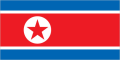
Translated from the World Intellectual Property Organization (WIPO) The national flag of the Democratic People's Republic of Korea has a wide red stripe in the middle of the flag, narrow white stripes above and below it, and then blue stripes, and on the hoist side of the red stripe there is a red five-pointed star within a white circle.
The ratio of the height to the length of the flag is 1 : 2.
Unofficial translation by WorldometerTranslated from the Ministry of Foreign Affairs of the Democratic People's Republic of Korea The red colour of the national flag symbolizes the red blood of the anti-Japanese revolutionary martyrs and heroic fighters who fought for the liberation and independence of the motherland, and the invincible might of the Korean people firmly united around the Republic. The white colour symbolizes that the Republic is the state of a single nation that has lived purely on one territory with one bloodline, language and culture. The blue colour symbolizes the vigorous appearance of the Korean people struggling for the victory of the socialist cause, and the spirit of the peoples struggling for world peace and progress. The red five-pointed star figuratively shows the wise spirit of the Korean people advancing vigorously while inheriting the anti-Japanese revolutionary tradition, and the prospects for the development of the Republic.
Unofficial translation by WorldometerTranslated from Kim Il Sung University, Democratic People's Republic of Korea That is why, in the days of the founding of the state, the great leader Comrade Kim Il Sung clearly set out the fundamental direction and position for establishing the national flag, namely that the national flag of the Republic to be founded should be, in both name and reality, Korean in its form and in the content it carries, and personally taught in concrete terms even the ideological content to be carried in the national flag and the way of expressing it.
Unofficial translation by WorldometerTranslated from the Ministry of Foreign Affairs of the Democratic People's Republic of Korea The national flag of the Democratic People's Republic of Korea was established on 9 September Juche 37 (1948), together with the founding of the Democratic People's Republic of Korea, and is regulated by the Socialist Constitution of the Republic.
Unofficial translation by WorldometerSources:- wipo.int ↗ - the World Intellectual Property Organization (WIPO)
- mfa.gov.kp ↗ - the Ministry of Foreign Affairs of the Democratic People's Republic of Korea
- ryongnamsan.edu.kp ↗ - Kim Il Sung University, Democratic People's Republic of Korea
- National anthem
- Aegukka (애국가)
- Title (in Korean)
- 애국가
- Title (in Korean, Romanized)
- Aegukka
- Title (in English, translated)
- Patriotic Song
- Unofficial title (in Korean)
- 아침은 빛나라
- Unofficial title (in Korean, Romanized)
- Ach’imŭn pinnara
- Unofficial title (in English, translated)
- Let Morning Shine
- Lyrics
1아침은 빛나라 이 강산 은금의 자원도 가득한 삼천리 아름다운 내 조국 반만년 오랜 력사에 찬란한 문화로 자라난 슬기론 인민의 이 영광 몸과 맘 다바쳐 이 조선 길이 받드세
2백두산 기상을 다 안고 근로의 정신은 깃들어 진리로 뭉쳐진 억센 뜻 온 세계 앞서 나가라 솟는 힘 노도도 내밀어 인민의 뜻으로 선 나라 한없이 부강하는 이 조선 길이 빛내세
Source: - Citizens
- Koreans
- Official name:Politics - National Symbols - Official Name of the DPRK ↗ - Naenara Democratic People's Republic of Korea
- Official name, Citizens:The World Factbook: North Korea - CIA
- National flag:wipo.int ↗ - the World Intellectual Property Organization (WIPO)
- National flag:mfa.gov.kp ↗ - the Ministry of Foreign Affairs of the Democratic People's Republic of Korea
- National flag:ryongnamsan.edu.kp ↗ - Kim Il Sung University, Democratic People's Republic of Korea
- National anthem:nationalanthems.info ↗
Geography
- Location
- Eastern Asia, northern half of the Korean Peninsula bordering the Korea Bay and the Sea of Japan, between China and South Korea
- Total area
- 120,538 km²
- Land area
- 120,408 km²
- Water area
- 130 km²
- Land borders
- 1,607 km(3 countries)
- China
- 1,352 km
- South Korea
- 237 km
- Russia
- 18 km
Source:- The World Factbook: North Korea - CIA
- Coastline
- 2,495 km
- Terrain
Mostly hills and mountains separated by deep, narrow valleys; wide coastal plains in west, discontinuous in east - Mean elevation
- 600 m
- Highest point
- 2,744 mPaektu-san
- Lowest point
- 0 mSea of Japan
- Climate
Temperate, with rainfall concentrated in summer; long, bitter winters - Avg. temperature
- 7.3 °C
- Avg. daily range
- 2.8 to 12.2 °C
- Annual precipitation
- 1,103 mm
Temperature °CMeanDaily rangePrecipitation mmMonthly climate normals Month Avg. high, °C Mean, °C Avg. low, °C Precipitation, mm January −4.1 −9.4 −15 22 February −0.9 −6.1 −11.7 27 March 5 0.2 −4.7 38 April 12.9 7.7 2.6 65 May 18.9 13.8 8.8 103 June 22.7 18.3 14.2 127 July 25.2 21.6 18.4 255 August 25.6 21.6 18.2 224 September 21.6 16.4 12.1 103 October 15 9.3 4.6 54 November 5.7 1 −3.4 55 December −2.2 −7 −12 31 Country-wide averages over 1991–2020.
Sources:- The World Factbook: North Korea - CIA
- Climate Change Knowledge Portal (ERA5 reanalysis) ↗ - World Bank
- Weather
- Loading
- Land use2023
- Arable19.1%Perm. crops2.1%Pasture0.4%Forest64.0%Other14.5%
- Arable land
- 2,295,000 hectares (19.1%)
- Permanent crops
- 250,300 hectares (2.1%)
- Permanent meadows & pastures
- 50,000 hectares (0.4%)
- Forest
- 7,705,218 hectares (64.0%)
- Other land
- 1,740,482 hectares (14.5%)
Source: - Natural hazards2026
- River floods6.5High#57/191Coastal floods6.4High#31/191Tropical cyclones5.7High#29/191Earthquakes4.4Medium#81/191Drought3.7Medium#73/191Epidemics3.1Low#156/191Tsunamis1.0Very low#97/191
Scores out of 10, ranks out of 191 countries.
Source:- INFORM Risk Index ↗ - European Commission Joint Research Centre
- Location, Land borders, Coastline, Terrain, Mean elevation, Highest point, Lowest point, Climate:The World Factbook: North Korea - CIA
- Climate:Climate Change Knowledge Portal (ERA5 reanalysis) ↗ - World Bank
- Land use:FAOSTAT Land Use domain ↗ - FAO
- Natural hazards:INFORM Risk Index ↗ - European Commission Joint Research Centre
Demographics
- Population change2026
- +0.24% per year+62,655 people/yearWorld Rank159thof 237
- Birth rate
- 12.3 per 1,000 population
- Death rate
- 10.1 per 1,000 population
- Net migration rate
- −0.1 per 1,000 population
- 2026
- 36.8 yearsWorld Rank92ndof 237
- Age structure2026
- 0-14 years18.9%15-64 years68.1%65 years +13.0%
- Share aged 65 and over
- 13.0%
- Share aged under 18
- 22.5%
- Total dependency ratio
- 47
- Youth dependency ratio
- 28
- Elderly dependency ratio
- 19
- Sex ratio
- 0.98 male / female
MaleAgeFemalePopulation by age group, % of total population Age Male Female 80+ 0.9% 1.8% 70-79 2.3% 3.0% 60-69 5.4% 5.8% 50-59 7.5% 7.6% 40-49 6.3% 6.3% 30-39 7.4% 7.2% 20-29 6.9% 6.6% 10-19 6.3% 6.0% 0-9 6.5% 6.2% - 2026
- 0.35 below the replacement level for North Korea ()1.75 births per womanreplacement 2.10123World Rank130thof 237
- 0.82 daughters per woman0.18 below replacement, long-run each generation smaller than the lastreplacement 1.000.511.5
- 2026
- +2.3 per 1,000 populationfor every 1,000 people, 2.3 more births than deaths a year
- 2026
- −0.1 per 1,000 population
- Urbanization2026
- 64.5% live in cities17,186,914 urban residents
- Largest cities2008latest available
- Pyongyang, Hamhung, Ch'ongjin, SinuijuRankCityPopulation (2008 census)1Pyongyang2,521,7852Hamhung703,6103Ch'ongjin614,8924Sinuiju334,0315Wonsan328,4676Namp'o310,5317Sariwon271,4348Kaech'on262,3899Kanggye251,97110Sunch'on250,738Source:
- Central Bureau of Statistics, DPR Korea (2008 census), via City Population by Thomas Brinkhoff ↗
- Population distribution
- Population concentrated in the plains and lowlands; least-populated regions are the mountainous provinces adjacent to the Chinese border; largest concentrations are in the western provinces, particularly the municipal district of Pyongyang, and around Hungnam and Wonsan in the east.
- Ethnic groups
- Racially homogeneous, with a small Chinese community and a few ethnic Japanese.
- Religions
- Traditionally Buddhist and Confucian, with some Christians and followers of the syncretic Chondogyo (Religion of the Heavenly Way).
Autonomous religious activity is now almost nonexistent. Government-sponsored religious groups exist to provide an illusion of religious freedom.
Source:- The World Factbook: North Korea - CIA
- Languages
- Korean (한국어)
- Population, Population change, Median age, Age structure, Total fertility rate, Net reproduction rate, Natural change, Net migration rate:UN World Population Prospects ↗
- Urbanization:UN World Urbanization Prospects ↗
- Largest cities:Central Bureau of Statistics, DPR Korea (2008 census), via City Population by Thomas Brinkhoff ↗
- Population distribution, Ethnic groups, Religions:The World Factbook: North Korea - CIA
Government & Administration
- Form of state
- RepublicA 2026 revision describes the state, in the Preamble, as "a people-centered socialist state", and names the Chairman of the State Affairs Commission head of state, replacing the title "supreme leader" (Art. 86).
- System of government
- One-partyThe state conducts all activities under the leadership of the Workers' Party of Korea (Art. 9).
- Territorial organisation
- Unitary
- Capital
- Pyongyang3.2 million people(2024)
- National holidays
- 21 days in 2026
- ThuJan 1New Year's Day
- SunFeb 8Founding Day of the Korean People's Army
- MonFeb 16Day of the Shining Star
- TueFeb 17Day of the Shining StarKorean New Year
- TueMar 3Daeboreum
- SunMar 8International Women's Day
- SunApr 5Cheongmyeong Festival
- WedApr 15Day of the Sun
- ThuApr 16Day of the Sun
- SatApr 25Founding Day of the Korean People's Revolutionary Army
- FriMay 1International Workers' Day
- SatJun 6Foundation Day of the Korean Children's Union
- MonJul 27Day of Victory in the Great Fatherland Liberation War
- SatAug 15Liberation Day
- TueAug 25Day of Songun
- FriAug 28Youth Day
- WedSep 9Founding Day of the DPRK
- FriSep 25Chuseok
- SatOct 10Foundation Day of the Workers' Party of Korea
- MonNov 16Mother's Day
- SunDec 27Socialist Constitution Day
Nationwide public holidays only, excluding regional, bank and government-only days.
- Time
- KSTKorean Standard TimeUTC+9
- Currency
- North Korean Won (KPW)
- Calling code
- +850
- Internet TLD
- .kp
- ISO 3166-1 codes
- KP, PRK
- Infrastructure
- Passengers carried
- 3,690 by the country's airlines(2023)
- Heliports
- 8
- Aircraft departures
- 74 by the country's airlines(2023)
- Air freight
- 0 million tonne-km(2023)
- Aircraft registration prefix
- P
Sources:- The World Factbook: North Korea - CIA
- World Development Indicators ↗ - World Bank
- 2025
- 15 / 100World Rank172ndof 182Confidence interval
Corruption index score by year Year Score Lower bound Upper bound 2012 8 2 13 2013 8 2 14 2014 8 3 13 2015 8 2 14 2016 12 10 15 2017 17 10 24 2018 14 12 16 2019 17 11.8 22.2 2020 18 12.3 23.7 2021 16 11.8 20.2 2022 17 10.8 23.2 2023 17 10.8 23.2 2024 15 8.2 21.8 2025 15 8.2 21.8 Source:- Corruption Perceptions Index 2025 ↗ - Transparency International, CC BY 4.0
- Form of state, System of government, Territorial organisation:Constitution of the Democratic People's Republic of Korea, as revised in March 2026, unofficial English translation by Hyunseung Lee ↗ - HRNK Insider (Committee for Human Rights in North Korea), 18 May 2026
- National holidays:Open World Holidays Framework (vacanza/holidays) ↗
- Infrastructure:The World Factbook: North Korea - CIA
- Infrastructure:World Development Indicators ↗ - World Bank
- Corruption Perceptions Index:Corruption Perceptions Index 2025 ↗ - Transparency International, CC BY 4.0
Economy
- Low income
- Labor force2024
- 17.6 million (67% of population)World Rank37thof 187
- Labor force participation2024
- 82.2% of people aged 15+
- Unemployment2024
- 3.5%
- Youth unemployment2024
- 7.8% ages 15 to 24
- Labor productivity2024
- $1.4 per hour worked at PPP
- Agricultural products2024
- Meat of rabbits and hares (fresh or chilled), Beans (dry), Cabbages, and 7 more
- 1Meat of rabbits and hares (fresh or chilled)171.3×
- 2Beans (dry)10×
- 3Cabbages8.6×
- 4Apples7.6×
- 5Sweet potatoes5.9×
- 6Pears5.1×
- 7Rice2.5×
- 8Maize (corn)1.7×
- 9Hen eggs in shell (fresh)1.3×
- 10Potatoes1×
ProductSource:- FAOSTAT ↗ - Food and Agriculture Organization
- Industries
- military products
- machine building, electric power, chemicals
- mining (coal, iron ore, limestone, magnesite, graphite, copper, zinc, lead, and precious metals), metallurgy
- textiles, food processing
- tourism
Source:- The World Factbook: North Korea - CIA


- Income level:World Development Indicators ↗ - World Bank
- Labor force, Labor force participation, Unemployment, Youth unemployment, Labor productivity:ILOSTAT ↗ - International Labour Organization
- Trade, Industries:The World Factbook: North Korea - CIA
- Agricultural products:FAOSTAT ↗ - Food and Agriculture Organization
Cost of Living
- Cost of living index
- Loading
- Monthly costs (excluding rent)
- Loading
- Rent
- Loading
- Buying an apartment
- Loading
Society
- Literacy2008latest available
- 100% of adults
- Mobile subscriptions2022
- 6.4 million
- Fixed telephone lines
- 1,180,438
Counts subscriptions, not people.
Source:- ITU DataHub ↗ - International Telecommunication Union
- UNESCO World Heritage Sites
- 2 sites2 cultural1 mixed
Site Type Koguryo Tombs Complex Historic Monuments and Sites in Kaesong Mount Kumgang – Diamond Mountain from the Sea Mixed Source:- The World Factbook: North Korea - CIA
- Literacy:UIS Data Browser ↗ - UNESCO Institute for Statistics
- Mobile subscriptions:ITU DataHub ↗ - International Telecommunication Union
- UNESCO World Heritage Sites:The World Factbook: North Korea - CIA
Crime & Safety
- Travel advisory (US)
- Loading
- Active humanitarian crisisAug 2026
- None - no active crisis
- Active humanitarian crisis:INFORM Severity Index ↗ - European Commission Joint Research Centre
Health
- Life expectancy2026
- 74.0 years
- Physicians2017
- 3.63 per 1,000 population
- Hospital beds2018
- 12.8 per 1,000 population
- Infant mortality2026
- 12.8 per 1,000 live births
- Maternal mortality2023
- 67 per 100,000 live births
- Alcohol consumption2022
- 4.8 litres of pure alcohol per adult per year
- Tobacco use2015latest available
- 19.9% of adults
- Men
- 39.9%
- Women
- 0%
Source:- Global Health Observatory ↗ - World Health Organization
- Road traffic deaths2019
- 24.2 per 100,000 population
- Life expectancy, Infant mortality:UN World Population Prospects ↗
- Physicians, Hospital beds, Road traffic deaths:World Development Indicators ↗ - World Bank
- Maternal mortality:Maternal mortality estimates ↗ - UN Maternal Mortality Estimation Inter-agency Group
- Alcohol consumption, Tobacco use:Global Health Observatory ↗ - World Health Organization
Environment
- CO₂ emissions2024
- 66.2 Mt per yearup 0.9 percent on the previous year0.9% from 2023
- CO₂ per capita
- 2.5 t per personWorld Rank112thof 207
- Share of global CO₂
- 0.17%
- Methane (CH₄)
- 20.1 Mt CO₂-eq
- Nitrous oxide (N₂O)
- 1.69 Mt CO₂-eq
- Fluorinated gases
- 3.21 Mt CO₂-eq
- All greenhouse gases
- 91.3 Mt CO₂-eq
Source:- Emissions Database for Global Atmospheric Research (EDGAR) ↗ - European Commission, Joint Research Centre
- 2024
- 20.5 µg/m³ of PM2.51.5 years of life expectancy lost against the WHO guidelineMost polluted57thof 236
- WHO guideline
- 5 µg/m³
Source:- Air Quality Life Index ↗ - Energy Policy Institute at the University of Chicago
- Environmental issues
- water pollution
- inadequate potable water
- deforestation
- soil erosion and degradation
Source:- The World Factbook: North Korea - CIA
- International agreements
- 15 of 20 landmark treaties in forceParty to 48 multilateral environmental agreements
Treaty Standing Joined Climate Paris Agreement in force 2016 UN Framework Convention on Climate Change in force 1995 Kyoto Protocol in force 2005 Ozone layer Montreal Protocol in force 1995 Vienna Convention (Ozone Layer) in force 1995 Biodiversity Convention on Biological Diversity in force 1995 CITES not a party Convention on Migratory Species (Bonn) not a party Cartagena Protocol on Biosafety in force 2003 Nagoya Protocol in force 2019 Land and heritage Ramsar Convention on Wetlands in force 2018 World Heritage Convention in force 1998 UN Convention to Combat Desertification in force 2004 Chemicals and waste Basel Convention in force 2008 Rotterdam Convention (PIC) in force 2004 Stockholm Convention (POPs) in force 2004 Minamata Convention on Mercury not a party Oceans UN Convention on the Law of the Sea signed 1982, not ratified High Seas Treaty (BBNJ) not a party MARPOL 73/78 in force 1985 Source:- International Environmental Agreements Database ↗ - Université Laval
- CO₂ emissions:Emissions Database for Global Atmospheric Research (EDGAR) ↗ - European Commission, Joint Research Centre
- Air pollution:Air Quality Life Index ↗ - Energy Policy Institute at the University of Chicago
- Environmental issues:The World Factbook: North Korea - CIA
- International agreements:International Environmental Agreements Database ↗ - Université Laval
Food & Water
- No access to safe drinking water2022
- 0.3% of the population
- Renewable water2022
- 77 billion m³ per year
- Per person
- 2,930 m³ per year
- Dependency ratio
- 13% originates outside the country
- Annual water withdrawal
- 8.7 billion m³ per year
- Withdrawn for agriculture
- 76%
- Water stress
- 28% of available freshwater withdrawn
Source:- AQUASTAT ↗ - Food and Agriculture Organization
- Undernourishment2022
- 45.5% of the population11.8 million people
- Obesity2024
- 12% of adults
- Men
- 9.2%
- Women
- 14.7%
Source:- Global Health Observatory ↗ - World Health Organization
- Underweight children2017
- 9.3% of children under five
- No access to safe drinking water, Renewable water:AQUASTAT ↗ - Food and Agriculture Organization
- Undernourishment:Food security indicators (FAOSTAT) ↗ - Food and Agriculture Organization
- Obesity:Global Health Observatory ↗ - World Health Organization
- Underweight children:World Development Indicators ↗ - World Bank
Energy
- Energy consumption2024
- Per capita
- 26.3 GJ per person
- Share of world total
- 0.11%
- Supply
- Deficitproduces 94% of what it consumes, 2024
Source:- International Energy Statistics ↗ - U.S. Energy Information Administration
- Electricity2024
- Trade ended, last exchange reported in 202327 TWh generated per year
- Generation
- 27 TWh per year
- Consumption
- 23 TWh per year
Source:- International Energy Statistics ↗ - U.S. Energy Information Administration
- Oil, gas & coal
- No meaningful productionproduces under 2% of what it consumes, 2024Imports201810,640 b/d
Oil imports and exports count crude oil only.
- Energy consumption, Electricity, Oil, gas & coal:International Energy Statistics ↗ - U.S. Energy Information Administration
Defense
- Military personnel2025
- as many as 1.3 millionactive-duty Korean People's ArmyEstimates vary.
- Military service2025
- Conscriptionmen 17–30, women 17–23, reportedly up to 10 years for men and up to 7 years for women
- Space program2025
- National Aerospace Technology Administration (NATA; established 2013; re-named in 2023 from the National Aerospace Development Administration or NADA); State Space Development Bureau; Academy of National Defense Science; Ministry of People’s Armed Forces
North Korea’s leader has emphasized the development of space capabilities, particularly satellite launch vehicles (SLVs) and remote sensing satellites; manufactures satellites and rockets/SLVs; independently launches rockets/SLVs; SLV program is viewed as closely related to the country's development of intercontinental ballistic missiles; passed a national space law in 2013, and revised it in 2022 to allow for the use of space for national defense; has cooperated with Iran on space-related technologies, and signed a mutual defense treaty with Russia in 2024 that stated the two countries would “develop exchanges and joint research in science and technology, including space”
- Launch sites
- Sohae Satellite Launching Station (aka Tongch'ang-dong Space Launch Center; North Pyongan province); Tonghae Satellite Launching Ground (North Hamgyong province)
- 1980s
- Initiated space program
- 1998
- Failed first attempt to place a satellite in orbit on a 3-stage Paektusan-1 satellite launch vehicle (SLV)
- 2012
- Successfully placed first satellite (Kwangmyŏngsŏng-3 or Bright Star-3) in orbit on Unha-3 SLV (satellite failed to operate)
- 2016
- Second satellite (Kwangmyŏngsŏng-4) placed in orbit on Unha-3 SLV (reportedly a remote sensing (RS) satellite that also failed to operate)
- 2023
- Placed a military RS satellite (Malligyong-1) in orbit on Chollima-1 SLV
- 2024
- Failed attempt to place a second military RS satellite in orbit on new type SLV
Key milestones
the predecessor of NATA/NADA was the Korean Committee of Space Technology (KCST), which was established in the 1980s
Source:- The World Factbook: North Korea - CIA
- Nuclear weapons2026
- 60 warheadsNone deployed, 60 in the military stockpile
Deployed, strategicOn long-range missiles and at bomber bases 0 Deployed, nonstrategicOn short-range weapons None known ReserveIn storage, not on launchers 60 Military stockpileDeployed and reserve, held for use 60 RetiredAwaiting dismantlement 0 Total inventory 60 Approximate FAS estimates. Parts may not sum.
Source:- Status of World Nuclear Forces ↗ - Federation of American Scientists
- Military personnel, Military service, Space program:The World Factbook: North Korea - CIA
- Nuclear weapons:Status of World Nuclear Forces ↗ - Federation of American Scientists
