

National Identity
- Official name
- Republic of Korea
- Official name (in Korean)
- 대한민국
- Official name (in Korean, Romanized)
- Daehan Minguk
- Name etymology
derived from the Chinese name for Goryeo, which was the Korean dynasty that united the peninsula in the 10th century A.D.; the South Korean name "Han'guk" derives from the long form, "Taehan-min'guk," which is itself a derivation from "Daehan-je'guk," which means "the Great Han Empire"
Sources:- Constitution of the Republic of Korea ↗ - KLRI Korea Legislation Research Institute
- The World Factbook: South Korea - CIA
- National emblem
- National flag
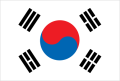
As published by the Ministry of the Interior and Safety of the Republic of Korea The Taegeukgi consists of a white background, a red and blue taegeuk circle in the center, and four black trigrams (collectively called geongongamri), one in each corner of the flag.
As published in EnglishAs published by the Ministry of the Interior and Safety of the Republic of Korea The white background represents brightness, purity, and peace, qualities that are highly valued by the people. The taegeuk, which has long been a commonly used motif, denotes the harmony between the negative cosmic forces (yin : blue portion) and the positive cosmic forces (yang : red portion), depicting the truth of nature that all things are created and evolve through the interaction of yin and yang. The four black trigrams are specific representations of the movement and harmony of these forces. In detail, the geon symbolizes the sky, the gon the earth, the gam water, and the ri fire. Together, they create harmony around the taegeuk mark.
In short, the Taegeukgi flag embodies the vision of the Korean people who, like the universe, seek continuous creation and enrichment.As published in EnglishAs published by the Ministry of the Interior and Safety of the Republic of Korea Origin
Following the trend for modern states to adopt national flags, the decision to create a national flag for Korea emerged with the ratification of the Korea-United States Treaty of 1882. No accurate records remain of the Korean flag chosen for use at the signing ceremony; however, some argue that the flag was similar to the ensign flag featured in the Flags of Maritime Nations issued by the U.S.
Navy Department’s Bureau of Navigation and found in 2004.
In his capacity as Envoy Extraordinary and Plenipotentiary under King Gojong, Park Yeong-hyo kept a record of his diplomatic mission to Japan in 1882. According to his journal, known as Sahwagiryak, in September of that year while aboard the ship to Japan, Park created a four-trigram flag with a taegeuk circle (instead of the flag with eight black bars that had been used prior to 1800). The flag was used from September 25, 1882, according to Park’s report to the government on October 3 of that year. By royal order on March 6, 1883, King Gojong promulgated that Park’s flag with a taegeuk circle in the center and four trigrams around it (the flag named Taegeukgi) be the national flag. However, due to a lack of specific guidelines, the flag design took different forms. On June 29, 1942, the Provisional Government issued a national flag style guide to ensure that subsequent flags would be created in a consistent manner. Despite these efforts, however, ordinary people were unaware of these guidelines.After the establishment of the Republic of Korea on August 15, 1948, the government felt an increasing need to standardize flag construction. Thus in January 1949, it formed the National Flag Correction Committee, which announced the National Flag Construction Guidelines on October 15 of that year. A number of regulations were later implemented, providing for the systematic management of the flag: the Act on the Flag of the Republic of Korea, enacted in January 2007; the Enforcement Decree of the Act on the Flag of the Republic of Korea, in July 2007; and the Regulations on the Hoisting, Management, and Promotion of the National Flag in September 2009 (by instructions from the Prime Minister).As published in EnglishSource:- mois.go.kr ↗ - the Ministry of the Interior and Safety of the Republic of Korea
- National anthem
- Aegukga (애국가)0:57
- Title (in Korean)
- 애국가
- Title (in Korean, Romanized)
- Aegukga
- Title (in English, translated)
- Patriotic Song
- Lyrics
1동해 물과 백두산이 마르고 닳도록 하느님이 보우하사 우리나라 만세
Chorus무궁화 삼천리 화려강산 대한사람 대한으로 길이 보전하세
2남산 위에 저 소나무 철갑을 두른 듯 바람서리 불변함은 우리 기상일세
무궁화 삼천리 화려강산3가을 하늘 공활한데 높고 구름 없이 밝은 달은 우리 가슴 일편단심일세
무궁화 삼천리 화려강산4이 기상과 이 맘으로 충성을 다하여 괴로우나 즐거우나 나라 사랑하세
무궁화 삼천리 화려강산Source: - Citizens
- Koreans
- Official name:Constitution of the Republic of Korea ↗ - KLRI Korea Legislation Research Institute
- Official name, Citizens:The World Factbook: South Korea - CIA
- National flag:mois.go.kr ↗ - the Ministry of the Interior and Safety of the Republic of Korea
- National anthem:nationalanthems.info ↗
Geography
- Location
- Eastern Asia, southern half of the Korean Peninsula bordering the Sea of Japan and the Yellow Sea
- Total area
- 99,720 km²
- Land area
- 96,920 km²
- Water area
- 2,800 km²
- Land borders
- 237 km(1 country)
- North Korea
- 237 km
Source:- The World Factbook: South Korea - CIA
- Coastline
- 2,413 km
- Terrain
Mostly hills and mountains; wide coastal plains in west and south - Mean elevation
- 282 m
- Highest point
- 1,950 mHalla-san
- Lowest point
- 0 mSea of Japan
- Climate
Temperate, with rainfall heavier in summer than winter; cold winters - Avg. temperature
- 12.5 °C
- Avg. daily range
- 8.6 to 16.8 °C
- Annual precipitation
- 1,237 mm
Temperature °CMeanDaily rangePrecipitation mmMonthly climate normals Month Avg. high, °C Mean, °C Avg. low, °C Precipitation, mm January 3.2 −1 −5.1 32 February 5.7 1.2 −3 37 March 10.7 6 1.6 61 April 17 12 7.1 87 May 22 17.2 12.6 99 June 25.4 21.3 17.6 149 July 27.6 24.4 21.7 255 August 28.4 25 22 228 September 24.6 20.5 16.8 149 October 19.4 14.4 10 61 November 12.3 7.6 3.5 48 December 5.3 1.1 −2.8 31 Country-wide averages over 1991–2020.
Sources:- The World Factbook: South Korea - CIA
- Climate Change Knowledge Portal (ERA5 reanalysis) ↗ - World Bank
- Weather
- Loading
- Land use2023
- Arable14.9%Perm. crops2.1%Pasture0.6%Forest64.4%Other19.5%
- Arable land
- 1,456,000 hectares (14.9%)
- Permanent crops
- 205,000 hectares (2.1%)
- Permanent meadows & pastures
- 56,000 hectares (0.6%)
- Forest
- 6,286,678 hectares (64.4%)
- Other land
- 1,905,322 hectares (19.5%)
Source: - Natural hazards2026
- Tropical cyclones8.3Very high#6/191River floods7.1Very high#39/191Coastal floods7.1Very high#21/191Earthquakes6.9Very high#45/191Tsunamis5.6High#49/191Epidemics3.4Low#145/191Drought0.3Very low#174/191
Scores out of 10, ranks out of 191 countries.
Source:- INFORM Risk Index ↗ - European Commission Joint Research Centre
- Location, Land borders, Coastline, Terrain, Mean elevation, Highest point, Lowest point, Climate:The World Factbook: South Korea - CIA
- Climate:Climate Change Knowledge Portal (ERA5 reanalysis) ↗ - World Bank
- Land use:FAOSTAT Land Use domain ↗ - FAO
- Natural hazards:INFORM Risk Index ↗ - European Commission Joint Research Centre
Demographics
- Population change2026
- −0.13% per year−66,641 people/yearWorld Rank185thof 237
- Birth rate
- 4.8 per 1,000 population
- Death rate
- 7.5 per 1,000 population
- Net migration rate
- +1.2 per 1,000 population
- 2026
- 46.2 yearsWorld Rank16thof 237
- Age structure2026
- 0-14 years9.8%15-64 years68.7%65 years +21.4%
- Share aged 65 and over
- 21.4%
- Share aged under 18
- 12.5%
- Total dependency ratio
- 45
- Youth dependency ratio
- 14
- Elderly dependency ratio
- 31
- Sex ratio
- 0.99 male / female
MaleAgeFemalePopulation by age group, % of total population Age Male Female 80+ 1.7% 3.3% 70-79 4.1% 4.8% 60-69 7.5% 7.8% 50-59 8.3% 8.2% 40-49 7.6% 7.2% 30-39 7.2% 6.3% 20-29 6.0% 5.5% 10-19 4.5% 4.3% 0-9 2.8% 2.7% - 2026
- 1.34 below the replacement level for South Korea ()0.76 births per womanreplacement 2.10123World Rank235thof 237
- 0.37 daughters per woman0.63 below replacement, long-run each generation smaller than the lastreplacement 1.000.511.5
- 2026
- −2.6 per 1,000 populationfor every 1,000 people, 2.6 more deaths than births a year
- 2026
- +1.2 per 1,000 population
- Urbanization2026
- 81.2% live in cities41,890,389 urban residents
- Largest cities2025
- Seoul, Busan, Incheon, DaeguRankCityPopulation (2025 census)1Seoul9,315,0662Busan3,235,3623Incheon3,093,5904Daegu2,363,6435Daejeon1,469,2996Gwangju1,431,9037Suwon1,221,6168Ulsan1,103,5099Yongin1,085,18210Goyang1,036,961Source:
- National Statistical Office, South Korea (2025 census), via City Population by Thomas Brinkhoff ↗
- Population distribution
- The population is primarily concentrated in the lowland areas, where density is high; Gyeonggi Province in the northwest, which surrounds the capital of Seoul and contains the port of Incheon, is the most densely populated province; Gangwon in the northeast is the least populated.
- Ethnic groups
- Korean
- Religions2021
- Protestant17.0%Buddhist16.0%Catholic6.0%None60.0%
Many people also carry on at least some Confucian traditions and practices.
Source:- The World Factbook: South Korea - CIA
- Languages
- Korean (한국어)
- Population, Population change, Median age, Age structure, Total fertility rate, Net reproduction rate, Natural change, Net migration rate:UN World Population Prospects ↗
- Urbanization:UN World Urbanization Prospects ↗
- Largest cities:National Statistical Office, South Korea (2025 census), via City Population by Thomas Brinkhoff ↗
- Population distribution, Ethnic groups, Religions:The World Factbook: South Korea - CIA
Government & Administration
- Form of state
- RepublicThe President is head of state, elected by the people by universal, equal, direct and secret ballot; Article 1 declares the Republic of Korea "a democratic republic" in which sovereignty resides in the people (Arts. 1, 67).Source:
- 대한민국헌법 (Constitution of the Republic of Korea) ↗, Arts. 1, 67
- System of government
- PresidentialExecutive power is vested in the Executive Branch headed by the President; the National Assembly may only recommend removal of the Prime Minister or a State Council member, and no provision allows dissolution of the Assembly (Arts. 42, 63, 66).Source:
- 대한민국헌법 (Constitution of the Republic of Korea) ↗, Arts. 42, 63, 66
- Territorial organisation
- Unitary
- Official websites
- Government (in Korean)
- President (in Korean)
- Parliament (in Korean)
- Capital
- Seoul9.6 million people(2020)
- National holidays
- 22 days in 2026
- ThuJan 1New Year's Day
- MonFeb 16The day preceding Korean New Year
- TueFeb 17Korean New Year
- WedFeb 18The second day of Korean New Year
- SunMar 1Independence Movement Day
- MonMar 2Alternative holiday for Independence Movement Day
- FriMay 1Labor Day
- TueMay 5Children's Day
- SunMay 24Buddha's Birthday
- MonMay 25Alternative holiday for Buddha's Birthday
- WedJun 3Local Election Day
- SatJun 6Memorial Day
- FriJul 17Constitution Day
- SatAug 15Liberation Day
- MonAug 17Alternative holiday for Liberation Day
- ThuSep 24The day preceding Chuseok
- FriSep 25Chuseok
- SatSep 26The second day of Chuseok
- SatOct 3National Foundation Day
- MonOct 5Alternative holiday for National Foundation Day
- FriOct 9Hangul Day
- FriDec 25Christmas Day
Nationwide public holidays only, excluding regional, bank and government-only days.
- Time
- KSTKorean Standard TimeUTC+9
- Currency
- South Korean Won (KRW)
- Entry requirements
- Official visa and entry information (in Korean)
- Calling code
- +82
- Internet TLD
- .kr
- ISO 3166-1 codes
- KR, KOR
- Infrastructure
- Passengers carried
- 76,272,454 by the country's airlines(2023)
- Heliports
- 1,280
- Aircraft departures
- 459,735 by the country's airlines(2023)
- Air freight
- 12,293.8 million tonne-km(2023)
- Aircraft registration prefix
- HL
Sources:- The World Factbook: South Korea - CIA
- World Development Indicators ↗ - World Bank
- Flag carrier
- Korean AirPrivately owned (Hanjin Group)
- Passenger rail
- Korail (in Korean)
- 2025
- 63 / 100World Rank31stof 182
Significant improverUp 10 points since 2016, when it scored 53.
Confidence intervalCorruption index score by year Year Score Lower bound Upper bound 2012 56 52 60 2013 55 51 59 2014 55 51 59 2015 54 50 58 2016 53 49 57 2017 54 50 58 2018 57 53 61 2019 59 55 63 2020 61 59.2 62.8 2021 62 60.1 63.9 2022 63 61.3 64.7 2023 63 60.9 65.1 2024 64 62.4 65.6 2025 63 60.5 65.5 Source:- Corruption Perceptions Index 2025 ↗ - Transparency International, CC BY 4.0
- Form of state, System of government, Territorial organisation:대한민국헌법 (Constitution of the Republic of Korea) ↗ - Ministry of Government Legislation (Korean Law Information Center)
- National holidays:Open World Holidays Framework (vacanza/holidays) ↗
- Infrastructure:The World Factbook: South Korea - CIA
- Infrastructure:World Development Indicators ↗ - World Bank
- Corruption Perceptions Index:Corruption Perceptions Index 2025 ↗ - Transparency International, CC BY 4.0
Economy
- High income
- GDP growth (real)2026
- +3.3% per yearWorld Rank86thof 195
- GDP per capita (PPP)2026
- GDP per capita (nominal)
- $43,512 (33rd in the world)
Source:- 2025
- Services57.2% of GDPIndustry34.3% of GDPAgriculture1.5% of GDPManufacturing27.4%part of industry
- Households
- +48%
- Government
- +17.6%
- Investment
- +29.1%
- Exports
- +45.8%
- Imports
- −40.6%
The shape of the economyGDP by end useSource:- World Development Indicators ↗ - World Bank
- Inflation2026
- 2.7%up 0.6 percentage points0.6pp from 2025
- Labor force2024
- 29.8 million (58% of population)World Rank23rdof 187
- Labor force participation2024
- 64.5% of people aged 15+
- Unemployment2024
- 2.8%
- Youth unemployment2024
- 6.4% ages 15 to 24
- Labor productivity2024
- $47.6 per hour worked at PPP
- Budget balance2026
- 1.3% of GDP deficit
- Current account
- 18.8% of GDP, $421.9 billion surplus
Source: - Debt2024
- Government debt52.5% of GDPHousehold debt90.1% of GDPCompany debt110.5% of GDPInterest on debt1% of GDPCentral government debt44.8% of GDP
- Trade2025
- Goods$718.9 billion82.7%
- Services$150.1 billion17.3%
- Total exports
- $869.1 billion
- Change from 2024
- up 2.7 percent on the previous year2.7%
Sources:- World Development Indicators ↗ - World Bank
- The World Factbook: South Korea - CIA
- 2024
- +1.56World Rank4thof 145
- Agricultural products2024
- Onions and shallots (green), Cabbages, Tangerines and mandarins (including clementines), and 7 more
- 1Onions and shallots (green)38×
- 2Cabbages14.9×
- 3Tangerines and mandarins (including clementines)5.8×
- 4Meat of pig with the bone (fresh or chilled)5.5×
- 5Onions and shallots (dry)5.1×
- 6Green garlic4.5×
- 7Squash and gourds (including pumpkins)4.2×
- 8Hen eggs in shell (fresh)4.1×
- 9Meat of chickens (fresh or chilled)3.4×
- 10Rice2.8×
ProductSource:- FAOSTAT ↗ - Food and Agriculture Organization
- Gold reserves2025
- 104 tonnesWorth $14.7 billion, 3% of total official reserves by value
- Industries
- electronics, telecommunications, automobile production, chemicals, shipbuilding, steel
- Income level, GDP by sector, Trade, Gold reserves:World Development Indicators ↗ - World Bank
- GDP (nominal), GDP growth (real), GDP per capita (PPP), Inflation, Budget balance:IMF World Economic Outlook ↗
- Labor force, Labor force participation, Unemployment, Youth unemployment, Labor productivity:ILOSTAT ↗ - International Labour Organization
- Debt:IMF Global Debt Database ↗
- Debt:IMF Public Finances in Modern History ↗
- Trade, Industries:The World Factbook: South Korea - CIA
- Economic Complexity Index:Atlas of Economic Complexity ↗ - Harvard Growth Lab
- Agricultural products:FAOSTAT ↗ - Food and Agriculture Organization
Cost of Living
- Cost of living index
- Loading
- Monthly costs (excluding rent)
- Loading
- Rent
- Loading
- Buying an apartment
- Loading
- Average gross salary2022
- ₩4,091,000 per month$3,168 (USD), $4,525 (PPP)
- Men
- ₩4,726,000 per month($3,659)
- Women
- ₩3,129,000 per month($2,423)
Source:- ILOSTAT ↗ - International Labour Organization
- 2024
- ₩2,060,740 per month, gross$1,511 (USD), $2,362 (PPP)
- Average gross salary, Minimum wage:ILOSTAT ↗ - International Labour Organization
Society
- 2023
- 0.937Very highWorld Rank20thof 193South KoreaWorld
Human Development Index by year Year South Korea World 1990 0.738 0.608 1991 0.749 0.611 1992 0.759 0.614 1993 0.770 0.617 1994 0.779 0.620 1995 0.789 0.625 1996 0.801 0.631 1997 0.812 0.636 1998 0.809 0.641 1999 0.821 0.646 2000 0.830 0.651 2001 0.838 0.657 2002 0.846 0.662 2003 0.852 0.669 2004 0.859 0.675 2005 0.866 0.681 2006 0.871 0.688 2007 0.876 0.694 2008 0.878 0.698 2009 0.881 0.701 2010 0.894 0.707 2011 0.899 0.713 2012 0.901 0.717 2013 0.905 0.721 2014 0.910 0.726 2015 0.914 0.731 2016 0.918 0.735 2017 0.922 0.739 2018 0.924 0.741 2019 0.927 0.745 2020 0.928 0.742 2021 0.933 0.742 2022 0.928 0.752 2023 0.937 0.756 Source:- Human Development Report ↗ - United Nations Development Programme
- 2021
- 32.9
- Mean years of schooling2023
- 12.7 years
- Expected for a child today
- 16.6 years
Source:- Human Development Report ↗ - United Nations Development Programme
- Literacy2008latest available
- 98% of adults
- Education expenditure2022
- 5.4% of GDP
- Internet users2024
- 97.9% of the population
- Households with Internet access
- 100%
Source:- ITU DataHub ↗ - International Telecommunication Union
- Mobile subscriptions2024
- 89.2 million
- Fixed telephone lines
- 21,290,602
- Fixed broadband
- 47.8 subscriptions per 100 people
Counts subscriptions, not people.
Source:- ITU DataHub ↗ - International Telecommunication Union
- Credit-card ownership2021
- 68% of adults
- Debit-card ownership
- 84%
- Account at a bank or mobile-money provider
- 99%
- Made or received a digital payment
- 98%
Source:- Global Findex Database ↗ - World Bank
- Refugees hosted2025
- 4,311 people
- Asylum seekers
- 36,503
- Stateless persons
- 243
- Internally displaced persons
- 6,000(2023)All due to disasters
- Refugees from South Korea abroad
- 118
Sources:- Refugee Data Finder ↗ - UN Refugee Agency
- Global Internal Displacement Database ↗ - Internal Displacement Monitoring Centre
- 2024
- Official tourism site16.4 million arrivalsWorld Rank16thof 139
- Per resident
- 3.2 arrivals per 10 residents
- Same-day visitors
- 3,000 arrivals(2020, latest available)
- $22 billion
- Spending per arrival
- $1,344
- Share of GDP
- 2.5% tourism direct GDP(2019, latest available)
- Domestic trips
- 116.5 million overnight trips by residents
- $31.4 billion
- Average hotel stay
- 1.5 nights(2017, latest available)
Overnight arrivals by year2020 to 2024A tourist stays at least one night. Arrivals count trips, not people.
Source:- UN Tourism Data Dashboard ↗ - UN Tourism
- UNESCO World Heritage Sites
- 17 sites15 cultural2 natural
Site Type Jeju Volcanic Island and Lava Tubes Natural Changdeokgung Palace Complex Cultural Jongmyo Shrine Cultural Seokguram Grotto and Bulguksa Temple Cultural Hwaseong Fortress Cultural Gochang, Hwasun, and Ganghwa Dolmen Sites Cultural Gyeongju Historic Areas Cultural Namhansanseong Cultural Baekje Historic Areas Cultural Sansa, Buddhist Mountain Monasteries in Korea Cultural Royal Tombs of the Joseon Dynasty Cultural Petroglyphs along the Bangucheon Stream Cultural The Factbook names 12 of the 17 sites.
Source:- The World Factbook: South Korea - CIA
- Human Development Index, Mean years of schooling:Human Development Report ↗ - United Nations Development Programme
- Income inequality (Gini), Education expenditure:World Development Indicators ↗ - World Bank
- Literacy:UIS Data Browser ↗ - UNESCO Institute for Statistics
- Internet users, Mobile subscriptions:ITU DataHub ↗ - International Telecommunication Union
- Credit-card ownership:Global Findex Database ↗ - World Bank
- Refugees hosted:Refugee Data Finder ↗ - UN Refugee Agency
- Refugees hosted:Global Internal Displacement Database ↗ - Internal Displacement Monitoring Centre
- Inbound tourists:UN Tourism Data Dashboard ↗ - UN Tourism
- UNESCO World Heritage Sites:The World Factbook: South Korea - CIA
Crime & Safety
- Travel advisory (US)
- Loading
- Active humanitarian crisisAug 2026
- None - no active crisis
- Homicide rate2024
- Very low by global standards0.5 per 100,000 peopleWorld Rank107thof 115
- Crime rates
- 7 offence categories
Offence Per 100,000 Count Year Homicide (victims) 0.5 253 2024 Serious assault 44.3 22,916 2023 Sexual violence 43.3 22,393 2023 Kidnapping 0.1 64 2023 Burglary 37.8 19,582 2022 Theft 352.0 182,270 2022 Vehicle theft 4.7 2,435 2022 A low figure can also mean weak recording.
Source:- UNODC Data Portal ↗ - UN Office on Drugs and Crime
- Prison population2023
- 114.2 per 100,000 people
- Persons held
- 59,088
Source:- UNODC Data Portal ↗ - UN Office on Drugs and Crime
- Active humanitarian crisis:INFORM Severity Index ↗ - European Commission Joint Research Centre
- Homicide rate, Crime rates, Prison population:UNODC Data Portal ↗ - UN Office on Drugs and Crime
Health
- Life expectancy2026
- 84.6 years
- Health expenditure2024
- 8.7% of GDP$3,137 per person
- Physicians2022
- 2.61 per 1,000 population
- Hospital beds2022
- 12.8 per 1,000 population
- Infant mortality2026
- 1.9 per 1,000 live births
- Maternal mortality2023
- 4 per 100,000 live births
- Alcohol consumption2022
- 8.4 litres of pure alcohol per adult per year
- Tobacco use2022
- 19.6% of adults
- Men
- 33.4%
- Women
- 5.8%
Source:- Global Health Observatory ↗ - World Health Organization
- Alcohol and Tobacco Spending2023
- 1.5% of household spendingWorld Rank83rdof 105
- World median
- 3.1%
Source:- The World Factbook: South Korea - CIA
- Road traffic deaths2019
- 8.6 per 100,000 population
- Life expectancy, Infant mortality:UN World Population Prospects ↗
- Health expenditure, Physicians, Hospital beds, Road traffic deaths:World Development Indicators ↗ - World Bank
- Maternal mortality:Maternal mortality estimates ↗ - UN Maternal Mortality Estimation Inter-agency Group
- Alcohol consumption, Tobacco use:Global Health Observatory ↗ - World Health Organization
- Alcohol and Tobacco Spending:The World Factbook: South Korea - CIA
Environment
- CO₂ emissions2024
- 588 Mt per yeardown 0.4 percent on the previous year0.4% from 2023
- CO₂ per capita
- 11.3 t per personWorld Rank20thof 207
- Share of global CO₂
- 1.5%
- Methane (CH₄)
- 44.7 Mt CO₂-eq
- Nitrous oxide (N₂O)
- 13.1 Mt CO₂-eq
- Fluorinated gases
- 22.4 Mt CO₂-eq
- All greenhouse gases
- 668.2 Mt CO₂-eq
Source:- Emissions Database for Global Atmospheric Research (EDGAR) ↗ - European Commission, Joint Research Centre
- 2024
- 19.6 µg/m³ of PM2.51.4 years of life expectancy lost against the WHO guidelineMost polluted62ndof 236
- WHO guideline
- 5 µg/m³
- National standard
- 15 µg/m³
- Life expectancy gain if the national standard were met
- 0.5 years
Source:- Air Quality Life Index ↗ - Energy Policy Institute at the University of Chicago
- Environmental issues
- air pollution in large cities
- acid rain
- water pollution from sewage and industrial effluents
- drift-net fishing
- solid waste disposal
- transboundary air pollution from China
Source:- The World Factbook: South Korea - CIA
- International agreements
- 19 of 20 landmark treaties in forceParty to 100 multilateral environmental agreements
Treaty Standing Joined Climate Paris Agreement in force 2016 UN Framework Convention on Climate Change in force 1994 Kyoto Protocol in force 2005 Ozone layer Montreal Protocol in force 1992 Vienna Convention (Ozone Layer) in force 1992 Biodiversity Convention on Biological Diversity in force 1995 CITES in force 1993 Convention on Migratory Species (Bonn) not a party Cartagena Protocol on Biosafety in force 2008 Nagoya Protocol in force 2017 Land and heritage Ramsar Convention on Wetlands in force 1997 World Heritage Convention in force 1988 UN Convention to Combat Desertification in force 1999 Chemicals and waste Basel Convention in force 1994 Rotterdam Convention (PIC) in force 2004 Stockholm Convention (POPs) in force 2007 Minamata Convention on Mercury in force 2020 Oceans UN Convention on the Law of the Sea in force 1996 High Seas Treaty (BBNJ) in force 2026 MARPOL 73/78 in force 1984 Source:- International Environmental Agreements Database ↗ - Université Laval
- CO₂ emissions:Emissions Database for Global Atmospheric Research (EDGAR) ↗ - European Commission, Joint Research Centre
- Air pollution:Air Quality Life Index ↗ - Energy Policy Institute at the University of Chicago
- Environmental issues:The World Factbook: South Korea - CIA
- International agreements:International Environmental Agreements Database ↗ - Université Laval
Food & Water
- No access to safe drinking water2022
- 2.4% of the population
- Renewable water2022
- 70 billion m³ per year
- Per person
- 1,346 m³ per year
- Dependency ratio
- 7% originates outside the country
- Annual water withdrawal
- 27 billion m³ per year
- Withdrawn for agriculture
- 59%
- Water stress
- 85% of available freshwater withdrawn
Source:- AQUASTAT ↗ - Food and Agriculture Organization
- Undernourishment2022
- <2.5% of the population
- Obesity2024
- 8.4% of adults
- Men
- 10.4%
- Women
- 6%
Source:- Global Health Observatory ↗ - World Health Organization
- Underweight children2020
- 0.4% of children under five
- No access to safe drinking water, Renewable water:AQUASTAT ↗ - Food and Agriculture Organization
- Undernourishment:Food security indicators (FAOSTAT) ↗ - Food and Agriculture Organization
- Obesity:Global Health Observatory ↗ - World Health Organization
- Underweight children:World Development Indicators ↗ - World Bank
Energy
- Energy consumption2024
- Per capita
- 253.3 GJ per person
- Share of world total
- 2.0%
- Supply
- Deficitproduces 17% of what it consumes, 2024
Source:- International Energy Statistics ↗ - U.S. Energy Information Administration
- Electricity2024
- No electricity trade578 TWh generated per year
- Generation
- 578 TWh per year
- Consumption
- 558 TWh per year
Source:- International Energy Statistics ↗ - U.S. Energy Information Administration
- Oil, gas & coal
- Deficitproduces 4.5% of what it consumes, 2025Imports20202.6 million b/d
Oil imports and exports count crude oil only.
- Energy consumption, Electricity, Oil, gas & coal:International Energy Statistics ↗ - U.S. Energy Information Administration
- Oil, gas & coal:Worldwide Oil and Gas Survey ↗ - Oil & Gas Journal
Defense
- Military expenditure2024
- 2.6% of GDP$47.6 billion, 11.3% of government spending
- Military personnel2025
- approximately 500,000active Armed Forces
- Army
- 365,000
- Navy
- 70,000including about 30,000 Marines
- Air Force
- 65,000
Source:- The World Factbook: South Korea - CIA
- Military service2025
- Conscriptionmen 18–35, typically served from 20–28, 18–21 months based on the branch of service and up to 36 months for alternative service; voluntary men and women 18–29
Women, in service since 1950, are able to serve in all branches and as of 2024 more than 15,000 served in the armed forces.
Source:- The World Factbook: South Korea - CIA
- Space program2025
- Korea AeroSpace Administration (KASA; established 2024); Korea Aerospace Research Institute (KARI; established 1989 and previously acted as South Korea's space agency)
Has an ambitious space program focused on developing satellites, satellite launch vehicles (SLVs), and interplanetary probes; has a national space strategy; manufactures and operates satellites, including those with communications, remote sensing (RS), scientific, and multipurpose capabilities; manufactures and launches SLVs; developing interplanetary space vehicles, including orbital probes and landers; participates in international programs and works with an array of foreign space agencies and industries, including those of Australia, the ESA, individual ESA member states (particularly France, Germany, Italy, Spain, UK), India, Indonesia, Israel, Japan, Peru, Russia, UAE, and the US; has an active commercial space industry
- Launch sites
- Naro Space Center (South Jeolla province)
- 1992
- First domestically made technology-demonstrator satellite (KITSAT-1) launched on European rocket
- 1993-1998
- Launched first single-stage sounding rocket (KSR-1) and first two-stage sounding rocket (KSR-2)
- 1999
- First domestically built multi-purpose satellite (KOMPSAT-1, aka Arirang-1) launched by US
- 2008
- First South Korean astronaut in space on International Space Station
- 2013
- First successful satellite launch of two-stage Korean Space Launch Vehicle-I (KSLV-I; aka Naro)
- 2021
- Maiden launch of three-stage KSLV-II (aka Nuri); signed the US-led Artemis Accords for space and lunar exploration
- 2022
- First successful attempt to place satellites into orbit on the KSLV-II/Nuri; domestically made lunar orbiter (Danuri) reached Moon's orbit; began development of the Korea Positioning System (KPS) satellite navigational network
- 2024
- Third successful launch of Nuri SLV placed eight small satellites in orbit, including a remote sensing satellite (NexSat-2) with radar imaging technology
Key milestones
Source:- The World Factbook: South Korea - CIA
- Nuclear weapons2026
- None - no nuclear arsenal
- Military expenditure:SIPRI Military Expenditure Database ↗ - Stockholm International Peace Research Institute
- Military expenditure:World Development Indicators ↗ - World Bank
- Military personnel, Military service, Space program:The World Factbook: South Korea - CIA
- Nuclear weapons:Status of World Nuclear Forces ↗ - Federation of American Scientists
International Memberships
 United Nationssince 1991G20since 1999