

National Identity
- Official name
- Federative Republic of Brazil
- Official name (in Portuguese)
- República Federativa do Brasil
- Name etymology
the country name derives from the brazil tree that used to grow plentifully along the coast of Brazil and that was used to produce a deep red dye
Sources:- Constitution of the Federative Republic of Brazil ↗ - Supreme Federal Court
- The World Factbook: Brazil - CIA
- Coat of arms
- National flag
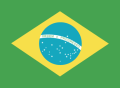
Translated from gov.br kept the tradition of the old national colours - green and yellow - in the following manner: a yellow rhombus on a green field, having in the middle the blue celestial sphere, crossed by a white band, in an oblique direction descending from left to right, with the words “Ordem e Progresso”.
Unofficial translation by WorldometerTranslated from Planalto, Brazil Considering that the colours of our old flag recall the struggles and the glorious victories of the army and the navy in the defence of the homeland;
Considering, therefore, that these colours, independently of the form of government, symbolise the perpetuity and integrity of the homeland among the other nations;
Unofficial translation by WorldometerTranslated from gov.br The stars, which form part of the sphere, represent the Southern Cross constellation. Each one corresponds to a state and, in accordance with Law No. 8,421, of 11 May 1992, must be updated in the event of the creation or extinction of any state. The only star above the inscription “Ordem e Progresso” is called Spica and represents the State of Pará.
Unofficial translation by WorldometerTranslated from the Federal Senate of Brazil Decree of 18 September 1822 – Dom Pedro, Regent and Perpetual Defender of Brazil, in decrees countersigned by José Bonifácio de Andrada e Silva, creates the Royal Flag and the coat of arms; establishes “spring green” and “gold yellow” as national colours.
Unofficial translation by WorldometerTranslated from the Federal Senate of Brazil Decree of 15 November 1889 – With the Proclamation of the Republic, the Provisional Government adopts, for three days, a version of the flag of the Lopes Trovão Republican Club.
Unofficial translation by WorldometerTranslated from gov.br After the proclamation of the Republic, in 1889, a new flag was created to represent the achievements and the historic moment for the country. Conceived by Raimundo Teixeira Mendes and Miguel Lemos, with drawing by Décio Vilares, it was inspired by the Flag of the Empire, designed by the French painter Jean Baptiste Debret.
Unofficial translation by WorldometerTranslated from the Federal Senate of Brazil Decree No. 04, of 19 November 1889 – Establishes the distinctive features of the National Flag and of the National Arms; and of the seals and signets of the Republic.
Unofficial translation by WorldometerTranslated from the Federal Senate of Brazil Law No. 8,421, of 12 May 1992 – Amends Law No. 5,700, with regard to the updating of the National Symbols, now no longer unalterable. The
new States of the Federation come to be represented by new stars; and those corresponding to extinct States are removed from the National Flag.
Unofficial translation by WorldometerSources:- gov.br ↗
- planalto.gov.br ↗ - Planalto, Brazil
- www2.senado.leg.br ↗ - the Federal Senate of Brazil
- National anthem
- Hino Nacional Brasileiro1:53
- Title (in Portuguese)
- Hino Nacional Brasileiro
- Title (in English, translated)
- Brazilian National Anthem
- Lyrics
1Ouviram do Ipiranga às margens plácidas De um povo heróico o brado retumbante, E o sol da liberdade, em raios fúlgidos, Brilhou no céu da Pátria nesse instante,
Se o penhor dessa igualdade Conseguimos conquistar com braço forte, Em teu seio, ó, Liberdade, Desafia o nosso peito a própria morte!
Ó Pátria amada, Idolatrada, Salve! Salve!
Brasil, um sonho intenso, um raio vívido, De amor e de esperança à terra desce, Se em teu formoso céu, risonho e límpido, A imagem do Cruzeiro resplandece.
Gigante pela própria natureza, és belo, és forte, impávido colosso, E o teu futuro espelha essa grandeza,
ChorusTerra adorada, Entre outras mil, és tu, Brasil, Ó Pátria amada! Dos filhos deste solo és mãe gentil, Pátria amada, Brasil!
2Deitado eternamente em berço esplêndido, ao som do mar e à luz do céu profundo, Fulguras, ó Brasil, florão da América, Iluminado ao sol do novo mundo!
Do que a terra mais garrida Teus risonhos lindos campos tem mais flores, “Nossos bosques tem mais vida” “Nossa vida” no teu seio “mais amores”
Ó Pátria amada, Idolatrada, Salve! Salve!
Brasil, de amor eterno seja símbolo O lábaro que ostentas estrelado, E diga o verde-louro dessa flâmula “Paz no futuro e glória no passado.”
Mas se ergues da justiça a clava forte, Verás que um filho teu não foge à luta, Nem teme, quem te adora, a própria morte,
Terra adorada, Entre outras mil, és tu, Brasil,Source: - Citizens
- Brazilians
- Official name:Constitution of the Federative Republic of Brazil ↗ - Supreme Federal Court
- Official name, Citizens:The World Factbook: Brazil - CIA
- National flag:gov.br ↗
- National flag:planalto.gov.br ↗ - Planalto, Brazil
- National flag:www2.senado.leg.br ↗ - the Federal Senate of Brazil
- National anthem:nationalanthems.info ↗
Geography
- Location
- Eastern South America, bordering the Atlantic Ocean
- Total area
- 8,515,770 km²
- Land area
- 8,358,140 km²
- Water area
- 157,630 km²
- Land borders
- 16,145 km(10 countries)
- Coastline
- 7,491 km
- Terrain
Mostly flat to rolling lowlands in north; some plains, hills, mountains, and narrow coastal belt - Mean elevation
- 320 m
- Highest point
- 2,994 mPico da Neblina
- Lowest point
- 0 mAtlantic Ocean
- Climate
Mostly tropical, but temperate in south - Avg. temperature
- 25 °C
- Avg. daily range
- 21.1 to 30.1 °C
- Annual precipitation
- 1,785 mm
Temperature °CMeanDaily rangePrecipitation mmMonthly climate normals Month Avg. high, °C Mean, °C Avg. low, °C Precipitation, mm January 30 25.4 22 238 February 30 25.3 22 224 March 29.9 25.2 21.9 239 April 29.6 24.9 21.4 190 May 28.9 24.1 20.4 138 June 28.9 23.6 19.6 79 July 29.3 23.6 19.1 59 August 30.8 24.7 19.8 51 September 31.6 25.7 21 73 October 31.6 26.1 21.8 119 November 30.7 25.8 21.9 167 December 30.4 25.6 22.1 208 Country-wide averages over 1991–2020.
Sources:- The World Factbook: Brazil - CIA
- Climate Change Knowledge Portal (ERA5 reanalysis) ↗ - World Bank
- Weather
- Loading
- Land use2023
- Arable6.7%Perm. crops0.9%Pasture20.7%Forest58.9%Other12.7%
- Arable land
- 55,642,000 hectares (6.7%)
- Permanent crops
- 7,756,000 hectares (0.9%)
- Permanent meadows & pastures
- 173,360,800 hectares (20.7%)
- Forest
- 492,598,736 hectares (58.9%)
- Other land
- 106,456,464 hectares (12.7%)
Source: - Major rivers
- Major lakes
- Lagoa dos Patos10,140 km²Lagoa Mirim2,970 km²
- Natural hazards2026
- River floods7.7Very high#26/191Epidemics6.4High#39/191Coastal floods5.0High#60/191Drought4.5Medium#60/191Earthquakes0.6Very low#123/191Tsunamis0.0Very lowTropical cyclones0.0Very low
Scores out of 10, ranks out of 191 countries.
Source:- INFORM Risk Index ↗ - European Commission Joint Research Centre
- Location, Land borders, Coastline, Terrain, Mean elevation, Highest point, Lowest point, Climate, Major rivers, Major lakes:The World Factbook: Brazil - CIA
- Climate:Climate Change Knowledge Portal (ERA5 reanalysis) ↗ - World Bank
- Land use:FAOSTAT Land Use domain ↗ - FAO
- Natural hazards:INFORM Risk Index ↗ - European Commission Joint Research Centre
Demographics
- Population change2026
- +0.35% per year+750,261 people/yearWorld Rank154thof 237
- Birth rate
- 11.7 per 1,000 population
- Death rate
- 7.3 per 1,000 population
- Net migration rate
- −1.0 per 1,000 population
- 2026
- 35.2 yearsWorld Rank103rdof 237
- Age structure2026
- 0-14 years19.1%15-64 years69.0%65 years +11.9%
- Share aged 65 and over
- 11.9%
- Share aged under 18
- 23.2%
- Total dependency ratio
- 45
- Youth dependency ratio
- 28
- Elderly dependency ratio
- 17
- Sex ratio
- 0.97 male / female
MaleAgeFemalePopulation by age group, % of total population Age Male Female 80+ 0.8% 1.3% 70-79 2.4% 3.1% 60-69 4.5% 5.1% 50-59 5.8% 6.2% 40-49 7.4% 7.7% 30-39 7.6% 7.6% 20-29 7.4% 7.3% 10-19 6.9% 6.6% 0-9 6.3% 6.1% - 2026
- 0.51 below the replacement level for Brazil ()1.59 births per womanreplacement 2.10123World Rank152ndof 237
- 0.76 daughters per woman0.24 below replacement, long-run each generation smaller than the lastreplacement 1.000.511.5
- 2026
- +4.3 per 1,000 populationfor every 1,000 people, 4.3 more births than deaths a year
- 2026
- −1.0 per 1,000 population
- Urbanization2026
- 88.5% live in cities188,920,662 urban residents
- Largest cities2025
- São Paulo, Rio de Janeiro, Brasília, FortalezaRankCityPopulation (2025 unofficial estimate)1São Paulo11,887,0702Rio de Janeiro6,730,6603Brasília2,891,2704Fortaleza2,578,4805Salvador2,564,2006Belo Horizonte2,415,8707Manaus2,281,3908Curitiba1,830,8009Recife1,588,38010Goiânia1,500,980Source:
- Brazilian Institute of Geography and Statistics (2025 unofficial estimate), via City Population by Thomas Brinkhoff ↗
- Population distribution
- The vast majority of people live along or near the Atlantic coast in the east; the population core is in the southeast, anchored by the cities of São Paolo, Brasília, and Rio de Janeiro.
- Ethnic groups2022
- Mixed45.3%White43.5%Black10.2%Indigenous0.6%Asian0.4%
- Religions2022
- Roman Catholic56.8%Evangelical26.9%None9.3%Other4.0%Spiritism (Espírita)1.8%Unspecified1.4%Umbanda and Candomblé1.1%Indigenous religions.06%Undeclared0.2%
- Languages
- Portuguese (Português)
- Population, Population change, Median age, Age structure, Total fertility rate, Net reproduction rate, Natural change, Net migration rate:UN World Population Prospects ↗
- Urbanization:UN World Urbanization Prospects ↗
- Largest cities:Brazilian Institute of Geography and Statistics (2025 unofficial estimate), via City Population by Thomas Brinkhoff ↗
- Population distribution, Ethnic groups, Religions:The World Factbook: Brazil - CIA
Government & Administration
- Form of state
- RepublicThe President is elected with the Vice-President by direct, secret universal vote, with a second round if needed; the state is "the Federative Republic of Brazil", a union of States, Municipalities and the Federal District (Arts. 1, 14, 77).Source:
- System of government
- PresidentialThe President exercises executive power and appoints and dismisses Ministers of State; Congress may summon ministers and hold the President to account only through impeachment, and the text gives no power to dissolve Congress (Arts. 2, 50, 76, 84, 86).Source:
- Constituição da República Federativa do Brasil de 1988, texto compilado ↗, Arts. 2, 50, 76, 84, 86
- Territorial organisation
- Federal
- Official websites
- Government (in Portuguese)
- President
- Parliament (in Portuguese)
- Capital
- Brasília2.9 million people(2022)
- National holidays
- 10 days in 2026
- ThuJan 1Universal Fraternization Day
- FriApr 3Good Friday
- TueApr 21Tiradentes' Day
- FriMay 1Worker's Day
- MonSep 7Independence Day
- MonOct 12Our Lady of Aparecida
- MonNov 2All Souls' Day
- SunNov 15Republic Proclamation Day
- FriNov 20National Day of Zumbi and Black Awareness
- FriDec 25Christmas Day
Nationwide public holidays only, excluding regional, bank and government-only days.
- Time
- BRTBrasilia Standard TimeUTC−3
Brazil spans multiple time zones, the capital's is shown here. All 4 time zones
- Currency
- Brazilian Real (BRL)
- Entry requirements
- Official visa and entry information (in Portuguese, English available)
- Calling code
- +55
- Internet TLD
- .br
- ISO 3166-1 codes
- BR, BRA
- Infrastructure
- Passengers carried
- 95,398,485 by the country's airlines(2023)
- Heliports
- 1,871
- Aircraft departures
- 791,523 by the country's airlines(2023)
- Air freight
- 1,387.1 million tonne-km(2023)
- Aircraft registration prefix
- PP
Sources:- The World Factbook: Brazil - CIA
- World Development Indicators ↗ - World Bank
- 2025
- 35 / 100World Rank107thof 182Confidence interval
Corruption index score by year Year Score Lower bound Upper bound 2012 43 38 49 2013 42 36 48 2014 43 36 50 2015 38 29 47 2016 40 33 47 2017 37 30 44 2018 35 28 42 2019 35 28.3 41.7 2020 38 33.9 42.1 2021 38 35.3 40.7 2022 38 35.4 40.6 2023 36 33.6 38.4 2024 34 30 38 2025 35 30.5 39.5 Source:- Corruption Perceptions Index 2025 ↗ - Transparency International, CC BY 4.0
- Form of state, System of government, Territorial organisation:Constituição da República Federativa do Brasil de 1988, texto compilado ↗ - Presidency of the Republic of Brazil, Casa Civil
- National holidays:Open World Holidays Framework (vacanza/holidays) ↗
- Infrastructure:The World Factbook: Brazil - CIA
- Infrastructure:World Development Indicators ↗ - World Bank
- Corruption Perceptions Index:Corruption Perceptions Index 2025 ↗ - Transparency International, CC BY 4.0
Economy
- Upper middle income
- GDP growth (real)2026
- +2.2% per yearWorld Rank125thof 195
- GDP per capita (PPP)2026
- GDP per capita (nominal)
- $12,397 (83rd in the world)
Source:- 2025
- Services59.7% of GDPIndustry20.1% of GDPAgriculture6.1% of GDPManufacturing11.8%part of industry
- Households
- +63.4%
- Government
- +19.1%
- Investment
- +17.1%
- Exports
- +17.8%
- Imports
- −17.5%
The shape of the economyGDP by end useSource:- World Development Indicators ↗ - World Bank
- Inflation2026
- 4.4%down 0.7 percentage points0.7pp from 2025
- Labor force2024
- 107.9 million (51% of population)World Rank6thof 187
- Labor force participation2024
- 63.3% of people aged 15+
- Unemployment2024
- 6.8%
- Youth unemployment2024
- 15.7% ages 15 to 24
- Labor productivity2024
- $21.1 per hour worked at PPP
- Labor cost2020
- R$14.78 per hour$2.87 (USD), $6.31 (PPP)
- Budget balance2026
- 8.1% of GDP deficit
- Current account
- 2.4% of GDP, $63.5 billion deficit
Source: - Debt2024
- Government debt87.3% of GDPHousehold debt36.4% of GDPCompany debt57.1% of GDPInterest on debt8.3% of GDPCentral government debt83.5% of GDP
- Trade2025
- Goods$350.5 billion86.6%
- Services$54.4 billion13.4%
- Total exports
- $404.9 billion
- Change from 2024
- up 4.1 percent on the previous year4.1%
Sources:- World Development Indicators ↗ - World Bank
- The World Factbook: Brazil - CIA
- 2024
- +0.37World Rank56thof 145
- Projected GDP growth
- +1.7% a year over the next 10 years
Source:- Atlas of Economic Complexity ↗ - Harvard Growth Lab
- Agricultural products2024
- Sugar cane, Soya beans, Oranges, and 4 more
- 1Sugar cane3.7×
- 2Soya beans3.4×
- 3Oranges2.2×
- 4Meat of chickens (fresh or chilled)1×
- 5Maize (corn)0.9×
- 6Cassava (fresh)0.5×
- 7Raw milk of cattle0.4×
ProductSource:- FAOSTAT ↗ - Food and Agriculture Organization
- Gold reserves2025
- 172 tonnesWorth $24.2 billion, 7% of total official reserves by value
- Industries
- textiles, shoes, chemicals, cement, lumber, iron ore, tin, steel, aircraft, motor vehicles and parts, other machinery and equipment
- Income level, GDP by sector, Trade, Gold reserves:World Development Indicators ↗ - World Bank
- GDP (nominal), GDP growth (real), GDP per capita (PPP), Inflation, Budget balance:IMF World Economic Outlook ↗
- Labor force, Labor force participation, Unemployment, Youth unemployment, Labor productivity, Labor cost:ILOSTAT ↗ - International Labour Organization
- Debt:IMF Global Debt Database ↗
- Debt:IMF Public Finances in Modern History ↗
- Trade, Industries:The World Factbook: Brazil - CIA
- Economic Complexity Index:Atlas of Economic Complexity ↗ - Harvard Growth Lab
- Agricultural products:FAOSTAT ↗ - Food and Agriculture Organization
Cost of Living
- Cost of living index
- Loading
- Monthly costs (excluding rent)
- Loading
- Rent
- Loading
- Buying an apartment
- Loading
- Average gross salary2025
- R$3,393 per month$607 (USD), $1,314 (PPP)
- Median
- R$2,200 per month($394)
- Men
- R$3,710 per month($664)
- Women
- R$3,035 per month($543)
Source:- ILOSTAT ↗ - International Labour Organization
- 2024
- R$1,412 per month, gross$262 (USD), $559 (PPP)
- Average gross salary, Minimum wage:ILOSTAT ↗ - International Labour Organization
Society
- 2023
- 0.786HighWorld Rank84thof 193BrazilWorld
Human Development Index by year Year Brazil World 1990 0.641 0.608 1991 0.645 0.611 1992 0.648 0.614 1993 0.654 0.617 1994 0.659 0.620 1995 0.666 0.625 1996 0.671 0.631 1997 0.676 0.636 1998 0.680 0.641 1999 0.684 0.646 2000 0.690 0.651 2001 0.694 0.657 2002 0.700 0.662 2003 0.705 0.669 2004 0.712 0.675 2005 0.718 0.681 2006 0.725 0.688 2007 0.732 0.694 2008 0.739 0.698 2009 0.742 0.701 2010 0.748 0.707 2011 0.753 0.713 2012 0.758 0.717 2013 0.762 0.721 2014 0.765 0.726 2015 0.764 0.731 2016 0.765 0.735 2017 0.770 0.739 2018 0.774 0.741 2019 0.776 0.745 2020 0.770 0.742 2021 0.768 0.742 2022 0.780 0.752 2023 0.786 0.756 Source:- Human Development Report ↗ - United Nations Development Programme
- 2024
- 50.3
- Mean years of schooling2023
- 8.4 years
- Expected for a child today
- 15.8 years
Source:- Human Development Report ↗ - United Nations Development Programme
- Literacy2024
- 94.7% of adults
- Education expenditure2022
- 5.6% of GDP
- Share of government spending
- 12.9%
Source:- World Development Indicators ↗ - World Bank
- Internet users2024
- 84.5% of the population
- Households with Internet access
- 83.4%
Source:- ITU DataHub ↗ - International Telecommunication Union
- Mobile subscriptions2024
- 216.1 million
- Fixed telephone lines
- 22,545,016
- Fixed broadband
- 24.1 subscriptions per 100 people
Counts subscriptions, not people.
Source:- ITU DataHub ↗ - International Telecommunication Union
- Credit-card ownership2024
- 44% of adults
- Debit-card ownership
- 74%
- Account at a bank or mobile-money provider
- 86%
- Mobile-money account
- 58%
- Made or received a digital payment
- 77%
Source:- Global Findex Database ↗ - World Bank
- Refugees hosted2025
- 267,381 people
- Asylum seekers
- 90,085
- Stateless persons
- 20
- Internally displaced persons
- 19,000All due to conflicts
- Refugees from Brazil abroad
- 4,671
Sources:- Refugee Data Finder ↗ - UN Refugee Agency
- Global Internal Displacement Database ↗ - Internal Displacement Monitoring Centre
- Inbound tourists2024
- Official tourism site6.8 million arrivalsup 7% against 20197% above 2019World Rank37thof 139
- Per resident
- 3.2 arrivals per 100 residents
- $7.4 billion
- Spending per arrival
- $1,086
- Domestic trips
- 190.9 million overnight trips by residents(2011, latest available)
- Residents' trips abroad
- 10.6 million overnight trips(2018, latest available)
- $23.9 billion
- Hotel beds
- 2.4 million(2016, latest available)
Overnight arrivals by year2010 to 2024A tourist stays at least one night. Arrivals count trips, not people.
Source:- UN Tourism Data Dashboard ↗ - UN Tourism
- UNESCO World Heritage Sites
- 24 sites15 cultural9 natural1 mixed
Site Type Brasilia Cultural Historic Salvador de Bahia Cultural Historic Ouro Preto Cultural Historic Center of the Town of Olinda Cultural Iguaçu National Park Natural Jesuit Missions of the Guaranis Cultural Rio de Janeiro: Carioca Landscapes Cultural Central Amazon Conservation Complex Natural Atlantic Forest South-East Reserves Natural Historic Center of Salvador de Bahia Cultural Sanctuary of Bom Jesus do Congonhas Cultural Serra da Capivara National Park Cultural Historic Center of Sao Luis Cultural Discovery Coast Atlantic Forest Reserves Natural Historic Center of the Town of Diamantina Cultural Pantanal Conservation Area Natural Brazilian Atlantic Islands: Fernando de Noronha and Atol das Rocas Reserves Natural Cerrado Protected Areas: Chapada dos Veadeiros and Emas National Parks Natural Historic Centre of the Town of Goiás Cultural São Francisco Square in the Town of São Cristóvão Cultural Rio de Janeiro: Carioca Landscapes between the Mountain and the Sea Cultural Pampulha Modern Ensemble Cultural Valongo Wharf Archaeological Site Cultural Paraty and Ilha Grande – Culture and Biodiversity Mixed Sítio Roberto Burle Marx Cultural Lençóis Maranhenses National Park Natural Peruaçu River Canyon Natural Source:- The World Factbook: Brazil - CIA
- Human Development Index, Mean years of schooling:Human Development Report ↗ - United Nations Development Programme
- Income inequality (Gini), Education expenditure:World Development Indicators ↗ - World Bank
- Literacy:UIS Data Browser ↗ - UNESCO Institute for Statistics
- Internet users, Mobile subscriptions:ITU DataHub ↗ - International Telecommunication Union
- Credit-card ownership:Global Findex Database ↗ - World Bank
- Refugees hosted:Refugee Data Finder ↗ - UN Refugee Agency
- Refugees hosted:Global Internal Displacement Database ↗ - Internal Displacement Monitoring Centre
- Inbound tourists:UN Tourism Data Dashboard ↗ - UN Tourism
- UNESCO World Heritage Sites:The World Factbook: Brazil - CIA
Crime & Safety
- Travel advisory (US)
- Loading
- Active humanitarian crisisAug 2026
- Medium5.2 out of 10International displacementSeverity by monthSep 2024 to Aug 2026What the score is made ofImpact of the crisis7.5Conditions of people affected4.2Complexity of the crisis4.5
Data reliability as rated by INFORM: Medium. Last updated Aug 31, 2026.
Source:- INFORM Severity Index ↗ - European Commission Joint Research Centre
- Homicide rate2024
- High by global standards18.7 per 100,000 peopleWorld Rank11thof 115
- Crime rates
- 7 offence categories
Offence Per 100,000 Count Year Homicide (victims) 18.7 39,625 2024 Serious assault 106.1 224,068 2023 Sexual violence 28.3 56,254 2013 Kidnapping 3.0 6,401 2023 Burglary 17.1 35,637 2020 Theft 644.5 1,344,822 2020 Vehicle theft 82.9 172,953 2020 A low figure can also mean weak recording.
Source:- UNODC Data Portal ↗ - UN Office on Drugs and Crime
- Prison population2022
- 399.3 per 100,000 people
- Persons held
- 839,672
Source:- UNODC Data Portal ↗ - UN Office on Drugs and Crime
- Active humanitarian crisis:INFORM Severity Index ↗ - European Commission Joint Research Centre
- Homicide rate, Crime rates, Prison population:UNODC Data Portal ↗ - UN Office on Drugs and Crime
Health
- Life expectancy2026
- 76.4 years
- Health expenditure2023
- 9.7% of GDP$1,010 per person
- Physicians2023
- 2.36 per 1,000 population
- Hospital beds2021
- 2.5 per 1,000 population
- Infant mortality2026
- 11.2 per 1,000 live births
- Maternal mortality2023
- 67 per 100,000 live births
- Alcohol consumption2022
- 9.4 litres of pure alcohol per adult per year
- Tobacco use2015latest available
- 15.2% of adults
- Men
- 19.3%
- Women
- 11.1%
Source:- Global Health Observatory ↗ - World Health Organization
- Alcohol and Tobacco Spending2023
- 1.7% of household spendingWorld Rank78thof 105
- World median
- 3.1%
Source:- The World Factbook: Brazil - CIA
- Road traffic deaths2019
- 16 per 100,000 population
- Life expectancy, Infant mortality:UN World Population Prospects ↗
- Health expenditure, Physicians, Hospital beds, Road traffic deaths:World Development Indicators ↗ - World Bank
- Maternal mortality:Maternal mortality estimates ↗ - UN Maternal Mortality Estimation Inter-agency Group
- Alcohol consumption, Tobacco use:Global Health Observatory ↗ - World Health Organization
- Alcohol and Tobacco Spending:The World Factbook: Brazil - CIA
Environment
- CO₂ emissions2024
- 491.5 Mt per yearup 2.3 percent on the previous year2.3% from 2023
- CO₂ per capita
- 2.2 t per personWorld Rank119thof 207
- Share of global CO₂
- 1.2%
- Methane (CH₄)
- 621.2 Mt CO₂-eq
- Nitrous oxide (N₂O)
- 169.1 Mt CO₂-eq
- Fluorinated gases
- 17.4 Mt CO₂-eq
- All greenhouse gases
- 1,299.2 Mt CO₂-eq
Source:- Emissions Database for Global Atmospheric Research (EDGAR) ↗ - European Commission, Joint Research Centre
- 2024
- 13.5 µg/m³ of PM2.50.8 years of life expectancy lost against the WHO guidelineMost polluted104thof 236
- WHO guideline
- 5 µg/m³
- National standard
- 10 µg/m³
- Life expectancy gain if the national standard were met
- 0.3 years
Source:- Air Quality Life Index ↗ - Energy Policy Institute at the University of Chicago
- Environmental issues
- deforestation in Amazon Basin
- illegal wildlife trade
- illegal poaching
- air and water pollution in Rio de Janeiro, Sao Paulo, and other large cities
- land degradation and water pollution from mining
- wetland degradation
- oil spills
Source:- The World Factbook: Brazil - CIA
- International agreements
- 20 of 20 landmark treaties in forceParty to 91 multilateral environmental agreements
Treaty Standing Joined Climate Paris Agreement in force 2016 UN Framework Convention on Climate Change in force 1994 Kyoto Protocol in force 2005 Ozone layer Montreal Protocol in force 1990 Vienna Convention (Ozone Layer) in force 1990 Biodiversity Convention on Biological Diversity in force 1994 CITES in force 1975 Convention on Migratory Species (Bonn) in force 2015 Cartagena Protocol on Biosafety in force 2004 Nagoya Protocol in force 2021 Land and heritage Ramsar Convention on Wetlands in force 1993 World Heritage Convention in force 1977 UN Convention to Combat Desertification in force 1997 Chemicals and waste Basel Convention in force 1992 Rotterdam Convention (PIC) in force 2004 Stockholm Convention (POPs) in force 2004 Minamata Convention on Mercury in force 2017 Oceans UN Convention on the Law of the Sea in force 1994 High Seas Treaty (BBNJ) in force 2026 MARPOL 73/78 in force 1988 Source:- International Environmental Agreements Database ↗ - Université Laval
- CO₂ emissions:Emissions Database for Global Atmospheric Research (EDGAR) ↗ - European Commission, Joint Research Centre
- Air pollution:Air Quality Life Index ↗ - Energy Policy Institute at the University of Chicago
- Environmental issues:The World Factbook: Brazil - CIA
- International agreements:International Environmental Agreements Database ↗ - Université Laval
Food & Water
- No access to safe drinking water2022
- 1.9% of the population
- Renewable water2022
- 8,647 billion m³ per year
- Per person
- 41,116 m³ per year
- Dependency ratio
- 35% originates outside the country
- Annual water withdrawal
- 68 billion m³ per year
- Withdrawn for agriculture
- 61%
- Water stress
- 1% of available freshwater withdrawn
Source:- AQUASTAT ↗ - Food and Agriculture Organization
- Undernourishment2022
- 4.2% of the population9 million people
- Obesity2024
- 30.1% of adults
- Men
- 26.1%
- Women
- 33.9%
Source:- Global Health Observatory ↗ - World Health Organization
- Underweight children2019
- 3.5% of children under five
- No access to safe drinking water, Renewable water:AQUASTAT ↗ - Food and Agriculture Organization
- Undernourishment:Food security indicators (FAOSTAT) ↗ - Food and Agriculture Organization
- Obesity:Global Health Observatory ↗ - World Health Organization
- Underweight children:World Development Indicators ↗ - World Bank
Energy
- Energy consumption2024
- Per capita
- 53.2 GJ per person
- Share of world total
- 1.8%
- Supply
- Surplusproduces 1.1× what it consumes, 2024
Source:- International Energy Statistics ↗ - U.S. Energy Information Administration
- Electricity2024
- Net importer, net 12 TWh in 2024, 1.8% of consumption737 TWh generated per year
- Generation
- 737 TWh per year
- Consumption
- 636 TWh per year
- Imports
- 14 TWh per year
- Exports
- 2.5 TWh per year
- Net
- −12 TWh per year
Source:- International Energy Statistics ↗ - U.S. Energy Information Administration
- Oil, gas & coal
- Surplusproduces 1.3× what it consumes, 2024Oil reserves202515.9 billion barrelsWorld Rank15thof 99
Oil imports and exports count crude oil only.
- Mineral resources2025
- Lithium, Rare earths
Mineral Mine production Reserves Lithiumas pure lithium 12,000 t4.1% of world 540,000 t Rare earthsas rare-earth oxide 2,000 t0.51% of world 11 million t USGS estimates. Shows only minerals where the country is a major producer.
Source:- Mineral Commodity Summaries ↗ - U.S. Geological Survey
- Energy consumption, Electricity, Oil, gas & coal:International Energy Statistics ↗ - U.S. Energy Information Administration
- Oil, gas & coal:Worldwide Oil and Gas Survey ↗ - Oil & Gas Journal
- Mineral resources:Mineral Commodity Summaries ↗ - U.S. Geological Survey
Defense
- Military expenditure2024
- 1% of GDP$20.9 billion, 2.1% of government spending
- Military personnel2025
- approximately 360,000active Armed Forces
- Army
- 220,000
- Navy
- 70,000
- Air Force
- 70,000
Source:- The World Factbook: Brazil - CIA
- Military service2025
- Conscriptionmen 18–45, generally 12 months, only 5–10% of those inducted are required to serve; voluntary men 17–45, women 18–45
In 2024, women were reported to comprise approximately 10% of the Brazilian military.
Source:- The World Factbook: Brazil - CIA
- Space program2025
- Brazilian Space Agency (Agência Espacial Brasileira, AEB; established in 1994 when Brazil’s space program was transferred from the military to civilian control); National Institute for Space Research (INPE, under the Ministry of Science, Technology and Innovations); Department of Aerospace Science and Technology (DCTA, under the Aeronautics Command (COMAER) of the Ministry of Defense)
Develops, builds, operates, and tracks satellites, including communications, remote sensing (RS), multi-mission, navigational, and scientific/testing/research; satellites are launched by foreign partners, but Brazil has a long-standing sounding (research) rocket and satellite launch vehicle (SLV) program and rocket launch facilities; cooperates with a variety of foreign space agencies and commercial entities, including those of Argentina, Canada, the ESA, individual ESA member states (particularly France and Germany), India, Japan, Russia, South Africa, South Korea, Ukraine, and the US; has a state-controlled communications company that operates Brazil’s communications satellites and a growing commercial space sector
- Launch sites
- Alcantara Launch Center (Maranhão state); Barreira do Inferno Launch Center (Rio Grande do Norte state)
- 1960s
- Established a national space program under the Air Force
- 1984
- Began satellite launch vehicle (SLV) program (Veículo Lançador de Satélites or VLS-1)
- 1985
- First communications satellite jointly produced with Canada and launched on European SLV
- 1993
- First domestically built experimental communications satellite (Satélite de Coleta de Dados, SCD-1) launched by US
- 2004
- Launched a sounding rocket into sub-orbital space, but the subsequent catastrophic failure of a VLS-1 during a test launch led to scaling back the program
- 2006
- First Brazilian astronaut to the International Space Station on a Russian rocket
- 2008
- Began work on a 3-stage microsatellite launch vehicle (Veículo Lançador de Microssatélite or VLM-1) in partnership with Germany
- 2021
- First independently produced remote sensing (RS) satellite (Amazonia-1) launched by India; signed US-led Artemis Accords on space exploration cooperation and signed cooperation agreements with the space agencies of China, India, Russia, and South Africa for the joint development of an RS satellite constellation
- 2022
- Successfully launched suborbital rocket more than 225 km (140 miles) in height
Key milestones
Source:- The World Factbook: Brazil - CIA
- Nuclear weapons2026
- None - no nuclear arsenal
- Military expenditure:SIPRI Military Expenditure Database ↗ - Stockholm International Peace Research Institute
- Military expenditure:World Development Indicators ↗ - World Bank
- Military personnel, Military service, Space program:The World Factbook: Brazil - CIA
- Nuclear weapons:Status of World Nuclear Forces ↗ - Federation of American Scientists
