

National Identity
- Official name
- Federal Republic of Nigeria
- Name etymology
named for the Niger River that flows through the west of the country to the Atlantic Ocean; the name of the river probably comes from the local Tuareg name, egereou n-igereouen (big rivers)
Sources:- Constitution of the Federal Republic of Nigeria 1999 ↗ - National Library of Nigeria
- The World Factbook: Nigeria - CIA
- Coat of arms
- National flag
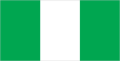
As published by Embassy of the Federal Republic of Nigeria, Dublin, Ireland The flag has three vertical bands of green, white, and green.
As published in EnglishAs published by Embassy of the Federal Republic of Nigeria, Dublin, Ireland The two green stripes represent natural wealth, and the white represents peace and unity
As published in EnglishAs published by the Nigerian Embassy in Tel-Aviv, Israel It was designed by a student, Taiwo Akinkunmi, in 1959. Mr. Taiwo Akinkunmi decided to enter a competition for the best Nigerian flag design and won. [...] The flag was raised at the Independence Day of Nigeria on 1st October 1960 for the first time.
As published in EnglishSources:- nigerianembassydublin.org ↗ - Embassy of the Federal Republic of Nigeria, Dublin, Ireland
- nigerianembassy.co.il ↗ - the Nigerian Embassy in Tel-Aviv, Israel
- National anthem
- Nigeria We Hail Thee1:46
- Title
- Nigeria We Hail Thee
- Lyrics
- English
1Nigeria we hail thee, Our own dear native land, Though tribe and tongue may differ, In brotherhood we stand, Nigerians all, are proud to serve Our sovereign Motherland.
2Our flag shall be a symbol That truth and justice reign, In peace or battle honour’d, And this we count as gain, To hand on to our children A banner without stain.
3O God of all creation, Grant this our one request, Help us to build a nation Where no man is oppressed, And so with peace and plenty Nigeria may be blessed.
- Citizens
- Nigerians
- Official name:Constitution of the Federal Republic of Nigeria 1999 ↗ - National Library of Nigeria
- Official name, Citizens:The World Factbook: Nigeria - CIA
- Coat of arms:Image credit
- National flag:nigerianembassydublin.org ↗ - Embassy of the Federal Republic of Nigeria, Dublin, Ireland
- National flag:nigerianembassy.co.il ↗ - the Nigerian Embassy in Tel-Aviv, Israel
- National anthem:nationalanthems.info ↗
- National anthem:Recording credit
Geography
- Location
- Total area
- 923,768 km²
- Land area
- 910,768 km²
- Water area
- 13,000 km²
- Land borders
- 4,477 km(4 countries)
- Coastline
- 853 km
- Terrain
Southern lowlands merge into central hills and plateaus; mountains in southeast, plains in north - Mean elevation
- 380 m
- Highest point
- 2,419 mChappal Waddi
- Lowest point
- 0 mAtlantic Ocean
- Climate
Varies equatorial in south, tropical in center, arid in north - Avg. temperature
- 27.1 °C
- Avg. daily range
- 22.2 to 32.7 °C
- Annual precipitation
- 1,090 mm
Temperature °CMeanDaily rangePrecipitation mmMonthly climate normals Month Avg. high, °C Mean, °C Avg. low, °C Precipitation, mm January 32.4 25.3 18.7 6 February 34.6 27.6 21 12 March 36.4 29.7 23.6 29 April 36.3 30.4 25.1 58 May 34.5 29.2 25 108 June 32 27.5 23.9 139 July 29.8 25.8 22.8 185 August 28.9 25.1 22.4 236 September 30.1 25.7 22.5 182 October 32 26.7 22.4 106 November 33.2 26.6 20.7 24 December 32.5 25.3 18.9 6 Country-wide averages over 1991–2020.
Sources:- The World Factbook: Nigeria - CIA
- Climate Change Knowledge Portal (ERA5 reanalysis) ↗ - World Bank
- Weather
- Loading
- Land use2023
- Arable40.5%Perm. crops8.1%Pasture27.6%Forest19.1%Other4.7%
- Arable land
- 36,872,000 hectares (40.5%)
- Permanent crops
- 7,354,209 hectares (8.1%)
- Permanent meadows & pastures
- 25,172,000 hectares (27.6%)
- Forest
- 17,383,724 hectares (19.1%)
- Other land
- 4,295,067 hectares (4.7%)
Source: - Major lakes
- Lake Chad10,360 km²
- Natural hazards2026
- River floods8.3Very high#16/191Epidemics8.0Very high#2/191Coastal floods6.5High#28/191Drought3.1Low#97/191Earthquakes0.1Very low#127/191Tsunamis0.0Very lowTropical cyclones0.0Very low
Scores out of 10, ranks out of 191 countries.
Source:- INFORM Risk Index ↗ - European Commission Joint Research Centre
- Location, Land borders, Coastline, Terrain, Mean elevation, Highest point, Lowest point, Climate, Major rivers, Major lakes:The World Factbook: Nigeria - CIA
- Climate:Climate Change Knowledge Portal (ERA5 reanalysis) ↗ - World Bank
- Land use:FAOSTAT Land Use domain ↗ - FAO
- Natural hazards:INFORM Risk Index ↗ - European Commission Joint Research Centre
Demographics
- Population change2026
- +2.06% per year+4,904,050 people/yearWorld Rank42ndof 237
- Birth rate
- 31.8 per 1,000 population
- Death rate
- 11.5 per 1,000 population
- Net migration rate
- 0.0 per 1,000 population
- 2026
- 18.3 yearsWorld Rank218thof 237
- Age structure2026
- 0-14 years40.0%15-64 years56.9%65 years +3.1%
- Share aged 65 and over
- 3.1%
- Share aged under 18
- 47.0%
- Total dependency ratio
- 76
- Youth dependency ratio
- 70
- Elderly dependency ratio
- 5
- Sex ratio
- 1.02 male / female
MaleAgeFemalePopulation by age group, % of total population Age Male Female 80+ 0.2% 0.2% 70-79 0.7% 0.7% 60-69 1.5% 1.6% 50-59 2.8% 2.8% 40-49 4.4% 4.3% 30-39 6.0% 5.8% 20-29 9.0% 8.6% 10-19 12.2% 11.8% 0-9 13.9% 13.5% - 2026
- 1.60 above the replacement level for Nigeria ()4.20 births per womanreplacement 2.6012345World Rank16thof 237
- 1.63 daughters per woman0.63 above replacement, long-run each generation larger than the lastreplacement 1.000.511.52
- 2026
- +20.3 per 1,000 populationfor every 1,000 people, 20.3 more births than deaths a year
- 2026
- 0.0 per 1,000 population
- Urbanization2026
- 64.6% live in cities156,548,433 urban residents
- Largest urban areas2026
- Lagos, Onitsha, Kano, OwerriRankUrban AreaPopulation (2026 estimate)1Lagos12,956,6392Onitsha5,761,7183Kano4,906,9174Owerri3,948,5675Ibadan3,763,6756Port Harcourt2,381,8387Kaduna1,913,1878Benin City1,867,7839Warri1,648,29310Uyo1,605,851
Unlike official city figures, UN urban areas cover the entire built-up area, which can include multiple cities and towns.
- Population distribution
- Largest population of any African nation; significant population clusters are scattered throughout the country, with the highest density areas being in the south and southwest.
- Ethnic groups2018
- Hausa30.0%Yoruba15.5%Igbo (Ibo)15.2%Fulani6.0%Tiv2.4%Kanuri/Beriberi2.4%Ibibio1.8%Ijaw/Izon1.8%Other24.9%
Nigeria is composed of more than 250 ethnic groups.
Source:- The World Factbook: Nigeria - CIA
- Religions2018
- Muslim53.5%Roman Catholic10.6%Other Christian35.3%Other0.6%
- Languages
- English
- Population, Population change, Median age, Age structure, Total fertility rate, Net reproduction rate, Natural change, Net migration rate:UN World Population Prospects ↗
- Urbanization, Largest cities:UN World Urbanization Prospects ↗
- Population distribution, Ethnic groups, Religions:The World Factbook: Nigeria - CIA
Government & Administration
- Form of state
- RepublicThe President is Head of State, elected directly with a majority and at least a quarter of the votes in two-thirds of the States; the state is "the Federal Republic of Nigeria", a Federation of States and a Federal Capital Territory (ss. 2, 130, 134).Source:
- System of government
- PresidentialThe President is Chief Executive and appoints Ministers subject to Senate confirmation; the National Assembly can remove the President only for gross misconduct, not by a confidence vote, and both Houses stand dissolved after a fixed four-year term (ss. 64, 130, 143, 147).Source:
- Constitution of the Federal Republic of Nigeria 1999, Cap. C23 L.F.N. 2004 ↗, ss. 64, 130, 143, 147
- Territorial organisation
- Federal
- Official websites
- Capital
- Abuja1.7 million people(2012)
- National holidays
- 14 days in 2026
- ThuJan 1New Year's Day
- ThuMar 19Eid al-Fitr
- FriMar 20Eid al-Fitr Holiday
- FriApr 3Good Friday
- MonApr 6Easter Monday
- FriMay 1Workers' Day
- ThuMay 28Eid al-Adha (estimated)
- FriMay 29Eid al-Adha Holiday (estimated)
- FriJun 12Democracy Day
- WedAug 26Prophet's Birthday (estimated)
- ThuOct 1National Day
- FriDec 25Christmas Day
- SatDec 26Boxing Day
- MonDec 28Boxing Day (observed)
Nationwide public holidays only, excluding regional, bank and government-only days.
- Time
- WATWest Africa TimeUTC+1
- Currency
- Nigerian Naira (NGN)
- Entry requirements
- Official visa and entry information
- Calling code
- +234
- Internet TLD
- .ng
- ISO 3166-1 codes
- NG, NGA
- Infrastructure
- Passengers carried
- 5,269,404 by the country's airlines(2023)
- Heliports
- 15
- Aircraft departures
- 61,466 by the country's airlines(2023)
- Air freight
- 3.1 million tonne-km(2023)
- Aircraft registration prefix
- 5N
Sources:- The World Factbook: Nigeria - CIA
- World Development Indicators ↗ - World Bank
- Passenger rail
- Nigerian Railway Corporation
- 2025
- 26 / 100World Rank142ndof 182Confidence interval
Corruption index score by year Year Score Lower bound Upper bound 2012 27 22 31 2013 25 20 30 2014 27 22 32 2015 26 22 30 2016 28 24 31 2017 27 24 30 2018 27 24 30 2019 26 22.9 29.1 2020 25 22.6 27.4 2021 24 21.4 26.6 2022 24 21.4 26.6 2023 25 22.3 27.7 2024 26 23.6 28.4 2025 26 23.6 28.4 Source:- Corruption Perceptions Index 2025 ↗ - Transparency International, CC BY 4.0
- Form of state, System of government, Territorial organisation:Constitution of the Federal Republic of Nigeria 1999, Cap. C23 L.F.N. 2004 ↗ - National Human Rights Commission of Nigeria
- National holidays:Open World Holidays Framework (vacanza/holidays) ↗
- Infrastructure:The World Factbook: Nigeria - CIA
- Infrastructure:World Development Indicators ↗ - World Bank
- Corruption Perceptions Index:Corruption Perceptions Index 2025 ↗ - Transparency International, CC BY 4.0
Economy
- Lower middle income
- GDP growth (real)2026
- +4.2% per yearWorld Rank56thof 195
- GDP per capita (PPP)2026
- GDP per capita (nominal)
- $1,594 (167th in the world)
Source:- 2025
- Services58.2% of GDPIndustry16.4% of GDPAgriculture23% of GDPManufacturing8.3%part of industryThe shape of the economySource:
- World Development Indicators ↗ - World Bank
- Inflation2026
- 15.6%down 7.4 percentage points7.4pp from 2025
- Labor force2024
- 113.3 million (49% of population)World Rank5thof 187
- Labor force participation2024
- 82.6% of people aged 15+
- Unemployment2024
- 3.0%
- Youth unemployment2024
- 5.1% ages 15 to 24
- Labor productivity2024
- $5.5 per hour worked at PPP
- Budget balance2026
- 3.3% of GDP deficit
- Current account
- 7% of GDP, $27.2 billion surplus
Source: - Debt2024
- Government debt52.9% of GDPInterest on debt2.5% of GDPCentral government debt49.7% of GDP
- Trade2025
- Goods$57.5 billion91.9%
- Services$5.1 billion8.1%
- Total exports
- $62.5 billion
- Change from 2024
- up 8.7 percent on the previous year8.7%
Sources:- World Development Indicators ↗ - World Bank
- The World Factbook: Nigeria - CIA
- 2024
- −2.26World Rank141stof 145
- Projected GDP growth
- +2.4% a year over the next 10 years
Source:- Atlas of Economic Complexity ↗ - Harvard Growth Lab
- Agricultural products2024
- Yams, Taro, Cow peas (dry), and 7 more
- 1Yams34.7×
- 2Taro23.2×
- 3Cow peas (dry)20.8×
- 4Cassava (fresh)9×
- 5Sorghum5×
- 6Groundnuts (in shell)3.7×
- 7Bananas2.4×
- 8Sweet potatoes2.2×
- 9Oil palm fruit1.3×
- 10Tomatoes1×
ProductSource:- FAOSTAT ↗ - Food and Agriculture Organization
- Gold reserves2025
- 21.4 tonnesWorth $3 billion, 7% of total official reserves by value
- Industries
- crude oil, coal, tin, columbite
- rubber products, wood
- hides and skins, textiles, cement and other construction materials, food products, footwear, chemicals, fertilizer, printing, ceramics, steel
- Income level, GDP by sector, Trade, Gold reserves:World Development Indicators ↗ - World Bank
- GDP (nominal), GDP growth (real), GDP per capita (PPP), Inflation, Budget balance:IMF World Economic Outlook ↗
- Labor force, Labor force participation, Unemployment, Youth unemployment, Labor productivity:ILOSTAT ↗ - International Labour Organization
- Debt:IMF Global Debt Database ↗
- Debt:IMF Public Finances in Modern History ↗
- Trade, Industries:The World Factbook: Nigeria - CIA
- Economic Complexity Index:Atlas of Economic Complexity ↗ - Harvard Growth Lab
- Agricultural products:FAOSTAT ↗ - Food and Agriculture Organization
Cost of Living
- Cost of living index
- Loading
- Monthly costs (excluding rent)
- Loading
- Rent
- Loading
- Buying an apartment
- Loading
- Average gross salary2024
- NGN 76,489 per month$52 (USD), $288 (PPP)
- Median
- NGN 50,000 per month($34)
- Men
- NGN 83,737 per month($57)
- Women
- NGN 61,116 per month($41)
Source:- ILOSTAT ↗ - International Labour Organization
- 2024
- NGN 65,000 per month, gross$44 (USD), $245 (PPP)
- Share of the average gross salary
- 85%
Source:- ILOSTAT ↗ - International Labour Organization
- Average gross salary, Minimum wage:ILOSTAT ↗ - International Labour Organization
Society
- 2023
- 0.560MediumWorld Rank164thof 193NigeriaWorld
Human Development Index by year Year Nigeria World 1990 0.379 0.608 1991 0.383 0.611 1992 0.388 0.614 1993 0.393 0.617 1994 0.397 0.620 1995 0.402 0.625 1996 0.408 0.631 1997 0.413 0.636 1998 0.419 0.641 1999 0.425 0.646 2000 0.435 0.651 2001 0.438 0.657 2002 0.451 0.662 2003 0.464 0.669 2004 0.477 0.675 2005 0.484 0.681 2006 0.489 0.688 2007 0.492 0.694 2008 0.497 0.698 2009 0.499 0.701 2010 0.502 0.707 2011 0.508 0.713 2012 0.512 0.717 2013 0.517 0.721 2014 0.524 0.726 2015 0.530 0.731 2016 0.532 0.735 2017 0.534 0.739 2018 0.537 0.741 2019 0.544 0.745 2020 0.547 0.742 2021 0.554 0.742 2022 0.557 0.752 2023 0.560 0.756 Source:- Human Development Report ↗ - United Nations Development Programme
- 2022
- 33.9
- Mean years of schooling2023
- 7.6 years
- Expected for a child today
- 10.5 years
Source:- Human Development Report ↗ - United Nations Development Programme
- Literacy2024
- 70.4% of adults
- Education expenditure2023
- 0.3% of GDP
- Share of government spending
- 3.6%
Source:- World Development Indicators ↗ - World Bank
- Internet users2024
- 41.2% of the population
- Households with Internet access
- 44.9%
Source:- ITU DataHub ↗ - International Telecommunication Union
- Mobile subscriptions2024
- 164.6 million
- Fixed telephone lines
- 102,714
- Fixed broadband
- 0.1 subscriptions per 100 people
Counts subscriptions, not people.
Source:- ITU DataHub ↗ - International Telecommunication Union
- Credit-card ownership2024
- 3% of adults
- Debit-card ownership
- 48%
- Account at a bank or mobile-money provider
- 63%
- Mobile-money account
- 33%
- Made or received a digital payment
- 54%
Source:- Global Findex Database ↗ - World Bank
- Refugees hosted2025
- 123,923 people
- Asylum seekers
- 15,115
- Internally displaced persons
- 3,666,0003,496,000 due to conflicts, 170,000 due to disasters
- Refugees from Nigeria abroad
- 480,725
Sources:- Refugee Data Finder ↗ - UN Refugee Agency
- Global Internal Displacement Database ↗ - Internal Displacement Monitoring Centre
- Inbound tourists2024
- Official tourism site538,927 arrivalsdown 73% against 201973% below 2019World Rank100thof 139
- Per resident
- 0.2 arrivals per 100 residents
- All visitors
- 1.3 million arrivals, overnight and same-day
- Visitor spending in the country
- $344.4 million
- Spending per arrival
- $639
- Share of GDP
- 4.3% tourism direct GDP(2020, latest available)
- Domestic trips
- 1.8 million overnight trips by residents
- Residents' spending abroad
- $7.1 billion
- Hotel beds
- 693,766
Overnight arrivals by year2010 to 2024A tourist stays at least one night. Arrivals count trips, not people.
Source:- UN Tourism Data Dashboard ↗ - UN Tourism
- UNESCO World Heritage Sites
- 2 sites2 cultural
Site Sukur Cultural Landscape Osun-Osogbo Sacred Grove Source:- The World Factbook: Nigeria - CIA
- Human Development Index, Mean years of schooling:Human Development Report ↗ - United Nations Development Programme
- Income inequality (Gini), Education expenditure:World Development Indicators ↗ - World Bank
- Literacy:UIS Data Browser ↗ - UNESCO Institute for Statistics
- Internet users, Mobile subscriptions:ITU DataHub ↗ - International Telecommunication Union
- Credit-card ownership:Global Findex Database ↗ - World Bank
- Refugees hosted:Refugee Data Finder ↗ - UN Refugee Agency
- Refugees hosted:Global Internal Displacement Database ↗ - Internal Displacement Monitoring Centre
- Inbound tourists:UN Tourism Data Dashboard ↗ - UN Tourism
- UNESCO World Heritage Sites:The World Factbook: Nigeria - CIA
Crime & Safety
- Travel advisory (US)
- Loading
- Active humanitarian crisisAug 2026
- Very high8.5 out of 10Conflict and violence, International displacement
Crisis Since Sep 2024 Severity Country overallAll crises below combined 8.5Very high Conflict in the BAY statesConflict and violence 8.6Very high Conflict in North West NigeriaConflict and violence 7.8High Conflict in North Central NigeriaConflict and violence 7.3High International displacement from Cameroon to NigeriaInternational displacement 4.6Medium Data reliability as rated by INFORM: Very high. Last updated Aug 31, 2026.
Source:- INFORM Severity Index ↗ - European Commission Joint Research Centre
- Homicide rate2023
- High by global standards15.7 per 100,000 peopleWorld Rank13thof 115
- Crime rates
- 7 offence categories
Offence Per 100,000 Count Year Homicide (victims) 15.7 35,884 2023 Serious assault 9.1 16,487 2013 Sexual violence 1.0 1,788 2013 Kidnapping 0.3 574 2013 Burglary 1.4 2,520 2013 Theft 13.3 24,068 2013 Vehicle theft 1.1 2,043 2013 A low figure can also mean weak recording.
Source:- UNODC Data Portal ↗ - UN Office on Drugs and Crime
- Prison population2022
- 31.7 per 100,000 people
- Persons held
- 70,797
Source:- UNODC Data Portal ↗ - UN Office on Drugs and Crime
- Active humanitarian crisis:INFORM Severity Index ↗ - European Commission Joint Research Centre
- Homicide rate, Crime rates, Prison population:UNODC Data Portal ↗ - UN Office on Drugs and Crime
Health
- Life expectancy2026
- 55.0 years
- Health expenditure2023
- 4.2% of GDP$67 per person
- Physicians2023
- 0.38 per 1,000 population
- Hospital beds2004latest available
- 0.5 per 1,000 population
- Infant mortality2026
- 66.9 per 1,000 live births
- Maternal mortality2023
- 993 per 100,000 live births
- Alcohol consumption2022
- 2.3 litres of pure alcohol per adult per year
- Tobacco use2015latest available
- 4.7% of adults
- Men
- 8.7%
- Women
- 0.7%
Source:- Global Health Observatory ↗ - World Health Organization
- Alcohol and Tobacco Spending2023
- 0.9% of household spendingWorld Rank92ndof 105
- World median
- 3.1%
Source:- The World Factbook: Nigeria - CIA
- Road traffic deaths2019
- 20.7 per 100,000 population
- Life expectancy, Infant mortality:UN World Population Prospects ↗
- Health expenditure, Physicians, Hospital beds, Road traffic deaths:World Development Indicators ↗ - World Bank
- Maternal mortality:Maternal mortality estimates ↗ - UN Maternal Mortality Estimation Inter-agency Group
- Alcohol consumption, Tobacco use:Global Health Observatory ↗ - World Health Organization
- Alcohol and Tobacco Spending:The World Factbook: Nigeria - CIA
Environment
- CO₂ emissions2024
- 131.9 Mt per yearup 4.8 percent on the previous year4.8% from 2023
- CO₂ per capita
- 0.6 t per personWorld Rank169thof 207
- Share of global CO₂
- 0.33%
- Methane (CH₄)
- 175.1 Mt CO₂-eq
- Nitrous oxide (N₂O)
- 29 Mt CO₂-eq
- Fluorinated gases
- 14.5 Mt CO₂-eq
- All greenhouse gases
- 350.6 Mt CO₂-eq
Source:- Emissions Database for Global Atmospheric Research (EDGAR) ↗ - European Commission, Joint Research Centre
- 2024
- 30.5 µg/m³ of PM2.52.5 years of life expectancy lost against the WHO guidelineMost polluted19thof 236
- WHO guideline
- 5 µg/m³
- National standard
- 20 µg/m³
- Life expectancy gain if the national standard were met
- 1 years
Source:- Air Quality Life Index ↗ - Energy Policy Institute at the University of Chicago
- Environmental issues
- urban air and water pollution
- rapid deforestation
- soil degradation
- loss of arable land
- water, air, and soil pollution from oil spills
Source:- The World Factbook: Nigeria - CIA
- International agreements
- 19 of 20 landmark treaties in forceParty to 93 multilateral environmental agreements
Treaty Standing Joined Climate Paris Agreement in force 2017 UN Framework Convention on Climate Change in force 1994 Kyoto Protocol in force 2005 Ozone layer Montreal Protocol in force 1989 Vienna Convention (Ozone Layer) in force 1989 Biodiversity Convention on Biological Diversity in force 1994 CITES in force 1975 Convention on Migratory Species (Bonn) in force 1987 Cartagena Protocol on Biosafety in force 2003 Nagoya Protocol in force 2022 Land and heritage Ramsar Convention on Wetlands in force 2001 World Heritage Convention in force 1975 UN Convention to Combat Desertification in force 1997 Chemicals and waste Basel Convention in force 1992 Rotterdam Convention (PIC) in force 2004 Stockholm Convention (POPs) in force 2004 Minamata Convention on Mercury in force 2018 Oceans UN Convention on the Law of the Sea in force 1994 High Seas Treaty (BBNJ) signed 2024, not ratified MARPOL 73/78 in force 2002 Source:- International Environmental Agreements Database ↗ - Université Laval
- CO₂ emissions:Emissions Database for Global Atmospheric Research (EDGAR) ↗ - European Commission, Joint Research Centre
- Air pollution:Air Quality Life Index ↗ - Energy Policy Institute at the University of Chicago
- Environmental issues:The World Factbook: Nigeria - CIA
- International agreements:International Environmental Agreements Database ↗ - Université Laval
Food & Water
- No access to safe drinking water2022
- 31.5% of the population
- Renewable water2022
- 286 billion m³ per year
- Per person
- 1,283 m³ per year
- Dependency ratio
- 23% originates outside the country
- Annual water withdrawal
- 12 billion m³ per year
- Withdrawn for agriculture
- 44%
- Water stress
- 10% of available freshwater withdrawn
Source:- AQUASTAT ↗ - Food and Agriculture Organization
- Undernourishment2022
- 17% of the population36.3 million people
- Obesity2024
- 13.7% of adults
- Men
- 8.5%
- Women
- 18.9%
Source:- Global Health Observatory ↗ - World Health Organization
- Underweight children2021
- 24.4% of children under five
- No access to safe drinking water, Renewable water:AQUASTAT ↗ - Food and Agriculture Organization
- Undernourishment:Food security indicators (FAOSTAT) ↗ - Food and Agriculture Organization
- Obesity:Global Health Observatory ↗ - World Health Organization
- Underweight children:World Development Indicators ↗ - World Bank
Energy
- Energy consumption2024
- Per capita
- 7.97 GJ per person
- Share of world total
- 0.29%
- Supply
- Surplusproduces 2.7× what it consumes, 2024
Source:- International Energy Statistics ↗ - U.S. Energy Information Administration
- Electricity2024
- Exports only, 2.3 TWh exported, nothing imported in 202438 TWh generated per year
- Generation
- 38 TWh per year
- Consumption
- 30 TWh per year
- Exports
- 2.3 TWh per year
Source:- International Energy Statistics ↗ - U.S. Energy Information Administration
- Oil, gas & coal
- Surplusproduces 3.2× what it consumes, 2024Oil reserves202537.5 billion barrelsWorld Rank11thof 99Exports20181.9 million b/d
Oil imports and exports count crude oil only.
- Mineral resources2025
- Rare earths
Mineral Mine production Reserves Rare earthsas rare-earth oxide 1,500 t0.38% of world Not available USGS estimates. Shows only minerals where the country is a major producer.
Source:- Mineral Commodity Summaries ↗ - U.S. Geological Survey
- Energy consumption, Electricity, Oil, gas & coal:International Energy Statistics ↗ - U.S. Energy Information Administration
- Oil, gas & coal:Worldwide Oil and Gas Survey ↗ - Oil & Gas Journal
- Mineral resources:Mineral Commodity Summaries ↗ - U.S. Geological Survey
Defense
- Military expenditure2024
- 0.6% of GDP$1.1 billion, 3.1% of government spending
- Military personnel2025
- estimated 140,000active Armed ForcesEstimates vary.
- Military service2025
- Voluntaryno conscription; men and women 18–25
- Space program2025
- National Space Research and Development Agency (NARSDA; established 1999); Defense Space Administration (DSA; established 2014)
Has a national space program that focuses on acquiring satellites for agricultural and environmental applications, meteorology, mining and disaster monitoring, security, and socio-economic development; designs, builds (mostly with foreign assistance), and operates satellites; processes overhead imagery data for analysis and sharing; developing additional capabilities in satellite and satellite payload production, including remote sensing technologies; has a sounding rocket program for researching rockets and rocket propulsion, with goal of launching domestically produced satellites into space from a Nigerian spaceport by 2030; works with a variety of foreign space agencies and industries, including those of Algeria, Bangladesh, Belarus, China, Ghana, India, Japan, Kenya, Mongolia, South Africa, Thailand, Turkey, the UK, the US, and Vietnam; has a government-owned satellite company and a small commercial aerospace sector
- 2003
- First remote sensing (RS) microsatellite (NigeriaSat-1) built jointly with the UK and launched by Russia
- 2007
- First communications satellite (NigSatCom-1) built and launched by China (failed in orbit, 2008)
- 2011
- First domestically built remote sensing (RS) satellite (NigeriaSat-X) launched by Russia
- 2019
- Inaugurated a geospatial data analysis center
- 2022
- Signed US-led Artemis Accords for space exploration
- 2023
- First military reconnaissance RS satellite (DelSat-1) launched by China
Key milestones
NARSDA originated from the National Centre for Remote Sensing, the National Committee on Space Applications (both established in 1987), and the Directorate of Science (established 1993)
Source:- The World Factbook: Nigeria - CIA
- Nuclear weapons2026
- None - no nuclear arsenal
- Military expenditure:SIPRI Military Expenditure Database ↗ - Stockholm International Peace Research Institute
- Military expenditure:World Development Indicators ↗ - World Bank
- Military personnel, Military service, Space program:The World Factbook: Nigeria - CIA
- Nuclear weapons:Status of World Nuclear Forces ↗ - Federation of American Scientists


