

National Identity
- Official name
- Republic of Cuba
- Official name (in Spanish)
- República de Cuba
- Name etymology
the origin of the name is disputed; it could be derived from a local Taino word, either cubao, meaning "where fertile land is abundant," or coabana, meaning "great place"
Sources:- Constitution of the Republic of Cuba ↗ - National Assembly of People's Power - Cuban Parliament
- The World Factbook: Cuba - CIA
- Coat of arms
- National flag
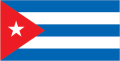
- a) Five horizontal stripes of the same width;
- b) three of indigo blue colour and two white, arranged alternately;
- c) at one of its ends it has an equilateral triangle of red colour, one of whose sides is vertical, occupies the entire height of the flag, and constitutes its hoist edge; and
- a) The lone five-pointed star, which represents the free, independent and sovereign republic, as well as the unity of Cubans;
- b) the equilateral triangle, which represents the historical ideals of liberty, equality and fraternity; the red colour placed within it alludes to the blood shed in the struggle;
- c) the white stripes, which indicate the purity of the ideals and the virtue of Cubans; and
- d) the blue stripes, which reveal the lofty and glorious aspirations of our patriots and represent the administrative division of Cuba at the time the National Flag was designed, during the colonial era.
Translated from the Official Gazette of the Republic of Cuba The National Flag is rectangular in shape, twice as long as it is wide, composed of:
d) the triangle bears at its centre a white five-pointed star, inscribed in an imaginary circle, whose diameter is equal to one third of the height of the flag, with one of its points oriented towards the upper free edge of the flag.
Unofficial translation by WorldometerTranslated from the Official Gazette of the Republic of Cuba The elements that make up the National Flag are:
Unofficial translation by WorldometerTranslated from Cubadebate It was created in the United States by the former general in the service of Spain Narciso López, born in Venezuela, [...] having conceived it in the company of Miguel Teurbe Tolón and of his wife and first cousin Emilia, who was the first to embroider it
Unofficial translation by WorldometerTranslated from the Press Information Centre of Cuba On 19 May 1850 Narciso López used this same flag when landing at Cárdenas with 600 men to begin the insurrection. He takes the city, hoisting for the first time on Cuban territory the flag of the lone star.
Unofficial translation by WorldometerTranslated from the Official Gazette of the Republic of Cuba The flag of the lone star is a symbol of the nation and constitutes the National Flag.
It was adopted at the Assembly of Guáimaro on 11 April 1869.
Unofficial translation by WorldometerSources:- gacetaoficial.gob.cu ↗ - the Official Gazette of the Republic of Cuba
- cubadebate.cu ↗ - Cubadebate
- cubahora.cu ↗ - the Press Information Centre of Cuba
- National anthem
- La Bayamesa1:10
- Title (in Spanish)
- La Bayamesa
- Title (in English, translated)
- The Bayamo Song
- Lyrics
Al combate, corred, bayameses, Que la Patria os contempla orgullosa; No temáis una muerte gloriosa, Que morir por la Patria es vivir.
En cadenas vivir, es vivir en afrenta y oprobio sumido; Del clarín escuchad el sonido; ¡A las armas, valientes, corred! En cadenas vivir, es vivir En afrenta y oprobio sumido; Del clarín escuchad el sonido; ¡A las armas, valientes, corred!
Source: - Citizens
- Cubans
- Official name:Constitution of the Republic of Cuba ↗ - National Assembly of People's Power - Cuban Parliament
- Official name, Citizens:The World Factbook: Cuba - CIA
- National flag:gacetaoficial.gob.cu ↗ - the Official Gazette of the Republic of Cuba
- National flag:cubadebate.cu ↗ - Cubadebate
- National flag:cubahora.cu ↗ - the Press Information Centre of Cuba
- National anthem:nationalanthems.info ↗
Geography
- Location
- Caribbean, island between the Caribbean Sea and the North Atlantic Ocean, 150 km south of Key West, Florida
- Total area
- 110,860 km²
- Land area
- 109,820 km²
- Water area
- 1,040 km²
- Land borders
- 28.5 km
Guantanamo Naval Base is leased by the US and remains part of Cuba
Source:- The World Factbook: Cuba - CIA
- Coastline
- 3,735 km
- Terrain
Mostly flat to rolling plains, with rugged hills and mountains in the southeast - Mean elevation
- 108 m
- Highest point
- 1,974 mPico Turquino
- Lowest point
- 0 mCaribbean Sea
- Climate
Tropical moderated by trade winds; dry season (November to April); rainy season (May to October) - Avg. temperature
- 25.5 °C
- Avg. daily range
- 22.6 to 29.4 °C
- Annual precipitation
- 967 mm
Temperature °CMeanDaily rangePrecipitation mmMonthly climate normals Month Avg. high, °C Mean, °C Avg. low, °C Precipitation, mm January 26.8 22.9 19.9 29 February 27.5 23.3 20 25 March 28.3 24 20.5 31 April 29.6 25.3 22 47 May 30.2 26.2 23.3 129 June 30.9 27.2 24.5 133 July 31.7 27.7 24.9 92 August 31.8 27.8 25 114 September 31 27.1 24.5 151 October 29.7 26.2 23.8 126 November 28.1 24.7 22.1 56 December 27.2 23.6 20.9 32 Country-wide averages over 1991–2020.
Sources:- The World Factbook: Cuba - CIA
- Climate Change Knowledge Portal (ERA5 reanalysis) ↗ - World Bank
- Weather
- Loading
- Land use2023
- Arable28.0%Perm. crops6.3%Pasture27.4%Forest34.9%Other3.5%
- Arable land
- 2,908,600 hectares (28.0%)
- Permanent crops
- 653,000 hectares (6.3%)
- Permanent meadows & pastures
- 2,839,400 hectares (27.4%)
- Forest
- 3,618,000 hectares (34.9%)
- Other land
- 361,000 hectares (3.5%)
Source: - Natural hazards2026
- Tropical cyclones8.0Very high#10/191Coastal floods5.7High#46/191Earthquakes5.0High#72/191Epidemics4.6Medium#107/191Drought3.7Medium#73/191Tsunamis3.3Low#76/191River floods0.5Very low#150/191
Scores out of 10, ranks out of 191 countries.
Source:- INFORM Risk Index ↗ - European Commission Joint Research Centre
- Location, Land borders, Coastline, Terrain, Mean elevation, Highest point, Lowest point, Climate:The World Factbook: Cuba - CIA
- Climate:Climate Change Knowledge Portal (ERA5 reanalysis) ↗ - World Bank
- Land use:FAOSTAT Land Use domain ↗ - FAO
- Natural hazards:INFORM Risk Index ↗ - European Commission Joint Research Centre
Demographics
- Population change2026
- −0.41% per year−44,545 people/yearWorld Rank197thof 237
- Birth rate
- 8.5 per 1,000 population
- Death rate
- 10.6 per 1,000 population
- Net migration rate
- −2.0 per 1,000 population
- 2026
- 42.5 yearsWorld Rank43rdof 237
- Age structure2026
- 0-14 years14.7%15-64 years67.7%65 years +17.6%
- Share aged 65 and over
- 17.6%
- Share aged under 18
- 18.1%
- Total dependency ratio
- 48
- Youth dependency ratio
- 22
- Elderly dependency ratio
- 26
- Sex ratio
- 0.97 male / female
MaleAgeFemalePopulation by age group, % of total population Age Male Female 80+ 1.8% 2.6% 70-79 3.5% 4.3% 60-69 6.5% 7.3% 50-59 8.1% 8.5% 40-49 6.1% 5.9% 30-39 6.9% 6.5% 20-29 6.0% 5.7% 10-19 5.7% 5.4% 0-9 4.7% 4.4% - 2026
- 0.65 below the replacement level for Cuba ()1.45 births per womanreplacement 2.10123World Rank181stof 237
- 0.70 daughters per woman0.30 below replacement, long-run each generation smaller than the lastreplacement 1.000.511.5
- 2026
- −2.2 per 1,000 populationfor every 1,000 people, 2.2 more deaths than births a year
- 2026
- −2.0 per 1,000 population
- Urbanization2026
- 77.3% live in cities8,420,864 urban residents
- Largest cities2022latest available
- Havana, Santiago de Cuba, Camagüey, HolguínRankCity or TownPopulation (2012 census)1Havana2,137,8472Santiago de Cuba431,4113Camagüey310,8194Holguín302,8905Santa Clara217,9076Guantánamo213,3757Las Tunas176,1398Bayamo159,0149Cienfuegos153,04810Matanzas145,034Source:
- National Office of Statistics, Cuba (2012 census), via City Population by Thomas Brinkhoff ↗
- Population distribution
- Large population clusters found throughout the country, the more significant ones being in the larger towns and cities, particularly the capital of Havana.
- Ethnic groups2012
- White64.1%Mulatto or mixed26.6%Black9.3%
Figures are racial self-identification from the 2012 census.
Source:- The World Factbook: Cuba - CIA
- Religions2020
- Estimates only, no authoritative source on religious affiliation exists.Christian58.9%Folk religion17.6%Buddhist<1%Hindu<1%Jewish<1%Muslim<1%Other<1%None23.2%
Folk religions include religions of African origin, spiritualism, and others intermingled with Catholicism or Protestantism.
Source:- The World Factbook: Cuba - CIA
- Languages
- Spanish (Español)
- Population, Population change, Median age, Age structure, Total fertility rate, Net reproduction rate, Natural change, Net migration rate:UN World Population Prospects ↗
- Urbanization:UN World Urbanization Prospects ↗
- Largest cities:National Office of Statistics, Cuba (2012 census), via City Population by Thomas Brinkhoff ↗
- Population distribution, Ethnic groups, Religions:The World Factbook: Cuba - CIA
Government & Administration
- Form of state
- RepublicThe Constitution declares the socialist system it endorses to be irrevocable.
- System of government
- One-partyThe Communist Party of Cuba, "the only party", is "the highest leading political force of society and the State", and the National Assembly of People's Power is the only body with constituent and legislative authority.
- Territorial organisation
- Unitary
- Capital
- Havana2.1 million people(2022)
- National holidays
- 10 days in 2026
- ThuJan 1Liberation Day
- FriJan 2Victory Day
- FriApr 3Good Friday
- FriMay 1International Workers' Day
- SatJul 25Commemoration of the Assault of the Moncada garrison
- SunJul 26Day of the National Rebellion
- MonJul 27Commemoration of the Assault of the Moncada garrison
- SatOct 10Independence Day
- FriDec 25Christmas Day
- ThuDec 31New Year's Eve
Nationwide public holidays only, excluding regional, bank and government-only days.
- Time
- Currency
- Cuban Peso (CUP)
- Entry requirements
- Official visa and entry information
- Calling code
- +53
- Internet TLD
- .cu
- ISO 3166-1 codes
- CU, CUB
- Infrastructure
- Passengers carried
- 136,998 by the country's airlines(2023)
- Heliports
- 4
- Aircraft departures
- 1,694 by the country's airlines(2023)
- Air freight
- 5.2 million tonne-km(2023)
- Aircraft registration prefix
- CU
Sources:- The World Factbook: Cuba - CIA
- World Development Indicators ↗ - World Bank
- Flag carrier
- Cubana de AviaciónState-owned
- 2025
- 40 / 100World Rank84thof 182
Significant declinerDown 8 points since 2019, when it scored 48.
Confidence intervalCorruption index score by year Year Score Lower bound Upper bound 2012 48 41 55 2013 46 39 53 2014 46 39 53 2015 47 41 53 2016 47 42 52 2017 47 43 51 2018 47 43 51 2019 48 44.9 51.1 2020 47 42.4 51.6 2021 46 41 51 2022 45 40.3 49.7 2023 42 36.3 47.7 2024 41 35.9 46.1 2025 40 35.7 44.3 Source:- Corruption Perceptions Index 2025 ↗ - Transparency International, CC BY 4.0
- Form of state, System of government, Territorial organisation:Constitution of the Republic of Cuba, 2019 ↗ - Presidency of the Republic of Cuba
- National holidays:Open World Holidays Framework (vacanza/holidays) ↗
- Infrastructure:The World Factbook: Cuba - CIA
- Infrastructure:World Development Indicators ↗ - World Bank
- Corruption Perceptions Index:Corruption Perceptions Index 2025 ↗ - Transparency International, CC BY 4.0
Economy
- Upper middle income
- 2024
- Services73.4% of GDPIndustry23.8% of GDPAgriculture1.2% of GDPManufacturing10.7%part of industry
- Households
- +90.9%
- Government
- +24.8%
- Investment
- +24.2%
- Exports
- +42.5%
- Imports
- −82.4%
The shape of the economyGDP by end useSource:- World Development Indicators ↗ - World Bank
- Labor force2024
- 4.9 million (45% of population)World Rank88thof 187
- Labor force participation2024
- 52.6% of people aged 15+
- Unemployment2024
- 1.8%
- Youth unemployment2024
- 4.3% ages 15 to 24
- Labor productivity2024
- $22.3 per hour worked at PPP
- Trade2023
- China34%

- Spain12%

- Germany6%

- Switzerland5%

- Hong Kong4%

Source:- The World Factbook: Cuba - CIA
- 2024
- −1.10World Rank122ndof 145
- Projected GDP growth
- +0.9% a year over the next 10 years
Source:- Atlas of Economic Complexity ↗ - Harvard Growth Lab
- Agricultural products2024
- Plantains and cooking bananas, Squash and gourds (including pumpkins), Sugar cane, and 6 more
- 1Plantains and cooking bananas9.6×
- 2Squash and gourds (including pumpkins)7.9×
- 3Sugar cane4×
- 4Sweet potatoes2.2×
- 5Cassava (fresh)1.9×
- 6Bananas1×
- 7Tomatoes0.8×
- 8Raw milk of cattle0.2×
- 9Maize (corn)0.2×
ProductSource:- FAOSTAT ↗ - Food and Agriculture Organization
- Industries
- petroleum, nickel, cobalt, pharmaceuticals, tobacco, construction, steel, cement, agricultural machinery, sugar
- Income level, GDP by sector:World Development Indicators ↗ - World Bank
- Labor force, Labor force participation, Unemployment, Youth unemployment, Labor productivity:ILOSTAT ↗ - International Labour Organization
- Trade, Industries:The World Factbook: Cuba - CIA
- Economic Complexity Index:Atlas of Economic Complexity ↗ - Harvard Growth Lab
- Agricultural products:FAOSTAT ↗ - Food and Agriculture Organization
Cost of Living
- Cost of living index
- Loading
- Monthly costs (excluding rent)
- Loading
- Rent
- Loading
- Buying an apartment
- Loading
Society
- 2023
- 0.762HighWorld Rank97thof 193CubaWorld
Human Development Index by year Year Cuba World 1990 0.687 0.608 1991 0.681 0.611 1992 0.674 0.614 1993 0.665 0.617 1994 0.662 0.620 1995 0.664 0.625 1996 0.675 0.631 1997 0.679 0.636 1998 0.683 0.641 1999 0.690 0.646 2000 0.697 0.651 2001 0.705 0.657 2002 0.711 0.662 2003 0.721 0.669 2004 0.734 0.675 2005 0.747 0.681 2006 0.766 0.688 2007 0.780 0.694 2008 0.788 0.698 2009 0.788 0.701 2010 0.783 0.707 2011 0.781 0.713 2012 0.777 0.717 2013 0.771 0.721 2014 0.770 0.726 2015 0.769 0.731 2016 0.767 0.735 2017 0.767 0.739 2018 0.769 0.741 2019 0.769 0.745 2020 0.762 0.742 2021 0.745 0.742 2022 0.764 0.752 2023 0.762 0.756 Source:- Human Development Report ↗ - United Nations Development Programme
- Mean years of schooling2023
- 10.6 years
- Expected for a child today
- 13.9 years
Source:- Human Development Report ↗ - United Nations Development Programme
- Literacy2019
- 97.7% of adults
- Education expenditure2022
- 8.4% of GDP
- Share of government spending
- 17%
Source:- World Development Indicators ↗ - World Bank
- Internet users2024
- 70.5% of the population
- Households with Internet access
- 33%
Source:- ITU DataHub ↗ - International Telecommunication Union
- Mobile subscriptions2024
- 8 million
- Fixed telephone lines
- 1,590,748
- Fixed broadband
- 3.1 subscriptions per 100 people
Counts subscriptions, not people.
Source:- ITU DataHub ↗ - International Telecommunication Union
- Refugees hosted2025
- 129 people
- Asylum seekers
- 37
- Internally displaced persons
- 2,700All due to disasters
- Refugees from Cuba abroad
- 26,986
Sources:- Refugee Data Finder ↗ - UN Refugee Agency
- Global Internal Displacement Database ↗ - Internal Displacement Monitoring Centre
- Inbound tourists2022
- Official tourism site1.6 million arrivalsdown 62% against 201962% below 2019World Rank71stof 139
- Per resident
- 1.5 arrivals per 10 residents
- Same-day visitors
- 34,000 arrivals(2016, latest available)
- $1 billion
- Spending per arrival
- $650
- Residents' trips abroad
- 732,000 overnight trips
- Hotel beds
- 110,842
- Average hotel stay
- 5 nights
Overnight arrivals by year2010 to 2022A tourist stays at least one night. Arrivals count trips, not people.
Source:- UN Tourism Data Dashboard ↗ - UN Tourism
- UNESCO World Heritage Sites
- 9 sites7 cultural2 natural
Site Type Old Havana Cultural Trinidad and the Valley de los Ingenios Cultural San Pedro de la Roca Castle Cultural Desembarco del Granma National Park Natural Viñales Valley Cultural Archaeological Landscape of the First Coffee Plantations Cultural Alejandro de Humboldt National Park Natural Historic Cienfuegos Cultural Historic Camagüey Cultural Source:- The World Factbook: Cuba - CIA
- Human Development Index, Mean years of schooling:Human Development Report ↗ - United Nations Development Programme
- Literacy:UIS Data Browser ↗ - UNESCO Institute for Statistics
- Education expenditure:World Development Indicators ↗ - World Bank
- Internet users, Mobile subscriptions:ITU DataHub ↗ - International Telecommunication Union
- Refugees hosted:Refugee Data Finder ↗ - UN Refugee Agency
- Refugees hosted:Global Internal Displacement Database ↗ - Internal Displacement Monitoring Centre
- Inbound tourists:UN Tourism Data Dashboard ↗ - UN Tourism
- UNESCO World Heritage Sites:The World Factbook: Cuba - CIA
Crime & Safety
- Travel advisory (US)
- Loading
- Active humanitarian crisisAug 2026
- High6.9 out of 10Cyclone, Political and economic crisisSeverity by monthSep 2024 to Aug 2026What the score is made ofImpact of the crisis8.5Conditions of people affected7.4Complexity of the crisis4.9
Data reliability as rated by INFORM: High. Last updated Aug 31, 2026.
Source:- INFORM Severity Index ↗ - European Commission Joint Research Centre
- Homicide rate2019
- Medium by global standards4.5 per 100,000 peopleWorld Rank34thof 115
- Crime rates
- 1 offence category
Offence Per 100,000 Count Year Homicide (victims) 4.5 500 2019 A low figure can also mean weak recording.
Source:- UNODC Data Portal ↗ - UN Office on Drugs and Crime
- Prison population2020
- 805.3 per 100,000 people
- Persons held
- 90,000
Source:- UNODC Data Portal ↗ - UN Office on Drugs and Crime
- Active humanitarian crisis:INFORM Severity Index ↗ - European Commission Joint Research Centre
- Homicide rate, Crime rates, Prison population:UNODC Data Portal ↗ - UN Office on Drugs and Crime
Health
- Life expectancy2026
- 78.6 years
- Health expenditure2023
- 9.4% of GDP
- Physicians2021
- 9.54 per 1,000 population
- Hospital beds2023
- 4.3 per 1,000 population
- Infant mortality2026
- 4.3 per 1,000 live births
- Maternal mortality2023
- 35 per 100,000 live births
- Alcohol consumption2022
- 5.6 litres of pure alcohol per adult per year
- Tobacco use2015latest available
- 22.5% of adults
- Men
- 31.3%
- Women
- 13.7%
Source:- Global Health Observatory ↗ - World Health Organization
- Road traffic deaths2019
- 8.9 per 100,000 population
- Life expectancy, Infant mortality:UN World Population Prospects ↗
- Health expenditure, Physicians, Hospital beds, Road traffic deaths:World Development Indicators ↗ - World Bank
- Maternal mortality:Maternal mortality estimates ↗ - UN Maternal Mortality Estimation Inter-agency Group
- Alcohol consumption, Tobacco use:Global Health Observatory ↗ - World Health Organization
Environment
- CO₂ emissions2024
- 21 Mt per yearup 4.9 percent on the previous year4.9% from 2023
- CO₂ per capita
- 1.8 t per personWorld Rank127thof 207
- Share of global CO₂
- 0.05%
- Methane (CH₄)
- 11.8 Mt CO₂-eq
- Nitrous oxide (N₂O)
- 2.54 Mt CO₂-eq
- Fluorinated gases
- 0.69 Mt CO₂-eq
- All greenhouse gases
- 36 Mt CO₂-eq
Source:- Emissions Database for Global Atmospheric Research (EDGAR) ↗ - European Commission, Joint Research Centre
- 2024
- 8.1 µg/m³ of PM2.50.3 years of life expectancy lost against the WHO guidelineMost polluted154thof 236
- WHO guideline
- 5 µg/m³
Source:- Air Quality Life Index ↗ - Energy Policy Institute at the University of Chicago
- Environmental issues
- soil degradation and desertification (brought on by poor farming techniques and natural disasters)
- biodiversity loss
- deforestation
- air and water pollution
Source:- The World Factbook: Cuba - CIA
- International agreements
- 20 of 20 landmark treaties in forceParty to 77 multilateral environmental agreements
Treaty Standing Joined Climate Paris Agreement in force 2017 UN Framework Convention on Climate Change in force 1994 Kyoto Protocol in force 2005 Ozone layer Montreal Protocol in force 1992 Vienna Convention (Ozone Layer) in force 1992 Biodiversity Convention on Biological Diversity in force 1994 CITES in force 1990 Convention on Migratory Species (Bonn) in force 2008 Cartagena Protocol on Biosafety in force 2003 Nagoya Protocol in force 2015 Land and heritage Ramsar Convention on Wetlands in force 2001 World Heritage Convention in force 1981 UN Convention to Combat Desertification in force 1997 Chemicals and waste Basel Convention in force 1995 Rotterdam Convention (PIC) in force 2008 Stockholm Convention (POPs) in force 2008 Minamata Convention on Mercury in force 2018 Oceans UN Convention on the Law of the Sea in force 1994 High Seas Treaty (BBNJ) in force 2026 MARPOL 73/78 in force 1993 Source:- International Environmental Agreements Database ↗ - Université Laval
- CO₂ emissions:Emissions Database for Global Atmospheric Research (EDGAR) ↗ - European Commission, Joint Research Centre
- Air pollution:Air Quality Life Index ↗ - Energy Policy Institute at the University of Chicago
- Environmental issues:The World Factbook: Cuba - CIA
- International agreements:International Environmental Agreements Database ↗ - Université Laval
Food & Water
- No access to safe drinking water2022
- 5.1% of the population
- Renewable water2022
- 38 billion m³ per year
- Per person
- 3,447 m³ per year
- Dependency ratio
- 0% originates outside the country
- Annual water withdrawal
- 7 billion m³ per year
- Withdrawn for agriculture
- 65%
- Water stress
- 24% of available freshwater withdrawn
Source:- AQUASTAT ↗ - Food and Agriculture Organization
- Undernourishment2022
- 2.8% of the population300,000 people
- Obesity2024
- 23% of adults
- Men
- 19.7%
- Women
- 26.2%
Source:- Global Health Observatory ↗ - World Health Organization
- Underweight children2019
- 2.4% of children under five
- No access to safe drinking water, Renewable water:AQUASTAT ↗ - Food and Agriculture Organization
- Undernourishment:Food security indicators (FAOSTAT) ↗ - Food and Agriculture Organization
- Obesity:Global Health Observatory ↗ - World Health Organization
- Underweight children:World Development Indicators ↗ - World Bank
Energy
- Energy consumption2024
- Per capita
- 27.6 GJ per person
- Share of world total
- 0.05%
- Supply
- Deficitproduces 36% of what it consumes, 2024
Source:- International Energy Statistics ↗ - U.S. Energy Information Administration
- Electricity2024
- No electricity trade19 TWh generated per year
- Generation
- 19 TWh per year
- Consumption
- 16 TWh per year
Source:- International Energy Statistics ↗ - U.S. Energy Information Administration
- Oil, gas & coal
- Deficitproduces 26% of what it consumes, 2024Oil reserves2025124 million barrelsWorld Rank67thof 99Imports201848,480 b/d
Oil imports and exports count crude oil only.
- Energy consumption, Electricity, Oil, gas & coal:International Energy Statistics ↗ - U.S. Energy Information Administration
- Oil, gas & coal:Worldwide Oil and Gas Survey ↗ - Oil & Gas Journal
Defense
- Military expenditure2018latest available
- 2.9% of GDP$128.6 million
- Military personnel2025
- estimated 50,000active Armed ForcesLimited information.
- Military service2025
- Conscriptionmen 17–28, 24 months with the Armed Forces or the Ministry of Interior; voluntary women 17–28; reserve commitment for men until age 45
- Nuclear weapons2026
- None - no nuclear arsenal
- Military expenditure:SIPRI Military Expenditure Database ↗ - Stockholm International Peace Research Institute
- Military expenditure:World Development Indicators ↗ - World Bank
- Military personnel, Military service:The World Factbook: Cuba - CIA
- Nuclear weapons:Status of World Nuclear Forces ↗ - Federation of American Scientists
