

National Identity
- Official name
- Kingdom of Saudi Arabia
- Official name (in Arabic)
- المملكة العربية السعودية
- Official name (in Arabic, Romanized)
- Al-Mamlakah Al-‘Arabīyah As-Su‘ūdīyah
- Name etymology
named after the ruling dynasty of the country, the House of Saud; the name Arabia can be traced back at least as far as the ancient Romans, who referred to the peninsula as "Arabia Felix" (Arabia the Fortunate)
Sources:- Basic Law of Governance ↗ - The Embassy of The Kingdom of Saudi Arabia in Washington DC
- The World Factbook: Saudi Arabia - CIA
- National emblem
- National flag
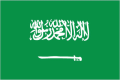
Translated from saudiflag.sa A rectangle whose width equals two-thirds of its length, and its colour is green extending from the staff to the end of the flag; in its centre are the two testimonies of faith "There is no god but God, Muhammad is the Messenger of God", and a drawn sword beneath them and parallel to them, its hilt to the right; the testimony of faith and the sword are drawn in white in the middle of its area.
Unofficial translation by WorldometerTranslated from the Saudi Press Agency Each of these colours and emblems has deep meanings; the green colour symbolises growth and fertility, the white colour symbolises peace and purity, and the sword symbolises justice and security. This symbolism of the sword has Arab roots, since among the Arabs the sword is considered a twin of nobility and chivalry.
Unofficial translation by WorldometerTranslated from the Saudi Press Agency The history of the Saudi national flag goes back to the banner carried by the imams of the First Saudi State, who founded the state and unified its lands; the banner at that time was green, made of khazz and silk, and on it was written: "There is no god but God, Muhammad is the Messenger of God", and it was tied to a staff or a pole of wood.
Unofficial translation by WorldometerTranslated from the Saudi Press Agency The flag continued with these specifications during the era of the First Saudi State, up to the reign of King Abdulaziz bin Abdulrahman – may God have mercy on him –, when two crossed swords were added to the flag, at a pivotal stage in which the backs of the steeds embraced the battle cries of the heroes until the homeland was unified, security was established and prosperity spread throughout the country. Then, at a later stage, the two swords were replaced by a drawn sword at the top, until the proposal of the Shura Council was submitted to King Abdulaziz – may God have mercy on him –, who approved it on 11 March 1937, so that the sword was placed beneath the phrase (There is no god but God, Muhammad is the Messenger of God), and the shape of the flag settled into what it is now.
Unofficial translation by WorldometerTranslated from the Saudi Press Agency On 9 Sha'ban 1444 AH, corresponding to 1 March 2023, a gracious Royal Order was issued providing that the day of ( 11 March ) of each year shall be a day dedicated to the flag, under the name ( Flag Day ); because the day of 27 Dhu al-Hijjah 1355 AH, corresponding to 11 March 1937, is the day on which King Abdulaziz, may God have mercy on him, approved the flag in the form we see today
Unofficial translation by WorldometerSources:- saudiflag.sa ↗
- spa.gov.sa ↗ - the Saudi Press Agency
- National anthem
- Aash Al Maleek (عاش المليك)0:38
- Title (in Arabic)
- عاش المليك
- Title (in Arabic, Romanized)
- Aash Al Maleek
- Title (in English, translated)
- Long Live Our Beloved King
- Lyrics
سارعي للمجد والعلياء مجدي لخالق السماء وارفعي الخفاق اخضر يحمل النور المسطر رددي الله اكبر يا موطني موطني قد عشت فخر المسلمين عاش المليك للعلم والوطن
Source: - Citizens
- Saudis
- Official name:Basic Law of Governance ↗ - The Embassy of The Kingdom of Saudi Arabia in Washington DC
- Official name, Citizens:The World Factbook: Saudi Arabia - CIA
- National flag:saudiflag.sa ↗
- National flag:spa.gov.sa ↗ - the Saudi Press Agency
- National anthem:nationalanthems.info ↗
Geography
- Location
- Middle East, bordering the Persian Gulf and the Red Sea, north of Yemen
- Total area
- 2,149,690 km²
- Land area
- 2,149,690 km²
- Water area
- 0.00 km²
- Land borders
- 4,272 km(7 countries)
- Coastline
- 2,640 km
- Terrain
Mostly sandy desert - Mean elevation
- 665 m
- Highest point
- 3,000 mAs Sarawat range
- Lowest point
- 0 mPersian Gulf
- Climate
Harsh, dry desert with great temperature extremes - Avg. temperature
- 26 °C
- Avg. daily range
- 19.1 to 32.6 °C
- Annual precipitation
- 64 mm
Temperature °CMeanDaily rangePrecipitation mmMonthly climate normals Month Avg. high, °C Mean, °C Avg. low, °C Precipitation, mm January 21.2 15 9.1 10 February 24 17.6 11.1 6 March 28.1 21.6 14.8 10 April 33.1 26.5 19.4 9 May 37.7 31.2 23.7 3 June 40.6 33.8 26 1 July 41.4 34.9 27.4 1 August 41.4 34.9 27.6 3 September 39 32.1 24.7 2 October 34 27.1 20 3 November 27.3 21 14.9 10 December 22.7 16.5 10.6 8 Country-wide averages over 1991–2020.
Sources:- The World Factbook: Saudi Arabia - CIA
- Climate Change Knowledge Portal (ERA5 reanalysis) ↗ - World Bank
- Weather
- Loading
- Land use2023
- Arable1.6%Pasture79.1%Forest1.3%Other17.9%
- Arable land
- 3,430,417 hectares (1.6%)
- Permanent crops
- 207,000 hectares (0.1%)
- Permanent meadows & pastures
- 170,000,000 hectares (79.1%)
- Forest
- 2,772,550 hectares (1.3%)
- Other land
- 38,559,033 hectares (17.9%)
Source: - Natural hazards2026
- Epidemics5.8High#67/191Drought5.0High#46/191River floods4.8Medium#101/191Coastal floods4.7Medium#72/191Earthquakes1.8Very low#113/191Tsunamis0.0Very lowTropical cyclones0.0Very low
Scores out of 10, ranks out of 191 countries.
Source:- INFORM Risk Index ↗ - European Commission Joint Research Centre
- Location, Land borders, Coastline, Terrain, Mean elevation, Highest point, Lowest point, Climate:The World Factbook: Saudi Arabia - CIA
- Climate:Climate Change Knowledge Portal (ERA5 reanalysis) ↗ - World Bank
- Land use:FAOSTAT Land Use domain ↗ - FAO
- Natural hazards:INFORM Risk Index ↗ - European Commission Joint Research Centre
Demographics
- Population change2026
- +1.73% per year+599,459 people/yearWorld Rank60thof 237
- Birth rate
- 16.1 per 1,000 population
- Death rate
- 2.3 per 1,000 population
- Net migration rate
- +3.1 per 1,000 population
- 2026
- 29.7 yearsWorld Rank139thof 237
- Age structure2026
- 0-14 years23.4%15-64 years73.4%65 years +3.2%
- Share aged 65 and over
- 3.2%
- Share aged under 18
- 27.7%
- Total dependency ratio
- 36
- Youth dependency ratio
- 32
- Elderly dependency ratio
- 4
- Sex ratio
- 1.52 male / female
MaleAgeFemalePopulation by age group, % of total population Age Male Female 80+ 0.2% 0.2% 70-79 0.7% 0.6% 60-69 2.3% 1.5% 50-59 5.3% 2.8% 40-49 10.5% 5.1% 30-39 14.7% 7.5% 20-29 11.0% 7.0% 10-19 7.6% 7.3% 0-9 8.0% 7.7% - 2026
- 0.17 above the replacement level for Saudi Arabia ()2.27 births per womanreplacement 2.10123World Rank87thof 237
- 1.09 daughters per woman0.09 above replacement, long-run each generation larger than the lastreplacement 1.000.511.5
- 2026
- +13.8 per 1,000 populationfor every 1,000 people, 13.8 more births than deaths a year
- 2026
- +3.1 per 1,000 population
- Urbanization2026
- 84.8% live in 29,808,929 urban residents
- Largest cities2022
- Riyadh, Jeddah, Mecca, MedinaRankCityPopulation (2022 census)1Riyadh6,924,5662Jeddah3,712,9173Mecca2,385,5094Medina1,411,5995Dammam1,386,1666Hofuf729,6067Tabuk594,3508Buraydah571,1699Ta'if563,28210Khamis Mushait535,065Source:
- General Authority for Statistics, Saudi Arabia (2022 census), via City Population by Thomas Brinkhoff ↗
- Population distribution
- Historically a population that was mostly nomadic or semi-nomadic, the Saudi population has become more settled since oil was discovered in the 1930s; most of the country's population is now concentrated in a wide area across the middle of the peninsula, from Ad Dammam in the east through Riyadh in the interior to Mecca-Medina in the west near the Red Sea.
- Ethnic groups
- Arab90.0%Afro-Asian10.0%
- Religions2020
- Muslim (official), Other
Among citizens, 85-90% are Sunni and 10-12% Shia.Other includes Eastern Orthodox, Protestant, Roman Catholic, Jewish, Hindu, Buddhist and Sikh.Public religious expression inconsistent with the government-sanctioned interpretation of Sunni Islam is mostly restricted, despite an expatriate community of various faiths making up more than 30% of the population.
Source:- The World Factbook: Saudi Arabia - CIA
- Languages
- Arabic (العربية)
- Population, Population change, Median age, Age structure, Total fertility rate, Net reproduction rate, Natural change, Net migration rate:UN World Population Prospects ↗
- Urbanization:UN World Urbanization Prospects ↗
- Largest cities:General Authority for Statistics, Saudi Arabia (2022 census), via City Population by Thomas Brinkhoff ↗
- Population distribution, Ethnic groups, Religions:The World Factbook: Saudi Arabia - CIA
Government & Administration
- Form of state
- Absolute monarchyThe King reigns; governance is limited to the sons of the Founder King and their sons, with allegiance pledged to the most suitable among them; the Basic Law calls the state "a sovereign Arab Islamic State" (Arts. 1, 5).
- System of government
- Unified authorityThe King is the final authority over judicial, executive and legislative powers; since 2022 a Royal Order has made the Crown Prince Prime Minister. Ministers are collectively responsible before the King, who may dissolve and reconstitute the appointed Shura Council (advisory) (Arts. 44, 56, 68).
- Territorial organisation
- Unitary
- Official websites
- Government (in Arabic, English available)
- Parliament
- Capital
- Riyadh7 million people(2022)
- National holidays
- 13 days in 2026
- SunFeb 22Founding Day Holiday
- ThuMar 19Eid al-Fitr Holiday
- FriMar 20Eid al-Fitr Holiday
- SatMar 21Eid al-Fitr Holiday
- SunMar 22Eid al-Fitr Holiday
- MonMar 23Eid al-Fitr Holiday (observed)
- TueMar 24Eid al-Fitr Holiday (observed)
- TueMay 26Day of Arafah
- WedMay 27Eid al-Adha Holiday
- ThuMay 28Eid al-Adha Holiday
- FriMay 29Eid al-Adha Holiday
- SunMay 31Eid al-Adha Holiday (observed)
- WedSep 23National Day Holiday
Nationwide public holidays only, excluding regional, bank and government-only days.
- Time
- ASTArabian Standard TimeUTC+3
- Currency
- Saudi Riyal (SAR)
- Entry requirements
- Official visa and entry information (in Arabic)
- Calling code
- +966
- Internet TLD
- .sa
- ISO 3166-1 codes
- SA, SAU
- Infrastructure
- Passengers carried
- 47,979,994 by the country's airlines(2023)
- Heliports
- 69
- Aircraft departures
- 302,451 by the country's airlines(2023)
- Air freight
- 1,036.8 million tonne-km(2023)
- Aircraft registration prefix
- HZ
Sources:- The World Factbook: Saudi Arabia - CIA
- World Development Indicators ↗ - World Bank
- Flag carrier
- SaudiaState-owned
- Passenger rail
- Saudi Arabia Railways
- 2025
- 57 / 100World Rank45thof 182Confidence interval
Corruption index score by year Year Score Lower bound Upper bound 2012 44 34 55 2013 46 35 57 2014 49 38 60 2015 52 40 64 2016 46 33 58 2017 49 39 59 2018 49 39 59 2019 53 40.6 65.4 2020 53 44.2 61.8 2021 53 46 60 2022 51 43.4 58.6 2023 52 43.3 60.7 2024 59 52.1 65.9 2025 57 50.7 63.3 Source:- Corruption Perceptions Index 2025 ↗ - Transparency International, CC BY 4.0
- Form of state, System of government, Territorial organisation:النظام الأساسي للحكم (Basic Law of Governance), Royal Order No. A/90, consolidated text with amendments ↗ - Bureau of Experts at the Council of Ministers
- National holidays:Open World Holidays Framework (vacanza/holidays) ↗
- Infrastructure:The World Factbook: Saudi Arabia - CIA
- Infrastructure:World Development Indicators ↗ - World Bank
- Corruption Perceptions Index:Corruption Perceptions Index 2025 ↗ - Transparency International, CC BY 4.0
Economy
- High income
- GDP growth (real)2026
- −3.3% per yearWorld Rank189thof 195
- GDP per capita (PPP)2026
- GDP per capita (nominal)
- $36,577 (42nd in the world)
Source:- 2025
- Services48.9% of GDPIndustry43% of GDPAgriculture2.6% of GDPManufacturing15.8%part of industry
- Households
- +46.2%
- Government
- +20.6%
- Investment
- +31.6%
- Exports
- +29.7%
- Imports
- −28.2%
The shape of the economyGDP by end useSource:- World Development Indicators ↗ - World Bank
- Inflation2026
- 1.9%down 0.1 percentage points0.1pp from 2025
- Labor force2024
- 16.9 million (50% of population)World Rank38thof 187
- Labor force participation2024
- 65.2% of people aged 15+
- Unemployment2024
- 3.5%
- Youth unemployment2024
- 11.5% ages 15 to 24
- Labor productivity2024
- $64.2 per hour worked at PPP
- Budget balance2026
- 6.5% of GDP deficit
- Current account
- 3.5% of GDP, $46.6 billion deficit
Source: - Debt2024
- Central government debt29.9% of GDPHousehold debt35.3% of GDPCompany debt46% of GDPInterest on debt1% of GDP
- Trade2025
- Goods$311 billion81.8%
- Services$69.4 billion18.2%
- Total exports
- $380.4 billion
- Change from 2024
- up 3.2 percent on the previous year3.2%
Sources:- World Development Indicators ↗ - World Bank
- The World Factbook: Saudi Arabia - CIA
- 2024
- +0.50World Rank50thof 145
- Projected GDP growth
- +1.8% a year over the next 10 years
Source:- Atlas of Economic Complexity ↗ - Harvard Growth Lab
- Agricultural products2024
- Dates, Raw milk of camel, Meat of sheep (fresh or chilled), and 7 more
- 1Dates179.6×
- 2Raw milk of camel30.1×
- 3Meat of sheep (fresh or chilled)13.4×
- 4Olives12.7×
- 5Meat of chickens (fresh or chilled)5.5×
- 6Watermelons5.4×
- 7Lemons and limes5×
- 8Hen eggs in shell (fresh)3.7×
- 9Raw milk of cattle3.4×
- 10Tomatoes3.4×
ProductSource:- FAOSTAT ↗ - Food and Agriculture Organization
- Gold reserves2025
- 323 tonnesWorth $45.4 billion, 9% of total official reserves by value
- Industries
- crude oil production, petroleum refining, basic petrochemicals, ammonia, industrial gases, sodium hydroxide (caustic soda), cement, fertilizer, plastics, metals, commercial ship repair, commercial aircraft repair, construction
- Income level, GDP by sector, Trade, Gold reserves:World Development Indicators ↗ - World Bank
- GDP (nominal), GDP growth (real), GDP per capita (PPP), Inflation, Budget balance:IMF World Economic Outlook ↗
- Labor force, Labor force participation, Unemployment, Youth unemployment, Labor productivity:ILOSTAT ↗ - International Labour Organization
- Debt:IMF Global Debt Database ↗
- Debt:IMF Public Finances in Modern History ↗
- Trade, Industries:The World Factbook: Saudi Arabia - CIA
- Economic Complexity Index:Atlas of Economic Complexity ↗ - Harvard Growth Lab
- Agricultural products:FAOSTAT ↗ - Food and Agriculture Organization
Cost of Living
- Cost of living index
- Loading
- Monthly costs (excluding rent)
- Loading
- Rent
- Loading
- Buying an apartment
- Loading
- Average gross salary2022
- SAR 6,748 per month$1,799 (USD), $3,478 (PPP)
- Men
- SAR 6,886 per month($1,836)
- Women
- SAR 6,169 per month($1,645)
Source:- ILOSTAT ↗ - International Labour Organization
- 2024
- SAR 4,000 per month, gross$1,067 (USD), $2,124 (PPP)
- Average gross salary, Minimum wage:ILOSTAT ↗ - International Labour Organization
Society
- 2023
- 0.900Very highWorld Rank37thof 193Saudi ArabiaWorld
Human Development Index by year Year Saudi Arabia World 1990 0.670 0.608 1991 0.681 0.611 1992 0.688 0.614 1993 0.693 0.617 1994 0.699 0.620 1995 0.705 0.625 1996 0.711 0.631 1997 0.718 0.636 1998 0.725 0.641 1999 0.729 0.646 2000 0.737 0.651 2001 0.744 0.657 2002 0.750 0.662 2003 0.762 0.669 2004 0.773 0.675 2005 0.782 0.681 2006 0.785 0.688 2007 0.786 0.694 2008 0.792 0.698 2009 0.794 0.701 2010 0.801 0.707 2011 0.811 0.713 2012 0.819 0.717 2013 0.827 0.721 2014 0.841 0.726 2015 0.851 0.731 2016 0.860 0.735 2017 0.869 0.739 2018 0.875 0.741 2019 0.878 0.745 2020 0.875 0.742 2021 0.878 0.742 2022 0.893 0.752 2023 0.900 0.756 Source:- Human Development Report ↗ - United Nations Development Programme
- Mean years of schooling2023
- 11.6 years
- Expected for a child today
- 16.9 years
Source:- Human Development Report ↗ - United Nations Development Programme
- Literacy2024
- 97.9% of adults
- Education expenditure2023
- 4.5% of GDP
- Share of government spending
- 15.8%
Source:- World Development Indicators ↗ - World Bank
- Internet users2024
- 100% of the population
- Households with Internet access
- 100%
Source:- ITU DataHub ↗ - International Telecommunication Union
- Mobile subscriptions2024
- 54.2 million
- Fixed telephone lines
- 6,706,993
- Fixed broadband
- 44.1 subscriptions per 100 people
Counts subscriptions, not people.
Source:- ITU DataHub ↗ - International Telecommunication Union
- Credit-card ownership2024
- 30% of adults
- Debit-card ownership
- 76%
- Account at a bank or mobile-money provider
- 79%
- Mobile-money account
- 37%
- Made or received a digital payment
- 76%
Source:- Global Findex Database ↗ - World Bank
- Refugees hosted2025
- 385 people
- Asylum seekers
- 3,915
- Stateless persons
- 70,000
- Refugees from Saudi Arabia abroad
- 2,424
Source:- Refugee Data Finder ↗ - UN Refugee Agency
- 2024
- Official tourism site29.7 million arrivalsup 70% against 201970% above 2019World Rank9thof 139
- Per resident
- 8.8 arrivals per 10 residents
- 3.8 million arrivals
- $46.3 billion
- Spending per arrival
- $1,559
- 4.8% tourism direct GDP
- 86.2 million overnight trips by residents
- 24 million overnight trips
- $31.8 billion
- Hotel beds
- 1 million
- 16.1 nights
Overnight arrivals by year2010 to 2024A tourist stays at least one night. Arrivals count trips, not people.
Source:- UN Tourism Data Dashboard ↗ - UN Tourism
- UNESCO World Heritage Sites
- 7 sites7 cultural1 natural
Site Type Hegra Archaeological Site (al-Hijr / Madā ͐ in Ṣāliḥ) Cultural At-Turaif District in ad-Dir'iyah Cultural Historic Jeddah, the Gate to Makkah Cultural Rock Art in the Hail Region of Saudi Arabia Cultural Al-Ahsa Oasis, an Evolving Cultural Landscape Cultural Ḥimā Cultural Area Cultural ‘Uruq Bani Ma’arid Natural The Cultural Landscape of Al-Faw Archaeological Area Cultural Source:- The World Factbook: Saudi Arabia - CIA
- Human Development Index, Mean years of schooling:Human Development Report ↗ - United Nations Development Programme
- Literacy:UIS Data Browser ↗ - UNESCO Institute for Statistics
- Education expenditure:World Development Indicators ↗ - World Bank
- Internet users, Mobile subscriptions:ITU DataHub ↗ - International Telecommunication Union
- Credit-card ownership:Global Findex Database ↗ - World Bank
- Refugees hosted:Refugee Data Finder ↗ - UN Refugee Agency
- Inbound tourists:UN Tourism Data Dashboard ↗ - UN Tourism
- UNESCO World Heritage Sites:The World Factbook: Saudi Arabia - CIA
Crime & Safety
- Travel advisory (US)
- Loading
- Active humanitarian crisisAug 2026
- None - no active crisis
- Homicide rate2024
- Very low by global standards0.8 per 100,000 peopleWorld Rank91stof 115
- Crime rates
- 4 offence categories
Offence Per 100,000 Count Year Homicide (victims) 0.8 272 2024 Serious assault 62.0 18,880 2019 Sexual violence 2.2 668 2019 Kidnapping 0.2 62 2019 A low figure can also mean weak recording.
Source:- UNODC Data Portal ↗ - UN Office on Drugs and Crime
- Prison population2019
- 159.7 per 100,000 people
- Persons held
- 48,660
Source:- UNODC Data Portal ↗ - UN Office on Drugs and Crime
- Active humanitarian crisis:INFORM Severity Index ↗ - European Commission Joint Research Centre
- Homicide rate, Crime rates, Prison population:UNODC Data Portal ↗ - UN Office on Drugs and Crime
Health
- Life expectancy2026
- 79.4 years
- Health expenditure2023
- 5.7% of GDP$1,825 per person
- Physicians2023
- 3.41 per 1,000 population
- Hospital beds2023
- 2.4 per 1,000 population
- Infant mortality2026
- 5.6 per 1,000 live births
- Maternal mortality2023
- 7 per 100,000 live births
- Tobacco use2023
- 14.7% of adults
- Men
- 25.7%
- Women
- 3.6%
Source:- Global Health Observatory ↗ - World Health Organization
- Alcohol and Tobacco Spending2023
- 0.7% of household spendingWorld Rank94thof 105
- World median
- 3.1%
Source:- The World Factbook: Saudi Arabia - CIA
- Road traffic deaths2019
- 35.9 per 100,000 population
- Life expectancy, Infant mortality:UN World Population Prospects ↗
- Health expenditure, Physicians, Hospital beds, Road traffic deaths:World Development Indicators ↗ - World Bank
- Maternal mortality:Maternal mortality estimates ↗ - UN Maternal Mortality Estimation Inter-agency Group
- Tobacco use:Global Health Observatory ↗ - World Health Organization
- Alcohol and Tobacco Spending:The World Factbook: Saudi Arabia - CIA
Environment
- CO₂ emissions2024
- 652.5 Mt per yearup 2.7 percent on the previous year2.7% from 2023
- CO₂ per capita
- 17.7 t per personWorld Rank10thof 207
- Share of global CO₂
- 1.6%
- Methane (CH₄)
- 113.1 Mt CO₂-eq
- Nitrous oxide (N₂O)
- 10.3 Mt CO₂-eq
- Fluorinated gases
- 63 Mt CO₂-eq
- All greenhouse gases
- 838.9 Mt CO₂-eq
Source:- Emissions Database for Global Atmospheric Research (EDGAR) ↗ - European Commission, Joint Research Centre
- 2024
- 37.5 µg/m³ of PM2.53.2 years of life expectancy lost against the WHO guidelineMost polluted11thof 236
- WHO guideline
- 5 µg/m³
- National standard
- 15 µg/m³
- Life expectancy gain if the national standard were met
- 2.2 years
Source:- Air Quality Life Index ↗ - Energy Policy Institute at the University of Chicago
- Environmental issues
- desertification
- depletion of underground water resources
- limited freshwater resources
- coastal pollution from oil spills
- air pollution
- waste management
Source:- The World Factbook: Saudi Arabia - CIA
- International agreements
- 18 of 20 landmark treaties in forceParty to 71 multilateral environmental agreements
Treaty Standing Joined Climate Paris Agreement in force 2016 UN Framework Convention on Climate Change in force 1995 Kyoto Protocol in force 2005 Ozone layer Montreal Protocol in force 1993 Vienna Convention (Ozone Layer) in force 1993 Biodiversity Convention on Biological Diversity in force 2002 CITES in force 1996 Convention on Migratory Species (Bonn) in force 1991 Cartagena Protocol on Biosafety in force 2007 Nagoya Protocol in force 2020 Land and heritage Ramsar Convention on Wetlands not a party World Heritage Convention in force 1978 UN Convention to Combat Desertification in force 1997 Chemicals and waste Basel Convention in force 1992 Rotterdam Convention (PIC) in force 2004 Stockholm Convention (POPs) in force 2012 Minamata Convention on Mercury in force 2019 Oceans UN Convention on the Law of the Sea in force 1996 High Seas Treaty (BBNJ) not a party MARPOL 73/78 in force 2005 Source:- International Environmental Agreements Database ↗ - Université Laval
- CO₂ emissions:Emissions Database for Global Atmospheric Research (EDGAR) ↗ - European Commission, Joint Research Centre
- Air pollution:Air Quality Life Index ↗ - Energy Policy Institute at the University of Chicago
- Environmental issues:The World Factbook: Saudi Arabia - CIA
- International agreements:International Environmental Agreements Database ↗ - Université Laval
Food & Water
- No access to safe drinking water2022
- 3% of the population
- Renewable water2022
- 2.4 billion m³ per year
- Per person
- 75 m³ per year
- Dependency ratio
- 0% originates outside the country
- Annual water withdrawal
- 26 billion m³ per year
- Withdrawn for agriculture
- 82%
- Water stress
- 974% of available freshwater withdrawn
Source:- AQUASTAT ↗ - Food and Agriculture Organization
- Undernourishment2022
- 3.5% of the population1.3 million people
- Obesity2024
- 40.1% of adults
- Men
- 36.5%
- Women
- 46.7%
Source:- Global Health Observatory ↗ - World Health Organization
- Underweight children2020
- 3.5% of children under five
- No access to safe drinking water, Renewable water:AQUASTAT ↗ - Food and Agriculture Organization
- Undernourishment:Food security indicators (FAOSTAT) ↗ - Food and Agriculture Organization
- Obesity:Global Health Observatory ↗ - World Health Organization
- Underweight children:World Development Indicators ↗ - World Bank
Energy
- Energy consumption2024
- Per capita
- 368.9 GJ per person
- Share of world total
- 2.0%
- Supply
- Surplusproduces 2.3× what it consumes, 2024
Source:- International Energy Statistics ↗ - U.S. Energy Information Administration
- Electricity2024
- 446 TWh generated per year
- Generation
- 446 TWh per year
- Consumption
- 406 TWh per year
- Imports
- 0.3 TWh per year
- Exports
- 0.4 TWh per year
- Net
- +0.1 TWh per year
Source:- International Energy Statistics ↗ - U.S. Energy Information Administration
- Oil, gas & coal
- Surplusproduces 2.9× what it consumes, 2024Oil reserves2025267.2 billion barrelsWorld Rank2ndof 99Exports20187.3 million b/d
Oil imports and exports count crude oil only.
- Energy consumption, Electricity, Oil, gas & coal:International Energy Statistics ↗ - U.S. Energy Information Administration
- Oil, gas & coal:Worldwide Oil and Gas Survey ↗ - Oil & Gas Journal
Defense
- Military expenditure2024
- 7.3% of GDP$80.3 billion, 22.3% of government spending
- Military personnel2025
- approximately 250,000active Saudi Armed Forces, including 125,000 under the Ministry of Defense and 125,000 in the National Guard
- Military service2025
- Voluntaryno conscription; men 17–40, women typically 21–40, although maximum age may vary by role
- Space program2024
- Saudi Space Agency (SSA; elevated to agency level from previous Saudi Space Commission or SSC, which was established in 2018); King Abdulaziz City for Science and Technology (KACST; established 1977)
Has a national space strategy (Vision 2030) that seeks to grow its domestic space industry and use the space sector to accelerate economic diversification, enhance scientific research and development, and raise private-sector participation in the global space industry; manufactures and operates communications, remote sensing (RS), and scientific satellites; develops a range of satellite subsystems and payload technologies; is the main founder and financier of the Arab Satellite Communications Organization (Arabsat, launched in 1976 and headquartered in Riyadh); cooperates with the space agencies and industries of a wide range of countries, including those of Belarus, China, Egypt, the ESA and its member states (particularly France, Germany, Greece, and Hungary), India, Kazakhstan, Morocco, Russia, South Africa, South Korea, Ukraine, the UAE, the UK, and the US; member of the Arab Space Cooperation Group
- 1985
- First communications satellite (Arabsat-1A) built and launched by European commercial companies; first Saudi astronaut in space on US Space Shuttle
- 2004
- First domestically built, experimental remote sensing (RS) satellite (SaudiSat-2) launched by Russia
- 2017-2019
- Contributed to China’s robotic spacecraft mission (Chang’e-4) to the far side of the Moon
- 2021
- Domestically built maritime-tracking satellite (Shaheen Sat) launched by Russia; began participating in Russia's astronaut training program
- 2022
- Signed US-led Artemis Accords on space and lunar exploration
- 2023
- Sent two astronauts, including first Saudi woman, to the International Space Station on a US commercial spacecraft
Key milestones
Source:- The World Factbook: Saudi Arabia - CIA
- Nuclear weapons2026
- None - no nuclear arsenal
- Military expenditure:SIPRI Military Expenditure Database ↗ - Stockholm International Peace Research Institute
- Military expenditure:World Development Indicators ↗ - World Bank
- Military personnel, Military service, Space program:The World Factbook: Saudi Arabia - CIA
- Nuclear weapons:Status of World Nuclear Forces ↗ - Federation of American Scientists


