

National Identity
- Official name
- Islamic Republic of Pakistan
- Official name (in Urdu)
- اسلامی جمہوریہ پاکستان
- Official name (in Urdu, Romanized)
- Islāmī Jumhūriya-e Pākistān
- Name etymology
the name is said to have been proposed in the early 1930s by Muslim students at Cambridge University, created from the initials of Punjab, Afghanistan, and Kashmir; the word pak also means "pure" in Persian or Pashto, and the Persian suffix -stan means "place of" or "country," so Pakistan literally means "Land of the Pure"
Sources:- Constitution of the Islamic Republic of Pakistan [As modified upto the 31st May, 2018] ↗ - The Pakistan Code - Ministry of Law and Justice
- The World Factbook: Pakistan - CIA
- National emblem
- National flag
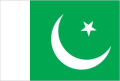
- Dark Green Field: Represents the Muslim majority of Pakistan
- White Vertical Bar: Represents religious minorities and minority religions
- White Crescent: Symbolizes progress
- Five-Pointed Star: Represents light and knowledge
As published by the Cabinet Division, Government of Pakistan A dark green rectangular flag in the proportion of length and width 3:2 with a white vertical bar at the mast, the green portion bearing a white crescent in the centre and a five-pointed white heraldic star.
The size of the white portion being one-fourth the size of the flag, nearest the mast, the remainder three-fourths being dark green.
As published in EnglishAs published by the Ministry of Foreign Affairs, Government of Pakistan Symbolism:
As published in EnglishAs published by the Ministry of Foreign Affairs, Government of Pakistan The national flag of Pakistan was designed by Syed Amir-uddin Kedwaii and was adopted on August 11, 1947, just three days before the country's independence.
As published in EnglishSources:- cabinet.gov.pk ↗ - the Cabinet Division, Government of Pakistan
- mofa.gov.pk ↗ - the Ministry of Foreign Affairs, Government of Pakistan
- National anthem
- Qaumī Tarāna (قومی ترانہ)1:22
- Title (in Urdu)
- قومی ترانہ
- Title (in Urdu, Romanized)
- Qaumī Tarāna
- Title (in English, translated)
- National Anthem
- Lyrics
پاک سرزمین شاد باد کشور حسین شاد باد تو نشان عزم عالیشان ! ارض پاکستان مرکز یقین شاد باد
پاک سرزمین کا نظام قوت اخوت عوام قوم ، ملک ، سلطنت ! پائندہ تابندہ باد شاد باد منزل مراد
پرچم ستارہ و ہلال رہبر ترقی و کمال ترجمان ماضی شان حال ! جان استقبال سایۂ خدائے ذوالجلال
Source: - Citizens
- Pakistanis
- Official name:Constitution of the Islamic Republic of Pakistan [As modified upto the 31st May, 2018] ↗ - The Pakistan Code - Ministry of Law and Justice
- Official name, Citizens:The World Factbook: Pakistan - CIA
- National flag:cabinet.gov.pk ↗ - the Cabinet Division, Government of Pakistan
- National flag:mofa.gov.pk ↗ - the Ministry of Foreign Affairs, Government of Pakistan
- National anthem:nationalanthems.info ↗
Geography
- Location
- Southern Asia, bordering the Arabian Sea, between India on the east and Iran and Afghanistan on the west and China in the north
- Total area
- 881,912 km²
- Land area
- 856,692 km²
- Water area
- 25,220 km²
- Land borders
- 7,257 km(4 countries)
- India
- 3,190 km
- Afghanistan
- 2,670 km
- Iran
- 959 km
- China
- 438 km
Source:- The World Factbook: Pakistan - CIA
- Coastline
- 1,046 km
- Terrain
Divided into three major geographic areas: the northern highlands, the Indus River plain in the center and east, and the Balochistan Plateau in the south and west - Mean elevation
- 900 m
- Highest point
- 8,611 mK2 (Mt. Godwin-Austen)
- Lowest point
- 0 mArabian Sea
- Climate
Mostly hot, dry desert temperate in northwest; arctic in north - Avg. temperature
- 20.6 °C
- Avg. daily range
- 14.4 to 26.8 °C
- Annual precipitation
- 422 mm
Temperature °CMeanDaily rangePrecipitation mmMonthly climate normals Month Avg. high, °C Mean, °C Avg. low, °C Precipitation, mm January 14.9 8.8 2.9 27 February 17.9 11.9 5.7 39 March 23.2 17 10.5 43 April 29.2 22.7 15.7 32 May 33.9 27.2 20.1 21 June 35.5 29.4 23 31 July 34.3 29.1 24 77 August 33.1 28 23.1 73 September 31.6 25.8 20.1 35 October 28.1 21.3 14.6 15 November 22.1 15.3 8.7 13 December 17.1 10.5 4.2 17 Country-wide averages over 1991–2020.
Sources:- The World Factbook: Pakistan - CIA
- Climate Change Knowledge Portal (ERA5 reanalysis) ↗ - World Bank
- Weather
- Loading
- Land use2023
- Arable39.3%Perm. crops1.0%Pasture6.5%Forest4.1%Other49.2%
- Arable land
- 30,260,000 hectares (39.3%)
- Permanent crops
- 735,000 hectares (1.0%)
- Permanent meadows & pastures
- 5,000,000 hectares (6.5%)
- Forest
- 3,150,888 hectares (4.1%)
- Other land
- 37,942,112 hectares (49.2%)
Source: - Natural hazards2026
- River floods9.5Very high#6/191Earthquakes9.2Very high#10/191Epidemics7.5Very high#9/191Tropical cyclones7.1Very high#20/191Tsunamis6.1High#33/191Drought4.9High#52/191Coastal floods4.4Medium#77/191
Scores out of 10, ranks out of 191 countries.
Source:- INFORM Risk Index ↗ - European Commission Joint Research Centre
- Location, Land borders, Coastline, Terrain, Mean elevation, Highest point, Lowest point, Climate, Major rivers:The World Factbook: Pakistan - CIA
- Climate:Climate Change Knowledge Portal (ERA5 reanalysis) ↗ - World Bank
- Land use:FAOSTAT Land Use domain ↗ - FAO
- Natural hazards:INFORM Risk Index ↗ - European Commission Joint Research Centre
Demographics
- Population change2026
- +1.60% per year+4,080,238 people/yearWorld Rank67thof 237
- Birth rate
- 26.7 per 1,000 population
- Death rate
- 6.4 per 1,000 population
- Net migration rate
- −4.4 per 1,000 population
- 2026
- 20.8 yearsWorld Rank192ndof 237
- Age structure2026
- 0-14 years35.8%15-64 years59.8%65 years +4.4%
- Share aged 65 and over
- 4.4%
- Share aged under 18
- 42.5%
- Total dependency ratio
- 67
- Youth dependency ratio
- 60
- Elderly dependency ratio
- 7
- Sex ratio
- 1.03 male / female
MaleAgeFemalePopulation by age group, % of total population Age Male Female 80+ 0.2% 0.3% 70-79 0.9% 1.1% 60-69 2.1% 2.2% 50-59 3.2% 3.2% 40-49 4.8% 4.7% 30-39 6.8% 6.5% 20-29 8.9% 8.5% 10-19 11.4% 10.9% 0-9 12.4% 11.9% - 2026
- 1.24 above the replacement level for Pakistan ()3.44 births per womanreplacement 2.201234World Rank44thof 237
- 1.56 daughters per woman0.56 above replacement, long-run each generation larger than the lastreplacement 1.000.511.52
- 2026
- +20.3 per 1,000 populationfor every 1,000 people, 20.3 more births than deaths a year
- 2026
- −4.4 per 1,000 population
- Urbanization2026
- 39.9% live in cities103,397,307 urban residents
- Largest cities2023
- Karachi, Lahore, Faisalabad, RawalpindiRankCity or MunicipalityPopulation (2023 census)1Karachi18,868,0212Lahore13,004,1353Faisalabad3,691,9994Rawalpindi3,357,6125Gujranwala2,511,1186Multan2,215,3817Hyderabad1,921,2758Peshawar1,905,9759Quetta1,565,54610Islamabad1,108,872Source:
- Pakistan Bureau of Statistics (2023 census), via City Population by Thomas Brinkhoff ↗
- Population distribution
- The Indus River and its tributaries attract most of the settlement, with Punjab province the most densely populated.
- Ethnic groups
- Punjabi44.7%Pashtun (Pathan)15.4%Sindhi14.1%Saraiki8.4%Muhajirs7.6%Baloch3.6%Other6.3%
- Religions2020
- Muslim96.4%Hindu1.6%Christian1.4%
Scheduled castes, Qadiani/Ahmadi, other, and Sikh each account for less than 1%.
Source:- The World Factbook: Pakistan - CIA
- Languages
- Urdu (اردو)
- Population, Population change, Median age, Age structure, Total fertility rate, Net reproduction rate, Natural change, Net migration rate:UN World Population Prospects ↗
- Urbanization:UN World Urbanization Prospects ↗
- Largest cities:Pakistan Bureau of Statistics (2023 census), via City Population by Thomas Brinkhoff ↗
- Population distribution, Ethnic groups, Religions:The World Factbook: Pakistan - CIA
Government & Administration
- Form of state
- Islamic RepublicThe Constitution makes Pakistan a "Federal Republic to be known as the Islamic Republic of Pakistan"; the President, head of state, is elected by an electoral college of both federal Houses and the Provincial Assemblies (Arts. 1, 41).
- System of government
- ParliamentaryThe National Assembly elects one of its Muslim members as Prime Minister by a majority of its total membership and can remove the Prime Minister by a no-confidence vote; the President dissolves the Assembly on the Prime Minister's advice (Arts. 58, 91, 95).
- Territorial organisation
- Federal
- Official websites
- Capital
- Islamabad1.1 million people(2023)
- National holidays
- 15 days in 2026
- ThuFeb 5Kashmir Solidarity Day
- FriMar 20Eid al-Fitr (estimated)
- SatMar 21Eid al-Fitr (estimated)
- SunMar 22Eid al-Fitr (estimated)
- MonMar 23Pakistan Day
- FriMay 1Labor Day
- WedMay 27Eid al-Adha (estimated)
- ThuMay 28Eid al-Adha (estimated)Youm-e-Takbeer
- FriMay 29Eid al-Adha (estimated)
- WedJun 24Ashura (estimated)
- ThuJun 25Ashura (estimated)
- FriAug 14Independence Day
- TueAug 25Prophet's Birthday (estimated)
- MonNov 9Iqbal Day
- FriDec 25Quaid-e-Azam Day
Nationwide public holidays only, excluding regional, bank and government-only days.
- Time
- PKTPakistan Standard TimeUTC+5
- Currency
- Pakistani Rupee (PKR)
- Entry requirements
- Official visa and entry information
- Calling code
- +92
- Internet TLD
- .pk
- ISO 3166-1 codes
- PK, PAK
- Infrastructure
- Passengers carried
- 7,153,419 by the country's airlines(2023)
- Heliports
- 48
- Aircraft departures
- 41,823 by the country's airlines(2023)
- Air freight
- 309.5 million tonne-km(2023)
- Aircraft registration prefix
- AP
Sources:- The World Factbook: Pakistan - CIA
- World Development Indicators ↗ - World Bank
- Flag carrier
- Pakistan International AirlinesPrivately owned (Arif Habib consortium)
- Passenger rail
- Pakistan Railways
- 2025
- 28 / 100World Rank136thof 182Confidence interval
Corruption index score by year Year Score Lower bound Upper bound 2012 27 23 31 2013 28 23 33 2014 29 24 34 2015 30 25 35 2016 32 28 35 2017 32 29 35 2018 33 30 36 2019 32 28 36 2020 31 28.1 33.9 2021 28 24.9 31.1 2022 27 23.9 30.1 2023 29 25.6 32.4 2024 27 23.7 30.3 2025 28 25.2 30.8 Source:- Corruption Perceptions Index 2025 ↗ - Transparency International, CC BY 4.0
- Form of state, System of government, Territorial organisation:The Constitution of the Islamic Republic of Pakistan, as amended up to the Constitution (Twenty-seventh Amendment) Act, 2025 ↗ - Ministry of Law and Justice (Pakistan Code)
- National holidays:Open World Holidays Framework (vacanza/holidays) ↗
- Infrastructure:The World Factbook: Pakistan - CIA
- Infrastructure:World Development Indicators ↗ - World Bank
- Corruption Perceptions Index:Corruption Perceptions Index 2025 ↗ - Transparency International, CC BY 4.0
Economy
- Lower middle income
- GDP growth (real)2026
- +3.6% per yearWorld Rank74thof 195
- GDP per capita (PPP)2026
- GDP per capita (nominal)
- $1,836 (165th in the world)
Source:- 2025
- Services50.9% of GDPIndustry20.1% of GDPAgriculture23% of GDPManufacturing13%part of industry
- Households
- +83.6%
- Government
- +9.3%
- Investment
- +14.3%
- Exports
- +10%
- Imports
- −17.2%
The shape of the economyGDP by end useSource:- World Development Indicators ↗ - World Bank
- Inflation2026
- 7.1%up 2.6 percentage points2.6pp from 2025
- Labor force2024
- 83.2 million (33% of population)World Rank7thof 187
- Labor force participation2024
- 52.3% of people aged 15+
- Unemployment2024
- 5.5%
- Youth unemployment2024
- 9.5% ages 15 to 24
- Labor productivity2024
- $7.1 per hour worked at PPP
- Budget balance2026
- 2.6% of GDP deficit
- Current account
- 0% of GDP, $139 million
Source: - Debt2024
- Central government debt70.1% of GDPHousehold debt2.1% of GDPCompany debt16.5% of GDPInterest on debt7.8% of GDP
- Trade2025
- Goods$31.5 billion77.6%
- Services$9.1 billion22.4%
- Total exports
- $40.6 billion
- Change from 2024
- up 0.8 percent on the previous year0.8%
Sources:- World Development Indicators ↗ - World Bank
- The World Factbook: Pakistan - CIA
- 2024
- −0.23World Rank89thof 145
- Projected GDP growth
- +3.6% a year over the next 10 years
Source:- Atlas of Economic Complexity ↗ - Harvard Growth Lab
- Agricultural products2024
- Raw milk of buffalo, Seed cotton (unginned), Sugar cane, and 5 more
- 1Raw milk of buffalo12.1×
- 2Seed cotton (unginned)2.2×
- 3Sugar cane2×
- 4Wheat1.8×
- 5Raw milk of cattle1.4×
- 6Potatoes1×
- 7Rice0.8×
- 8Maize (corn)0.4×
ProductSource:- FAOSTAT ↗ - Food and Agriculture Organization
- Gold reserves2025
- 64.8 tonnesWorth $9.1 billion, 34% of total official reserves by value
- Industries
- textiles and apparel, food processing, pharmaceuticals, surgical instruments, construction materials, paper products, fertilizer, shrimp
- Income level, GDP by sector, Trade, Gold reserves:World Development Indicators ↗ - World Bank
- GDP (nominal), GDP growth (real), GDP per capita (PPP), Inflation, Budget balance:IMF World Economic Outlook ↗
- Labor force, Labor force participation, Unemployment, Youth unemployment, Labor productivity:ILOSTAT ↗ - International Labour Organization
- Debt:IMF Global Debt Database ↗
- Debt:IMF Public Finances in Modern History ↗
- Trade, Industries:The World Factbook: Pakistan - CIA
- Economic Complexity Index:Atlas of Economic Complexity ↗ - Harvard Growth Lab
- Agricultural products:FAOSTAT ↗ - Food and Agriculture Organization
Cost of Living
- Cost of living index
- Loading
- Monthly costs (excluding rent)
- Loading
- Rent
- Loading
- Buying an apartment
- Loading
- Average gross salary2025
- PKR 26,629 per month$95 (USD), $407 (PPP)
- Median
- PKR 25,980 per month($92)
- Men
- PKR 27,303 per month($97)
- Women
- PKR 21,006 per month($75)
Source:- ILOSTAT ↗ - International Labour Organization
- 2024
- PKR 37,000 per month, gross$133 (USD), $570 (PPP)
- Average gross salary, Minimum wage:ILOSTAT ↗ - International Labour Organization
Society
- 2023
- 0.544LowWorld Rank168thof 193PakistanWorld
Human Development Index by year Year Pakistan World 1990 0.396 0.608 1991 0.400 0.611 1992 0.405 0.614 1993 0.408 0.617 1994 0.412 0.620 1995 0.415 0.625 1996 0.420 0.631 1997 0.422 0.636 1998 0.426 0.641 1999 0.431 0.646 2000 0.436 0.651 2001 0.443 0.657 2002 0.450 0.662 2003 0.458 0.669 2004 0.472 0.675 2005 0.480 0.681 2006 0.489 0.688 2007 0.495 0.694 2008 0.496 0.698 2009 0.497 0.701 2010 0.500 0.707 2011 0.504 0.713 2012 0.508 0.717 2013 0.512 0.721 2014 0.522 0.726 2015 0.527 0.731 2016 0.535 0.735 2017 0.537 0.739 2018 0.538 0.741 2019 0.540 0.745 2020 0.536 0.742 2021 0.537 0.742 2022 0.544 0.752 2023 0.544 0.756 Source:- Human Development Report ↗ - United Nations Development Programme
- 2024
- 33.5
- Mean years of schooling2023
- 4.3 years
- Expected for a child today
- 7.9 years
Source:- Human Development Report ↗ - United Nations Development Programme
- Literacy2021
- 58.9% of adults
- Education expenditure2023
- 1.9% of GDP
- Share of government spending
- 9.8%
Source:- World Development Indicators ↗ - World Bank
- Internet users2024
- 57.3% of the population
- Households with Internet access
- 69.7%
Source:- ITU DataHub ↗ - International Telecommunication Union
- Mobile subscriptions2024
- 193.1 million
- Fixed telephone lines
- 2,543,728
- Fixed broadband
- 1.5 subscriptions per 100 people
Counts subscriptions, not people.
Source:- ITU DataHub ↗ - International Telecommunication Union
- Credit-card ownership2024
- 2% of adults
- Debit-card ownership
- 11%
- Account at a bank or mobile-money provider
- 27%
- Mobile-money account
- 18%
- Made or received a digital payment
- 25%
Source:- Global Findex Database ↗ - World Bank
- Refugees hosted2025
- 1.5 million people
- Asylum seekers
- 220,540
- Stateless persons
- 60
- Internally displaced persons
- 672,000269,000 due to conflicts, 403,000 due to disasters
- Refugees from Pakistan abroad
- 88,450
Sources:- Refugee Data Finder ↗ - UN Refugee Agency
- Global Internal Displacement Database ↗ - Internal Displacement Monitoring Centre
- Inbound tourists2012latest available
- 966,000 arrivalsOfficial tourism site
- Per resident
- 0.5 arrivals per 100 residents
- $1.2 billion(2024)
- $3.8 billion(2024)
Overnight arrivals by year2010 to 2012A tourist stays at least one night. Arrivals count trips, not people.
Source:- UN Tourism Data Dashboard ↗ - UN Tourism
- UNESCO World Heritage Sites
- 6 sites6 cultural
Site Archaeological Ruins at Moenjodaro Buddhist Ruins of Takht-i-Bahi Taxila Fort and Shalamar Gardens in Lahore Historical Monuments at Makli, Thatta Rohtas Fort Source:- The World Factbook: Pakistan - CIA
- Human Development Index, Mean years of schooling:Human Development Report ↗ - United Nations Development Programme
- Income inequality (Gini), Education expenditure:World Development Indicators ↗ - World Bank
- Literacy:UIS Data Browser ↗ - UNESCO Institute for Statistics
- Internet users, Mobile subscriptions:ITU DataHub ↗ - International Telecommunication Union
- Credit-card ownership:Global Findex Database ↗ - World Bank
- Refugees hosted:Refugee Data Finder ↗ - UN Refugee Agency
- Refugees hosted:Global Internal Displacement Database ↗ - Internal Displacement Monitoring Centre
- Inbound tourists:UN Tourism Data Dashboard ↗ - UN Tourism
- UNESCO World Heritage Sites:The World Factbook: Pakistan - CIA
Crime & Safety
- Travel advisory (US)
- Loading
- Active humanitarian crisisAug 2026
- Very high8.3 out of 10Conflict and violence, Floods, International displacement, Political and economic crisis
Crisis Since Sep 2024 Severity Country overallAll crises below combined 8.3Very high Climatic Shocks in PakistanConflict and violence, Drought and drier conditions, Floods 7.9High Displacement from Afghanistan to PakistanInternational displacement 6.4High Data reliability as rated by INFORM: High. Last updated Aug 31, 2026.
Source:- INFORM Severity Index ↗ - European Commission Joint Research Centre
- Homicide rate2024
- Medium by global standards4.3 per 100,000 peopleWorld Rank35thof 115
- Crime rates
- 7 offence categories
Offence Per 100,000 Count Year Homicide (victims) 4.3 10,877 2024 Serious assault 12.8 31,665 2023 Sexual violence 2.4 5,867 2023 Kidnapping 12.3 30,411 2023 Burglary 9.4 22,929 2022 Theft 109.1 265,910 2022 Vehicle theft 43.7 106,475 2022 A low figure can also mean weak recording.
Source:- UNODC Data Portal ↗ - UN Office on Drugs and Crime
- Prison population2022
- 36 per 100,000 people
- Persons held
- 87,712
Source:- UNODC Data Portal ↗ - UN Office on Drugs and Crime
- Active humanitarian crisis:INFORM Severity Index ↗ - European Commission Joint Research Centre
- Homicide rate, Crime rates, Prison population:UNODC Data Portal ↗ - UN Office on Drugs and Crime
Health
- Life expectancy2026
- 68.1 years
- Health expenditure2023
- 2.5% of GDP$30 per person
- Physicians2021
- 1.16 per 1,000 population
- Hospital beds2020
- 0.6 per 1,000 population
- Infant mortality2026
- 46.5 per 1,000 live births
- Maternal mortality2023
- 155 per 100,000 live births
- Alcohol consumption2022
- 0.1 litres of pure alcohol per adult per year
- Tobacco use2015latest available
- 23.6% of adults
- Men
- 37.5%
- Women
- 9.6%
Source:- Global Health Observatory ↗ - World Health Organization
- Alcohol and Tobacco Spending2023
- 1.3% of household spendingWorld Rank86thof 105
- World median
- 3.1%
Source:- The World Factbook: Pakistan - CIA
- Road traffic deaths2019
- 13 per 100,000 population
- Life expectancy, Infant mortality:UN World Population Prospects ↗
- Health expenditure, Physicians, Hospital beds, Road traffic deaths:World Development Indicators ↗ - World Bank
- Maternal mortality:Maternal mortality estimates ↗ - UN Maternal Mortality Estimation Inter-agency Group
- Alcohol consumption, Tobacco use:Global Health Observatory ↗ - World Health Organization
- Alcohol and Tobacco Spending:The World Factbook: Pakistan - CIA
Environment
- CO₂ emissions2024
- 204 Mt per yeardown 2.3 percent on the previous year2.3% from 2023
- CO₂ per capita
- 0.9 t per personWorld Rank154thof 207
- Share of global CO₂
- 0.51%
- Methane (CH₄)
- 250.9 Mt CO₂-eq
- Nitrous oxide (N₂O)
- 59.5 Mt CO₂-eq
- Fluorinated gases
- 11.5 Mt CO₂-eq
- All greenhouse gases
- 525.9 Mt CO₂-eq
Source:- Emissions Database for Global Atmospheric Research (EDGAR) ↗ - European Commission, Joint Research Centre
- 2024
- 44.8 µg/m³ of PM2.53.9 years of life expectancy lost against the WHO guidelineMost polluted3rdof 236
- WHO guideline
- 5 µg/m³
- National standard
- 15 µg/m³
- Life expectancy gain if the national standard were met
- 2.9 years
Source:- Air Quality Life Index ↗ - Energy Policy Institute at the University of Chicago
- Environmental issues
- water pollution from raw sewage, industrial wastes, and agricultural runoff
- limited natural freshwater resources
- most of the population does not have access to potable water
- deforestation
- soil erosion
- desertification
- air pollution and noise pollution in urban areas
Source:- The World Factbook: Pakistan - CIA
- International agreements
- 19 of 20 landmark treaties in forceParty to 74 multilateral environmental agreements
Treaty Standing Joined Climate Paris Agreement in force 2016 UN Framework Convention on Climate Change in force 1994 Kyoto Protocol in force 2005 Ozone layer Montreal Protocol in force 1993 Vienna Convention (Ozone Layer) in force 1993 Biodiversity Convention on Biological Diversity in force 1994 CITES in force 1976 Convention on Migratory Species (Bonn) in force 1987 Cartagena Protocol on Biosafety in force 2009 Nagoya Protocol in force 2016 Land and heritage Ramsar Convention on Wetlands in force 1976 World Heritage Convention in force 1976 UN Convention to Combat Desertification in force 1997 Chemicals and waste Basel Convention in force 1994 Rotterdam Convention (PIC) in force 2005 Stockholm Convention (POPs) in force 2008 Minamata Convention on Mercury in force 2021 Oceans UN Convention on the Law of the Sea in force 1997 High Seas Treaty (BBNJ) signed 2025, not ratified MARPOL 73/78 in force 1995 Source:- International Environmental Agreements Database ↗ - Université Laval
- CO₂ emissions:Emissions Database for Global Atmospheric Research (EDGAR) ↗ - European Commission, Joint Research Centre
- Air pollution:Air Quality Life Index ↗ - Energy Policy Institute at the University of Chicago
- Environmental issues:The World Factbook: Pakistan - CIA
- International agreements:International Environmental Agreements Database ↗ - Université Laval
Food & Water
- No access to safe drinking water2022
- 8.6% of the population
- Renewable water2022
- 247 billion m³ per year
- Per person
- 1,013 m³ per year
- Dependency ratio
- 78% originates outside the country
- Annual water withdrawal
- 183 billion m³ per year
- Withdrawn for agriculture
- 94%
- Water stress
- 110% of available freshwater withdrawn
Source:- AQUASTAT ↗ - Food and Agriculture Organization
- Undernourishment2022
- 18.9% of the population43.7 million people
- Obesity2024
- 24.5% of adults
- Men
- 21%
- Women
- 28%
Source:- Global Health Observatory ↗ - World Health Organization
- Underweight children2018
- 23.1% of children under five
- No access to safe drinking water, Renewable water:AQUASTAT ↗ - Food and Agriculture Organization
- Undernourishment:Food security indicators (FAOSTAT) ↗ - Food and Agriculture Organization
- Obesity:Global Health Observatory ↗ - World Health Organization
- Underweight children:World Development Indicators ↗ - World Bank
Energy
- Energy consumption2024
- Per capita
- 12.3 GJ per person
- Share of world total
- 0.48%
- Supply
- Deficitproduces 55% of what it consumes, 2024
Source:- International Energy Statistics ↗ - U.S. Energy Information Administration
- Electricity2024
- 152 TWh generated per year
- Generation
- 152 TWh per year
- Consumption
- 128 TWh per year
- Imports
- 0.5 TWh per year
Source:- International Energy Statistics ↗ - U.S. Energy Information Administration
- Oil, gas & coal
- Deficitproduces 17% of what it consumes, 2024Oil reserves2025243 million barrelsWorld Rank52ndof 99
Oil imports and exports count crude oil only.
- Energy consumption, Electricity, Oil, gas & coal:International Energy Statistics ↗ - U.S. Energy Information Administration
- Oil, gas & coal:Worldwide Oil and Gas Survey ↗ - Oil & Gas Journal
Defense
- Military expenditure2024
- 2.7% of GDP$10.2 billion, 13.8% of government spending
- Military personnel2025
- approximately 650,000active Armed Forces
- Military service2025
- Voluntarymen and women 16–28, lower and upper age limits vary by military branch, position, and role; personnel cannot be deployed for combat until age 18
- Space program2025
- Pakistan Space & Upper Atmosphere Research Commission (SUPARCO; established 1961)
Space program dates back to the early 1960s, but funding shortfalls and shifts in priority toward ballistic missile development in the 1980s and 1990s hampered the program’s development; now has a strengthened focus on acquiring satellites and reaching agreements with other space powers for additional capabilities; manufactures and operates satellites; researching and developing other space-related capabilities and technologies, such as satellite payloads; also conducts research in areas such as astronomy, astrophysics, environmental monitoring, and space sciences; works with China, Russia, and Turkey (cooperated with the UK and US prior to the 1990s)
- Launch sites
- None; missile test sites at Somiani (Balochistan) and Tilla Jogian (Punjab)
- 1962-1972
- Launched about 200 sounding rockets with some US assistance
- 1990
- First domestically built experimental satellite (Badr-1) launched by China
- 2001
- First remote sensing (RS) satellite (Badr-2) built jointly with the UK and launched by Russia
- 2011
- First digital communications satellite (PakSat-1R) launched by China
- 2017
- Successfully test-launched ballistic missile system (Shaheed-III)
- 2023
- Joined China’s International Lunar Research Station program
- 2024
- First lunar orbiter/satellite (iCube Qamar) launched by China and deployed from China's Chang'e-6 spacecraft
- 2025
- First fully domestic RS satellite (PRSC-EO1) launched by China; selected country's first astronauts to be trained by China for mission to China's space station
Key milestones
Source:- The World Factbook: Pakistan - CIA
- Nuclear weapons2026
- 170 warheadsNone deployed, 170 in the military stockpile
Deployed, strategicOn long-range missiles and at bomber bases 0 Deployed, nonstrategicOn short-range weapons None known ReserveIn storage, not on launchers 170 Military stockpileDeployed and reserve, held for use 170 RetiredAwaiting dismantlement 0 Total inventory 170 Approximate FAS estimates. Parts may not sum.
Source:- Status of World Nuclear Forces ↗ - Federation of American Scientists
- Military expenditure:SIPRI Military Expenditure Database ↗ - Stockholm International Peace Research Institute
- Military expenditure:World Development Indicators ↗ - World Bank
- Military personnel, Military service, Space program:The World Factbook: Pakistan - CIA
- Nuclear weapons:Status of World Nuclear Forces ↗ - Federation of American Scientists
