

National Identity
- Official name
- Republic of Iceland
- Official name (in Icelandic)
- Lýðveldið Ísland
- Name etymology
Floki VILGERDARSON, an early Norse explorer of the island in the 10th century, applied the name "Land of Ice," from the local words ís (ice) and land (land)
Sources:- Constitution of the Republic of Iceland (No. 33, 17 June 1944, as amended 30 May 1984, 31 May 1991, 28 June 1995 and 24 June 1999) ↗ - Government of Iceland
- The World Factbook: Iceland - CIA
- Coat of arms
- National flag
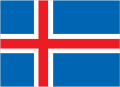
Translated from Althingi, the Parliament of Iceland The general national flag of Icelanders is sky-blue with a snow-white cross and a fiery-red cross within the white cross. The arms of the crosses extend all the way to the edges of the flag [...] The ratio between the width of the flag and its length is 18:25.
Unofficial translation by WorldometerTranslated from the Government Offices of Iceland his idea for a flag: a white cross on a blue field with a red cross within the white cross. The colours were to symbolise the blue of the mountains, the ice and the fire.
Unofficial translation by WorldometerTranslated from the National Archives of Iceland Its history can be traced back to Jörundur the Dog Days King, who gave Icelanders a new flag in 1809. That flag, however, disappeared from the scene at the same time as Jörundur, and it can be said that the matter did not truly begin until 1897, when Einar Benediktsson proposed that Icelanders should adopt a blue-and-white national flag. Icelanders were taken with Einar's idea, and the so-called white-blue flag became the unofficial flag of the country in the following years. It held that position until 12 June 1913, when Einar Pétursson decided to row around Reykjavík harbour with the flag at the stern of his boat. The captain of the Danish patrol ship Islands Falk would not accept this, as he considered that Einar was rowing under a flag that ships and boats in the Danish realm were not permitted to use, and he therefore confiscated the flag. That action enraged the townspeople, and many of them hoisted white and blue flags to the top of the pole in protest against it.
Unofficial translation by WorldometerTranslated from the National Archives of Iceland With that, the flag issue had become a heated matter among the people of the country and was debated at the next Althing, which led to the King issuing a decree on 22 November 1913 that Icelanders should receive a special flag. Despite the popularity of the white-blue flag, it was not chosen, because Christian X, King of Denmark, considered it too similar to the Greek royal flag, and instead approved a flag that Matthías Þórðarson, the National Antiquarian, had proposed in 1906, which was sky-blue with a white cross and a red cross within the white one.
Unofficial translation by WorldometerTranslated from Althingi, the Parliament of Iceland With reference to the royal decree of 22 November 1913, a royal decree was issued on 19 June 1915 on the shape and colours of the flag, whereby the tricolour design was determined. This flag then became the national flag when Iceland became a sovereign state on 1 December 1918, cf. the royal decree of 30 November 1918. With this, the flag was no longer merely a special flag but the long-desired symbol of the nation's sovereignty.
Unofficial translation by WorldometerTranslated from Althingi, the Parliament of Iceland When the founding of the republic was being prepared, the flag was discussed. No change was made to the design of the flag, its shape and colours, but rather to its use and handling. The law on the national flag of Icelanders currently in force was then enacted, which was the first law that the newly elected President of Iceland, Sveinn Björnsson, confirmed, and this was done at Þingvellir on 17 June 1944.
Unofficial translation by WorldometerSources:- althingi.is ↗ - Althingi, the Parliament of Iceland
- stjornarradid.is ↗ - the Government Offices of Iceland
- heimildir.is ↗ - the National Archives of Iceland
- althingi.is ↗ - Althingi, the Parliament of Iceland
- National anthem
- Lofsöngur1:39
- Title (in Icelandic)
- Lofsöngur
- Title (in English, translated)
- Song of Praise
- Alternate title (in Icelandic)
- Ó, Guð vors Lands
- Alternate title (in English, translated)
- O, God of Our Land
- Lyrics
1Ó, guð vors lands! Ó, lands vors guð! Vér lofum þitt heilaga, heilaga nafn! Úr sólkerfum himnanna hnýta þér krans Þínir herskarar, tímanna safn. Fyrir þér er einn dagur sem þúsund ár og þúsund ár dagur, ei meir: eitt eilífðar smáblóm með titrandi tár, sem tilbiður guð sinn og deyr. Íslands þúsund ár, Íslands þúsund ár, eitt eilífðar smáblóm með titrandi tár, sem tilbiður guð sinn og deyr.
2Ó, guð, ó, guð! Vér föllum fram og fórnum þér brennandi, brennandi sál, guð faðir, vor drottinn frá kyni til kyns, og vér kvökum vort helgasta mál. Vér kvökum og þökkum í þúsund ár, Því þú ert vort einasta skjól. Vér kvökum og þökkum með titrandi tár, Því þú tilbjóst vort forlagahjól. Íslands þúsund ár Íslands þúsund ár voru morgunsins húmköldu, hrynjandi tár, sem hitna við skínandi sól.
3Ó, guð vors lands! Ó, lands vors guð! Vér lifum sem blaktandi, blaktandi strá. Vér deyjum, ef þú ert ei ljós það og líf, sem að lyftir oss duftinu frá. Ó, vert þú hvern morgun vort ljúfasta líf, vor leiðtogi í daganna þraut og á kvöldin vor himneska hvíld og vor hlíf og vor hertogi á þjóðlífsins braut. Íslands þúsund ár Íslands þúsund ár verði gróandi þjóðlíf með þverrandi tár, sem þroskast á guðsríkis braut.
Source: - Citizens
- Icelanders
- Official name:Constitution of the Republic of Iceland (No. 33, 17 June 1944, as amended 30 May 1984, 31 May 1991, 28 June 1995 and 24 June 1999) ↗ - Government of Iceland
- Official name, Citizens:The World Factbook: Iceland - CIA
- National flag:althingi.is ↗ - Althingi, the Parliament of Iceland
- National flag:stjornarradid.is ↗ - the Government Offices of Iceland
- National flag:heimildir.is ↗ - the National Archives of Iceland
- National flag:althingi.is ↗ - Althingi, the Parliament of Iceland
- National anthem:nationalanthems.info ↗
Geography
- Location
- Northern Europe, island between the Greenland Sea and the North Atlantic Ocean, northwest of the United Kingdom
- Total area
- 103,000 km²
- Land area
- 100,250 km²
- Water area
- 2,750 km²
- Land borders
- None
- Coastline
- 4,970 km
- Terrain
Mostly plateau interspersed with mountain peaks, icefields; coast deeply indented by bays and fiords - Mean elevation
- 557 m
- Highest point
- 2,110 mHvannadalshnukur (at Vatnajokull Glacier)
- Lowest point
- 0 mAtlantic Ocean
- Climate
Temperate moderated by North Atlantic Current; mild, windy winters; damp, cool summers - Avg. temperature
- 1.9 °C
- Avg. daily range
- −0.6 to 4.1 °C
- Annual precipitation
- 1,451 mm
Temperature °CMeanDaily rangePrecipitation mmMonthly climate normals Month Avg. high, °C Mean, °C Avg. low, °C Precipitation, mm January −0.4 −2.6 −5 153 February −0.6 −2.9 −5.4 142 March −0.2 −2.4 −4.9 131 April 2.1 −0.1 −2.7 98 May 5.3 3.1 0.5 84 June 9.3 6.9 4.3 74 July 11.2 9 6.5 88 August 10.7 8.4 6 102 September 7.8 5.7 3.4 139 October 3.6 1.6 −0.7 148 November 0.8 −1.4 −3.8 141 December −0.4 −2.8 −5.3 153 Country-wide averages over 1991–2020.
Sources:- The World Factbook: Iceland - CIA
- Climate Change Knowledge Portal (ERA5 reanalysis) ↗ - World Bank
- Weather
- Loading
- Land use2023
- Arable1.2%Pasture15.0%Forest0.6%Other82.6%
- Arable land
- 121,000 hectares (1.2%)
- Permanent meadows & pastures
- 1,517,000 hectares (15.0%)
- Forest
- 59,552 hectares (0.6%)
- Other land
- 8,324,448 hectares (82.6%)
Source: - Natural hazards2026
- Coastal floods6.5High#28/191Earthquakes5.4High#65/191Epidemics2.2Very low#177/191River floods0.0Very lowTsunamis0.0Very lowTropical cyclones0.0Very lowDrought0.0Very low
Scores out of 10, ranks out of 191 countries.
Source:- INFORM Risk Index ↗ - European Commission Joint Research Centre
- Location, Land borders, Coastline, Terrain, Mean elevation, Highest point, Lowest point, Climate:The World Factbook: Iceland - CIA
- Climate:Climate Change Knowledge Portal (ERA5 reanalysis) ↗ - World Bank
- Land use:FAOSTAT Land Use domain ↗ - FAO
- Natural hazards:INFORM Risk Index ↗ - European Commission Joint Research Centre
Demographics
- Population change2026
- +1.02% per year+4,063 people/yearWorld Rank99thof 237
- Birth rate
- 10.8 per 1,000 population
- Death rate
- 6.7 per 1,000 population
- Net migration rate
- +5.0 per 1,000 population
- 2026
- 36.6 yearsWorld Rank98thof 237
- Age structure2026
- 0-14 years17.3%15-64 years66.4%65 years +16.3%
- Share aged 65 and over
- 16.3%
- Share aged under 18
- 21.1%
- Total dependency ratio
- 51
- Youth dependency ratio
- 26
- Elderly dependency ratio
- 25
- Sex ratio
- 1.05 male / female
MaleAgeFemalePopulation by age group, % of total population Age Male Female 80+ 1.7% 2.1% 70-79 3.7% 3.7% 60-69 5.2% 5.3% 50-59 5.9% 5.5% 40-49 7.0% 6.3% 30-39 8.6% 7.5% 20-29 7.1% 6.8% 10-19 6.2% 5.9% 0-9 6.0% 5.6% - 2026
- 0.61 below the replacement level for Iceland ()1.49 births per womanreplacement 2.10123World Rank171stof 237
- 0.72 daughters per woman0.28 below replacement, long-run each generation smaller than the lastreplacement 1.000.511.5
- 2026
- +4.1 per 1,000 populationfor every 1,000 people, 4.1 more births than deaths a year
- 2026
- +5.0 per 1,000 population
- Urbanization2026
- 94.3% live in cities379,229 urban residents
- Largest localities2026
- Reykjavík, Keflavík og Njarðvík, Akureyri, SelfossRankLocalityPopulation (2026 estimate)1Reykjavík247,1622Keflavík og Njarðvík22,5723Akureyri20,4674Selfoss11,0665Akranes8,6076Vestmannaeyjar4,5187Hveragerði3,3538Álftanes2,9169Ísafjörður2,80710Egilsstaðir2,719Source:
- Statistics Iceland (2026 estimate), via City Population by Thomas Brinkhoff ↗
- Population distribution
- Iceland is almost entirely urban, with half of the population located in and around the capital of Reykjavik; smaller clusters are primarily found along the coast in the north and west.
- Ethnic groups2024
- Figures count country of birth, not ethnicity.Icelandic78.7%Polish5.8%Danish1.0%Ukrainian1.0%Other13.5%
- Religions2024
- Evangelical Lutheran Church of Iceland58.6%Roman Catholic3.8%Independent Congregation of Reykjavik2.6%Independent Congregation of Hafnarfjordur1.9%Pagan worship1.5%Icelandic Ethical Humanist Association1.4%Other or unspecified18.7%None7.7%
The Evangelical Lutheran Church of Iceland is the official church.Other includes Zuist and Pentecostal.
Source:- The World Factbook: Iceland - CIA
- Languages
- Icelandic (Íslenska)
- Population, Population change, Median age, Age structure, Total fertility rate, Net reproduction rate, Natural change, Net migration rate:UN World Population Prospects ↗
- Urbanization:UN World Urbanization Prospects ↗
- Largest cities:Statistics Iceland (2026 estimate), via City Population by Thomas Brinkhoff ↗
- Population distribution, Ethnic groups, Religions:The World Factbook: Iceland - CIA
Government & Administration
- Form of state
- RepublicThe Constitution states form and system together in one sentence: "Iceland is a Republic with a parliamentary government" (Art. 1).Source:
- System of government
- Semi-presidentialAlthough often described as parliamentary, Iceland is classified as semi-presidential because it combines a President elected by direct ballot (Art. 5) with a government bound to the Althingi's (parliament's) confidence; the Constitution itself calls the government parliamentary (Art. 1).Source:
- Territorial organisation
- Unitary
- Official websites
- Capital
- Reykjavík135,714 people(2024)
- National holidays
- 14 days in 2026
- ThuJan 1New Year's Day
- ThuApr 2Maundy Thursday
- FriApr 3Good Friday
- SunApr 5Easter Sunday
- MonApr 6Easter Monday
- ThuApr 23First Day of Summer
- FriMay 1Labor Day
- ThuMay 14Ascension Day
- SunMay 24Pentecost
- MonMay 25Pentecost Monday
- WedJun 17National Day
- MonAug 3Commerce Day
- FriDec 25Christmas Day
- SatDec 26Second Day of Christmas
Nationwide public holidays only, excluding regional, bank and government-only days.
- Time
- GMTGreenwich Mean TimeUTC+0
- Currency
- Icelandic Króna (ISK)
- Entry requirements
- Official visa and entry information
- Calling code
- +354
- Internet TLD
- .is
- ISO 3166-1 codes
- IS, ISL
- Infrastructure
- Passengers carried
- 4,342,331 by the country's airlines(2023)
- Heliports
- 1
- Aircraft departures
- 37,800 by the country's airlines(2023)
- Air freight
- 191.9 million tonne-km(2023)
- Aircraft registration prefix
- TF
Sources:- The World Factbook: Iceland - CIA
- World Development Indicators ↗ - World Bank
- Flag carrier
- IcelandairPrivately owned
- 2025
- 77 / 100World Rank10thof 182Confidence interval
Corruption index score by year Year Score Lower bound Upper bound 2012 82 75 89 2013 78 73 83 2014 79 74 84 2015 79 72 86 2016 78 71 84 2017 77 70 84 2018 76 69 83 2019 78 70.4 85.6 2020 75 68.7 81.3 2021 74 67.9 80.1 2022 74 67.7 80.3 2023 72 66.2 77.8 2024 77 72.7 81.3 2025 77 70.5 83.5 Source:- Corruption Perceptions Index 2025 ↗ - Transparency International, CC BY 4.0
- Form of state, System of government, Territorial organisation:Stjórnarskrá lýðveldisins Íslands, as amended to 2013 ↗ - Prime Minister's Office of Iceland
- National holidays:Open World Holidays Framework (vacanza/holidays) ↗
- Infrastructure:The World Factbook: Iceland - CIA
- Infrastructure:World Development Indicators ↗ - World Bank
- Corruption Perceptions Index:Corruption Perceptions Index 2025 ↗ - Transparency International, CC BY 4.0
Economy
- High income
- GDP growth (real)2026
- +1.4% per yearWorld Rank154thof 195
- GDP per capita (PPP)2026
- GDP per capita (nominal)
- $107,464 (7th in the world)
Source:- 2025
- Services66.2% of GDPIndustry20.1% of GDPAgriculture3.7% of GDPManufacturing8.5%part of industry
- Households
- +49.6%
- Government
- +26.1%
- Investment
- +26.6%
- Exports
- +40.1%
- Imports
- −42.4%
The shape of the economyGDP by end useSource:- World Development Indicators ↗ - World Bank
- Inflation2026
- 5.6%up 1.5 percentage points1.5pp from 2025
- Labor force2024
- 243,133 (62% of population)World Rank173rdof 187
- Labor force participation2024
- 75.2% of people aged 15+
- Unemployment2024
- 3.6%
- Youth unemployment2024
- 8.8% ages 15 to 24
- Labor productivity2024
- $66.2 per hour worked at PPP
- Labor cost2025
- ISK 8,573 per hour$66.75 (USD), $51.46 (PPP)
- Budget balance2026
- 1.4% of GDP deficit
- Current account
- 2.5% of GDP, $1.1 billion deficit
Source: - Debt
- Government debt202459.1% of GDPHousehold debt202372.7% of GDPCompany debt2023123.2% of GDPInterest on debt20244.1% of GDPCentral government debt202459.9% of GDP
- Trade2025
- Goods$7.4 billion47.6%
- Services$8.2 billion52.4%
- Total exports
- $15.6 billion
- Change from 2024
- up 10.5 percent on the previous year10.5%
Sources:- World Development Indicators ↗ - World Bank
- The World Factbook: Iceland - CIA
- Agricultural products2024
- Meat of sheep (fresh or chilled), Raw milk of cattle, Meat of chickens (fresh or chilled), and 5 more
- 1Meat of sheep (fresh or chilled)35.8×
- 2Raw milk of cattle10.3×
- 3Meat of chickens (fresh or chilled)4×
- 4Meat of cattle with the bone (fresh or chilled)3.6×
- 5Meat of pig with the bone (fresh or chilled)2.8×
- 6Hen eggs in shell (fresh)2.8×
- 7Barley1.8×
- 8Potatoes0.7×
ProductSource:- FAOSTAT ↗ - Food and Agriculture Organization
- Gold reserves2025
- 2 tonnesWorth $278.7 million, 4% of total official reserves by value
- Industries
- tourism, fish processing
- aluminum smelting
- geothermal power, hydropower
- medical/pharmaceutical products
Source:- The World Factbook: Iceland - CIA
- Income level, GDP by sector, Trade, Gold reserves:World Development Indicators ↗ - World Bank
- GDP (nominal), GDP growth (real), GDP per capita (PPP), Inflation, Budget balance:IMF World Economic Outlook ↗
- Labor force, Labor force participation, Unemployment, Youth unemployment, Labor productivity, Labor cost:ILOSTAT ↗ - International Labour Organization
- Debt:IMF Global Debt Database ↗
- Debt:IMF Public Finances in Modern History ↗
- Trade, Industries:The World Factbook: Iceland - CIA
- Agricultural products:FAOSTAT ↗ - Food and Agriculture Organization
Cost of Living
- Cost of living index
- Loading
- Monthly costs (excluding rent)
- Loading
- Rent
- Loading
- Buying an apartment
- Loading
- Average gross salary2020
- €5,558 per month$6,349 (USD), $5,552 (PPP)
- Median
- €4,983 per month($5,692)
- Men
- €6,258 per month($7,148)
- Women
- €4,834 per month($5,521)
Source:- ILOSTAT ↗ - International Labour Organization
- 2024
- ISK 425,985 per month, gross$3,088 (USD), $2,730 (PPP)
- Average gross salary, Minimum wage:ILOSTAT ↗ - International Labour Organization
Society
- 2023
- 0.972Very highWorld Rank1stof 193IcelandWorld
Human Development Index by year Year Iceland World 1990 0.841 0.608 1991 0.853 0.611 1992 0.860 0.614 1993 0.863 0.617 1994 0.868 0.620 1995 0.863 0.625 1996 0.873 0.631 1997 0.881 0.636 1998 0.893 0.641 1999 0.895 0.646 2000 0.902 0.651 2001 0.910 0.657 2002 0.917 0.662 2003 0.925 0.669 2004 0.928 0.675 2005 0.935 0.681 2006 0.936 0.688 2007 0.941 0.694 2008 0.935 0.698 2009 0.934 0.701 2010 0.935 0.707 2011 0.941 0.713 2012 0.946 0.717 2013 0.950 0.721 2014 0.954 0.726 2015 0.956 0.731 2016 0.959 0.735 2017 0.962 0.739 2018 0.966 0.741 2019 0.969 0.745 2020 0.965 0.742 2021 0.967 0.742 2022 0.964 0.752 2023 0.972 0.756 Source:- Human Development Report ↗ - United Nations Development Programme
- 2019
- 26.8
- Mean years of schooling2023
- 13.9 years
- Expected for a child today
- 18.9 years
Source:- Human Development Report ↗ - United Nations Development Programme
- Education expenditure2022
- 7.3% of GDP
- Share of government spending
- 15.7%
Source:- World Development Indicators ↗ - World Bank
- Internet users2024
- 98.2% of the population
- Households with Internet access
- 98.3%
Source:- ITU DataHub ↗ - International Telecommunication Union
- Mobile subscriptions2024
- 475,724
- Fixed telephone lines
- 68,518
- Fixed broadband
- 37.5 subscriptions per 100 people
Counts subscriptions, not people.
Source:- ITU DataHub ↗ - International Telecommunication Union
- Credit-card ownership2021
- 74% of adults
- Debit-card ownership
- 94%
- Account at a bank or mobile-money provider
- 100%
- Made or received a digital payment
- 100%
Source:- Global Findex Database ↗ - World Bank
- Refugees hosted2025
- 8,231 people
- Asylum seekers
- 767
- Stateless persons
- 32
- Internally displaced persons
- 3,700All due to disasters
- Refugees from Iceland abroad
- 17
Sources:- Refugee Data Finder ↗ - UN Refugee Agency
- Global Internal Displacement Database ↗ - Internal Displacement Monitoring Centre
- Inbound tourists2021latest available
- 698,000 arrivalsdown 65% against 201965% below 2019Official tourism site
- Per resident
- 1.9 arrivals per resident
- Same-day visitors
- 19,000 arrivals
- $3.2 billion(2024)
- Share of GDP
- 6.1% tourism direct GDP(2022)
- Residents' trips abroad
- 219,000 overnight trips
- $1.8 billion(2024)
- Hotel beds
- 33,320
- Average hotel stay
- 1.7 nights
Overnight arrivals by year2010 to 2021A tourist stays at least one night. Arrivals count trips, not people.
Source:- UN Tourism Data Dashboard ↗ - UN Tourism
- UNESCO World Heritage Sites
- 3 sites1 cultural2 natural
Site Type Thingvellir National Park Cultural Surtsey Natural Vatnajökull National Park - Dynamic Nature of Fire and Ice Natural Source:- The World Factbook: Iceland - CIA
- Human Development Index, Mean years of schooling:Human Development Report ↗ - United Nations Development Programme
- Income inequality (Gini), Education expenditure:World Development Indicators ↗ - World Bank
- Internet users, Mobile subscriptions:ITU DataHub ↗ - International Telecommunication Union
- Credit-card ownership:Global Findex Database ↗ - World Bank
- Refugees hosted:Refugee Data Finder ↗ - UN Refugee Agency
- Refugees hosted:Global Internal Displacement Database ↗ - Internal Displacement Monitoring Centre
- Inbound tourists:UN Tourism Data Dashboard ↗ - UN Tourism
- UNESCO World Heritage Sites:The World Factbook: Iceland - CIA
Crime & Safety
- Travel advisory (US)
- Loading
- Active humanitarian crisisAug 2026
- None - no active crisis
- Homicide rate2024
- 2 per 100,000 peopleLow by global standards
- Crime rates
- 6 offence categories
Offence Per 100,000 Count Year Homicide (victims) 2.0 8 2024 Serious assault 49.8 193 2023 Sexual violence 130.0 504 2023 Burglary 285.5 1,086 2022 Theft 897.6 3,414 2022 Vehicle theft 5.8 22 2022 A low figure can also mean weak recording.
Source:- UNODC Data Portal ↗ - UN Office on Drugs and Crime
- Prison population2023
- 35.6 per 100,000 people
- Persons held
- 138
Source:- UNODC Data Portal ↗ - UN Office on Drugs and Crime
- Active humanitarian crisis:INFORM Severity Index ↗ - European Commission Joint Research Centre
- Homicide rate, Crime rates, Prison population:UNODC Data Portal ↗ - UN Office on Drugs and Crime
Health
- Life expectancy2026
- 83.3 years
- Health expenditure2024
- 9% of GDP$7,642 per person
- Physicians2023
- 4.37 per 1,000 population
- Hospital beds2020
- 2.8 per 1,000 population
- Infant mortality2026
- 1.1 per 1,000 live births
- Maternal mortality2023
- 3 per 100,000 live births
- Alcohol consumption2022
- 8.2 litres of pure alcohol per adult per year
- Tobacco use2023
- 9.7% of adults
- Men
- 9.9%
- Women
- 9.4%
Source:- Global Health Observatory ↗ - World Health Organization
- Road traffic deaths2019
- 2 per 100,000 population
- Life expectancy, Infant mortality:UN World Population Prospects ↗
- Health expenditure, Physicians, Hospital beds, Road traffic deaths:World Development Indicators ↗ - World Bank
- Maternal mortality:Maternal mortality estimates ↗ - UN Maternal Mortality Estimation Inter-agency Group
- Alcohol consumption, Tobacco use:Global Health Observatory ↗ - World Health Organization
Environment
- CO₂ emissions2024
- 3.29 Mt per yearup 2.3 percent on the previous year2.3% from 2023
- CO₂ per capita
- 9.3 t per personWorld Rank25thof 207
- Share of global CO₂
- 0.01%
- Methane (CH₄)
- 0.48 Mt CO₂-eq
- Nitrous oxide (N₂O)
- 0.26 Mt CO₂-eq
- Fluorinated gases
- 0.24 Mt CO₂-eq
- All greenhouse gases
- 4.28 Mt CO₂-eq
Source:- Emissions Database for Global Atmospheric Research (EDGAR) ↗ - European Commission, Joint Research Centre
- 2024
- 3 µg/m³ of PM2.5Most polluted204thof 236
- WHO guideline
- 5 µg/m³
- National standard
- 10 µg/m³
Source:- Air Quality Life Index ↗ - Energy Policy Institute at the University of Chicago
- Environmental issues
- water pollution from fertilizer runoff
- International agreements
- 16 of 20 landmark treaties in forceParty to 108 multilateral environmental agreements
Treaty Standing Joined Climate Paris Agreement in force 2016 UN Framework Convention on Climate Change in force 1994 Kyoto Protocol in force 2005 Ozone layer Montreal Protocol in force 1989 Vienna Convention (Ozone Layer) in force 1989 Biodiversity Convention on Biological Diversity in force 1994 CITES in force 2000 Convention on Migratory Species (Bonn) not a party Cartagena Protocol on Biosafety signed 2001, not ratified Nagoya Protocol not a party Land and heritage Ramsar Convention on Wetlands in force 1978 World Heritage Convention in force 1996 UN Convention to Combat Desertification in force 1997 Chemicals and waste Basel Convention in force 1995 Rotterdam Convention (PIC) not a party Stockholm Convention (POPs) in force 2004 Minamata Convention on Mercury in force 2018 Oceans UN Convention on the Law of the Sea in force 1994 High Seas Treaty (BBNJ) in force 2026 MARPOL 73/78 in force 1985 Source:- International Environmental Agreements Database ↗ - Université Laval
- CO₂ emissions:Emissions Database for Global Atmospheric Research (EDGAR) ↗ - European Commission, Joint Research Centre
- Air pollution:Air Quality Life Index ↗ - Energy Policy Institute at the University of Chicago
- Environmental issues:The World Factbook: Iceland - CIA
- International agreements:International Environmental Agreements Database ↗ - Université Laval
Food & Water
- No access to safe drinking water2022
- 0% of the population
- Renewable water2022
- 170 billion m³ per year
- Per person
- 446,950 m³ per year
- Dependency ratio
- 0% originates outside the country
- Annual water withdrawal
- 0.3 billion m³ per year
- Withdrawn for agriculture
- 0%
- Water stress
- 0% of available freshwater withdrawn
Source:- AQUASTAT ↗ - Food and Agriculture Organization
- Obesity2024
- 22.2% of adults
- Men
- 23.3%
- Women
- 21%
Source:- Global Health Observatory ↗ - World Health Organization
- No access to safe drinking water, Renewable water:AQUASTAT ↗ - Food and Agriculture Organization
- Obesity:Global Health Observatory ↗ - World Health Organization
Energy
- Energy consumption2024
- Per capita
- 300.4 GJ per person
- Share of world total
- 0.02%
- Supply
- Deficitproduces 58% of what it consumes, 2024
Source:- International Energy Statistics ↗ - U.S. Energy Information Administration
- Electricity2024
- No electricity trade19 TWh generated per year
- Generation
- 19 TWh per year
- Consumption
- 18 TWh per year
Source:- International Energy Statistics ↗ - U.S. Energy Information Administration
- Oil, gas & coal
- No domestic productionconsumes 21,107 b/d in 2025Consumption202521,107 b/d
Oil imports and exports count crude oil only.
- Energy consumption, Electricity, Oil, gas & coal:International Energy Statistics ↗ - U.S. Energy Information Administration
Defense
- Nuclear weapons2026
- None - no nuclear arsenal
- Nuclear weapons:Status of World Nuclear Forces ↗ - Federation of American Scientists

