

National Identity
- Official name
- Republic of Guinea-Bissau
- Official name (in Portuguese)
- República da Guiné-Bissau
- Name etymology
the country is partly named after the Guinea region of West Africa that lies along the Gulf of Guinea; the name itself is derived from the Tuareg word aginaw, meaning "black people;" Bissau, the name of the capital city, distinguishes the country from neighboring Guinea and is derived from the local Bijuga people
Sources:- Constitution of the Republic of Guinea-Bissau ↗ - National People's Assembly
- The World Factbook: Guinea-Bissau - CIA
- Coat of arms
- National flag
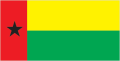
Translated from the National People's Assembly of Guinea-Bissau 2- The National Flag of the Republic of Guinea-Bissau is formed by three rectangular stripes, red in colour, in a vertical position, and yellow and green, in a horizontal position, respectively on the upper and the lower right sides. The red stripe is marked with a black five-pointed star.
Unofficial translation by WorldometerTranslated from the National People's Assembly of Guinea-Bissau The Black Star of the flag is a symbol of African unity, yellow represents the sun, green is hope, and red represents the blood shed during the long struggle for independence from Portugal.
Unofficial translation by WorldometerTranslated from the National People's Assembly of Guinea-Bissau The flag of Guinea-Bissau was adopted in 1973, when independence from Portugal was proclaimed.
Unofficial translation by WorldometerSources:- parlamento.gw ↗ - the National People's Assembly of Guinea-Bissau
- anp.gw ↗ - the National People's Assembly of Guinea-Bissau
- National anthem
- Esta é a Nossa Pátria Bem Amada1:01
- Title (in Portuguese)
- Esta é a Nossa Pátria Bem Amada
- Title (in English, translated)
- This Is Our Beloved Country
- Lyrics
1Sol, suor e o verde e mar, Séculos de dor e esperança: Esta é a terra dos nossos avós! Fruto das nosas mãos, Da flôr do nosso sangue: Esta é a nossa pátria amada.
ChorusViva a pátria gloriosa! Floriu nos céus a bandeira da luta. Avante, contra o jugo estrangeiro! Nós vamos construir Na patria immortal A paz e o progresso! Nós vamos construir Na patria immortal A paz e o progresso! paz e o progresso!
2Ramos do mesmo tronco, Olhos na mesma luz: Esta é a força da nossa união! Cantem o mar e a terra A madrugada eo sol Que a nossa luta fecundou.
Viva a pátria gloriosa!Source: - Citizens
- Bissau-Guineans
- Official name:Constitution of the Republic of Guinea-Bissau ↗ - National People's Assembly
- Official name, Citizens:The World Factbook: Guinea-Bissau - CIA
- Coat of arms:Image credit
- National flag:parlamento.gw ↗ - the National People's Assembly of Guinea-Bissau
- National flag:anp.gw ↗ - the National People's Assembly of Guinea-Bissau
- National anthem:nationalanthems.info ↗
Geography
- Location
- Total area
- 36,125 km²
- Land area
- 28,120 km²
- Water area
- 8,005 km²
- Land borders
- 762 km(2 countries)
- Coastline
- 350 km
- Terrain
Mostly low-lying coastal plain with a deeply indented estuarine coastline rising to savanna in east; numerous off-shore islands including the Arquipelago Dos Bijagos consisting of 18 main islands and many small islets - Mean elevation
- 70 m
- Highest point
- 277 mDongol Ronde
- Lowest point
- 0 mAtlantic Ocean
- Climate
Tropical generally hot and humid; monsoonal-type rainy season (June to November) with southwesterly winds; dry season (December to May) with northeasterly harmattan winds - Avg. temperature
- 27.6 °C
- Avg. daily range
- 23.1 to 33.2 °C
- Annual precipitation
- 1,295 mm
Temperature °CMeanDaily rangePrecipitation mmMonthly climate normals Month Avg. high, °C Mean, °C Avg. low, °C Precipitation, mm January 33.2 25.9 19.7 0 February 35.1 27.5 21 1 March 36.5 29 22.7 0 April 36.7 29.7 23.9 0 May 35.9 29.8 25 11 June 33 28.6 25.3 98 July 30.2 26.8 24.3 321 August 29.7 26.4 24 410 September 30.5 26.7 23.9 297 October 31.9 27.6 24.2 135 November 32.8 27.4 22.7 20 December 33 26 20.1 2 Country-wide averages over 1991–2020.
Sources:- The World Factbook: Guinea-Bissau - CIA
- Climate Change Knowledge Portal (ERA5 reanalysis) ↗ - World Bank
- Weather
- Loading
- Land use2023
- Arable14.1%Perm. crops8.9%Pasture6.9%Forest75.0%
- Arable land
- 395,531 hectares (14.1%)
- Permanent crops
- 250,000 hectares (8.9%)
- Permanent meadows & pastures
- 195,000 hectares (6.9%)
- Forest
- 2,108,066 hectares (75.0%)
- Other land
- 0 hectares (0.0%)
Reported categories cover 104.9% of the land area.
Source: - Natural hazards2026
- Epidemics7.0Very high#24/191River floods2.8Low#134/191Coastal floods2.1Very low#122/191Drought1.9Very low#129/191Earthquakes0.1Very low#127/191Tsunamis0.0Very lowTropical cyclones0.0Very low
Scores out of 10, ranks out of 191 countries.
Source:- INFORM Risk Index ↗ - European Commission Joint Research Centre
- Location, Land borders, Coastline, Terrain, Mean elevation, Highest point, Lowest point, Climate:The World Factbook: Guinea-Bissau - CIA
- Climate:Climate Change Knowledge Portal (ERA5 reanalysis) ↗ - World Bank
- Land use:FAOSTAT Land Use domain ↗ - FAO
- Natural hazards:INFORM Risk Index ↗ - European Commission Joint Research Centre
Demographics
- Population change2026
- +2.15% per year+48,293 people/yearWorld Rank37thof 237
- Birth rate
- 28.7 per 1,000 population
- Death rate
- 6.9 per 1,000 population
- Net migration rate
- −0.8 per 1,000 population
- 2026
- 19.6 yearsWorld Rank204thof 237
- Age structure2026
- 0-14 years37.8%15-64 years58.9%65 years +3.3%
- Share aged 65 and over
- 3.3%
- Share aged under 18
- 44.6%
- Total dependency ratio
- 70
- Youth dependency ratio
- 64
- Elderly dependency ratio
- 6
- Sex ratio
- 0.98 male / female
MaleAgeFemalePopulation by age group, % of total population Age Male Female 80+ 0.1% 0.2% 70-79 0.6% 1.0% 60-69 1.3% 1.9% 50-59 2.7% 3.1% 40-49 4.6% 4.8% 30-39 6.6% 6.6% 20-29 8.9% 8.8% 10-19 11.6% 11.4% 0-9 13.1% 12.7% - 2026
- 1.32 above the replacement level for Guinea-Bissau ()3.62 births per womanreplacement 2.301234World Rank35thof 237
- 1.60 daughters per woman0.60 above replacement, long-run each generation larger than the lastreplacement 1.000.511.52
- 2026
- +21.8 per 1,000 populationfor every 1,000 people, 21.8 more births than deaths a year
- 2026
- −0.8 per 1,000 population
- Urbanization2026
- 47.2% live in cities1,084,713 urban residents
- Largest cities2009latest available
- Bissau, Gabú, Bafatá, CanchungoRankCity or Urban LocalityPopulation (2009 census)1Bissau387,9092Gabú43,5563Bafatá29,5564Canchungo12,0445Bissorã9,8986Bula9,0107Farim9,0058Mansôa8,3139Ingoré8,10710Buba7,898Source:
- National Statistics Institute, Guinea-Bissau (2009 census), via City Population by Thomas Brinkhoff ↗
- Population distribution
- Approximately one fifth of the population lives in the capital city of Bissau along the Atlantic coast; the remainder is distributed among the eight mainly rural regions.
- Ethnic groups2015
- Balanta30.0%Fulani30.0%Manjaco14.0%Mandinga13.0%Papel7.0%Unspecified smaller ethnic groups6.0%
- Religions2020
- Muslim46.1%Folk religion30.6%Christian18.9%Other or unaffiliated4.4%
- Languages
- Portuguese (Português)
- Population, Population change, Median age, Age structure, Total fertility rate, Net reproduction rate, Natural change, Net migration rate:UN World Population Prospects ↗
- Urbanization:UN World Urbanization Prospects ↗
- Largest cities:National Statistics Institute, Guinea-Bissau (2009 census), via City Population by Thomas Brinkhoff ↗
- Population distribution, Ethnic groups, Religions:The World Factbook: Guinea-Bissau - CIA
Government & Administration
- Form of state
- RepublicThe President of the Republic is elected by direct universal suffrage of registered voters.Sources:
- Constituição da República da Guiné-Bissau ↗
- Constitution of the Republic of Guinea-Bissau, approved by referendum on 30 August 2026
- System of government
- Semi-presidentialUnder a constitution approved by referendum on 30 August 2026, the President directs the Government and appoints and dismisses the Prime Minister, and the Government also answers to parliament; a military-led transition governs and says the 6 December 2026 elections will have to be delayed.Sources:
- Constituição da República da Guiné-Bissau ↗
- Constitution of the Republic of Guinea-Bissau, approved by referendum on 30 August 2026
- System in practice
- Military rule
- Territorial organisation
- Unitary
- Transitional arrangement
- Yes
- Official websites
- President (in Portuguese, English available)
- Parliament (in Portuguese)
- Capital
- Bissau440,118 people(2022)
- National holidays
- 11 days in 2026
- ThuJan 1New Year's Day
- TueJan 20National Heroes' Day
- FriJan 23Day of the Beginning of the Armed Struggle
- SunMar 8International Women's Day
- FriMar 20Eid al-Fitr (estimated)
- SunApr 5Easter Sunday
- FriMay 1Worker's Day
- WedMay 27Eid al-Adha (estimated)
- MonAug 3Pidjiguiti Day
- ThuSep 24Independence Day
- FriDec 25Christmas Day
Nationwide public holidays only, excluding regional, bank and government-only days.
- Time
- GMTGreenwich Mean TimeUTC+0
- Currency
- West African CFA Franc (XOF)
- Calling code
- +245
- Internet TLD
- .gw
- ISO 3166-1 codes
- GW, GNB
- Infrastructure
- Aircraft registration prefix
- J5
Source:- The World Factbook: Guinea-Bissau - CIA
- 2025
- 21 / 100World Rank161stof 182Confidence interval
Corruption index score by year Year Score Lower bound Upper bound 2012 25 22 29 2013 19 15 23 2014 19 15 23 2015 17 13 21 2016 16 13 20 2017 17 14 20 2018 16 13 19 2019 18 13.2 22.8 2020 19 14.6 23.4 2021 21 16.6 25.4 2022 21 16.6 25.4 2023 22 17.2 26.8 2024 21 13.9 28.1 2025 21 13.9 28.1 Source:- Corruption Perceptions Index 2025 ↗ - Transparency International, CC BY 4.0
- Form of state, System of government, System in practice, Territorial organisation, Transitional arrangement:Constituição da República da Guiné-Bissau ↗ - National People's Assembly of Guinea-Bissau
- Form of state, System of government, System in practice, Territorial organisation, Transitional arrangement:Constitution of the Republic of Guinea-Bissau, approved by referendum on 30 August 2026
- National holidays:Open World Holidays Framework (vacanza/holidays) ↗
- Infrastructure:The World Factbook: Guinea-Bissau - CIA
- Infrastructure:World Development Indicators ↗ - World Bank
- Corruption Perceptions Index:Corruption Perceptions Index 2025 ↗ - Transparency International, CC BY 4.0
Economy
- Low income
- GDP growth (real)2026
- +4.7% per yearWorld Rank39thof 195
- GDP per capita (PPP)2026
- GDP per capita (nominal)
- $1,429 (173rd in the world)
Source:- 2025
- Services39.1% of GDPIndustry15.7% of GDPAgriculture40.6% of GDPManufacturing8.6%part of industry
- Households
- +71.9%
- Government
- +15.5%
- Investment
- +25.8%
- Exports
- +13.9%
- Imports
- −27%
The shape of the economyGDP by end useSource:- World Development Indicators ↗ - World Bank
- Inflation2026
- 2.5%up 1.6 percentage points1.6pp from 2025
- Labor force2024
- 872,547 (40% of population)World Rank148thof 187
- Labor force participation2024
- 64.8% of people aged 15+
- Unemployment2024
- 2.6%
- Youth unemployment2024
- 2.8% ages 15 to 24
- Labor productivity2024
- $3.1 per hour worked at PPP
- Budget balance2026
- 4% of GDP deficit
- Current account
- 7% of GDP, $206 million deficit
Source: - Debt2024
- Central government debt82.3% of GDPInterest on debt3.3% of GDP
- Trade2024
- Goods$229.4 million81.8%
- Services$51 million18.2%
- Total exports
- $280.4 million
- Change from 2023
- down 1.4 percent on the previous year1.4%
Sources:- World Development Indicators ↗ - World Bank
- The World Factbook: Guinea-Bissau - CIA
- Agricultural products2024
- Cashew nuts (in shell), Groundnuts (in shell), Natural rubber in primary forms, and 7 more
- 1Cashew nuts (in shell)209.8×
- 2Groundnuts (in shell)26.4×
- 3Natural rubber in primary forms16.6×
- 4Plantains and cooking bananas12.7×
- 5Millet10.9×
- 6Coconuts (in shell)7.7×
- 7Raw milk of goats6.9×
- 8Sorghum4.4×
- 9Sweet potatoes4.1×
- 10Rice2.9×
ProductSource:- FAOSTAT ↗ - Food and Agriculture Organization
- Industries
- agricultural products processing, beer, soft drinks
- Income level, GDP by sector, Trade:World Development Indicators ↗ - World Bank
- GDP (nominal), GDP growth (real), GDP per capita (PPP), Inflation, Budget balance:IMF World Economic Outlook ↗
- Labor force, Labor force participation, Unemployment, Youth unemployment, Labor productivity:ILOSTAT ↗ - International Labour Organization
- Debt:IMF Global Debt Database ↗
- Debt:IMF Public Finances in Modern History ↗
- Trade, Industries:The World Factbook: Guinea-Bissau - CIA
- Agricultural products:FAOSTAT ↗ - Food and Agriculture Organization
Cost of Living
- Average gross salary2022
- F CFA 87,940 per month$141 (USD), $398 (PPP)
- Median
- F CFA 60,000 per month($96)
- Men
- F CFA 92,823 per month($149)
- Women
- F CFA 74,487 per month($119)
Source:- ILOSTAT ↗ - International Labour Organization
- 2024
- F CFA 19,030 per month, gross$31 (USD), $83 (PPP)
- Average gross salary, Minimum wage:ILOSTAT ↗ - International Labour Organization
Society
- 2023
- 0.514LowWorld Rank174thof 193Guinea-BissauWorld
Human Development Index by year Year Guinea-Bissau World 2005 0.412 0.681 2006 0.424 0.688 2007 0.431 0.694 2008 0.436 0.698 2009 0.444 0.701 2010 0.452 0.707 2011 0.460 0.713 2012 0.462 0.717 2013 0.469 0.721 2014 0.476 0.726 2015 0.481 0.731 2016 0.486 0.735 2017 0.491 0.739 2018 0.493 0.741 2019 0.501 0.745 2020 0.498 0.742 2021 0.502 0.742 2022 0.511 0.752 2023 0.514 0.756 Source:- Human Development Report ↗ - United Nations Development Programme
- 2021
- 33.4
- Mean years of schooling2023
- 3.7 years
- Expected for a child today
- 10.6 years
Source:- Human Development Report ↗ - United Nations Development Programme
- Literacy2022
- 63.9% of adults
- Education expenditure2013latest available
- 2% of GDP
- Share of government spending
- 16.2%
Source:- World Development Indicators ↗ - World Bank
- Internet users2022
- 27.7% of the population
- Households with Internet access
- 26.1%
Source:- ITU DataHub ↗ - International Telecommunication Union
- Mobile subscriptions2022
- 2.7 million
- Fixed telephone lines
- 0
- Fixed broadband
- 0.2 subscriptions per 100 people
Counts subscriptions, not people.
Source:- ITU DataHub ↗ - International Telecommunication Union
- Refugees hosted2025
- 24 people
- Asylum seekers
- 30
- Internally displaced persons
- 700All due to disasters
- Refugees from Guinea-Bissau abroad
- 1,910
Sources:- Refugee Data Finder ↗ - UN Refugee Agency
- Global Internal Displacement Database ↗ - Internal Displacement Monitoring Centre
- Inbound tourists2019latest available
- 52,400 arrivals
- Per resident
- 2.7 arrivals per 100 residents
- $23.2 million(2023)
- $79.1 million(2023)
Overnight arrivals by year2010 to 2019A tourist stays at least one night. Arrivals count trips, not people.
Source:- UN Tourism Data Dashboard ↗ - UN Tourism
- UNESCO World Heritage Sites
- 1 site1 natural
Site Type Coastal and Marine Ecosystems of the Bijagós Archipelago – Omatí Minhô Natural Source:- The World Factbook: Guinea-Bissau - CIA
- Human Development Index, Mean years of schooling:Human Development Report ↗ - United Nations Development Programme
- Income inequality (Gini), Education expenditure:World Development Indicators ↗ - World Bank
- Literacy:UIS Data Browser ↗ - UNESCO Institute for Statistics
- Internet users, Mobile subscriptions:ITU DataHub ↗ - International Telecommunication Union
- Refugees hosted:Refugee Data Finder ↗ - UN Refugee Agency
- Refugees hosted:Global Internal Displacement Database ↗ - Internal Displacement Monitoring Centre
- Inbound tourists:UN Tourism Data Dashboard ↗ - UN Tourism
- UNESCO World Heritage Sites:The World Factbook: Guinea-Bissau - CIA
Crime & Safety
- Travel advisory (US)
- Loading
- Active humanitarian crisisAug 2026
- None - no active crisis
- Homicide rate2017
- 1.1 per 100,000 peopleLow by global standards
- Crime rates
- 5 offence categories
Offence Per 100,000 Count Year Homicide (victims) 1.1 21 2017 Serious assault 109.2 2,000 2016 Kidnapping 0.7 13 2016 Theft 57.3 997 2014 Vehicle theft 0.3 5 2014 A low figure can also mean weak recording.
Source:- UNODC Data Portal ↗ - UN Office on Drugs and Crime
- Prison population2017
- 31.8 per 100,000 people
- Persons held
- 596
Source:- UNODC Data Portal ↗ - UN Office on Drugs and Crime
- Active humanitarian crisis:INFORM Severity Index ↗ - European Commission Joint Research Centre
- Homicide rate, Crime rates, Prison population:UNODC Data Portal ↗ - UN Office on Drugs and Crime
Health
- Life expectancy2026
- 64.6 years
- Health expenditure2023
- 8.8% of GDP$82 per person
- Physicians2022
- 0.25 per 1,000 population
- Hospital beds2009latest available
- 1 per 1,000 population
- Infant mortality2026
- 46.5 per 1,000 live births
- Maternal mortality2023
- 505 per 100,000 live births
- Alcohol consumption2022
- 3.2 litres of pure alcohol per adult per year
- Tobacco use2015latest available
- 11% of adults
- Men
- 21%
- Women
- 0.9%
Source:- Global Health Observatory ↗ - World Health Organization
- Road traffic deaths2019
- 32.2 per 100,000 population
- Life expectancy, Infant mortality:UN World Population Prospects ↗
- Health expenditure, Physicians, Hospital beds, Road traffic deaths:World Development Indicators ↗ - World Bank
- Maternal mortality:Maternal mortality estimates ↗ - UN Maternal Mortality Estimation Inter-agency Group
- Alcohol consumption, Tobacco use:Global Health Observatory ↗ - World Health Organization
Environment
- CO₂ emissions2024
- 0.34 Mt per yearup 3.9 percent on the previous year3.9% from 2023
- CO₂ per capita
- 0.2 t per personWorld Rank197thof 207
- Share of global CO₂
- < 0.01%
- Methane (CH₄)
- 2.3 Mt CO₂-eq
- Nitrous oxide (N₂O)
- 0.54 Mt CO₂-eq
- All greenhouse gases
- 3.19 Mt CO₂-eq
Source:- Emissions Database for Global Atmospheric Research (EDGAR) ↗ - European Commission, Joint Research Centre
- 2024
- 15.2 µg/m³ of PM2.51 years of life expectancy lost against the WHO guidelineMost polluted89thof 236
- WHO guideline
- 5 µg/m³
Source:- Air Quality Life Index ↗ - Energy Policy Institute at the University of Chicago
- Environmental issues
- deforestation (overharvesting of trees for timber and agricultural purposes)
- soil erosion
- overgrazing
- overfishing
Source:- The World Factbook: Guinea-Bissau - CIA
- International agreements
- 20 of 20 landmark treaties in forceParty to 56 multilateral environmental agreements
Treaty Standing Joined Climate Paris Agreement in force 2018 UN Framework Convention on Climate Change in force 1996 Kyoto Protocol in force 2006 Ozone layer Montreal Protocol in force 2003 Vienna Convention (Ozone Layer) in force 2003 Biodiversity Convention on Biological Diversity in force 1996 CITES in force 1990 Convention on Migratory Species (Bonn) in force 1995 Cartagena Protocol on Biosafety in force 2010 Nagoya Protocol in force 2014 Land and heritage Ramsar Convention on Wetlands in force 1990 World Heritage Convention in force 2006 UN Convention to Combat Desertification in force 1996 Chemicals and waste Basel Convention in force 2005 Rotterdam Convention (PIC) in force 2008 Stockholm Convention (POPs) in force 2008 Minamata Convention on Mercury in force 2019 Oceans UN Convention on the Law of the Sea in force 1994 High Seas Treaty (BBNJ) in force 2026 MARPOL 73/78 in force 2017 Source:- International Environmental Agreements Database ↗ - Université Laval
- CO₂ emissions:Emissions Database for Global Atmospheric Research (EDGAR) ↗ - European Commission, Joint Research Centre
- Air pollution:Air Quality Life Index ↗ - Energy Policy Institute at the University of Chicago
- Environmental issues:The World Factbook: Guinea-Bissau - CIA
- International agreements:International Environmental Agreements Database ↗ - Université Laval
Food & Water
- No access to safe drinking water2022
- 20.7% of the population
- Renewable water2022
- 31 billion m³ per year
- Per person
- 14,913 m³ per year
- Dependency ratio
- 49% originates outside the country
- Annual water withdrawal
- 0.2 billion m³ per year
- Withdrawn for agriculture
- 76%
- Water stress
- 1% of available freshwater withdrawn
Source:- AQUASTAT ↗ - Food and Agriculture Organization
- Undernourishment2022
- 32.4% of the population700,000 people
- Obesity2024
- 12.7% of adults
- Men
- 7.8%
- Women
- 17.1%
Source:- Global Health Observatory ↗ - World Health Organization
- Underweight children2019
- 18.8% of children under five
- No access to safe drinking water, Renewable water:AQUASTAT ↗ - Food and Agriculture Organization
- Undernourishment:Food security indicators (FAOSTAT) ↗ - Food and Agriculture Organization
- Obesity:Global Health Observatory ↗ - World Health Organization
- Underweight children:World Development Indicators ↗ - World Bank
Energy
- Energy consumption2024
- Per capita
- 2.49 GJ per person
- Share of world total
- < 0.01%
- Supply
- No meaningful productionproduces under 2% of what it consumes, 2024
Source:- International Energy Statistics ↗ - U.S. Energy Information Administration
- Electricity2024
- No electricity trade0.1 TWh generated per year
- Generation
- 0.1 TWh per year
- Consumption
- 0.1 TWh per year
Source:- International Energy Statistics ↗ - U.S. Energy Information Administration
- Oil, gas & coal
- No domestic productionconsumes 2,443 b/d in 2024Consumption20242,443 b/d
Oil imports and exports count crude oil only.
- Energy consumption, Electricity, Oil, gas & coal:International Energy Statistics ↗ - U.S. Energy Information Administration
Defense
- Military expenditure2023
- 1.2% of GDP$25.3 million, 5.8% of government spending
- Military personnel2025
- estimated 4,000active FARP
- Military service2025
- Selective conscriptionmen and women 18–25, Air Force service is voluntary
- Nuclear weapons2026
- None - no nuclear arsenal
- Military expenditure:SIPRI Military Expenditure Database ↗ - Stockholm International Peace Research Institute
- Military expenditure:World Development Indicators ↗ - World Bank
- Military personnel, Military service:The World Factbook: Guinea-Bissau - CIA
- Nuclear weapons:Status of World Nuclear Forces ↗ - Federation of American Scientists

