

National Identity
- Official name
- Republic of Singapore
- Official name (in Malay)
- Republik Singapura
- Official name (in Chinese)
- 新加坡共和国
- Official name (in Chinese, Romanized)
- Xīnjiāpō Gònghéguó
- Official name (in Tamil)
- சிங்கப்பூர் குடியரசு
- Official name (in Tamil, Romanized)
- Ciṅkappūr Kuṭiyarasu
- Name etymology
name derives from the Sanskrit words simha (lion) and pur (city); according to Malayan folklore, an Indian prince visited Singapore in the 7th century and mistook the first animal he saw for a lion, which is not native to the country
Sources:- Constitution of the Republic of Singapore ↗ - Singapore Statutes Online
- The World Factbook: Singapore - CIA
- Coat of arms
- National flag
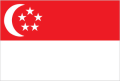
As published by the Legislation Division of the Attorney-General's Chambers of Singapore The National Flag consists of 2 equal horizontal sections, red above white. In the upper left canton is a white crescent moon beside 5 white stars arranged in a circle.
As published in EnglishAs published by the Legislation Division of the Attorney-General's Chambers of Singapore The red colour symbolises universal brotherhood and equality of man. The white colour signifies pervading and everlasting purity and virtue. The crescent moon represents a young nation on the ascendant, and the 5 stars stand for the nation’s ideals of democracy, peace, progress, justice and equality.
As published in EnglishAs published by the National Library Board of Singapore Tasked by then Prime Minister Lee Kuan Yew, a committee led by Toh began the process of creating the state flag in 1959, shortly after Singapore became a self-governing state. The design was completed in two months and the process involved learning about other countries’ national flags and translating Toh’s political ideas into the design of the flag.14
As published in EnglishAs published by the National Library Board of Singapore During the flag creation process, the committee developed several alternative designs and made prototypes to evaluate each design. The designs included an all-blue flag as well as a flag with both blue and white. For the chosen red and white design, the five stars in the emblem were selected to represent the ideals of Singapore. The crescent was subsequently added as the five stars “did not look balanced” on their own. [...] Toh’s initial intention was to have an all-red background for the flag, but the Legislative Assembly decided on a red and white background instead. An all-red background was thought to be unsuitable, possibly because red was regarded as a rallying point for communism at the time.16
As published in EnglishAs published by the National Library Board of Singapore The new state flag of Singapore was unveiled on 3 December 1959 during the launch of National Loyalty Week. It was revealed together with two other state symbols – the state crest and the state national anthem – following the inauguration of Yusof bin Ishak as Yang di-Pertuan Negara on that day.17 The new flag replaced the Union Jack – the national flag of the United Kingdom – that had represented Singapore for 140 years from 1819 to 1959.18 When Singapore was part of the Federation of Malaysia from 1963 to 1965, the flag of the federation was used to represent Singapore at international events and functions.19 The red and white flag was subsequently adopted as Singapore’s national flag when it became an independent nation on 9 August 1965.20
As published in EnglishSources:- sso.agc.gov.sg ↗ - the Legislation Division of the Attorney-General's Chambers of Singapore
- nlb.gov.sg ↗ - the National Library Board of Singapore
- National anthem
- Majulah Singapura1:19
- Title (in Malay)
- Majulah Singapura
- Title (in English, translated)
- Onward Singapore
- Lyrics
Mari kita rakyat Singapura Sama-sama menuju bahagia Cita-cita kita yang mulia Berjaya Singapura
Marilah kita bersatu Dengan semangat yang baru Semua kita berseru Majulah Singapura Majulah Singapura
Marilah kita bersatu Dengan semangat yang baru Semua kita berseru Majulah Singapura Majulah Singapura
Source: - Citizens
- Singaporeans
- Official name:Constitution of the Republic of Singapore ↗ - Singapore Statutes Online
- Official name, Citizens:The World Factbook: Singapore - CIA
- Coat of arms:Image credit
- National flag:sso.agc.gov.sg ↗ - the Legislation Division of the Attorney-General's Chambers of Singapore
- National flag:nlb.gov.sg ↗ - the National Library Board of Singapore
- National anthem:nationalanthems.info ↗
Geography
- Location
- Total area
- 744 km²
- Land area
- 744 km²
- Water area
- 0.00 km²
- Land borders
- None
- Coastline
- 193 km
- Terrain
Lowlying, gently undulating central plateau - Highest point
- 166 mBukit Timah
- Lowest point
- 0 mSingapore Strait
- Climate
Tropical hot, humid, rainy; two distinct monsoon seasons - northeastern monsoon (December to March) and southwestern monsoon (June to September); inter-monsoon - frequent afternoon and early evening thunderstorms - Avg. temperature
- 27 °C
- Avg. daily range
- 25.5 to 28.8 °C
- Annual precipitation
- 2,508 mm
Temperature °CMeanDaily rangePrecipitation mmMonthly climate normals Month Avg. high, °C Mean, °C Avg. low, °C Precipitation, mm January 28 26.1 24.8 191 February 28.5 26.5 25 113 March 29 27 25.4 178 April 29.3 27.4 25.8 219 May 29.4 27.7 26.2 230 June 29.3 27.7 26.1 198 July 28.9 27.4 25.9 192 August 28.7 27.3 25.8 181 September 28.8 27.2 25.7 169 October 28.8 27.1 25.5 227 November 28.4 26.6 25.3 310 December 28.1 26.3 25 299 Country-wide averages over 1991–2020.
Sources:- The World Factbook: Singapore - CIA
- Climate Change Knowledge Portal (ERA5 reanalysis) ↗ - World Bank
- Weather
- Loading
- Land use2023
- Arable0.8%Perm. crops0.1%Forest22.0%Other77.1%
- Arable land
- 560 hectares (0.8%)
- Permanent crops
- 100 hectares (0.1%)
- Forest
- 15,800 hectares (22.0%)
- Other land
- 55,340 hectares (77.1%)
Source: - Natural hazards2026
- Epidemics4.3Medium#116/191Coastal floods2.0Very low#127/191Earthquakes0.1Very low#127/191River floods0.0Very lowTsunamis0.0Very lowTropical cyclones0.0Very lowDrought0.0Very low
Scores out of 10, ranks out of 191 countries.
Source:- INFORM Risk Index ↗ - European Commission Joint Research Centre
- Location, Land borders, Coastline, Terrain, Highest point, Lowest point, Climate:The World Factbook: Singapore - CIA
- Climate:Climate Change Knowledge Portal (ERA5 reanalysis) ↗ - World Bank
- Land use:FAOSTAT Land Use domain ↗ - FAO
- Natural hazards:INFORM Risk Index ↗ - European Commission Joint Research Centre
Demographics
- Population change2026
- +0.60% per year+34,998 people/yearWorld Rank130thof 237
- Birth rate
- 8.6 per 1,000 population
- Death rate
- 5.2 per 1,000 population
- Net migration rate
- +2.3 per 1,000 population
- 2026
- 36.8 yearsWorld Rank93rdof 237
- Age structure2026
- 0-14 years11.7%15-64 years73.5%65 years +14.8%
- Share aged 65 and over
- 14.8%
- Share aged under 18
- 14.2%
- Total dependency ratio
- 36
- Youth dependency ratio
- 16
- Elderly dependency ratio
- 20
- Sex ratio
- 1.07 male / female
MaleAgeFemalePopulation by age group, % of total population Age Male Female 80+ 1.1% 1.8% 70-79 3.2% 3.7% 60-69 5.2% 5.2% 50-59 6.0% 5.8% 40-49 7.3% 6.9% 30-39 10.3% 8.8% 20-29 10.0% 8.3% 10-19 4.4% 4.1% 0-9 4.1% 3.9% - 2026
- 1.13 below the replacement level for Singapore ()0.97 births per womanreplacement 2.10123World Rank231stof 237
- 0.47 daughters per woman0.53 below replacement, long-run each generation smaller than the lastreplacement 1.000.511.5
- 2026
- +3.3 per 1,000 populationfor every 1,000 people, 3.3 more births than deaths a year
- 2026
- +2.3 per 1,000 population
- Urbanization2026
- 100.0% live in cities5,905,748 urban residents
- Largest planning areas2025
- Tampines, Bedok, Sengkang, WoodlandsRankPlanning AreaPopulation (2025 estimate)1Tampines290,0902Bedok274,3603Sengkang267,6004Woodlands254,4405Jurong West253,8406Yishun228,7307Hougang227,2208Punggol204,1509Choa Chu Kang187,55010Bukit Batok165,830Source:
- Singapore Department of Statistics (2025 estimate), via City Population by Thomas Brinkhoff ↗
- Population distribution
- Most of the urbanization is along the southern coast, with relatively dense population clusters found in the central areas.
- Ethnic groups2021
- Chinese74.2%Malay13.7%Indian8.9%Other3.2%
Malay includes indigenous Malays and Indonesians. Indian includes Indian, Pakistani, Bangladeshi, or Sri Lankan. Other includes Eurasians, Caucasians, Japanese, Filipino, Vietnamese.Figures come from self-identification across four set categories.
Source:- The World Factbook: Singapore - CIA
- Religions2020
- Buddhist31.1%Christian18.9%Muslim15.6%Taoist8.8%Hindu5.0%Other0.6%None20.0%
- Languages
- Malay (Bahasa Melayu), Chinese (中文), Tamil (தமிழ்), English
- Population, Population change, Median age, Age structure, Total fertility rate, Net reproduction rate, Natural change, Net migration rate:UN World Population Prospects ↗
- Urbanization:UN World Urbanization Prospects ↗
- Largest cities:Singapore Department of Statistics (2025 estimate), via City Population by Thomas Brinkhoff ↗
- Population distribution, Ethnic groups, Religions:The World Factbook: Singapore - CIA
Government & Administration
- Form of state
- RepublicThe President is elected by the citizens and acts on Cabinet advice except for specified discretionary powers; the Constitution makes Singapore "a sovereign republic to be known as the Republic of Singapore" (Arts. 3, 17A).
- System of government
- Semi-presidentialAlthough often described as parliamentary, Singapore is classified as semi-presidential because it combines a directly elected President with a Prime Minister who must command a parliamentary majority; the President may declare the office vacant once that confidence is lost (Arts. 25, 26).
- Territorial organisation
- Unitary
- Official websites
- Capital
- Singapore6 million people(2024)
- National holidays
- 14 days in 2026
- ThuJan 1New Year's Day
- TueFeb 17Chinese New Year
- WedFeb 18Chinese New Year
- SatMar 21Eid al-Fitr
- FriApr 3Good Friday
- FriMay 1Labor Day
- WedMay 27Eid al-Adha
- SunMay 31Vesak Day
- MonJun 1Vesak Day (observed)
- SunAug 9National Day
- MonAug 10National Day (observed)
- SunNov 8Diwali
- MonNov 9Diwali (observed)
- FriDec 25Christmas Day
Nationwide public holidays only, excluding regional, bank and government-only days.
- Time
- SGTSingapore Standard TimeUTC+8
- Currency
- Singapore Dollar (SGD)
- Entry requirements
- Official visa and entry information
- Calling code
- +65
- Internet TLD
- .sg
- ISO 3166-1 codes
- SG, SGP
- Infrastructure
- Passengers carried
- 47,502,834 by the country's airlines(2023)
- Heliports
- 1
- Aircraft departures
- 218,963 by the country's airlines(2023)
- Air freight
- 7,604.2 million tonne-km(2023)
- Aircraft registration prefix
- 9V
Sources:- The World Factbook: Singapore - CIA
- World Development Indicators ↗ - World Bank
- Flag carrier
- Singapore AirlinesPartly state-owned
- 2025
- 84 / 100World Rank3rdof 182Confidence interval
Corruption index score by year Year Score Lower bound Upper bound 2012 87 83 90 2013 86 82 90 2014 84 81 87 2015 85 82 88 2016 84 81 88 2017 84 80 88 2018 85 82 88 2019 85 81.6 88.4 2020 85 83 87 2021 85 83.1 86.9 2022 83 80.9 85.1 2023 83 81.1 84.9 2024 84 81.6 86.4 2025 84 81.5 86.5 Source:- Corruption Perceptions Index 2025 ↗ - Transparency International, CC BY 4.0
- Form of state, System of government, Territorial organisation:Constitution of the Republic of Singapore (1963, 2020 Revised Edition), as at 26 October 2026 ↗ - Legislation Division, Attorney-General's Chambers of Singapore
- National holidays:Open World Holidays Framework (vacanza/holidays) ↗
- Infrastructure:The World Factbook: Singapore - CIA
- Infrastructure:World Development Indicators ↗ - World Bank
- Corruption Perceptions Index:Corruption Perceptions Index 2025 ↗ - Transparency International, CC BY 4.0
Economy
- High income
- GDP growth (real)2026
- +5% per yearWorld Rank38thof 195
- GDP per capita (PPP)2026
- GDP per capita (nominal)
- $109,117 (6th in the world)
Source:- 2025
- Services71.6% of GDPIndustry22.7% of GDPAgriculture0% of GDPManufacturing17.4%part of industry
- Households
- +31.1%
- Government
- +10.3%
- Investment
- +22.5%
- Exports
- +177.9%
- Imports
- −142.5%
The shape of the economyGDP by end useSource:- World Development Indicators ↗ - World Bank
- Inflation2026
- 2.3%up 1.4 percentage points1.4pp from 2025
- Labor force2024
- 3.6 million (61% of population)World Rank99thof 187
- Labor force participation2024
- 69.2% of people aged 15+
- Unemployment2024
- 2.7%
- Youth unemployment2024
- 6.3% ages 15 to 24
- Labor productivity2024
- $99.5 per hour worked at PPP
- Budget balance2026
- 3.7% of GDP surplus
- Current account
- 16.7% of GDP, $111.5 billion surplus
Source: - Debt2024
- Central government debt177% of GDPHousehold debt44.3% of GDPCompany debt122.7% of GDP
- Trade2025
- Goods$651.6 billion60.7%
- Services$422.3 billion39.3%
- Total exports
- $1.1 trillion
- Change from 2024
- up 7.3 percent on the previous year7.3%
Sources:- World Development Indicators ↗ - World Bank
- The World Factbook: Singapore - CIA
- 2024
- +1.45World Rank5thof 145
- Projected GDP growth
- +2.8% a year over the next 10 years
Source:- Atlas of Economic Complexity ↗ - Harvard Growth Lab
- Agricultural products2024
- Meat of ducks (fresh or chilled), Hen eggs in shell (fresh), Meat of chickens (fresh or chilled), and 2 more
- 1Meat of ducks (fresh or chilled)49.9×
- 2Hen eggs in shell (fresh)45.3×
- 3Meat of chickens (fresh or chilled)32.1×
- 4Spinach6.5×
- 5Meat of pig with the bone (fresh or chilled)5.4×
ProductSource:- FAOSTAT ↗ - Food and Agriculture Organization
- Gold reserves2025
- 194 tonnesWorth $27.2 billion, 6% of total official reserves by value
- Industries
- electronics, chemicals, financial services, oil drilling equipment, petroleum refining, biomedical products, scientific instruments, telecommunication equipment, processed food and beverages, ship repair, offshore platform construction, entrepot trade
- Income level, GDP by sector, Trade, Gold reserves:World Development Indicators ↗ - World Bank
- GDP (nominal), GDP growth (real), GDP per capita (PPP), Inflation, Budget balance:IMF World Economic Outlook ↗
- Labor force, Labor force participation, Unemployment, Youth unemployment, Labor productivity:ILOSTAT ↗ - International Labour Organization
- Debt:IMF Global Debt Database ↗
- Trade, Industries:The World Factbook: Singapore - CIA
- Economic Complexity Index:Atlas of Economic Complexity ↗ - Harvard Growth Lab
- Agricultural products:FAOSTAT ↗ - Food and Agriculture Organization
Cost of Living
- Cost of living index
- Loading
- Monthly costs (excluding rent)
- Loading
- Rent
- Loading
- Buying an apartment
- Loading
- Average gross salary2021
- SGD 4,680 per month$3,483 (USD), $4,420 (PPP)
- Men
- SGD 4,875 per month($3,629)
- Women
- SGD 4,437 per month($3,303)
Source:- ILOSTAT ↗ - International Labour Organization
- Average gross salary:ILOSTAT ↗ - International Labour Organization
Society
- 2023
- 0.946Very highWorld Rank13thof 193SingaporeWorld
Human Development Index by year Year Singapore World 1990 0.819 0.608 1991 0.826 0.611 1992 0.833 0.614 1993 0.840 0.617 1994 0.848 0.620 1995 0.854 0.625 1996 0.859 0.631 1997 0.866 0.636 1998 0.869 0.641 1999 0.875 0.646 2000 0.882 0.651 2001 0.885 0.657 2002 0.891 0.662 2003 0.897 0.669 2004 0.905 0.675 2005 0.911 0.681 2006 0.911 0.688 2007 0.914 0.694 2008 0.924 0.698 2009 0.928 0.701 2010 0.932 0.707 2011 0.933 0.713 2012 0.933 0.717 2013 0.934 0.721 2014 0.934 0.726 2015 0.935 0.731 2016 0.934 0.735 2017 0.935 0.739 2018 0.939 0.741 2019 0.942 0.745 2020 0.944 0.742 2021 0.948 0.742 2022 0.942 0.752 2023 0.946 0.756 Source:- Human Development Report ↗ - United Nations Development Programme
- Mean years of schooling2023
- 12 years
- Expected for a child today
- 16.7 years
Source:- Human Development Report ↗ - United Nations Development Programme
- Literacy2021
- 97.7% of adults
- Education expenditure2024
- 2.2% of GDP
- Share of government spending
- 12.9%
Source:- World Development Indicators ↗ - World Bank
- Internet users2024
- 94.4% of the population
- Households with Internet access
- 98.5%
Source:- ITU DataHub ↗ - International Telecommunication Union
- Mobile subscriptions2024
- 10 million
- Fixed telephone lines
- 2,040,800
- Fixed broadband
- 27.8 subscriptions per 100 people
Counts subscriptions, not people.
Source:- ITU DataHub ↗ - International Telecommunication Union
- Credit-card ownership2021
- 42% of adults
- Debit-card ownership
- 94%
- Account at a bank or mobile-money provider
- 98%
- Mobile-money account
- 31%
- Made or received a digital payment
- 95%
Source:- Global Findex Database ↗ - World Bank
- Refugees hosted2025
- 0 people
- Stateless persons
- 1,109
- Refugees from Singapore abroad
- 39
Source:- Refugee Data Finder ↗ - UN Refugee Agency
- Inbound tourists2024
- Official tourism site13 million arrivalsdown 14% against 201914% below 2019World Rank24thof 139
- Per resident
- 2.2 arrivals per resident
- Same-day visitors
- 3.5 million arrivals
- $23.8 billion
- Spending per arrival
- $1,831
- 2.6% tourism direct GDP(2015, latest available)
- Residents' trips abroad
- 5.2 million overnight trips(2022)
- $31.3 billion
Overnight arrivals by year2010 to 2024A tourist stays at least one night. Arrivals count trips, not people.
Source:- UN Tourism Data Dashboard ↗ - UN Tourism
- UNESCO World Heritage Sites
- 1 site1 cultural
Site Singapore Botanic Gardens Source:- The World Factbook: Singapore - CIA
- Human Development Index, Mean years of schooling:Human Development Report ↗ - United Nations Development Programme
- Literacy:UIS Data Browser ↗ - UNESCO Institute for Statistics
- Education expenditure:World Development Indicators ↗ - World Bank
- Internet users, Mobile subscriptions:ITU DataHub ↗ - International Telecommunication Union
- Credit-card ownership:Global Findex Database ↗ - World Bank
- Refugees hosted:Refugee Data Finder ↗ - UN Refugee Agency
- Inbound tourists:UN Tourism Data Dashboard ↗ - UN Tourism
- UNESCO World Heritage Sites:The World Factbook: Singapore - CIA
Crime & Safety
- Travel advisory (US)
- Loading
- Active humanitarian crisisAug 2026
- None - no active crisis
- Homicide rate2024
- Very low by global standards0.2 per 100,000 peopleWorld Rank113thof 115
- Crime rates
- 7 offence categories
Offence Per 100,000 Count Year Homicide (victims) 0.2 10 2024 Serious assault 6.7 389 2023 Sexual violence 33.9 1,964 2023 Kidnapping 0.0 0 2011 Burglary 2.0 111 2022 Theft 135.3 7,642 2022 Vehicle theft 1.8 101 2022 A low figure can also mean weak recording.
Source:- UNODC Data Portal ↗ - UN Office on Drugs and Crime
- Prison population2023
- 170.2 per 100,000 people
- Persons held
- 9,851
Source:- UNODC Data Portal ↗ - UN Office on Drugs and Crime
- Active humanitarian crisis:INFORM Severity Index ↗ - European Commission Joint Research Centre
- Homicide rate, Crime rates, Prison population:UNODC Data Portal ↗ - UN Office on Drugs and Crime
Health
- Life expectancy2026
- 84.1 years
- Health expenditure2023
- 4.5% of GDP$3,922 per person
- Physicians2022
- 2.83 per 1,000 population
- Hospital beds2023
- 2.8 per 1,000 population
- Infant mortality2026
- 1.7 per 1,000 live births
- Maternal mortality2023
- 6 per 100,000 live births
- Alcohol consumption2022
- 2 litres of pure alcohol per adult per year
- Tobacco use2023
- 13.9% of adults
- Men
- 22.2%
- Women
- 5.6%
Source:- Global Health Observatory ↗ - World Health Organization
- Alcohol and Tobacco Spending2023
- 1.7% of household spendingWorld Rank78thof 105
- World median
- 3.1%
Source:- The World Factbook: Singapore - CIA
- Road traffic deaths2019
- 2.1 per 100,000 population
- Life expectancy, Infant mortality:UN World Population Prospects ↗
- Health expenditure, Physicians, Hospital beds, Road traffic deaths:World Development Indicators ↗ - World Bank
- Maternal mortality:Maternal mortality estimates ↗ - UN Maternal Mortality Estimation Inter-agency Group
- Alcohol consumption, Tobacco use:Global Health Observatory ↗ - World Health Organization
- Alcohol and Tobacco Spending:The World Factbook: Singapore - CIA
Environment
- CO₂ emissions2024
- 58.9 Mt per yearup 4.9 percent on the previous year4.9% from 2023
- CO₂ per capita
- 9.6 t per personWorld Rank23rdof 207
- Share of global CO₂
- 0.15%
- Methane (CH₄)
- 4.75 Mt CO₂-eq
- Nitrous oxide (N₂O)
- 0.51 Mt CO₂-eq
- Fluorinated gases
- 12 Mt CO₂-eq
- All greenhouse gases
- 76.1 Mt CO₂-eq
Source:- Emissions Database for Global Atmospheric Research (EDGAR) ↗ - European Commission, Joint Research Centre
- 2024
- 11.1 µg/m³ of PM2.50.6 years of life expectancy lost against the WHO guidelineMost polluted126thof 236
- WHO guideline
- 5 µg/m³
- National standard
- 10 µg/m³
- Life expectancy gain if the national standard were met
- 0.1 years
Source:- Air Quality Life Index ↗ - Energy Policy Institute at the University of Chicago
- Environmental issues
- water pollution
- industrial pollution
- limited freshwater resources
- waste disposal problems from limited land availability
- air pollution
- deforestation
- seasonal smoke/haze from forest fires in Indonesia
Source:- The World Factbook: Singapore - CIA
- International agreements
- 16 of 20 landmark treaties in forceParty to 56 multilateral environmental agreements
Treaty Standing Joined Climate Paris Agreement in force 2016 UN Framework Convention on Climate Change in force 1997 Kyoto Protocol in force 2006 Ozone layer Montreal Protocol in force 1989 Vienna Convention (Ozone Layer) in force 1989 Biodiversity Convention on Biological Diversity in force 1996 CITES in force 1987 Convention on Migratory Species (Bonn) not a party Cartagena Protocol on Biosafety not a party Nagoya Protocol not a party Land and heritage Ramsar Convention on Wetlands not a party World Heritage Convention in force 2012 UN Convention to Combat Desertification in force 1999 Chemicals and waste Basel Convention in force 1996 Rotterdam Convention (PIC) in force 2005 Stockholm Convention (POPs) in force 2005 Minamata Convention on Mercury in force 2017 Oceans UN Convention on the Law of the Sea in force 1994 High Seas Treaty (BBNJ) in force 2026 MARPOL 73/78 in force 1991 Source:- International Environmental Agreements Database ↗ - Université Laval
- CO₂ emissions:Emissions Database for Global Atmospheric Research (EDGAR) ↗ - European Commission, Joint Research Centre
- Air pollution:Air Quality Life Index ↗ - Energy Policy Institute at the University of Chicago
- Environmental issues:The World Factbook: Singapore - CIA
- International agreements:International Environmental Agreements Database ↗ - Université Laval
Food & Water
- No access to safe drinking water2022
- 0% of the population
- Renewable water2022
- 0.6 billion m³ per year
- Per person
- 106 m³ per year
- Dependency ratio
- 0% originates outside the country
- Annual water withdrawal
- 0.4 billion m³ per year
- Withdrawn for agriculture
- 0%
- Water stress
- 33% of available freshwater withdrawn
Source:- AQUASTAT ↗ - Food and Agriculture Organization
- Obesity2024
- 17% of adults
- Men
- 18.2%
- Women
- 15.5%
Source:- Global Health Observatory ↗ - World Health Organization
- No access to safe drinking water, Renewable water:AQUASTAT ↗ - Food and Agriculture Organization
- Obesity:Global Health Observatory ↗ - World Health Organization
Energy
- Energy consumption2024
- Per capita
- 684.8 GJ per person
- Share of world total
- 0.62%
- Supply
- No meaningful productionproduces under 2% of what it consumes, 2024
Source:- International Energy Statistics ↗ - U.S. Energy Information Administration
- Electricity2024
- Trade ended, last exchange reported in 199459 TWh generated per year
- Generation
- 59 TWh per year
- Consumption
- 59 TWh per year
Source:- International Energy Statistics ↗ - U.S. Energy Information Administration
- Oil, gas & coal
- No meaningful productionproduces under 2% of what it consumes, 2024
Oil imports and exports count crude oil only.
- Energy consumption, Electricity, Oil, gas & coal:International Energy Statistics ↗ - U.S. Energy Information Administration
Defense
- Military expenditure2024
- 2.8% of GDP$15.1 billion, 20.1% of government spending
- Military personnel2025
- approximately 55,000active-duty Armed ForcesEstimates vary.
- Army
- 40,000
- Navy
- 7,000
- Air Force
- 8,000
The Army is comprised mostly of conscripts and reservists with a small core of professional soldiers, while the Air Force and Navy are staffed mainly by professional personnel.
Source:- The World Factbook: Singapore - CIA
- Military service2026
- Conscriptionmen 18–21, 24 months; voluntary men and women 18+, 16.5 for early enlistment program with parental consent
All male Singaporean citizens and permanent residents, unless exempted, are required to enter National Service (NS) upon attaining the age of 18; most NS conscripts serve in the Armed Forces, but some go into the Police Force or Civil Defense Force; conscripts comprise over half of the defense establishment.The Singapore Armed Forces (SAF) also has a uniformed volunteer auxiliary branch known as the Volunteer Corps (SAFVC); the SAFVC allows citizens and residents not subject to the National Service obligation, including Singaporean women, first generation permanent residents, and naturalized citizens, to contribute towards Singapore's defense; the volunteers must be 18-45 and physically fit.Members of the Gurkha Contingent (GC) of the Singapore Police Force are mostly recruited from a small number of hill tribes in Nepal; the GC was formed in 1949 originally from selected ex-British Army Gurkhas.
Source:- The World Factbook: Singapore - CIA
- Nuclear weapons2026
- None - no nuclear arsenal
- Military expenditure:SIPRI Military Expenditure Database ↗ - Stockholm International Peace Research Institute
- Military expenditure:World Development Indicators ↗ - World Bank
- Military personnel, Military service:The World Factbook: Singapore - CIA
- Nuclear weapons:Status of World Nuclear Forces ↗ - Federation of American Scientists
