

National Identity
- Official name
- Republic of Sierra Leone
- Name etymology
Portuguese explorer Pedro de SINTRA is usually credited with naming the country "Serra da Leao" (Lion Mountains) in 1462, but Venetian explorer Alvise CA' DA MOSTO recorded the name as "Serre-Lionne" in 1457, referring to the rumbling of thunder over the mountains
Sources:- The Constitution of Sierra Leone, 1991 ↗ - Parliament of Sierra Leone
- The World Factbook: Sierra Leone - CIA
- Coat of arms
- National flag
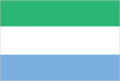
As published by the Office of the Attorney General and Ministry of Justice of Sierra Leone b. The design of the Flag shall be from the top of the Flag to the bottom thereof, three horizontal stripes of green, white and blue. c. The normal size of the Flag for official use shall be in the proportion of nine units across to six units down.
As published in EnglishSource:- oagmoj.gov.sl ↗ - the Office of the Attorney General and Ministry of Justice of Sierra Leone
- National anthem
- High We Exalt Thee, Realm Of The Free0:46
- Title
- High We Exalt Thee, Realm Of The Free
- Lyrics
- English
1High we exalt thee, realm of the free; Great is the love we have for thee; Firmly united ever we stand, Singing thy praise, O native land. We raise up our hearts and our voices on high, The hills and the valleys re-echo our cry; Blessing and peace be ever thine own, Land that we love, our Sierra Leone.
2One with a faith that wisdom inspires, One with a zeal that never tires; Ever we seek to honour thy name, Ours is the labour, thine the fame. We pray that no harm on thy children may fall, That blessing and peace may descend on us all; So may we serve thee ever alone, Land that we love, our Sierra Leone.
3Knowledge and truth our forefathers spread, Mighty the nations whom they led; Mighty they made thee, so too may we Show forth the good that is ever in thee. We pledge our devotion, our strength and our might, Thy cause to defend and to stand for thy right; All that we have be ever thine own, Land that we love, our Sierra Leone.
- Citizens
- Sierra Leoneans
- Official name:The Constitution of Sierra Leone, 1991 ↗ - Parliament of Sierra Leone
- Official name, Citizens:The World Factbook: Sierra Leone - CIA
- Coat of arms:Image credit
- National flag:oagmoj.gov.sl ↗ - the Office of the Attorney General and Ministry of Justice of Sierra Leone
- National anthem:nationalanthems.info ↗
- National anthem:Recording credit
Geography
- Location
- Total area
- 71,740 km²
- Land area
- 71,620 km²
- Water area
- 120 km²
- Land borders
- 1,093 km(2 countries)
- Coastline
- 402 km
- Terrain
Coastal belt of mangrove swamps, wooded hill country, upland plateau, mountains in east - Mean elevation
- 279 m
- Highest point
- 1,948 mLoma Mansa (Bintimani)
- Lowest point
- 0 mAtlantic Ocean
- Climate
Tropical hot, humid; summer rainy season (May to December); winter dry season (December to April) - Avg. temperature
- 25.7 °C
- Avg. daily range
- 22.5 to 30.3 °C
- Annual precipitation
- 2,515 mm
Temperature °CMeanDaily rangePrecipitation mmMonthly climate normals Month Avg. high, °C Mean, °C Avg. low, °C Precipitation, mm January 32.3 26.3 21.4 18 February 33.7 27.5 22.5 18 March 33.7 27.9 23.6 52 April 32.5 27.4 24 99 May 30.5 26.3 23.5 230 June 28.8 25 22.6 343 July 27.5 24.2 22.2 420 August 27.2 24 22.1 484 September 28.2 24.4 22.2 427 October 29.2 25 22.3 280 November 29.8 25.3 22.1 114 December 30.8 25.6 21.5 29 Country-wide averages over 1991–2020.
Sources:- The World Factbook: Sierra Leone - CIA
- Climate Change Knowledge Portal (ERA5 reanalysis) ↗ - World Bank
- Weather
- Loading
- Land use2023
- Arable21.9%Perm. crops2.3%Pasture30.5%Forest34.3%Other11.0%
- Arable land
- 1,584,000 hectares (21.9%)
- Permanent crops
- 165,000 hectares (2.3%)
- Permanent meadows & pastures
- 2,200,000 hectares (30.5%)
- Forest
- 2,475,722 hectares (34.3%)
- Other land
- 793,278 hectares (11.0%)
Source: - Natural hazards2026
- Epidemics7.7Very high#5/191River floods5.8High#79/191Coastal floods4.8Medium#69/191Tsunamis2.9Low#80/191Drought0.9Very low#153/191Earthquakes0.1Very low#127/191Tropical cyclones0.0Very low
Scores out of 10, ranks out of 191 countries.
Source:- INFORM Risk Index ↗ - European Commission Joint Research Centre
- Location, Land borders, Coastline, Terrain, Mean elevation, Highest point, Lowest point, Climate:The World Factbook: Sierra Leone - CIA
- Climate:Climate Change Knowledge Portal (ERA5 reanalysis) ↗ - World Bank
- Land use:FAOSTAT Land Use domain ↗ - FAO
- Natural hazards:INFORM Risk Index ↗ - European Commission Joint Research Centre
Demographics
- Population change2026
- +2.01% per year+176,950 people/yearWorld Rank45thof 237
- Birth rate
- 29.0 per 1,000 population
- Death rate
- 8.1 per 1,000 population
- Net migration rate
- −1.4 per 1,000 population
- 2026
- 19.9 yearsWorld Rank200thof 237
- Age structure2026
- 0-14 years37.2%15-64 years59.5%65 years +3.3%
- Share aged 65 and over
- 3.3%
- Share aged under 18
- 43.9%
- Total dependency ratio
- 68
- Youth dependency ratio
- 63
- Elderly dependency ratio
- 6
- Sex ratio
- 1 male / female
MaleAgeFemalePopulation by age group, % of total population Age Male Female 80+ 0.2% 0.2% 70-79 0.6% 0.8% 60-69 1.6% 1.9% 50-59 2.9% 3.1% 40-49 4.6% 4.6% 30-39 6.6% 6.6% 20-29 9.1% 9.1% 10-19 11.3% 11.2% 0-9 12.9% 12.7% - 2026
- 1.23 above the replacement level for Sierra Leone ()3.53 births per womanreplacement 2.301234World Rank39thof 237
- 1.53 daughters per woman0.53 above replacement, long-run each generation larger than the lastreplacement 1.000.511.52
- 2026
- +21.0 per 1,000 populationfor every 1,000 people, 21.0 more births than deaths a year
- 2026
- −1.4 per 1,000 population
- Urbanization2026
- 46.5% live in 4,183,637 urban residents
- Largest urban areas2026
- Freetown, Bo, Kenema, MakeniRankUrban AreaPopulation (2026 estimate)1Freetown1,970,4852Bo350,9993Kenema252,0474Makeni203,5445Koidu Town143,0906Mahera102,3217Kambia80,2548Port Loko79,7039Magburaka77,61410Mile 9174,689
Unlike official city figures, UN urban areas cover the entire built-up area, which can include multiple cities and towns.
- Population distribution
- Population clusters are found in the lower elevations of the south and west; the northern third of the country is less populated.
- Ethnic groups2019
- Temne35.4%Mende30.8%Limba8.8%Kono4.3%Korankoh4.0%Fullah3.8%Mandingo2.8%Loko2.0%Sherbro1.9%Creole1.2%Other5.0%
Creole are descendants of freed Jamaican slaves who were settled in the Freetown area in the late-18th century. Creole are also known as Krio.
Source:- The World Factbook: Sierra Leone - CIA
- Religions2019
- Muslim77.1%Christian22.9%
- Languages
- English
- Population, Population change, Median age, Age structure, Total fertility rate, Net reproduction rate, Natural change, Net migration rate:UN World Population Prospects ↗
- Urbanization, Largest cities:UN World Urbanization Prospects ↗
- Population distribution, Ethnic groups, Religions:The World Factbook: Sierra Leone - CIA
Government & Administration
- Form of state
- RepublicThe President is Head of State and supreme executive authority, elected by registered voters nationwide; a first-round winner needs at least 55 per cent of valid votes (ss. 40, 42).Source:
- System of government
- PresidentialThe President appoints ministers, and the Cabinet is collectively responsible to Parliament for advice given to the President, with no vote of no confidence (ss. 59, 60).Source:
- Territorial organisation
- Unitary
- Official websites
- Capital
- Freetown1.1 million people(2015)
- National holidays
- 14 days in 2026
- ThuJan 1New Year's Day
- WedFeb 18Armed Forces Day
- SunMar 8International Women's Day
- MonMar 9International Women's Day (observed)
- FriMar 20Eid al-Fitr (estimated)
- FriApr 3Good Friday
- MonApr 6Easter Monday
- MonApr 27Independence Day
- FriMay 1International Worker's Day
- WedMay 27Eid al-Adha (estimated)
- TueAug 25Prophet's Birthday (estimated)
- FriDec 25Christmas Day
- SatDec 26Boxing Day
- MonDec 28Boxing Day (observed)
Nationwide public holidays only, excluding regional, bank and government-only days.
- Time
- GMTGreenwich Mean TimeUTC+0
- Currency
- Sierra Leonean Leone (SLE)
- Entry requirements
- Official visa and entry information
- Calling code
- +232
- Internet TLD
- .sl
- ISO 3166-1 codes
- SL, SLE
- Infrastructure
- Heliports
- 3
- Aircraft registration prefix
- 9L
Source:- The World Factbook: Sierra Leone - CIA
- 2025
- 34 / 100World Rank109thof 182Confidence interval
Corruption index score by year Year Score Lower bound Upper bound 2012 31 28 34 2013 30 26 34 2014 31 27 35 2015 29 23 35 2016 30 25 35 2017 30 27 33 2018 30 26 34 2019 33 27.3 38.7 2020 33 29 37 2021 34 31 37 2022 34 31.2 36.8 2023 35 31.5 38.5 2024 33 29.4 36.6 2025 34 30.7 37.3 Source:- Corruption Perceptions Index 2025 ↗ - Transparency International, CC BY 4.0
- Form of state, System of government, Territorial organisation:The Constitution of Sierra Leone, 1991 (Act No. 6 of 1991) ↗ - Parliament of Sierra Leone
- National holidays:Open World Holidays Framework (vacanza/holidays) ↗
- Infrastructure:The World Factbook: Sierra Leone - CIA
- Infrastructure:World Development Indicators ↗ - World Bank
- Corruption Perceptions Index:Corruption Perceptions Index 2025 ↗ - Transparency International, CC BY 4.0
Economy
- Low income
- GDP growth (real)2026
- +4% per yearWorld Rank59thof 195
- GDP per capita (PPP)2026
- GDP per capita (nominal)
- $946 (184th in the world)
Source:- 2024
- Services42.6% of GDPIndustry25.6% of GDPAgriculture29.2% of GDPManufacturing7%part of industry
- Households
- +78.2%
- Government
- +5.9%
- Investment
- +23.2%
- Exports
- +20.9%
- Imports
- −28.2%
The shape of the economyGDP by end useSource:- World Development Indicators ↗ - World Bank
- Inflation2026
- 13.8%up 6.2 percentage points6.2pp from 2025
- Labor force2024
- 2.9 million (33% of population)World Rank113thof 187
- Labor force participation2024
- 53.6% of people aged 15+
- Unemployment2024
- 3.1%
- Youth unemployment2024
- 3.5% ages 15 to 24
- Labor productivity2024
- $4.3 per hour worked at PPP
- Budget balance2026
- 2.9% of GDP deficit
- Current account
- 4.7% of GDP, $400 million deficit
Source: - Debt2024
- Central government debt43% of GDPHousehold debt0% of GDPCompany debt0% of GDP
- Trade2024
- Goods$1.5 billion96.9%
- Services$49.6 million3.1%
- Total exports
- $1.6 billion
- Change from 2023
- up 15.7 percent on the previous year15.7%
Sources:- World Development Indicators ↗ - World Bank
- The World Factbook: Sierra Leone - CIA
- Agricultural products2024
- Cocoa beans, Cassava (fresh), Okra, and 7 more
- 1Cocoa beans31.1×
- 2Cassava (fresh)14.5×
- 3Okra11×
- 4Sweet potatoes4.9×
- 5Cucumbers and gherkins3.7×
- 6Groundnuts (in shell)3.1×
- 7Rice2.9×
- 8Oil palm fruit1.7×
- 9Yams1.6×
- 10Raw milk of cattle0.3×
ProductSource:- FAOSTAT ↗ - Food and Agriculture Organization
- Industries
- diamond mining
- iron ore, rutile and bauxite mining
- small-scale manufacturing (beverages, textiles, footwear)
- Income level, GDP by sector, Trade:World Development Indicators ↗ - World Bank
- GDP (nominal), GDP growth (real), GDP per capita (PPP), Inflation, Budget balance:IMF World Economic Outlook ↗
- Labor force, Labor force participation, Unemployment, Youth unemployment, Labor productivity:ILOSTAT ↗ - International Labour Organization
- Debt:IMF Global Debt Database ↗
- Trade, Industries:The World Factbook: Sierra Leone - CIA
- Agricultural products:FAOSTAT ↗ - Food and Agriculture Organization
Cost of Living
- 2023
- SLE 800 per month, gross$38 (USD), $151 (PPP)
- Minimum wage:ILOSTAT ↗ - International Labour Organization
Society
- 2023
- 0.467LowWorld Rank185thof 193Sierra LeoneWorld
Human Development Index by year Year Sierra Leone World 1990 0.313 0.608 1991 0.303 0.611 1992 0.305 0.614 1993 0.312 0.617 1994 0.312 0.620 1995 0.314 0.625 1996 0.311 0.631 1997 0.307 0.636 1998 0.304 0.641 1999 0.301 0.646 2000 0.318 0.651 2001 0.330 0.657 2002 0.345 0.662 2003 0.354 0.669 2004 0.363 0.675 2005 0.370 0.681 2006 0.372 0.688 2007 0.391 0.694 2008 0.400 0.698 2009 0.406 0.701 2010 0.410 0.707 2011 0.416 0.713 2012 0.418 0.717 2013 0.436 0.721 2014 0.438 0.726 2015 0.432 0.731 2016 0.441 0.735 2017 0.445 0.739 2018 0.451 0.741 2019 0.455 0.745 2020 0.454 0.742 2021 0.458 0.742 2022 0.463 0.752 2023 0.467 0.756 Source:- Human Development Report ↗ - United Nations Development Programme
- 2018
- 35.7
- Mean years of schooling2023
- 3.5 years
- Expected for a child today
- 9.1 years
Source:- Human Development Report ↗ - United Nations Development Programme
- Literacy2019
- 43.6% of adults
- Education expenditure2022
- 4.9% of GDP
- Share of government spending
- 29.4%
Source:- World Development Indicators ↗ - World Bank
- Internet users2020
- 17.1% of the population
- Households with Internet access
- 21.2%
Source:- ITU DataHub ↗ - International Telecommunication Union
- Mobile subscriptions2020
- 6.9 million
- Fixed telephone lines
- 189
- Fixed broadband
- 0 subscriptions per 100 people
Counts subscriptions, not people.
Source:- ITU DataHub ↗ - International Telecommunication Union
- Credit-card ownership2024
- 1% of adults
- Debit-card ownership
- 3%
- Account at a bank or mobile-money provider
- 39%
- Mobile-money account
- 32%
- Made or received a digital payment
- 37%
Source:- Global Findex Database ↗ - World Bank
- Refugees hosted2025
- 0 people
- Internally displaced persons
- 4,500All due to disasters
- Refugees from Sierra Leone abroad
- 8,327
Sources:- Refugee Data Finder ↗ - UN Refugee Agency
- Global Internal Displacement Database ↗ - Internal Displacement Monitoring Centre
- Inbound tourists2021latest available
- 40,000 arrivalsdown 37% against 201937% below 2019Official tourism site
- Per resident
- 0.5 arrivals per 100 residents
- Same-day visitors
- 4,000 arrivals
- $19.8 million(2023)
- Share of GDP
- 5.6% tourism direct GDP(2020, latest available)
- Residents' trips abroad
- 25,000 overnight trips
- $14.1 million(2023)
- Hotel beds
- 4,549
Overnight arrivals by year2010 to 2021A tourist stays at least one night. Arrivals count trips, not people.
Source:- UN Tourism Data Dashboard ↗ - UN Tourism
- UNESCO World Heritage Sites
- 1 site1 natural
Site Type Gola-Tiwai Complex Natural Source:- The World Factbook: Sierra Leone - CIA
- Human Development Index, Mean years of schooling:Human Development Report ↗ - United Nations Development Programme
- Income inequality (Gini), Education expenditure:World Development Indicators ↗ - World Bank
- Literacy:UIS Data Browser ↗ - UNESCO Institute for Statistics
- Internet users, Mobile subscriptions:ITU DataHub ↗ - International Telecommunication Union
- Credit-card ownership:Global Findex Database ↗ - World Bank
- Refugees hosted:Refugee Data Finder ↗ - UN Refugee Agency
- Refugees hosted:Global Internal Displacement Database ↗ - Internal Displacement Monitoring Centre
- Inbound tourists:UN Tourism Data Dashboard ↗ - UN Tourism
- UNESCO World Heritage Sites:The World Factbook: Sierra Leone - CIA
Crime & Safety
- Travel advisory (US)
- Loading
- Active humanitarian crisisAug 2026
- None - no active crisis
- Homicide rate2020
- Low by global standards2.2 per 100,000 peopleWorld Rank54thof 115
- Crime rates
- 1 offence category
Offence Per 100,000 Count Year Homicide (victims) 2.2 176 2020 A low figure can also mean weak recording.
Source:- UNODC Data Portal ↗ - UN Office on Drugs and Crime
- Prison population2022
- 58 per 100,000 people
- Persons held
- 4,801
Source:- UNODC Data Portal ↗ - UN Office on Drugs and Crime
- Active humanitarian crisis:INFORM Severity Index ↗ - European Commission Joint Research Centre
- Homicide rate, Crime rates, Prison population:UNODC Data Portal ↗ - UN Office on Drugs and Crime
Health
- Life expectancy2026
- 62.3 years
- Health expenditure2023
- 4.7% of GDP$36 per person
- Physicians2022
- 0.13 per 1,000 population
- Hospital beds2006latest available
- 0.4 per 1,000 population
- Infant mortality2026
- 68.1 per 1,000 live births
- Maternal mortality2023
- 354 per 100,000 live births
- Alcohol consumption2022
- 0.3 litres of pure alcohol per adult per year
- Tobacco use2015latest available
- 18.8% of adults
- Men
- 28.7%
- Women
- 9%
Source:- Global Health Observatory ↗ - World Health Organization
- Road traffic deaths2019
- 33 per 100,000 population
- Life expectancy, Infant mortality:UN World Population Prospects ↗
- Health expenditure, Physicians, Hospital beds, Road traffic deaths:World Development Indicators ↗ - World Bank
- Maternal mortality:Maternal mortality estimates ↗ - UN Maternal Mortality Estimation Inter-agency Group
- Alcohol consumption, Tobacco use:Global Health Observatory ↗ - World Health Organization
Environment
- CO₂ emissions2024
- 1.46 Mt per yearup 3.6 percent on the previous year3.6% from 2023
- CO₂ per capita
- 0.2 t per personWorld Rank193rdof 207
- Share of global CO₂
- < 0.01%
- Methane (CH₄)
- 5.57 Mt CO₂-eq
- Nitrous oxide (N₂O)
- 0.89 Mt CO₂-eq
- Fluorinated gases
- 0 Mt CO₂-eq
- All greenhouse gases
- 7.93 Mt CO₂-eq
Source:- Emissions Database for Global Atmospheric Research (EDGAR) ↗ - European Commission, Joint Research Centre
- 2024
- 14.7 µg/m³ of PM2.51 years of life expectancy lost against the WHO guidelineMost polluted95thof 236
- WHO guideline
- 5 µg/m³
Source:- Air Quality Life Index ↗ - Energy Policy Institute at the University of Chicago
- Environmental issues
- overharvesting of timber, expansion of cattle grazing, and slash-and-burn agriculture resulting in deforestation, soil exhaustion, and flooding
- loss of biodiversity
- air pollution
- water pollution
- overfishing
Source:- The World Factbook: Sierra Leone - CIA
- International agreements
- 18 of 20 landmark treaties in forceParty to 67 multilateral environmental agreements
Treaty Standing Joined Climate Paris Agreement in force 2016 UN Framework Convention on Climate Change in force 1995 Kyoto Protocol in force 2007 Ozone layer Montreal Protocol in force 2001 Vienna Convention (Ozone Layer) in force 2001 Biodiversity Convention on Biological Diversity in force 1995 CITES in force 1995 Convention on Migratory Species (Bonn) not a party Cartagena Protocol on Biosafety in force 2020 Nagoya Protocol not a party Land and heritage Ramsar Convention on Wetlands in force 2000 World Heritage Convention in force 2005 UN Convention to Combat Desertification in force 1997 Chemicals and waste Basel Convention in force 2017 Rotterdam Convention (PIC) in force 2017 Stockholm Convention (POPs) in force 2004 Minamata Convention on Mercury in force 2017 Oceans UN Convention on the Law of the Sea in force 1995 High Seas Treaty (BBNJ) in force 2026 MARPOL 73/78 in force 2001 Source:- International Environmental Agreements Database ↗ - Université Laval
- CO₂ emissions:Emissions Database for Global Atmospheric Research (EDGAR) ↗ - European Commission, Joint Research Centre
- Air pollution:Air Quality Life Index ↗ - Energy Policy Institute at the University of Chicago
- Environmental issues:The World Factbook: Sierra Leone - CIA
- International agreements:International Environmental Agreements Database ↗ - Université Laval
Food & Water
- No access to safe drinking water2022
- 37.4% of the population
- Renewable water2022
- 160 billion m³ per year
- Per person
- 19,331 m³ per year
- Dependency ratio
- 0% originates outside the country
- Annual water withdrawal
- 0.2 billion m³ per year
- Withdrawn for agriculture
- 22%
- Water stress
- 0% of available freshwater withdrawn
Source:- AQUASTAT ↗ - Food and Agriculture Organization
- Undernourishment2022
- 28.2% of the population2.4 million people
- Obesity2024
- 8.2% of adults
- Men
- 3%
- Women
- 13.1%
Source:- Global Health Observatory ↗ - World Health Organization
- Underweight children2021
- 12% of children under five
- No access to safe drinking water, Renewable water:AQUASTAT ↗ - Food and Agriculture Organization
- Undernourishment:Food security indicators (FAOSTAT) ↗ - Food and Agriculture Organization
- Obesity:Global Health Observatory ↗ - World Health Organization
- Underweight children:World Development Indicators ↗ - World Bank
Energy
- Energy consumption2024
- Per capita
- 2.9 GJ per person
- Share of world total
- < 0.01%
- Supply
- Deficitproduces 3.1% of what it consumes, 2024
Source:- International Energy Statistics ↗ - U.S. Energy Information Administration
- Electricity2024
- No electricity trade0.2 TWh generated per year
- Generation
- 0.2 TWh per year
- Consumption
- 0.1 TWh per year
Source:- International Energy Statistics ↗ - U.S. Energy Information Administration
- Oil, gas & coal
- Production endedlast produced in 2008Consumption202411,142 b/d
Oil imports and exports count crude oil only.
- Energy consumption, Electricity, Oil, gas & coal:International Energy Statistics ↗ - U.S. Energy Information Administration
Defense
- Military expenditure2024
- 0.5% of GDP$36.4 million, 0% of government spending
- Military personnel2025
- estimated 10,000active Armed Forces
- Military service2025
- Voluntaryno conscription; men and women 18–25
- Nuclear weapons2026
- None - no nuclear arsenal
- Military expenditure:SIPRI Military Expenditure Database ↗ - Stockholm International Peace Research Institute
- Military expenditure:World Development Indicators ↗ - World Bank
- Military personnel, Military service:The World Factbook: Sierra Leone - CIA
- Nuclear weapons:Status of World Nuclear Forces ↗ - Federation of American Scientists

