

National Identity
- Official name
- Republic of Maldives
- Official name (in Dhivehi)
- ދިވެހި ރާއްޖެ - ދިވެހިރާއްޖެ ޖުމޫރިޔާ
- Official name (in Dhivehi, Romanized)
- Dhivehi Raajje Jumhooriyya
- Name etymology
the origin of the name is obscure but may derive from the Sanskrit word maladvipa, meaning "garland of islands;" the local name, Dhivehi Raajje, means "land of the Dhivehi people" in the local language
Sources:- Constitution of Maldives ↗ - The President's Office - Republic of Maldives
- The World Factbook: Maldives - CIA
- National emblem
- National flag
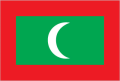
As published by The President's Office of the Republic of Maldives The national flag of the Maldives consists of a white crescent in the centre of a green rectangle
surrounded by a red border.
As published in EnglishTranslated from Public Service Media of the Maldives The national flag of the Maldives is something that symbolises the independence of the Maldivians and the honour and pride of the Maldivians.
Unofficial translation by WorldometerTranslated from Public Service Media of the Maldives The first flag used as the national flag was a plain red, rectangular flag. This flag was used from 1796 until 1903. Because red is a colour that can be seen clearly from far away, that colour was used in this flag as well. Of all the national flags used in the Maldives, this is also the flag that was used for the longest period.
Unofficial translation by WorldometerTranslated from Public Service Media of the Maldives After the plain red, rectangular flag had been used for 107 years, in 1903 black and white stripes were added to one side of this plain red flag, running from top to bottom. The black and white stripes symbolise the flagstaffs used for the flags of kings and queens. At that time, the flagstaffs were painted in this way. This flag was used until the year 1926.
Unofficial translation by WorldometerTranslated from Public Service Media of the Maldives In 1926, while Al Ameer Abdul Majeed Rannabandeyri Kilegefan was Prime Minister, a change was once again made to the national flag of the Maldives. This time, keeping the previous flag as it was, a crescent was added to the flag. This crescent is placed so that it faces the left side. The national flag began to be raised at government offices in 1945. This was the flag used in the Maldives until 1953.
Unofficial translation by WorldometerTranslated from Public Service Media of the Maldives In that same year, a major change was once again made to the national flag. Instead of the national flag, it began to be called the state flag. A small green rectangle was added inside the red rectangle of the flag. A crescent was also added inside that green part. Green was added to the plain red flag to show that the Maldives was under British protection.
Unofficial translation by WorldometerTranslated from Public Service Media of the Maldives That flag was used until changes came to the Maldives' system of government and the first republic began. With that, once again, a national flag began to be used instead of the state flag.
Unofficial translation by WorldometerTranslated from Public Service Media of the Maldives The change made this time was only to turn the crescent in the middle of the flag from the left to the right side.
Unofficial translation by WorldometerTranslated from Public Service Media of the Maldives In 1965, when the Maldives gained independence from British subjugation, the Council of Ministers passed a decision and removed the black and white band on the side of the flag next to the staff. The flag currently used in the Maldives began to be used in 1968.
Unofficial translation by WorldometerSources:- storage.googleapis.com ↗ - The President's Office of the Republic of Maldives
- psmnews.mv ↗ - Public Service Media of the Maldives
- National anthem
- Gaumee Salaam (ޤައުމީ ސަލާމް)1:08
- Title (in Dhivehi)
- ޤައުމީ ސަލާމް
- Title (in Dhivehi, Romanized)
- Gaumee Salaam
- Title (in English, translated)
- National Salute
- Lyrics
Chorusޤައުމީ މިއެކުވެރިކަން މަތީ ތިބެގެން ކުރީމެ ސަލާމް ޤައުމީ ބަހުން ގިނަހެޔޮ ދުޢާ ކުރަމުން ކުރީމެ ސަލާމް
1ޤައުމީ ނިޝާނަށް ޙުރުމިތާއެކު ބޯލަންބައި ތިބެގެން އައުދާނަކަން ލިބިގެން އެވާދިދައަށް ކުރީމެ ސަލާމް
ޤައުމީ މިއެކުވެރިކަން މަތީ ތިބެގެން ކުރީމެ ސަލާމް2ނަސްރާ ނަސީބާ ކާމިޔާބުގެ ރަމްޒަކަށް ހިމެނޭ ފެއްސާ ރަތާއި ހުދާ އެކީފެނުމުން ކުރީމެސަލާމް
ޤައުމީ މިއެކުވެރިކަން މަތީ ތިބެގެން ކުރީމެ ސަލާމްSource: - Citizens
- Maldivians
- Official name:Constitution of Maldives ↗ - The President's Office - Republic of Maldives
- Official name, Citizens:The World Factbook: Maldives - CIA
- National flag:storage.googleapis.com ↗ - The President's Office of the Republic of Maldives
- National flag:psmnews.mv ↗ - Public Service Media of the Maldives
- National anthem:nationalanthems.info ↗
Geography
- Location
- Southern Asia, group of atolls in the Indian Ocean, south-southwest of India
- Total area
- 298 km²
- Land area
- 298 km²
- Water area
- 0.00 km²
- Land borders
- None
- Coastline
- 644 km
- Terrain
Flat coral atolls, with white sandy beaches; sits atop the submarine volcanic Chagos-Laccadive Ridge - Mean elevation
- 2 m
- Highest point
- 5 m8th tee, golf course, Villingi Island
- Lowest point
- 0 mIndian Ocean
- Climate
Tropical hot, humid; dry, northeast monsoon (November to March); rainy, southwest monsoon (June to August) - Avg. temperature
- 27.3 °C
- Avg. daily range
- 26.4 to 27.9 °C
- Annual precipitation
- 1,746 mm
Temperature °CMeanDaily rangePrecipitation mmMonthly climate normals Month Avg. high, °C Mean, °C Avg. low, °C Precipitation, mm January 27.4 26.8 26.1 92 February 27.7 27.2 26.4 52 March 28.3 27.7 26.9 60 April 28.7 28 27 117 May 28.6 27.8 26.8 221 June 28.3 27.7 26.7 139 July 28 27.3 26.3 150 August 27.8 27.2 26.3 147 September 27.7 27 26.1 177 October 27.6 26.9 26 201 November 27.5 26.8 25.9 207 December 27.4 26.7 25.9 184 Country-wide averages over 1991–2020.
Sources:- The World Factbook: Maldives - CIA
- Climate Change Knowledge Portal (ERA5 reanalysis) ↗ - World Bank
- Weather
- Loading
- Land use2023
- Arable13.4%Perm. crops3.0%Pasture3.4%Forest12.5%Other67.7%
- Arable land
- 4,000 hectares (13.4%)
- Permanent crops
- 900 hectares (3.0%)
- Permanent meadows & pastures
- 1,000 hectares (3.4%)
- Forest
- 3,720 hectares (12.5%)
- Other land
- 20,180 hectares (67.7%)
Source: - Natural hazards2026
- Tsunamis9.0Very high#5/191Epidemics2.6Very low#167/191Earthquakes0.1Very low#127/191River floods0.0Very lowTropical cyclones0.0Very lowCoastal floods0.0Very lowDrought0.0Very low
Scores out of 10, ranks out of 191 countries.
Source:- INFORM Risk Index ↗ - European Commission Joint Research Centre
- Location, Land borders, Coastline, Terrain, Mean elevation, Highest point, Lowest point, Climate:The World Factbook: Maldives - CIA
- Climate:Climate Change Knowledge Portal (ERA5 reanalysis) ↗ - World Bank
- Land use:FAOSTAT Land Use domain ↗ - FAO
- Natural hazards:INFORM Risk Index ↗ - European Commission Joint Research Centre
Demographics
- Population change2026
- +0.35% per year+1,841 people/yearWorld Rank156thof 237
- Birth rate
- 9.8 per 1,000 population
- Death rate
- 2.5 per 1,000 population
- Net migration rate
- −3.9 per 1,000 population
- 2026
- 33.4 yearsWorld Rank117thof 237
- Age structure2026
- 0-14 years18.4%15-64 years76.3%65 years +5.3%
- Share aged 65 and over
- 5.3%
- Share aged under 18
- 22.8%
- Total dependency ratio
- 31
- Youth dependency ratio
- 24
- Elderly dependency ratio
- 7
- Sex ratio
- 1.6 male / female
MaleAgeFemalePopulation by age group, % of total population Age Male Female 80+ 0.5% 0.4% 70-79 1.1% 1.0% 60-69 2.8% 2.5% 50-59 5.4% 3.7% 40-49 12.1% 6.1% 30-39 17.8% 7.6% 20-29 8.5% 5.2% 10-19 7.5% 6.5% 0-9 5.9% 5.4% - 2026
- 0.57 below the replacement level for Maldives ()1.53 births per womanreplacement 2.10123World Rank157thof 237
- 0.74 daughters per woman0.26 below replacement, long-run each generation smaller than the lastreplacement 1.000.511.5
- 2026
- +7.4 per 1,000 populationfor every 1,000 people, 7.4 more births than deaths a year
- 2026
- −3.9 per 1,000 population
- Urbanization2026
- 43.0% live in 228,743 urban residents
- Largest localities2022
- Malé, Hulhumalé, Hithadhoo, KulhudhuffushiRankLocalityPopulation (2022 census)1Malé137,2382Hulhumalé65,7143Hithadhoo13,7594Kulhudhuffushi10,1315Fuvahmulah9,1776Feydhoo - Maradhoo6,8317Villimalé6,7558Thinadhoo6,2179Naifaru4,83210Gan4,815Source:
- National Bureau of Statistics, Maldives (2022 census), via City Population by Thomas Brinkhoff ↗
- Population distribution
- About a third of the population lives in the centrally located capital city of Male and almost a tenth in southern Addu City; the remainder of the populace is spread over the 200 or so populated islands of the archipelago.
- Ethnic groups
- A homogeneous mix of Sinhalese, Dravidian, Arab, Australasian and African ancestry, the result of shifting control over the region's sea trade routes.
- Religions
- Sunni Muslim (official)
- Languages
- Dhivehi (ދިވެހި)
- Population, Population change, Median age, Age structure, Total fertility rate, Net reproduction rate, Natural change, Net migration rate:UN World Population Prospects ↗
- Urbanization:UN World Urbanization Prospects ↗
- Largest cities:National Bureau of Statistics, Maldives (2022 census), via City Population by Thomas Brinkhoff ↗
- Population distribution, Ethnic groups, Religions:The World Factbook: Maldives - CIA
Government & Administration
- Form of state
- RepublicThe President is elected directly by universal and secret suffrage; the Constitution calls the Maldives "a sovereign, independent, democratic Republic based on the principles of Islam" and a unitary State (Arts. 2, 108).
- System of government
- PresidentialThe President is Head of Government and appoints the Cabinet, whose members need People's Majlis (parliament) approval and can be removed individually by want-of-confidence motions; the Majlis sits a fixed five-year term with no dissolution power (Arts. 79, 101, 106, 129).Sources:
- Territorial organisation
- Unitary
- Official websites
- Capital
- Malé211,908 people(2022)
- National holidays
- 18 days in 2026
- ThuJan 1New Year's Day
- WedFeb 18First Day of Ramadan (estimated)
- FriMar 20Eid al-Fitr (estimated)
- SatMar 21Eid al-Fitr Holiday (estimated)
- SunMar 22Eid al-Fitr Holiday (estimated)
- FriMay 1International Worker's Day
- TueMay 26Day of Arafah (estimated)
- WedMay 27Eid al-Adha (estimated)
- ThuMay 28Eid al-Adha Holiday (estimated)
- FriMay 29Eid al-Adha Holiday (estimated)
- SatMay 30Eid al-Adha Holiday (estimated)
- TueJun 16Islamic New Year (estimated)
- SunJul 26Independence Day
- FriAug 14National Day (estimated)
- TueAug 25Prophet's Birthday (estimated)
- SatSep 12The Day Maldives Embraced Islam (estimated)
- TueNov 3Victory Day
- WedNov 11Republic Day
Nationwide public holidays only, excluding regional, bank and government-only days.
- Time
- MVTMaldives TimeUTC+5
- Currency
- Maldivian Rufiyaa (MVR)
- Entry requirements
- Official visa and entry information
- Calling code
- +960
- Internet TLD
- .mv
- ISO 3166-1 codes
- MV, MDV
- Infrastructure
- Passengers carried
- 1,414,194 by the country's airlines(2023)
- Aircraft departures
- 33,484 by the country's airlines(2023)
- Air freight
- 29.5 million tonne-km(2023)
- Aircraft registration prefix
- 8Q
Sources:- The World Factbook: Maldives - CIA
- World Development Indicators ↗ - World Bank
- Flag carrier
- MaldivianState-owned
- 2025
- 39 / 100World Rank91stof 182
Significant improverUp 10 points since 2019, when it scored 29.
Confidence intervalCorruption index score by year Year Score Lower bound Upper bound 2016 36 27 46 2017 33 30 36 2018 31 27 35 2019 29 24.8 33.2 2020 43 30.4 55.6 2021 40 32.8 47.2 2022 40 32.1 47.9 2023 39 32.2 45.8 2024 38 33.3 42.7 2025 39 32.9 45.1 Source:- Corruption Perceptions Index 2025 ↗ - Transparency International, CC BY 4.0
- Form of state, System of government, Territorial organisation:ދިވެހިރާއްޖޭގެ ޖުމްހޫރިއްޔާގެ ޤާނޫނުއަސާސީ (Constitution of the Republic of Maldives), consolidated with the seventh amendment ↗ - Attorney General's Office of Maldives
- Form of state, System of government, Territorial organisation:Functional Translation of the Constitution of the Republic of Maldives 2008 ↗ - President's Office of Maldives
- National holidays:Open World Holidays Framework (vacanza/holidays) ↗
- Infrastructure:The World Factbook: Maldives - CIA
- Infrastructure:World Development Indicators ↗ - World Bank
- Corruption Perceptions Index:Corruption Perceptions Index 2025 ↗ - Transparency International, CC BY 4.0
Economy
- Upper middle income
- GDP growth (real)2026
- +1% per yearWorld Rank169thof 195
- GDP per capita (PPP)2026
- GDP per capita (nominal)
- $19,507 (67th in the world)
Source:- 2025
- Services69.9% of GDPIndustry9.3% of GDPAgriculture4.6% of GDPManufacturing1.8%part of industry
- Households
- +51.8%
- Government
- +17.5%
- Investment
- +30.8%
- Exports
- +78.2%
- Imports
- −78.3%
The shape of the economyGDP by end useSource:- World Development Indicators ↗ - World Bank
- Inflation2026
- 4%up 0.5 percentage points0.5pp from 2025
- Labor force2024
- 268,235 (51% of population)World Rank168thof 187
- Labor force participation2024
- 63.2% of people aged 15+
- Unemployment2024
- 4.3%
- Youth unemployment2024
- 14.8% ages 15 to 24
- Labor productivity2024
- $19.9 per hour worked at PPP
- Budget balance2026
- 11.9% of GDP deficit
- Current account
- 18.6% of GDP, $1.5 billion deficit
Source: - Debt2024
- Central government debt134% of GDPInterest on debt4.3% of GDP
- Trade2024
- Goods$382.7 million7.1%
- Services$5 billion92.9%
- Total exports
- $5.4 billion
- Change from 2023
- up 10.9 percent on the previous year10.9%
Sources:- World Development Indicators ↗ - World Bank
- The World Factbook: Maldives - CIA
- Agricultural products2024
- Papayas, Coconuts (in shell), Bananas, and 2 more
- 1Papayas92×
- 2Coconuts (in shell)6.3×
- 3Bananas5.2×
- 4Tomatoes1.3×
- 5Maize (corn)0.1×
ProductSource:- FAOSTAT ↗ - Food and Agriculture Organization
- Industries
- tourism, fish processing, shipping, boat building, coconut processing, woven mats, rope, handicrafts, coral and sand mining
- Income level, GDP by sector, Trade:World Development Indicators ↗ - World Bank
- GDP (nominal), GDP growth (real), GDP per capita (PPP), Inflation, Budget balance:IMF World Economic Outlook ↗
- Labor force, Labor force participation, Unemployment, Youth unemployment, Labor productivity:ILOSTAT ↗ - International Labour Organization
- Debt:IMF Global Debt Database ↗
- Debt:IMF Public Finances in Modern History ↗
- Trade, Industries:The World Factbook: Maldives - CIA
- Agricultural products:FAOSTAT ↗ - Food and Agriculture Organization
Cost of Living
- Cost of living index
- Loading
- Monthly costs (excluding rent)
- Loading
- Rent
- Loading
- Buying an apartment
- Loading
- Average gross salary2019
- MVR 11,551 per month$751 (USD), $1,141 (PPP)
- Median
- MVR 10,000 per month($650)
- Men
- MVR 12,682 per month($824)
- Women
- MVR 9,804 per month($637)
Source:- ILOSTAT ↗ - International Labour Organization
- 2022
- MVR 5,700 per month, gross$370 (USD), $587 (PPP)
- Average gross salary, Minimum wage:ILOSTAT ↗ - International Labour Organization
Society
- 2023
- 0.766HighWorld Rank93rdof 193MaldivesWorld
Human Development Index by year Year Maldives World 2000 0.639 0.651 2001 0.639 0.657 2002 0.645 0.662 2003 0.654 0.669 2004 0.655 0.675 2005 0.657 0.681 2006 0.672 0.688 2007 0.672 0.694 2008 0.681 0.698 2009 0.682 0.701 2010 0.689 0.707 2011 0.698 0.713 2012 0.704 0.717 2013 0.710 0.721 2014 0.718 0.726 2015 0.725 0.731 2016 0.732 0.735 2017 0.739 0.739 2018 0.744 0.741 2019 0.749 0.745 2020 0.730 0.742 2021 0.745 0.742 2022 0.764 0.752 2023 0.766 0.756 Source:- Human Development Report ↗ - United Nations Development Programme
- 2019
- 29.3
- Mean years of schooling2023
- 7.4 years
- Expected for a child today
- 12.8 years
Source:- Human Development Report ↗ - United Nations Development Programme
- Literacy2019
- 98.2% of adults
- Education expenditure2023
- 5.2% of GDP
- Share of government spending
- 10.6%
Source:- World Development Indicators ↗ - World Bank
- Internet users2024
- 85.2% of the population
- Households with Internet access
- 92.5%
Source:- ITU DataHub ↗ - International Telecommunication Union
- Mobile subscriptions2024
- 781,866
- Fixed telephone lines
- 11,998
- Fixed broadband
- 19.6 subscriptions per 100 people
Counts subscriptions, not people.
Source:- ITU DataHub ↗ - International Telecommunication Union
- Credit-card ownership2017
- 14% of adults
- Debit-card ownership
- 71%
- Account at a bank or mobile-money provider
- 80%
- Mobile-money account
- 23%
- Made or received a digital payment
- 68%
Source:- Global Findex Database ↗ - World Bank
- Inbound tourists2022
- Official tourism site1.7 million arrivalsdown 2% against 20192% below 2019World Rank70thof 139
- Per resident
- 3.2 arrivals per resident
- Same-day visitors
- 2,000 arrivals(2013, latest available)
- $4.8 billion(2024)
- $619 million(2024)
- Hotel beds
- 59,132
Overnight arrivals by year2010 to 2022A tourist stays at least one night. Arrivals count trips, not people.
Source:- UN Tourism Data Dashboard ↗ - UN Tourism
- Human Development Index, Mean years of schooling:Human Development Report ↗ - United Nations Development Programme
- Income inequality (Gini), Education expenditure:World Development Indicators ↗ - World Bank
- Literacy:UIS Data Browser ↗ - UNESCO Institute for Statistics
- Internet users, Mobile subscriptions:ITU DataHub ↗ - International Telecommunication Union
- Credit-card ownership:Global Findex Database ↗ - World Bank
- Inbound tourists:UN Tourism Data Dashboard ↗ - UN Tourism
Crime & Safety
- Travel advisory (US)
- Loading
- Active humanitarian crisisAug 2026
- None - no active crisis
- Homicide rate2019
- 0.6 per 100,000 peopleVery low by global standards
- Crime rates
- 7 offence categories
Offence Per 100,000 Count Year Homicide (victims) 0.6 3 2019 Serious assault 77.2 354 2017 Sexual violence 92.7 425 2017 Kidnapping 7.4 34 2017 Burglary 32.5 130 2013 Theft 1,670.5 6,683 2013 Vehicle theft 222.5 890 2013 A low figure can also mean weak recording.
Source:- UNODC Data Portal ↗ - UN Office on Drugs and Crime
- Prison population2017
- 404.1 per 100,000 people
- Persons held
- 1,852
Source:- UNODC Data Portal ↗ - UN Office on Drugs and Crime
- Active humanitarian crisis:INFORM Severity Index ↗ - European Commission Joint Research Centre
- Homicide rate, Crime rates, Prison population:UNODC Data Portal ↗ - UN Office on Drugs and Crime
Health
- Life expectancy2026
- 81.7 years
- Health expenditure2023
- 9.2% of GDP$1,159 per person
- Physicians2019
- 2.24 per 1,000 population
- Hospital beds2021
- 4.6 per 1,000 population
- Infant mortality2026
- 4.1 per 1,000 live births
- Maternal mortality2023
- 32 per 100,000 live births
- Alcohol consumption2022
- 1.6 litres of pure alcohol per adult per year
- Tobacco use2020
- 27.6% of adults
- Men
- 44.2%
- Women
- 11%
Source:- Global Health Observatory ↗ - World Health Organization
- Road traffic deaths2019
- 1.6 per 100,000 population
- Life expectancy, Infant mortality:UN World Population Prospects ↗
- Health expenditure, Physicians, Hospital beds, Road traffic deaths:World Development Indicators ↗ - World Bank
- Maternal mortality:Maternal mortality estimates ↗ - UN Maternal Mortality Estimation Inter-agency Group
- Alcohol consumption, Tobacco use:Global Health Observatory ↗ - World Health Organization
Environment
- CO₂ emissions2024
- 1.88 Mt per yearup 4.9 percent on the previous year4.9% from 2023
- CO₂ per capita
- 3.9 t per personWorld Rank80thof 207
- Share of global CO₂
- < 0.01%
- Methane (CH₄)
- 0.17 Mt CO₂-eq
- Nitrous oxide (N₂O)
- 0.04 Mt CO₂-eq
- All greenhouse gases
- 2.09 Mt CO₂-eq
Source:- Emissions Database for Global Atmospheric Research (EDGAR) ↗ - European Commission, Joint Research Centre
- 2024
- 7.2 µg/m³ of PM2.50.2 years of life expectancy lost against the WHO guidelineMost polluted161stof 236
- WHO guideline
- 5 µg/m³
Source:- Air Quality Life Index ↗ - Energy Policy Institute at the University of Chicago
- Environmental issues
- rising sea levels
- depletion of freshwater aquifers
- inadequate sewage treatment
- coral reef bleaching
Source:- The World Factbook: Maldives - CIA
- International agreements
- 18 of 20 landmark treaties in forceParty to 47 multilateral environmental agreements
Treaty Standing Joined Climate Paris Agreement in force 2016 UN Framework Convention on Climate Change in force 1994 Kyoto Protocol in force 2005 Ozone layer Montreal Protocol in force 1989 Vienna Convention (Ozone Layer) in force 1988 Biodiversity Convention on Biological Diversity in force 1993 CITES in force 2013 Convention on Migratory Species (Bonn) in force 2019 Cartagena Protocol on Biosafety in force 2003 Nagoya Protocol in force 2019 Land and heritage Ramsar Convention on Wetlands not a party World Heritage Convention in force 1986 UN Convention to Combat Desertification in force 2002 Chemicals and waste Basel Convention in force 1992 Rotterdam Convention (PIC) in force 2007 Stockholm Convention (POPs) in force 2007 Minamata Convention on Mercury not a party Oceans UN Convention on the Law of the Sea in force 2000 High Seas Treaty (BBNJ) in force 2026 MARPOL 73/78 in force 2005 Source:- International Environmental Agreements Database ↗ - Université Laval
- CO₂ emissions:Emissions Database for Global Atmospheric Research (EDGAR) ↗ - European Commission, Joint Research Centre
- Air pollution:Air Quality Life Index ↗ - Energy Policy Institute at the University of Chicago
- Environmental issues:The World Factbook: Maldives - CIA
- International agreements:International Environmental Agreements Database ↗ - Université Laval
Food & Water
- No access to safe drinking water2022
- 1.4% of the population
- Renewable water2022
- 0 billion m³ per year
- Per person
- 57 m³ per year
- Dependency ratio
- 0% originates outside the country
- Annual water withdrawal
- 0 billion m³ per year
- Withdrawn for agriculture
- 5%
- Water stress
- 16% of available freshwater withdrawn
Source:- AQUASTAT ↗ - Food and Agriculture Organization
- Undernourishment2022
- 10.3% of the population
- Obesity2024
- 17.9% of adults
- Men
- 13.4%
- Women
- 25.4%
Source:- Global Health Observatory ↗ - World Health Organization
- Underweight children2017
- 14.8% of children under five
- No access to safe drinking water, Renewable water:AQUASTAT ↗ - Food and Agriculture Organization
- Undernourishment:Food security indicators (FAOSTAT) ↗ - Food and Agriculture Organization
- Obesity:Global Health Observatory ↗ - World Health Organization
- Underweight children:World Development Indicators ↗ - World Bank
Energy
- Energy consumption2024
- Per capita
- 52.9 GJ per person
- Share of world total
- < 0.01%
- Supply
- No meaningful productionproduces under 2% of what it consumes, 2024
Source:- International Energy Statistics ↗ - U.S. Energy Information Administration
- Electricity2024
- No electricity trade0.9 TWh generated per year
- Generation
- 0.9 TWh per year
- Consumption
- 0.8 TWh per year
Source:- International Energy Statistics ↗ - U.S. Energy Information Administration
- Oil, gas & coal
- No domestic productionconsumes 12,787 b/d in 2024Consumption202412,787 b/d
Oil imports and exports count crude oil only.
- Energy consumption, Electricity, Oil, gas & coal:International Energy Statistics ↗ - U.S. Energy Information Administration
Defense
- Military personnel2025
- approximately 3,000–4,000active Defense Forces
- Military service2025
- Voluntaryno conscription; ages 18–25
In 2025, the Maldives began allowing Maldivians 16-28 (under 18 with parental consent) who lacked access to further education after completing their secondary education or employment could join the Maldives National Service Program and be recruited to the Army or Police.
Source:- The World Factbook: Maldives - CIA
- Nuclear weapons2026
- None - no nuclear arsenal
- Military personnel, Military service:The World Factbook: Maldives - CIA
- Nuclear weapons:Status of World Nuclear Forces ↗ - Federation of American Scientists
