

National Identity
- Official name
- Commonwealth of Australia
- Name etymology
the name Australia derives from the Latin australis meaning "southern;" the Australian landmass was long referred to as "Terra Australis," or the Southern Land
Sources:- Australia's Constitution ↗ - Parliament of Australia
- The World Factbook: Australia - CIA
- Coat of arms
- National flag
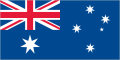
As published by the Parliament of Australia The Australian national flag has a blue field with the 'Union Jack' in the canton (the upper quarter next to the flagpole). The seven-pointed Commonwealth star in the lower hoist represents the six States and the Territories. In the fly are the five stars of the constellation of the Southern Cross. Four of the stars have seven points and the smallest one has five.
As published in EnglishAs published by the National Archives of Australia The Australian Flag consists of three parts set on a blue field. The first part is the Union Jack, illustrating the link with Britain. The second aspect is the Southern Cross, representing Australia. Finally, the Commonwealth Star represents Australia's federal system. Originally, the Commonwealth Star had six points (for the six states), but, in 1908 a seventh point was added to represent the territories of the Commonwealth.
As published in EnglishAs published by the National Archives of Australia The concept of a distinct national flag predated Federation. For the last two decades of the nineteenth century, the Australian Natives Association and the Australian Federation League displayed and popularised a design encompassing a Union Jack and the Southern Cross. One of the earliest documented official requests for designs for a national flag came in a dispatch dated 29 November 1900 from the Secretary of State for the Colonies in Britain.
As published in EnglishAs published by the National Archives of Australia Competitions seeking designs for a national flag run by the Melbourne Herald and the Review of Reviews in 1900 were well supported. On 29 April 1901 a notice was placed in the Commonwealth of Australia Gazette inviting entries in an official competition, offering a prize of £75 to the winning entry.
From the 32,823 entries received in the 1901 competition, five substantially similar designs were selected as joint winners.4 A photograph of the winning design, a composite 'embodying the general ideas of the five successful competitors, but different in detail'5, was published in the Review of Reviews on 20 September 1901.
As published in EnglishAs published by the National Archives of Australia The winning design was approved by King Edward VII in 1902. Federal Parliament passed a resolution on the 2 June 1904 to fly this flag 'upon all forts, vessels, saluting places and public buildings of the Commonwealth upon all occasions when flags are used'.
As published in EnglishAs published by the Department of the Prime Minister and Cabinet of Australia The design of the Southern Cross was simplified when the blue and red ensigns were gazetted in February 1903. The four main stars, which originally had different number of points to reflect their varying brilliance, all became seven‑pointed stars. The smallest star remained a five-pointed star.
In 1908, the six-pointed star representing the six states was replaced by a seven‑pointed star, the additional point representing the territories.
As published in EnglishAs published by the National Archives of Australia While the design and uses of the flag were proclaimed in the Commonwealth of Australia Gazette, it was not until the Flags Act 1953 that legislation was passed prescribing the form and use of the flag. Section 3 of the Act states that the flag (illustrated in the First Schedule to the Act) is 'declared to be the Australian National Flag'.
As published in EnglishSources:- aph.gov.au ↗ - the Parliament of Australia
- naa.gov.au ↗ - the National Archives of Australia
- pmc.gov.au ↗ - the Department of the Prime Minister and Cabinet of Australia
- National anthem
- Advance Australia Fair0:54
- Title
- Advance Australia Fair
- Lyrics
- English
1Australians all let us rejoice, For we are one and free; We’ve golden soil and wealth for toil, Our home is girt by sea; Our land abounds in Nature’s gifts Of beauty rich and rare; In history’s page, let every stage Advance Australia fair! In joyful strains then let us sing, “Advance Australia fair!”
2Beneath our radiant southern Cross, We’ll toil with hearts and hands; To make this Commonwealth of ours Renowned of all the lands; For those who’ve come across the seas We’ve boundless plains to share; With courage let us all combine To advance Australia fair. In joyful strains then let us sing “Advance Australia fair!”
Source: - Citizens
- Australians
- Official name:Australia's Constitution ↗ - Parliament of Australia
- Official name, Citizens:The World Factbook: Australia - CIA
- National flag:aph.gov.au ↗ - the Parliament of Australia
- National flag:naa.gov.au ↗ - the National Archives of Australia
- National flag:pmc.gov.au ↗ - the Department of the Prime Minister and Cabinet of Australia
- National anthem:nationalanthems.info ↗
Geography
- Location
- Oceania, continent between the Indian Ocean and the South Pacific Ocean
- Total area
- 7,741,220 km²
- Land area
- 7,682,300 km²
- Water area
- 58,920 km²
- Land borders
- None
- Coastline
- 25,760 km
- Terrain
Mostly low plateau with deserts; fertile plain in southeast - Mean elevation
- 330 m
- Highest point
- 2,228 mMount Kosciuszko
- Lowest point
- −15 mLake Eyre
- Climate
Generally arid to semiarid temperate in south and east; tropical in north - Avg. temperature
- 22.2 °C
- Avg. daily range
- 16.3 to 28.5 °C
- Annual precipitation
- 454 mm
Temperature °CMeanDaily rangePrecipitation mmMonthly climate normals Month Avg. high, °C Mean, °C Avg. low, °C Precipitation, mm January 34.5 28.4 22.7 84 February 33.4 27.6 22.1 84 March 31.7 25.7 20.2 52 April 28.7 22.6 16.8 24 May 24.4 18.3 12.8 21 June 21.3 15.2 10 21 July 21.2 14.7 9.1 18 August 23.3 16.5 10.2 16 September 27.1 20.3 13.6 16 October 30.3 23.6 16.9 21 November 32.5 26 19.6 33 December 33.7 27.5 21.5 63 Country-wide averages over 1991–2020.
Sources:- The World Factbook: Australia - CIA
- Climate Change Knowledge Portal (ERA5 reanalysis) ↗ - World Bank
- Weather
- Loading
- Land use2023
- Arable4.0%Pasture43.1%Forest17.3%Other35.4%
- Arable land
- 30,989,678 hectares (4.0%)
- Permanent crops
- 385,000 hectares (0.1%)
- Permanent meadows & pastures
- 331,869,000 hectares (43.1%)
- Forest
- 133,453,406 hectares (17.3%)
- Other land
- 272,371,916 hectares (35.4%)
Source: - Major rivers
- 1River Murray2,508km2Darling River1,545km3Murrumbidgee River1,485km4Lachlan River1,339km5Cooper Creek1,113km6Flinders River1,004kmSource:
- The World Factbook: Australia - CIA
- Major lakes
- Lake Eyre9,690 km²Lake Torrens5,780 km²Lake Gairdner4,470 km²Lake Mackay3,494 km²Lake Frome2,410 km²Lake Amadeus1,032 km²Lake Alexandrina570 km²Source:
- The World Factbook: Australia - CIA
- Natural hazards2026
- Coastal floods6.2High#37/191Drought6.1High#27/191Tsunamis5.7High#46/191River floods5.4High#91/191Tropical cyclones4.1Medium#36/191Epidemics3.4Low#145/191Earthquakes0.1Very low#127/191
Scores out of 10, ranks out of 191 countries.
Source:- INFORM Risk Index ↗ - European Commission Joint Research Centre
- Location, Land borders, Coastline, Terrain, Mean elevation, Highest point, Lowest point, Climate, Major rivers, Major lakes:The World Factbook: Australia - CIA
- Climate:Climate Change Knowledge Portal (ERA5 reanalysis) ↗ - World Bank
- Land use:FAOSTAT Land Use domain ↗ - FAO
- Natural hazards:INFORM Risk Index ↗ - European Commission Joint Research Centre
Demographics
- Population2026
- Includes Christmas Island, Cocos (Keeling) Islands, and Norfolk Island
- Population change2026
- +0.94% per year+253,070 people/yearWorld Rank103rdof 237
- Birth rate
- 11.1 per 1,000 population
- Death rate
- 6.9 per 1,000 population
- Net migration rate
- +4.8 per 1,000 population
- 2026
- 38.5 yearsWorld Rank81stof 237
- Age structure2026
- 0-14 years17.5%15-64 years64.0%65 years +18.5%
- Share aged 65 and over
- 18.5%
- Share aged under 18
- 21.2%
- Total dependency ratio
- 56
- Youth dependency ratio
- 27
- Elderly dependency ratio
- 29
- Sex ratio
- 0.99 male / female
MaleAgeFemalePopulation by age group, % of total population Age Male Female 80+ 2.1% 2.7% 70-79 4.0% 4.4% 60-69 5.2% 5.6% 50-59 5.9% 6.1% 40-49 6.5% 6.7% 30-39 7.2% 7.2% 20-29 6.5% 6.1% 10-19 6.3% 5.9% 0-9 5.9% 5.6% - 2026
- 0.46 below the replacement level for Australia ()1.64 births per womanreplacement 2.10123World Rank143rdof 237
- 0.79 daughters per woman0.21 below replacement, long-run each generation smaller than the lastreplacement 1.000.511.5
- 2026
- +4.3 per 1,000 populationfor every 1,000 people, 4.3 more births than deaths a year
- 2026
- +4.8 per 1,000 population
- Urbanization2026
- 87.8% live in cities23,915,035 urban residents
- Largest agglomerations2025
- Melbourne, Sydney, Brisbane, PerthRankAgglomerationPopulation (2025 estimate)1Melbourne, VIC5,328,2742Sydney, NSW5,219,6743Brisbane, QLD2,745,0864Perth, WA2,430,7575Adelaide, SA1,470,9386Gold Coast, QLD761,6347Newcastle, NSW541,6348Canberra, ACT521,0499Sunshine Coast, QLD424,74110Central Coast, NSW354,189Source:
- Australian Bureau of Statistics (2025 estimate), via City Population by Thomas Brinkhoff ↗
- Population distribution
- Population is primarily located on the periphery, with the highest concentration of people residing in the east and southeast; a secondary population center is located in and around Perth in the west; of the states and territories, New South Wales has, by far, the largest population; the interior, or "outback," has a very sparse population.
- Ethnic groups2021
- Respondents could report two ancestries.English33.0%Australian29.9%Irish9.5%Scottish8.6%Chinese5.5%Italian4.4%German4.0%Indian3.1%Australian Aboriginal2.9%Greek1.7%Unspecified4.7%
- Religions2021
- Roman Catholic20.0%Protestant18.1%Other Christian3.5%Muslim3.2%Hindu2.7%Buddhist2.4%Orthodox2.3%Other2.1%None38.4%Unspecified7.3%
- Protestant
- 18.1%
- Anglican
- 9.8%
- Uniting Church
- 2.6%
- Presbyterian and Reformed
- 1.6%
- Baptist
- 1.4%
- Pentecostal
- 1.0%
- Other Protestant
- 1.7%
- Orthodox
- 2.3%
- Eastern Orthodox
- 2.1%
- Oriental Orthodox
- 0.2%
Source:- The World Factbook: Australia - CIA
- Languages
- English
- Population, Population change, Median age, Age structure, Total fertility rate, Net reproduction rate, Natural change, Net migration rate:UN World Population Prospects ↗
- Urbanization:UN World Urbanization Prospects ↗
- Largest cities:Australian Bureau of Statistics (2025 estimate), via City Population by Thomas Brinkhoff ↗
- Population distribution, Ethnic groups, Religions:The World Factbook: Australia - CIA
Government & Administration
- Form of state
- Constitutional monarchyThe monarch is head of state, represented by a Governor-General appointed by and serving at the monarch's pleasure; the Constitution unites the states in a "Federal Commonwealth under the Crown" (covering cl. 3; ss. 2, 61).Source:
- Commonwealth of Australia Constitution Act (63 & 64 Vict. c. 12), in-force text ↗, covering cl. 3; ss. 2, 61
- System of government
- ParliamentaryThe Constitution names no Prime Minister or Cabinet; by convention the government needs the House of Representatives' confidence. Ministers must sit in Parliament within three months, and the Governor-General may dissolve the House or, after a deadlock, both Houses (ss. 5, 57, 64).Source:
- Territorial organisation
- Federal
- Official websites
- Capital
- Canberra484,630 people(2025)
- National holidays
- 7 days in 2026
- ThuJan 1New Year's Day
- MonJan 26Australia Day
- FriApr 3Good Friday
- MonApr 6Easter Monday
- SatApr 25ANZAC Day
- FriDec 25Christmas Day
- SatDec 26Boxing Day
Nationwide public holidays only, excluding regional, bank and government-only days.
- Time
- AESTAustralian Eastern TimeUTC+10 (UTC+11 in summer)
Australia spans multiple time zones, the capital's is shown here. All 5 time zones
- Currency
- Australian Dollar (AUD)
- Entry requirements
- Official visa and entry information
- Calling code
- +61
- Internet TLD
- .au
- ISO 3166-1 codes
- AU, AUS
- Infrastructure
- Passengers carried
- 68,958,577 by the country's airlines(2023)
- Heliports
- 392
- Aircraft departures
- 678,852 by the country's airlines(2023)
- Air freight
- 1,188.1 million tonne-km(2023)
- Aircraft registration prefix
- VH
Sources:- The World Factbook: Australia - CIA
- World Development Indicators ↗ - World Bank
- Flag carrier
- QantasPrivately owned
- 2025
- 76 / 100World Rank12thof 182
Significant declinerDown 9 points since 2012, when it scored 85.
Confidence intervalCorruption index score by year Year Score Lower bound Upper bound 2012 85 83 86 2013 81 79 83 2014 80 78 82 2015 79 77 81 2016 79 77 81 2017 77 75 79 2018 77 75 79 2019 77 74.8 79.2 2020 77 75.3 78.7 2021 73 70.3 75.7 2022 75 73.7 76.3 2023 75 72.5 77.5 2024 77 74.3 79.7 2025 76 73.7 78.3 Source:- Corruption Perceptions Index 2025 ↗ - Transparency International, CC BY 4.0
- Form of state, System of government, Territorial organisation:Commonwealth of Australia Constitution Act (63 & 64 Vict. c. 12), in-force text ↗ - Federal Register of Legislation (Australia)
- National holidays:Open World Holidays Framework (vacanza/holidays) ↗
- Infrastructure:The World Factbook: Australia - CIA
- Infrastructure:World Development Indicators ↗ - World Bank
- Corruption Perceptions Index:Corruption Perceptions Index 2025 ↗ - Transparency International, CC BY 4.0
Economy
- High income
- GDP growth (real)2026
- +1.9% per yearWorld Rank135thof 195
- GDP per capita (PPP)2026
- GDP per capita (nominal)
- $75,172 (12th in the world)
Source:- 2025
- Services67.5% of GDPIndustry23.9% of GDPAgriculture2.3% of GDPManufacturing5.3%part of industry
- Households
- +51.9%
- Government
- +23.1%
- Investment
- +24.5%
- Exports
- +23.2%
- Imports
- −22.7%
The shape of the economyGDP by end useSource:- World Development Indicators ↗ - World Bank
- Inflation2026
- 3.9%up 1 percentage points1pp from 2025
- Labor force2024
- 14.6 million (55% of population)World Rank42ndof 187
- Labor force participation2024
- 66.7% of people aged 15+
- Unemployment2024
- 3.9%
- Youth unemployment2024
- 9.4% ages 15 to 24
- Labor productivity2024
- $71.1 per hour worked at PPP
- Budget balance2026
- 3.2% of GDP deficit
- Current account
- 3.1% of GDP, $66.5 billion deficit
Source: - Debt2024
- Government debt49.8% of GDPHousehold debt112.1% of GDPCompany debt60.8% of GDPInterest on debt1.7% of GDPCentral government debt36.8% of GDP
- Trade2025
- Goods$337.4 billion78.6%
- Services$91.6 billion21.4%
- Total exports
- $429 billion
- Change from 2024
- up 0.8 percent on the previous year0.8%
Sources:- World Development Indicators ↗ - World Bank
- The World Factbook: Australia - CIA
- 2024
- +0.12World Rank74thof 145
- Projected GDP growth
- +1.2% a year over the next 10 years
Source:- Atlas of Economic Complexity ↗ - Harvard Growth Lab
- Agricultural products2024
- Lentils (dry), Chick peas (dry), Barley, and 7 more
- 1Lentils (dry)15×
- 2Chick peas (dry)12.6×
- 3Barley8.8×
- 4Rape or colza seed6.8×
- 5Oats5.5×
- 6Wheat4×
- 7Sorghum3.6×
- 8Meat of cattle with the bone (fresh or chilled)3.5×
- 9Seed cotton (unginned)3.1×
- 10Grapes2×
ProductSource:- FAOSTAT ↗ - Food and Agriculture Organization
- Industries
- mining, industrial and transportation equipment, food processing, chemicals, steel
- Income level, GDP by sector, Trade:World Development Indicators ↗ - World Bank
- GDP (nominal), GDP growth (real), GDP per capita (PPP), Inflation, Budget balance:IMF World Economic Outlook ↗
- Labor force, Labor force participation, Unemployment, Youth unemployment, Labor productivity:ILOSTAT ↗ - International Labour Organization
- Debt:IMF Global Debt Database ↗
- Debt:IMF Public Finances in Modern History ↗
- Trade, Industries:The World Factbook: Australia - CIA
- Economic Complexity Index:Atlas of Economic Complexity ↗ - Harvard Growth Lab
- Agricultural products:FAOSTAT ↗ - Food and Agriculture Organization
Cost of Living
- Cost of living index
- Loading
- Monthly costs (excluding rent)
- Loading
- Rent
- Loading
- Buying an apartment
- Loading
- Average gross salary2021
- A$5,906 per month$4,436 (USD), $3,926 (PPP)
- Median
- A$5,000 per month($3,756)
- Men
- A$6,840 per month($5,138)
- Women
- A$4,945 per month($3,715)
Source:- ILOSTAT ↗ - International Labour Organization
- 2024
- A$4,023 per month, gross$2,655 (USD), $2,819 (PPP)
- Average gross salary, Minimum wage:ILOSTAT ↗ - International Labour Organization
Society
- 2023
- 0.958Very highWorld Rank7thof 193AustraliaWorld
Human Development Index by year Year Australia World 1990 0.867 0.608 1991 0.868 0.611 1992 0.868 0.614 1993 0.872 0.617 1994 0.873 0.620 1995 0.882 0.625 1996 0.884 0.631 1997 0.887 0.636 1998 0.891 0.641 1999 0.893 0.646 2000 0.897 0.651 2001 0.900 0.657 2002 0.902 0.662 2003 0.906 0.669 2004 0.910 0.675 2005 0.914 0.681 2006 0.917 0.688 2007 0.919 0.694 2008 0.924 0.698 2009 0.927 0.701 2010 0.929 0.707 2011 0.933 0.713 2012 0.938 0.717 2013 0.935 0.721 2014 0.937 0.726 2015 0.938 0.731 2016 0.939 0.735 2017 0.940 0.739 2018 0.945 0.741 2019 0.947 0.745 2020 0.950 0.742 2021 0.954 0.742 2022 0.952 0.752 2023 0.958 0.756 Source:- Human Development Report ↗ - United Nations Development Programme
- 2020
- 33.8
- Mean years of schooling2023
- 12.9 years
- Expected for a child today
- 20.7 years
Source:- Human Development Report ↗ - United Nations Development Programme
- Education expenditure2022
- 5.1% of GDP
- Share of government spending
- 12.6%
Source:- World Development Indicators ↗ - World Bank
- Internet users2024
- 96.1% of the population
- Households with Internet access
- 97.8%
Source:- ITU DataHub ↗ - International Telecommunication Union
- Mobile subscriptions2024
- 30.1 million
- Fixed telephone lines
- 5,953,000
- Fixed broadband
- 36.5 subscriptions per 100 people
Counts subscriptions, not people.
Source:- ITU DataHub ↗ - International Telecommunication Union
- Credit-card ownership2021
- 51% of adults
- Debit-card ownership
- 96%
- Account at a bank or mobile-money provider
- 99%
- Made or received a digital payment
- 99%
Source:- Global Findex Database ↗ - World Bank
- Refugees hosted2025
- 34,562 people
- Asylum seekers
- 83,582
- Stateless persons
- 7,503
- Internally displaced persons
- 1,700All due to disasters
- Refugees from Australia abroad
- 32
Sources:- Refugee Data Finder ↗ - UN Refugee Agency
- Global Internal Displacement Database ↗ - Internal Displacement Monitoring Centre
- Inbound tourists2024
- 8.3 million visitor arrivals(overnight and same-day)Official tourism site
- $53.8 billion
- 2.9% tourism direct GDP(2023)
- Domestic trips
- 115 million overnight trips by residents
- $51.9 billion
- Hotel beds
- 676,638(2016, latest available)
- Average hotel stay
- 7.1 nights(2016, latest available)
Overnight and same-day visits are not published separately. Arrivals count trips, not people.
Source:- UN Tourism Data Dashboard ↗ - UN Tourism
- UNESCO World Heritage Sites
- 21 sites5 cultural12 natural4 mixed
Site Type Great Barrier Reef Natural Greater Blue Mountains Area Natural Fraser Island Natural Gondwana Rainforests Natural Lord Howe Island Group Natural Royal Exhibition Building and Carlton Gardens Cultural Shark Bay Natural Sydney Opera House Cultural Uluṟu-Kata Tjuṯa National Park Mixed Kakadu National Park Mixed Murujuga Cultural Landscape Cultural The Factbook names 11 of the 21 sites.includes one site on Heard Island and McDonald Islands
Source:- The World Factbook: Australia - CIA
- Human Development Index, Mean years of schooling:Human Development Report ↗ - United Nations Development Programme
- Income inequality (Gini), Education expenditure:World Development Indicators ↗ - World Bank
- Internet users, Mobile subscriptions:ITU DataHub ↗ - International Telecommunication Union
- Credit-card ownership:Global Findex Database ↗ - World Bank
- Refugees hosted:Refugee Data Finder ↗ - UN Refugee Agency
- Refugees hosted:Global Internal Displacement Database ↗ - Internal Displacement Monitoring Centre
- Inbound tourists:UN Tourism Data Dashboard ↗ - UN Tourism
- UNESCO World Heritage Sites:The World Factbook: Australia - CIA
Crime & Safety
- Travel advisory (US)
- Loading
- Active humanitarian crisisAug 2026
- None - no active crisis
- Homicide rate2024
- Very low by global standards0.9 per 100,000 peopleWorld Rank82ndof 115
- Crime rates
- 7 offence categories
Offence Per 100,000 Count Year Homicide (victims) 0.9 252 2024 Serious assault 309.8 81,933 2023 Sexual violence 137.3 36,318 2023 Kidnapping 1.9 501 2023 Burglary 577.1 151,200 2022 Theft 2,025.7 530,762 2022 Vehicle theft 210.1 55,037 2022 A low figure can also mean weak recording.
Source:- UNODC Data Portal ↗ - UN Office on Drugs and Crime
- Prison population2023
- 161.5 per 100,000 people
- Persons held
- 42,714
Source:- UNODC Data Portal ↗ - UN Office on Drugs and Crime
- Active humanitarian crisis:INFORM Severity Index ↗ - European Commission Joint Research Centre
- Homicide rate, Crime rates, Prison population:UNODC Data Portal ↗ - UN Office on Drugs and Crime
Health
- Life expectancy2026
- 84.3 years
- Health expenditure2023
- 10.4% of GDP$6,980 per person
- Physicians2022
- 4.09 per 1,000 population
- Hospital beds2016
- 3.8 per 1,000 population
- Infant mortality2026
- 2.5 per 1,000 live births
- Maternal mortality2023
- 2 per 100,000 live births
- Alcohol consumption2022
- 11.2 litres of pure alcohol per adult per year
- Tobacco use2023
- 12% of adults
- Men
- 13.7%
- Women
- 10.2%
Source:- Global Health Observatory ↗ - World Health Organization
- Alcohol and Tobacco Spending2023
- 3.6% of household spendingWorld Rank37thof 105
- World median
- 3.1%
Source:- The World Factbook: Australia - CIA
- Road traffic deaths2019
- 4.9 per 100,000 population
- Life expectancy, Infant mortality:UN World Population Prospects ↗
- Health expenditure, Physicians, Hospital beds, Road traffic deaths:World Development Indicators ↗ - World Bank
- Maternal mortality:Maternal mortality estimates ↗ - UN Maternal Mortality Estimation Inter-agency Group
- Alcohol consumption, Tobacco use:Global Health Observatory ↗ - World Health Organization
- Alcohol and Tobacco Spending:The World Factbook: Australia - CIA
Environment
- CO₂ emissions2024
- 383.4 Mt per yearup 1.6 percent on the previous year1.6% from 2023
- CO₂ per capita
- 14.4 t per personWorld Rank13thof 207
- Share of global CO₂
- 0.97%
- Methane (CH₄)
- 144.6 Mt CO₂-eq
- Nitrous oxide (N₂O)
- 50.8 Mt CO₂-eq
- Fluorinated gases
- 12.7 Mt CO₂-eq
- All greenhouse gases
- 591.5 Mt CO₂-eq
Source:- Emissions Database for Global Atmospheric Research (EDGAR) ↗ - European Commission, Joint Research Centre
- 2024
- 3.9 µg/m³ of PM2.5Most polluted192ndof 236
- WHO guideline
- 5 µg/m³
- National standard
- 8 µg/m³
Source:- Air Quality Life Index ↗ - Energy Policy Institute at the University of Chicago
- Environmental issues
- soil erosion from overgrazing, deforestation, industrial development, urbanization, and poor farming practices
- limited natural freshwater resources
- soil salinity from use of poor-quality water, drought, desertification
- habitat loss from agricultural clearing
- floral extinctions
- Great Barrier Reef preservation
- overfishing
- pollution
- invasive species
Source:- The World Factbook: Australia - CIA
- International agreements
- 17 of 20 landmark treaties in forceParty to 117 multilateral environmental agreements
Treaty Standing Joined Climate Paris Agreement in force 2016 UN Framework Convention on Climate Change in force 1994 Kyoto Protocol in force 2008 Ozone layer Montreal Protocol in force 1989 Vienna Convention (Ozone Layer) in force 1988 Biodiversity Convention on Biological Diversity in force 1993 CITES in force 1976 Convention on Migratory Species (Bonn) in force 1991 Cartagena Protocol on Biosafety not a party Nagoya Protocol signed 2012, not ratified Land and heritage Ramsar Convention on Wetlands in force 1975 World Heritage Convention in force 1975 UN Convention to Combat Desertification in force 2000 Chemicals and waste Basel Convention in force 1992 Rotterdam Convention (PIC) in force 2004 Stockholm Convention (POPs) in force 2004 Minamata Convention on Mercury in force 2022 Oceans UN Convention on the Law of the Sea in force 1994 High Seas Treaty (BBNJ) signed 2023, not ratified MARPOL 73/78 in force 1988 Source:- International Environmental Agreements Database ↗ - Université Laval
- CO₂ emissions:Emissions Database for Global Atmospheric Research (EDGAR) ↗ - European Commission, Joint Research Centre
- Air pollution:Air Quality Life Index ↗ - Energy Policy Institute at the University of Chicago
- Environmental issues:The World Factbook: Australia - CIA
- International agreements:International Environmental Agreements Database ↗ - Université Laval
Food & Water
- No access to safe drinking water2022
- 0% of the population
- Renewable water2022
- 492 billion m³ per year
- Per person
- 18,778 m³ per year
- Dependency ratio
- 0% originates outside the country
- Annual water withdrawal
- 17 billion m³ per year
- Withdrawn for agriculture
- 67%
- Water stress
- 5% of available freshwater withdrawn
Source:- AQUASTAT ↗ - Food and Agriculture Organization
- Obesity2024
- 30.6% of adults
- Men
- 31.4%
- Women
- 29.7%
Source:- Global Health Observatory ↗ - World Health Organization
- Underweight children2007latest available
- 0.5% of children under five
- No access to safe drinking water, Renewable water:AQUASTAT ↗ - Food and Agriculture Organization
- Obesity:Global Health Observatory ↗ - World Health Organization
- Underweight children:World Development Indicators ↗ - World Bank
Energy
- Energy consumption2024
- Per capita
- 236.7 GJ per person
- Share of world total
- 0.99%
- Supply
- Surplusproduces 3× what it consumes, 2024
Source:- International Energy Statistics ↗ - U.S. Energy Information Administration
- Electricity2024
- No electricity trade270 TWh generated per year
- Generation
- 270 TWh per year
- Consumption
- 257 TWh per year
Source:- International Energy Statistics ↗ - U.S. Energy Information Administration
- Oil, gas & coal
- Deficitproduces 32% of what it consumes, 2025Oil reserves20251.8 billion barrelsWorld Rank37thof 99
Oil imports and exports count crude oil only.
- Mineral resources2025
- Copper, Lithium, Rare earths
Mineral Mine production Reserves Copper 730,000 t3.2% of world 100 million t Lithiumas pure lithium 92,000 t31.7% of world 8.4 million t Rare earthsas rare-earth oxide 29,000 t7.4% of world 6.3 million t USGS estimates. Shows only minerals where the country is a major producer.
Source:- Mineral Commodity Summaries ↗ - U.S. Geological Survey
- Energy consumption, Electricity, Oil, gas & coal:International Energy Statistics ↗ - U.S. Energy Information Administration
- Oil, gas & coal:Worldwide Oil and Gas Survey ↗ - Oil & Gas Journal
- Mineral resources:Mineral Commodity Summaries ↗ - U.S. Geological Survey
Defense
- Military expenditure2024
- 1.9% of GDP$33.8 billion, 5% of government spending
- Military personnel2025
- approximately 60,000active ADF personnel
- Military service2025
- Voluntaryno conscription since 1972; men and women 17+ with parental consent, 18 to deploy
As of July 2024, New Zealanders who are permanent residents and have lived in Australia for at least 12 months could apply to join the ADF; from January 2025, eligible permanent residents from Canada, the UK, and the US were also to be allowed to apply.Women have served in all roles, including combat arms, since 2013; in 2024, they comprised slightly more than 20% of the military.
Source:- The World Factbook: Australia - CIA
- Space program2025
- Australian Space Agency (ASA; established 2018; headquarters opened in 2020)
Has a history of involvement in space-related activities, including astronomy, rockets, satellites, and space tracking; develops, builds, operates, and tracks satellites, including communications, remote sensing (RS), and navigational, often in partnership with other countries; develops other space technologies, including communications, RS capabilities, and telescopes; encouraging growth in domestic commercial space-industry sector, including satellite launch vehicles; cooperates with a variety of foreign space agencies and industries, including those of China, the ESA, individual ESA member states, India, Japan, New Zealand, South Korea, the UK, and the US; co-leads the Global Earth Observation System of Systems and hosts one of the telescopes for the international Square Kilometer Array radio telescope
- Launch sites
- Whalers Way Orbital Launch Complex (commercial site, South Australia); Arnhem Space Center (commercial site, Northern Territory); Bown Orbital Spaceport (commercial site, North Queensland)
- 1960
- Built first space-tracking station outside the US
- 1967
- First domestically built satellite (WRSEA) launched on a US rocket from Australian test range
- 1981
- Commissioned first national satellite system
- 1996
- First Australian in space on US Space Shuttle
- 2021
- Announced intent to provide a robotic lunar lander for US Artemis project
- 2022
- Launched a US NASA rocket from a commercial launch site; joint Australia-US space surveillance telescope based in Western Australia became operational
- 2025
- First attempted launch of Australian-designed and -manufactured orbital launch vehicle failed to reach orbit
Key milestones
Australia established a Defense Space Command in 2022
Source:- The World Factbook: Australia - CIA
- Nuclear weapons2026
- None - no nuclear arsenal
- Military expenditure:SIPRI Military Expenditure Database ↗ - Stockholm International Peace Research Institute
- Military expenditure:World Development Indicators ↗ - World Bank
- Military personnel, Military service, Space program:The World Factbook: Australia - CIA
- Nuclear weapons:Status of World Nuclear Forces ↗ - Federation of American Scientists
International Memberships
 United Nationssince 1945G20since 1999